Orange Coneflower
Rudbeckia fulgida
Family · Asteraceae
Rudbeckia fulgida spreads by rhizome and blooms August to October. Covers dividing clumps, leaf spot resistance versus R. hirta, and the Goldsturm cultivar.
Rudbeckia fulgida
Plant profile
- WateringModerateWater every 7 days
- Light exposurePartial sun
- Hardiness zoneUSDA 3–9
Growth
- Family
- Asteraceae
- Life cycle
- Perennial
- Growth speed
- 7/10
- Mature size
- 60–90 cm
- Spread
- 30–60 cm
- Flowering
- August to October
- Propagation
- Seed
- Division
Dormancydies back to a basal rosette of leaves at the first hard frost and regrows from the same rootstock in spring
Time to maturityreaches full flowering size within its second growing season from a division or young plant
Soil & climate
- Soil types
- clay, loam, rocky
- Drought tolerance
- Yes
Light & Placement
- Origin
- Illinois to the eastern United States
- Where to place it
- sunny border or bed
- naturalized meadow planting
- cottage garden
- cut flower row
- large container with a well-drained potting mix
Safety
- Pet safe
- No
ToxicityNot listed in the ASPCA's toxic or non-toxic plant database; no toxic principle documented
Invasive speciesspreads by rhizome into a widening clump but is not documented as invasive outside its native range; division keeps it within bounds
Data fromRudbeckia fulgida Aiton, GBIF Backbone TPOWO: Rudbeckia fulgida AitonNC State Extension Gardener Plant ToolboClemson HGIC Factsheet: Rudbeckia
Where it grows
World distribution
Orange Coneflower is native to a single country: United States.GBIF records 8,596 documented identifications across 41 countries, with the largest concentrations in United States, France, and United Kingdom.
- United States
Yellow to orange dots: concentration of documented identifications per country. Green countries: sourced native range. Source: GBIFNative range from POWO (Kew).
Rudbeckia fulgida is the perennial coneflower behind one of the most widely planted garden cultivars in North America, 'Goldsturm', and unlike its cousin the black-eyed Susan (Rudbeckia hirta), it does not depend on reseeding to come back each year. It lives on the same rootstock for years, widening slowly into a clump by underground rhizomes, and rewards a sunny, well-drained spot with a long run of gold and orange flowers from late summer into fall. Once established it needs little beyond an occasional division. Confusing it with R. hirta is easy at a glance, since both carry similar daisy-form flowers, but the growth habit underneath is entirely different.
A True Perennial, Not the Short-Lived Black-Eyed Susan
The species most people picture when they hear black-eyed Susan, Rudbeckia hirta, is typically grown as an annual or short-lived biennial that renews a planting mainly through self-seeding. Rudbeckia fulgida works differently: it persists on the same crown for years and spreads outward by rhizomes, the underground stems that let a single plant become a broad clump without any seed involved. That habit is also what makes 'Goldsturm', a selection of the variety sullivantii, so dependable in commercial plantings: because it multiplies vegetatively from division, every plant sold under that name is genetically identical, so a bed of 'Goldsturm' blooms in unison rather than showing the variation you would get from a seed-grown patch of R. hirta.
Origin and Native Habitat
Plants of the World Online lists the native range of Rudbeckia fulgida as Illinois to the eastern United States, and NC State Extension records it across more than two dozen states from Alabama to Wisconsin. In the wild it grows in open woods, glades and thickets, in both dry, rocky ground and moister soil, which explains why it tolerates such a range of garden conditions without fuss. The species was described by the English botanist William Aiton in 1789, and several regional varieties are recognized within it, including var. fulgida, var. sullivantii and var. deamii, which differ mainly in leaf shape and the fine hairs on the stem rather than in flower color.


Light, Soil and Watering
Give it full sun, at least six hours of direct light a day, for the fullest bloom; in partial shade it still flowers but stretches and produces fewer heads. It is not fussy about soil texture and grows in clay, loam or shallow, rocky ground, provided drainage is good; NC State Extension notes it tolerates both occasionally dry and moderately moist conditions but does poorly in soil that stays soggy. Once established, clumps handle drought and humid summer heat well, which is part of why maintenance rated by NC State Extension as low. New divisions and first-year plants are the exception: keep the soil evenly moist until roots take hold, then taper off to occasional deep watering.
How the Clump Spreads and When to Divide It
Because Rudbeckia fulgida grows outward by rhizome rather than by seed alone, a single planting thickens into a solid clump over a few seasons rather than scattering seedlings around the bed. Left undivided for too long, the center of an older clump tends to thin out and flower less, so Clemson Cooperative Extension recommends lifting and dividing every three to four years, in early spring as new growth emerges or in fall after bloom. Each division with a piece of root and a few shoots reestablishes quickly, which makes this one of the easier perennials to multiply for free along a border or to share with another gardener.
A Long Midsummer-to-Fall Bloom
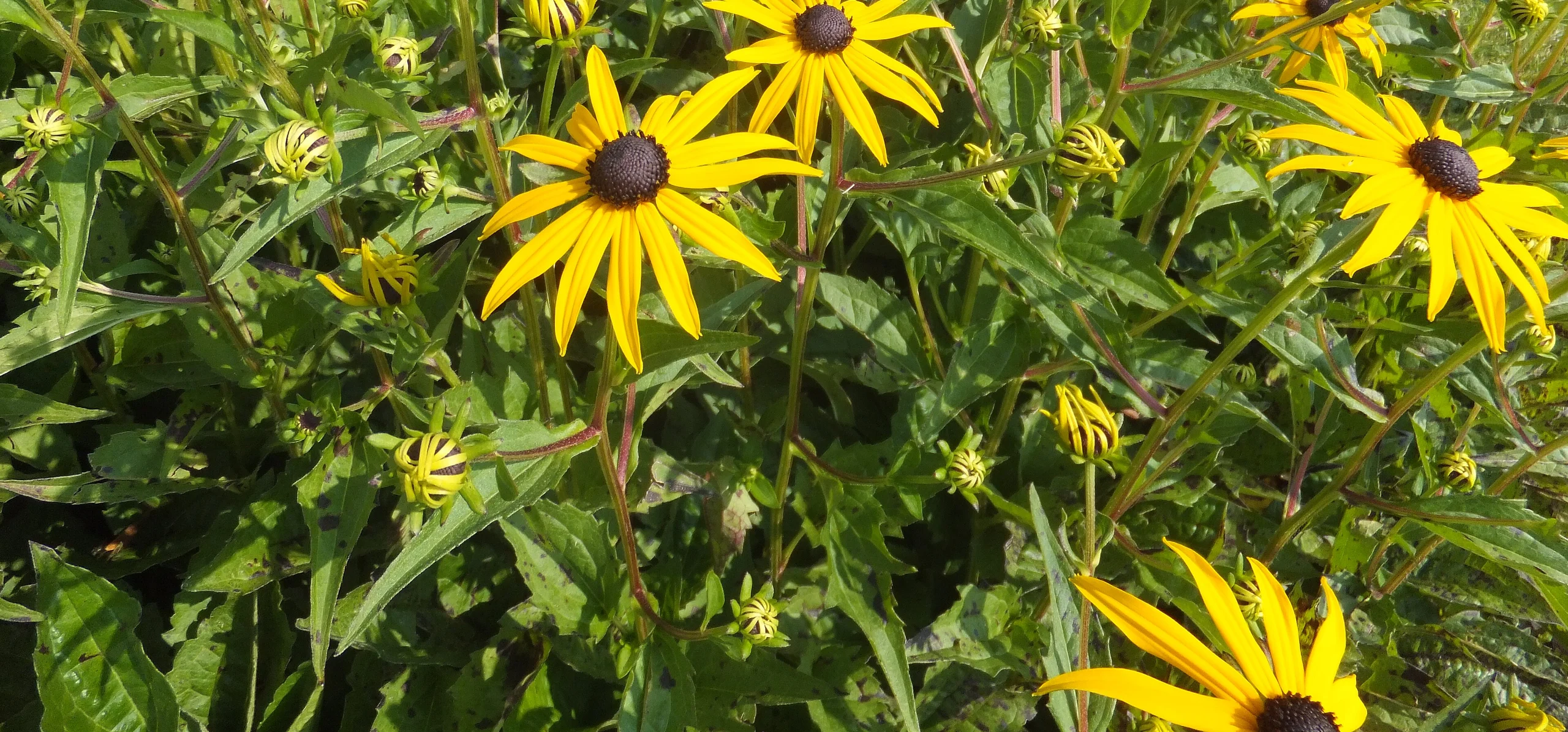
NC State Extension lists the bloom window as August through October, later than many summer-flowering perennials, with each flower carrying ten to twenty bright yellow-orange ray florets around a domed, purple-brown central disk. Deadheading spent flowers through summer keeps the display tidy and can encourage a few more buds, but it is not essential the way it is for shorter-lived Rudbeckia species, since the plant's persistence does not depend on setting seed. Many gardeners leave the last flush of flowers standing into fall, both for the look of the seed heads and for the wildlife described below.
Pests, Diseases and Why It Outperforms Its Cousin
NC State Extension reports no significant pest or disease problems for Rudbeckia fulgida and specifically credits it with good resistance to leaf spot, a marked contrast with R. hirta, which is more prone to Septoria leaf spot in humid weather. Southern blight, a soil-borne fungal disease of herbaceous ornamentals, is noted as an occasional risk in warm, wet climates, and some cultivars such as 'Little Goldstar' have been bred with resistance to it. Aphids and the general leaf-spot and powdery mildew issues that affect Rudbeckia as a genus can still turn up, and the same remedy applies as for other border perennials: space plants for airflow and water at the soil rather than overhead. Deer browse the foliage occasionally but tend to leave established clumps mostly alone.
Goldsturm and Other Compact Cultivars
'Goldsturm' remains the benchmark selection, growing 23 to 29 inches tall with a spread of 18 to 23 inches and a reputation for uniform, reliable bloom that made it a fixture of public and commercial plantings for decades. For smaller spaces, 'Little Goldstar' tops out at 14 to 16 inches with a similar spread and adds southern blight resistance, while 'City Garden' stays compact at 10 to 12 inches, small enough for a large container. All three keep the species' orange-yellow ray flowers and dark center cone; the differences are in mature size and, in Little Goldstar's case, disease tolerance rather than flower form.
Pollinators, Winter Seed Heads and Pet Safety
The open flowers draw bees, butterflies and other pollinators over a long season, and the foliage serves as a larval host plant for at least two butterfly species. Left standing through fall and into winter, the dark seed heads are a reliable food source for songbirds, especially American goldfinches, which is a good reason to hold off on a full cutback until late winter or early spring. Rudbeckia fulgida does not appear in the ASPCA's toxic or non-toxic plant database, so no toxic principle is documented for it in either direction; treat that as an absence of data rather than a guarantee, and keep an eye on pets that chew on garden foliage out of habit.
Test your plant knowledge
Tap a card to flip it and reveal the answer.
Rudbeckia fulgida is a true perennial that spreads slowly into clumps by underground rhizomes. Tap to reveal ✓ True
The popular cultivar 'Goldsturm' is a selection of Rudbeckia hirta. Tap to reveal ✕ False
NC State Extension rates Rudbeckia fulgida as having good resistance to leaf spot, with no significant pest or disease problems typically reported. Tap to reveal ✓ True
Clumps of Rudbeckia fulgida should be divided every 8 to 10 years to stay healthy. Tap to reveal ✕ False
Rudbeckia fulgida typically flowers from August through October, later in the season than many summer perennials. Tap to reveal ✓ True
Sources
References consulted for this guide
- Rudbeckia fulgida Aiton, GBIF Backbone Taxonomygbif.org
- POWO: Rudbeckia fulgida Aitonpowo.science.kew.org
- NC State Extension Gardener Plant Toolbox: Rudbeckia fulgidaplants.ces.ncsu.edu
- Clemson HGIC Factsheet: Rudbeckiahgic.clemson.edu
- Reference entity : Wikipédiaen.wikipedia.org