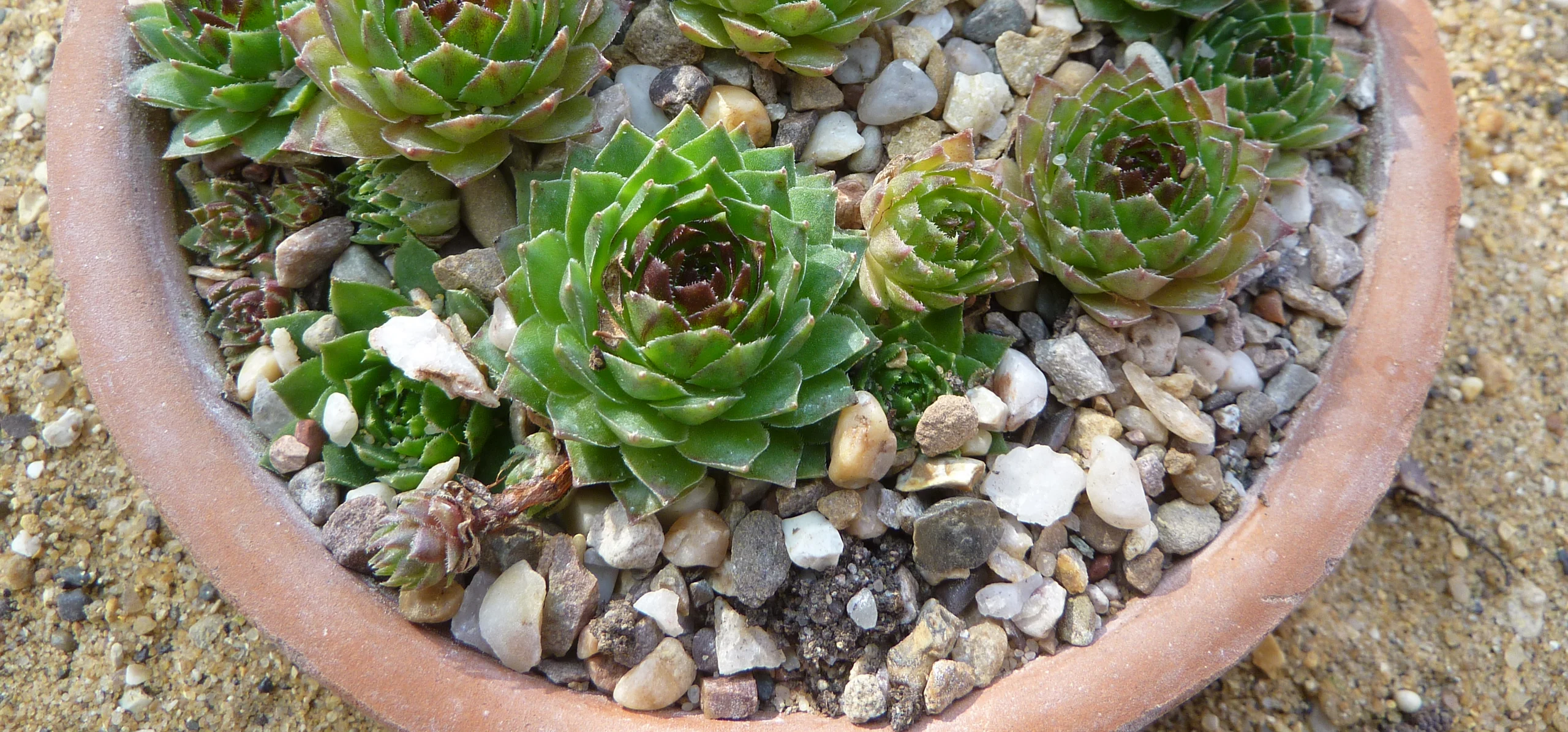
Common Houseleek
Sempervivum tectorum
Family · Crassulaceae
Sempervivum tectorum care: full sun and sharp drainage, almost no water, why the rosette flowers once then dies, and how the offset chicks replace it.
Sempervivum tectorum
Plant profile
- WateringVery littleWater every 21 days
- Light exposureFull sun
- Hardiness zoneUSDA 3–8
Growth
- Family
- Crassulaceae
- Life cycle
- Perennial
- Growth speed
- 4/10
- Mature size
- 5–20 cm
- Spread
- 10–50 cm
- Flowering
- Summer; reddish-purple starry flowers on a single stalk, then that rosette dies
- Propagation
- Offsets
- Seed
- Division
Dormancyevergreen; no true dormancy
Time to maturity5 to 10 years to flower
Soil & climate
- Soil pH
- pH 6–8
- Soil types
- sandy, gravelly, or loamy, sharply drained, poor, low-fertility soil tolerated
- Drought tolerance
- Yes
Light & Placement
- Origin
- Pyrenees to the western Balkan Peninsula (POWO)
- Where to place it
- rockery, scree bed, or wall crevice
- green roof or gravel garden
- alpine trough or raised bed
- shallow terracotta pan or trough with a drainage hole
Safety
- Toxicity
- Not individually listed by the ASPCA; no toxicity reported
- Pet safe
- Yes
Data fromGBIFPlants of the World Online (Kew)RHSMissouri Botanical GardenNC State Extension
Where it grows
World distribution
Common Houseleek is native to 9 countries: Albania, Austria, Croatia, France, Germany, Hungary, Italy, and Spain….GBIF records 46,473 documented identifications across 46 countries, with the largest concentrations in France, Switzerland, and United Kingdom.
- Albania
- Austria
- Croatia
- France
- Germany
- Hungary
- Italy
- Spain
- Switzerland
Yellow to orange dots: concentration of documented identifications per country. Green countries: sourced native range. Source: GBIFNative range from POWO (Kew).
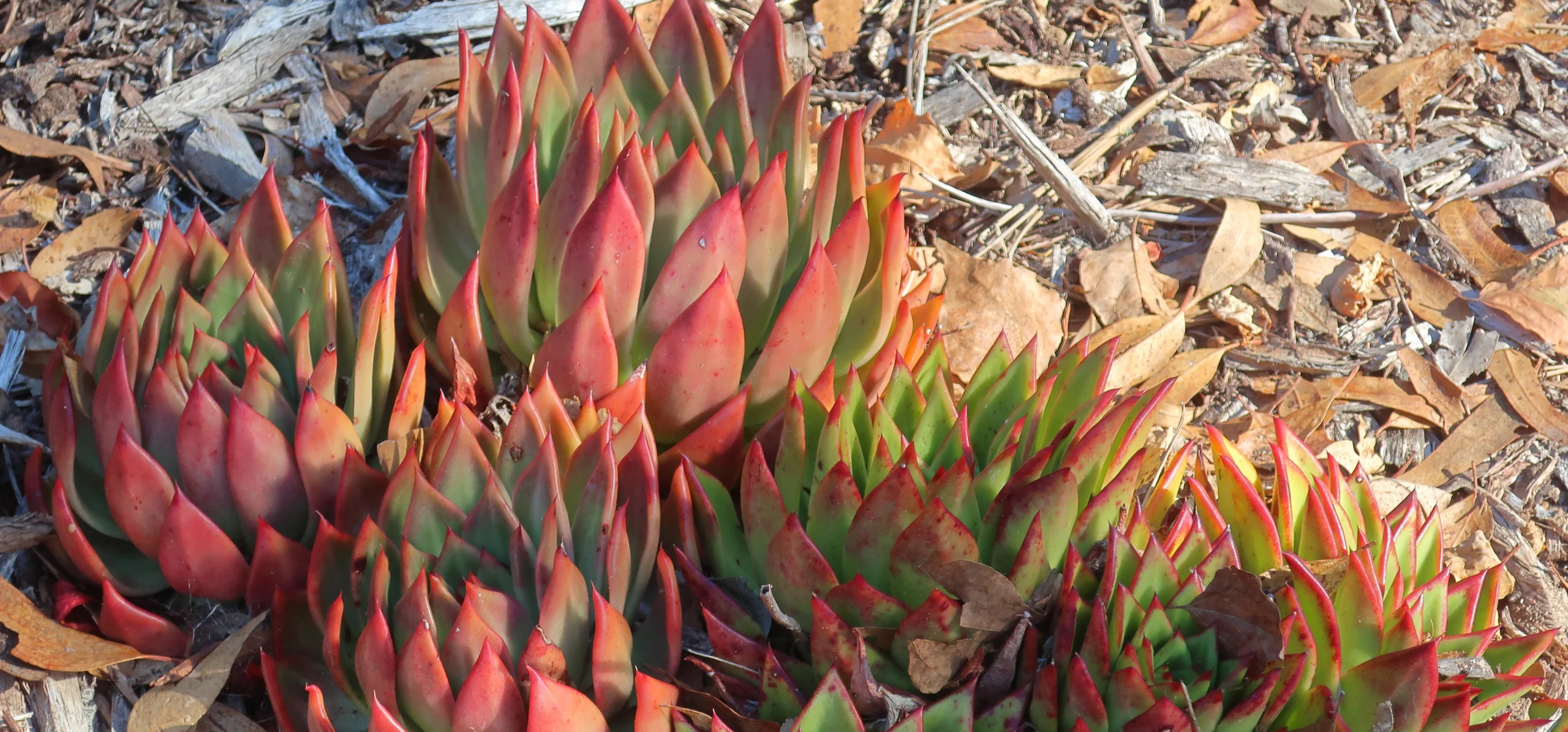
Sempervivum tectorum forms a tight, ground-hugging rosette of fleshy, pointed leaves, blue-green often flushed red-purple at the tips, and it is one of the toughest plants you can grow in a shallow pot, a gravel bed, or a crack in a wall. The RHS rates it H7, hardy in the severest continental winters below -20°C, and NC State Extension lists it across USDA zones 3a to 8b, so frost is rarely what kills a houseleek. What actually kills it is the opposite problem: a winter spent sitting in cold, airless, waterlogged compost. Buy one rosette and within a season or two it multiplies into a small colony of offsets, the chicks that give the plant its common name of hens and chicks.
The roof plant that is supposed to ward off lightning
The species name tectorum means "of roofs", and the Missouri Botanical Garden notes that in Europe this plant was once deliberately planted on thatch and tile roofs, partly to hold the covering down and partly out of a folk belief that a living houseleek warded off lightning strikes and fire. The same rosettes doubled as an emergency food source, their thick leaves eaten as a winter salad green when little else in the garden was growing. Kew's Plants of the World Online lists the native range as the Pyrenees east to the western Balkan Peninsula, mountain rock and scree country where a plant that stores its own water in tight, waxy leaves has an obvious advantage, long before anyone put it on a roof.
Full sun and drainage that never stays wet
The RHS calls for full sun and moderately fertile, well-drained soil, and notes the plant tolerates a north, south, east, or west aspect as long as the light itself is strong; it is the drainage, not the compass direction, that matters most. NC State Extension is more specific about the mix: sandy, gravelly, or loamy soil with a neutral pH around 6.0 to 8.0, and it adds that houseleek positively tolerates poor, thin soils that would starve most border perennials. In a container this means a cactus and succulent mix cut with extra grit, pumice, or coarse sand rather than an ordinary multipurpose compost, and a pot with a real drainage hole; on the ground it means a rockery, a scree bed, a gravel garden, or a genuine wall crevice rather than a border that holds moisture.


Watering: as little as possible, and none in a wet winter
NC State Extension's care advice is blunt on this point: avoid overwatering, and let the plant dry out between waterings, since it is drought tolerant and needs sharp drainage to perform well; overwatering is named as the direct route to crown rot. In practice a houseleek grown outdoors in open ground rarely needs supplemental water at all once established, rain being enough except in a prolonged dry spell; a potted specimen wants a thorough soak followed by a complete dry-out, not a fixed weekly schedule. The RHS adds a second warning specific to climates with wet winters: even a fully hardy rosette can be lost to a season of standing water at the crown, so a raised bed, a gritty top-dressing, or moving containers under cover through the wettest months matters more for survival than any amount of cold protection.
One flower, then the rosette dies
Every individual rosette of Sempervivum tectorum is monocarpic: it grows for several years, RHS growing notes put typical time to flowering maturity at five to ten years, then in summer sends up a single fleshy stem, to about 20cm by RHS figures or 8 to 12 inches by NC State's, topped with a flat cluster of starry, reddish-purple flowers. Once that stem has flowered and set seed, the rosette that produced it dies; Missouri Botanical Garden's plant profile describes this plainly, the hen flowers, sets seed, and dies, leaving the chicks around its base to fill the gap. This is not a sign of neglect or disease. The dead central rosette can be lifted out once it has browned off, and the ring of offsets around it simply closes over the space within a season, which is the entire reproductive strategy of the species written into its common name.
Propagating the chicks
The offsets are the easy route to new plants: the RHS lists propagation by rooting offsets or by seed sown in spring, and NC State Extension likewise names division of the offsets alongside seed as the standard methods. A chick that already has a short stub of root pulls away from the parent rosette with a gentle twist and can go straight into gritty, well-drained mix; it needs no rooting hormone and typically re-establishes within a few weeks without a plastic cover or extra humidity, since excess damp is the one thing this genus does not want. Seed germinates readily too but takes years to reach a flowering-size rosette, so anyone wanting a quick colony for a trough or a green roof does better dividing an established clump.
Colour and cultivars that shift with the seasons
Missouri Botanical Garden describes the rosette as built from 50 to 60 thick, hairless leaves, sometimes purple-tipped, and in practice the balance of green to red-purple in any one rosette moves through the year: colour deepens with stronger sun and cooler nights and fades back toward plain green in shade or in the mild stretch of spring growth. Because seedlings and sports vary so readily, growers have selected a very wide range of named forms of this species and its hybrids, from almost solid green to deep wine-red and to woolly, cobweb-tipped forms, sold under individual cultivar names rather than as generic Sempervivum tectorum. Buying a named cultivar rather than an unlabelled mix is the only reliable way to know in advance what colour a given rosette will settle into once it matures.
Vine weevil and rust
The RHS names two specific problems to watch for on this species: vine weevil and rust. Vine weevil grubs feed underground on the roots and the base of the rosette through autumn and winter, and the first visible sign is often a rosette that lifts loose from the compost with little resistance because its root system has already been eaten away, by which point the adult beetles that laid the eggs have usually moved on; checking the base of suspect rosettes and replacing badly infested compost is more reliable than waiting for foliage symptoms. Rust shows instead on the leaf surface, as raised, rust-coloured pustules, and is best managed by removing affected leaves promptly and keeping rosettes spaced enough that air moves freely between them, since still, humid air between crowded plants is what lets both problems spread from one rosette to the next.
Around pets and children
The ASPCA's toxic and non-toxic plant database does not carry an individual entry for Sempervivum tectorum under that name; its two closest matches by common name, both labelled Hens and Chickens, are in fact filed under a different plant, Echeveria elegans. No toxicity has been reported for the species in the sources checked here, and Missouri Botanical Garden's own note on its historical use as an edible winter salad green points the other way, but in the absence of a species-specific ASPCA listing it is worth keeping a genuinely curious puppy or grazing pet away from a newly divided planting rather than assuming safety by association with a similarly named plant.
Test your plant knowledge
Tap a card to flip it and reveal the answer.
An individual Sempervivum tectorum rosette flowers only once before it dies. Tap to reveal ✓ True
Houseleek needs frequent watering to keep the compost evenly moist. Tap to reveal ✕ False
Cold winter temperatures are the main threat to this plant's survival. Tap to reveal ✕ False
Vine weevil grubs can attack the roots of Sempervivum tectorum. Tap to reveal ✓ True
New rosettes called offsets or chicks form around the base and can be used to propagate new plants. Tap to reveal ✓ True
Sources
References consulted for this guide
- GBIF - Sempervivum tectorumgbif.org
- Plants of the World Online (Kew) - Sempervivum tectorumpowo.science.kew.org
- RHS - Sempervivum tectorumrhs.org.uk
- Missouri Botanical Garden - Sempervivum tectorummissouribotanicalgarden.org
- NC State Extension - Sempervivum tectorumplants.ces.ncsu.edu
- Reference entity : Wikipédiaen.wikipedia.org