Arrowhead Vine
Syngonium podophyllum
Family · Araceae
Syngonium podophyllum needs bright indirect light, evenly moist soil, and 40 to 60 percent humidity indoors; every part is toxic to cats, dogs and horses.
Syngonium podophyllum
Plant profile
- WateringModerateWater every 6 days
- Light exposureIndirect light
- Ideal temperature18–27 °C
- Humidity40–60 %
- Hardiness zoneUSDA 10–12
Growth
- Family
- Araceae
- Life cycle
- Perennial
- Growth speed
- 3/10
- Mature size
- 91–183 cm
- Spread
- 30–61 cm
- Propagation
- Cutting
- Division
- Layering
DormancyGrowth slows in cooler, lower-light winter months; no true leaf-drop dormancy
Time to maturityLeaf shape matures from arrow-shaped to deeply lobed once the plant is given a support to climb
Soil & climate
- Soil pH
- pH 5.5–6.5
- Soil types
- peat-based potting mix, pine bark, perlite
- Drought tolerance
- No
Light & Placement
- Origin
- Mexico to Tropical America
- Where to place it
- A metre or two back from an east or west window
- Kitchen or bathroom shelf with steady humidity
- Shaded or dappled patio in USDA zones 10 to 12
- Pot with a moss pole or bark support for the climbing, mature-leaf form
- Hanging basket for a trailing, juvenile-leaf habit
Safety
- Toxicity
- CatsToxic
- DogsToxic
- HorsesToxic
- HumansToxic
Data fromGBIFPlants of the World Online (Kew)ASPCANC State ExtensionUF/IFAS Extension
Where it grows
World distribution
Arrowhead Vine is native to 18 countries: Belize, Bolivia, Brazil, Colombia, Costa Rica, Ecuador, El Salvador, and French Guiana….GBIF records 9,024 documented identifications across 105 countries, with the largest concentrations in Brazil, Mexico, and United States.
- Belize
- Bolivia
- Brazil
- Colombia
- Costa Rica
- Ecuador
- El Salvador
- French Guiana
- Guatemala
- Guyana
- Honduras
- Mexico
Show 6 more countriesShow fewer countries
- Nicaragua
- Panama
- Peru
- Suriname
- Trinidad & Tobago
- Venezuela
Yellow to orange dots: concentration of documented identifications per country. Green countries: sourced native range. Source: GBIFNative range from POWO (Kew).
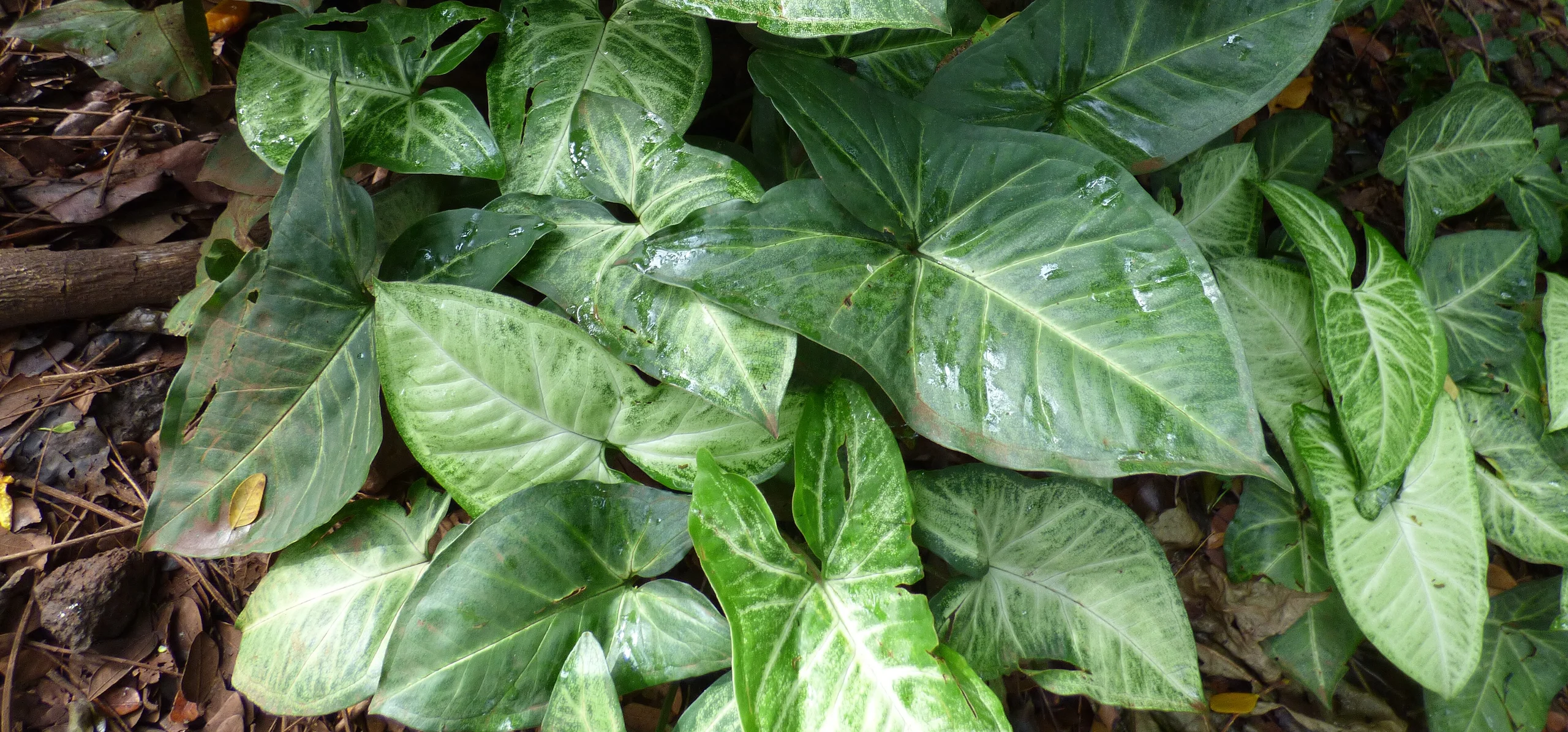
A Syngonium podophyllum fresh from the nursery is still wearing its juvenile face: compact, arrow-shaped leaves on an upright, clumping stem that looks nothing like a vine. Left to grow with something to climb, the plant changes completely, later leaves widen and split into deep lobes and the stem stretches out to trail or scramble. Most of the trouble new owners run into traces back to two things: soil that stays wet, which this plant tolerates far less than its tropical origin might suggest, and too little light, which keeps every new leaf small and simply arrow-shaped no matter how old the plant gets. Give it bright, indirect light and water that alternates a thorough soak with a dry spell, and it settles in as one of the more forgiving aroids to keep for years.
Native Range and the Changing Leaf Shape
Plants of the World Online (Kew) gives the native range of Syngonium podophyllum as Mexico to Tropical America, and GBIF's accepted classification places it in the arum family, Araceae, the same family as Monstera and Philodendron. In the wild the plant germinates on the forest floor and climbs tree trunks toward the light, using aerial roots that also appear along stems grown indoors once they get something to grip. The most distinctive trait is the leaf shape itself: juvenile leaves are simple and arrow-shaped, but once the plant starts climbing and maturing, new leaves emerge with deep lobes, sometimes split into several separate leaflets radiating from one point. A plant kept short and unsupported in a hanging basket can stay in its juvenile, arrow-leaved form indefinitely; it is the act of climbing that pushes it toward the more divided mature leaf.
Light and Placement
NC State Extension recommends dappled sunlight or partial shade, roughly two to six hours of direct sun a day, and notes that full sun will tend to burn or bleach the foliage, a risk that is highest on variegated cultivars where the paler patches scorch first. Indoors, the University of Florida's IFAS Extension puts the useful range at 250 to 1,000 foot-candles, close to what a position a metre or two back from an unobstructed east or west window provides. Below that range the plant rarely dies outright, it stretches instead: internodes lengthen, stems reach for the light, and the whole plant looks thin rather than full. Turning the pot occasionally keeps growth from leaning permanently toward the window.
Watering and Humidity
IFAS Extension's commercial growing guidelines list production humidity at 60 to 100 percent but treat 40 to 60 percent as the range that keeps foliage looking its best indoors, a level most kitchens and bathrooms reach without extra effort. Water once the top of the mix has dried slightly, never leave the pot sitting in a saucer of water, and cut back the frequency once growth slows over autumn and winter. NC State Extension lists soft rot among the diseases that affect this species, and it is almost always a watering problem rather than an infection that arrives on its own: mix that stays saturated is what invites the bacteria behind it.


Soil and Potting Mix
IFAS Extension's growing guidelines specify a blend of peat, pine bark, and vermiculite or perlite, with a target pH of 5.5 to 6.5, more acidic than the near-neutral mixes many houseplants tolerate. A standard peat-based potting mix cut with extra perlite for drainage approximates this closely enough for a windowsill plant; what matters is that water passes through within a few seconds rather than pooling on the surface. Repot once roots circle the base of the pot or emerge from the drainage holes, choosing a container only slightly larger than the current one.
Feeding
Commercial growers, per IFAS Extension, use fertilizers with an approximate 3-1-2 nitrogen-phosphorus-potassium ratio, such as 24-8-16 or 18-6-12, applied through regular fertigation at a nitrogen rate around 150 parts per million. For a potted houseplant the same ratio, diluted and applied as a liquid feed every three to four weeks during spring and summer and withheld through the darker months, follows the same logic without the commercial equipment: steady, moderate nitrogen rather than an occasional heavy dose.
Pruning and Training on a Moss Pole
Pinching out the growing tip just above a leaf node encourages the plant to branch from that point instead of sending out one long, sparse runner, and since NC State Extension lists stem cutting as a reliable propagation method, pruning and propagating usually happen in the same motion. A vine cut back hard recovers quickly, with new shoots breaking from nodes lower on the stem. Giving the plant a moss pole or a piece of bark to climb, rather than letting it trail from a hanging basket, is also what encourages the mature, lobed leaf form described above: aerial roots along the stem grip the support, and the plant responds to that contact by continuing to climb rather than clump.
Propagation from Stem Cuttings
NC State Extension lists division, layering, and stem cutting as propagation methods for this species. The simplest for a home grower is a stem cutting carrying at least one node, set in water or a damp mix; a section that already shows a visible aerial root at a node roots fastest, since that root only needs to reach soil or water rather than form from nothing. Keep cuttings warm and out of direct sun while they establish, then pot up once new roots have developed.
Pests, Diseases and Toxicity
NC State Extension lists aphids, mealybugs, spider mites, and banded greenhouse thrips as the pests most likely to appear, usually on leaf undersides or in leaf joints, and names bacterial leaf spot and soft rot as the diseases to watch for, both linked to excess moisture and poor airflow rather than any inherent weakness in the plant. The ASPCA lists Syngonium podophyllum, under the name Arrow-Head Vine, as toxic to cats, dogs, and horses, with insoluble calcium oxalate crystals as the toxic agent and oral irritation, drooling, and vomiting among the symptoms of ingestion. NC State Extension adds that the sap affects people too, capable of causing contact dermatitis and the same oral irritation if leaves are chewed, so the plant is worth keeping out of reach of pets and small children.
Test your plant knowledge
Tap a card to flip it and reveal the answer.
Syngonium podophyllum's leaves start out arrow-shaped and become deeply lobed once the plant climbs. Tap to reveal ✓ True
Arrowhead vine is safe for cats and dogs to chew on. Tap to reveal ✕ False
This plant grows best in full, direct sun all day. Tap to reveal ✕ False
A stem cutting with a node will root in water or damp mix. Tap to reveal ✓ True
The potting mix should be allowed to dry out completely between every watering. Tap to reveal ✕ False
Sources
References consulted for this guide
- GBIF - Syngonium podophyllumgbif.org
- Plants of the World Online (Kew) - Syngonium podophyllumpowo.science.kew.org
- ASPCA - Arrow-Head Vineaspca.org
- NC State Extension - Syngonium podophyllumplants.ces.ncsu.edu
- UF/IFAS Extension - Cultural Guidelines for Commercial Production of Interiorscape Syngonium (EP244)ask.ifas.ufl.edu
- Reference entity : Wikipédiaen.wikipedia.org