White Clover
Trifolium repens
Family · Fabaceae
White clover spreads by rooting stolons, fixes its own nitrogen and tolerates close mowing. Covers site, soil pH, watering, spread control and pet safety.
Trifolium repens
Plant profile
- WateringModerateWater every 7 days
- Light exposurePartial sun
Growth
- Family
- Fabaceae
- Life cycle
- Perennial
- Growth speed
- 7/10
- Mature size
- 10–45 cm
- Spread
- 10–50 cm
- Flowering
- May to October
- Propagation
- Seed
- Division
- Layering
Dormancyfoliage thins back in hard frost, regrows from the crown and stolons in spring
Time to maturity2-5 years
Soil & climate
- Soil pH
- pH 6–7
- Soil types
- chalk, clay, loam, sand
- Saline soil
- Not tolerated
- Drought tolerance
- No
Light & Placement
- Origin
- Macaronesia, NW Africa, Egypt to Zimbabwe, Europe to Mongolia and Himalaya
- Where to place it
- sunny lawn
- meadow or bee lawn mix
- bed edging
- pasture or ley
- shallow wide container with a moisture-retentive, well-drained mix
Safety
- Toxicity
- Not listed by the ASPCA as toxic or non-toxic
- Pet safe
- No
Invasive speciesspreads by rooting stolons and self-seeds readily; can be considered a lawn weed where a pure-grass lawn is wanted
Data fromRHS: Trifolium repens (white clover)Trifolium repens L., GBIF Backbone TaxonPenn State Extension: White CloverMissouri Botanical Garden: Trifolium repClemson HGIC: White Clover
Where it grows
World distribution
White Clover is native to 54 countries: Afghanistan, Albania, Algeria, Austria, Belarus, Belgium, Bhutan, and Bulgaria….GBIF records 1,832,582 documented identifications across 147 countries, with the largest concentrations in United Kingdom, France, and Netherlands.
- Afghanistan
- Albania
- Algeria
- Austria
- Belarus
- Belgium
- Bhutan
- Bulgaria
- Croatia
- Czechia
- Denmark
- Egypt
Show 42 more countriesShow fewer countries
- Estonia
- Ethiopia
- Faroe Islands
- Finland
- France
- Georgia
- Germany
- Greece
- Hungary
- Iceland
- India
- Iran
- Iraq
- Ireland
- Italy
- Kazakhstan
- Kenya
- Kyrgyzstan
- Lebanon
- Mongolia
- Morocco
- Nepal
- Netherlands
- Norway
- Pakistan
- Palestinian Territories
- Poland
- Portugal
- Romania
- Russia
- Spain
- Sweden
- Switzerland
- Tajikistan
- Tanzania
- Tunisia
- Türkiye
- Turkmenistan
- Ukraine
- United Kingdom
- Uzbekistan
- Zimbabwe
Yellow to orange dots: concentration of documented identifications per country. Green countries: sourced native range. Source: GBIFNative range from POWO (Kew).
If a low mat of three-lobed leaves and round white flower heads has taken over a corner of the lawn, or you sowed it there on purpose, it is almost certainly white clover, Trifolium repens, a creeping perennial legume native across Macaronesia, North Africa and Europe to Mongolia and the Himalaya, and now naturalized on most continents. It spreads by stolons that root wherever a leaf node touches soil, so a single plant becomes a dense patch within a season. Unlike the grass around it, it needs no nitrogen fertilizer: bacteria living in nodules on its roots pull nitrogen from the air and feed it back into the soil. That trait, not novelty, is why gardeners are sowing it on purpose again after decades of herbicide marketing that treated it as a weed to remove.
What You're Looking At: Habit, Family and Native Range
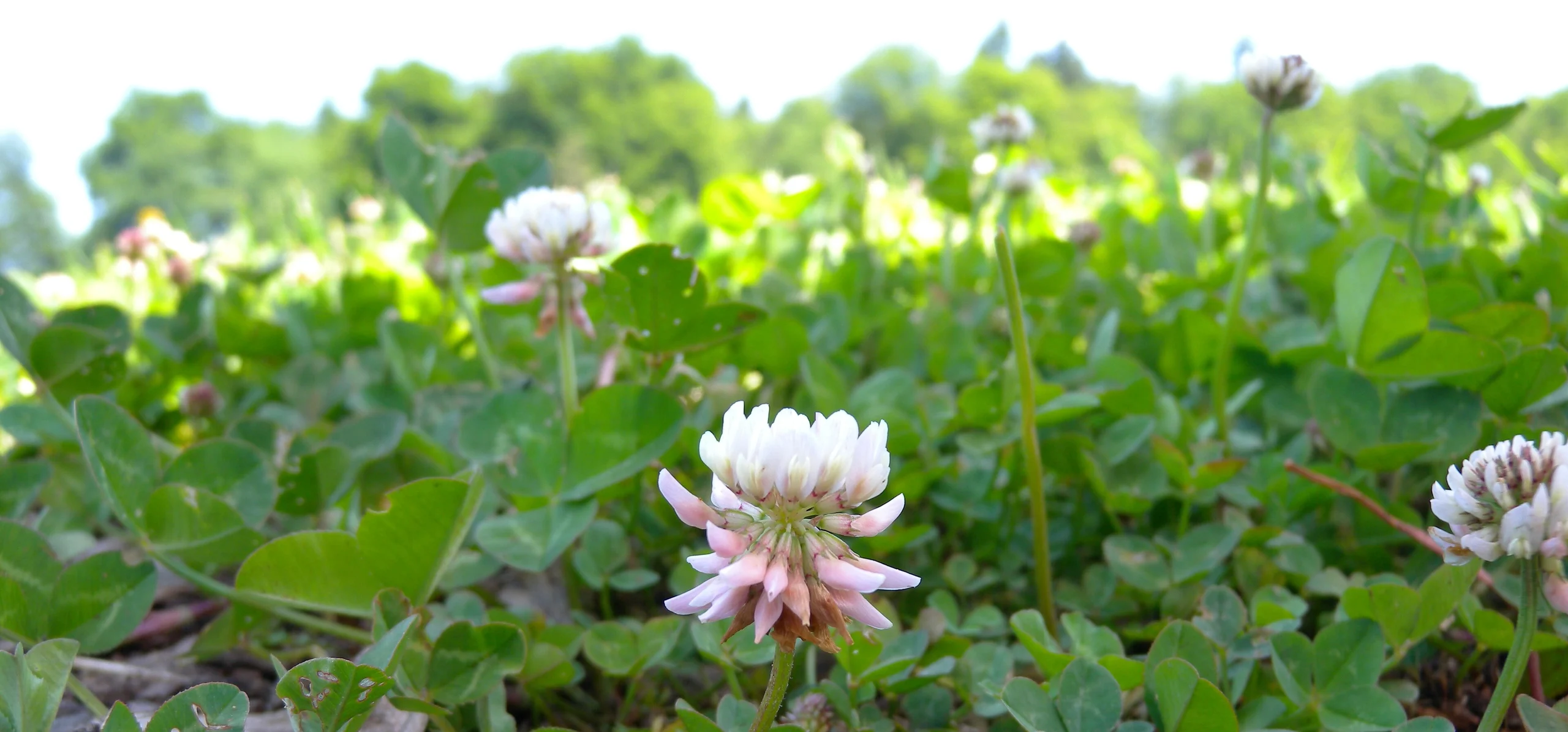
White clover belongs to Fabaceae, the pea and bean family, in the genus Trifolium. Its leaves are trifoliate, rounded and often marked with a pale chevron near the base of each leaflet, a useful field mark when comparing it with similar clovers. Plants can reach 45 cm tall where stems climb through taller grass, but in a mown lawn the mat usually sits closer to 10 cm. Creamy white flower heads, often tinged pink, open from May to October in temperate climates and feed bumblebees, wood mice and the caterpillars of the common blue butterfly. Some older references file it under the synonym Amoria repens, but Trifolium repens remains the accepted name in the GBIF backbone taxonomy.
Choosing a Type: Wild Seed, Ornamental Cultivars or Microclover
Straight species seed, sold as Dutch white clover, suits meadows, pasture leys and bee lawns where flowering matters. Ornamental cultivars such as 'Dragon's Blood' and 'Purpurascens' carry deep red or purple-flushed foliage and are grown as ground cover for their color rather than for forage. For a lawn blend that stays low with fewer flowering stalks between mowings, look for microclover seed, a smaller-leaved selection bred specifically to overseed into existing turf without dominating it visually.
Sun, Soil and Site
Full sun keeps growth dense and flowering strong; in partial shade the plant survives but flowers less and spreads more slowly. It grows across chalk, clay, loam and sand, with a preferred soil pH between 6 and 7, though it tolerates acid, neutral or alkaline ground. Aim for soil that is moist but well-drained; standing winter wet is one of the few conditions that reliably thins a stand.


Sowing and Establishing
White clover grows fastest when soil temperatures sit between roughly 10 and 29 degrees C, so spring and late summer to early autumn sowings knit into a mat fastest. Rake seed lightly into prepared, weed-free soil or overseed thin turf after a close mow so seed reaches soil contact. Keep the seedbed evenly moist until germination, which is usually the slower step; once rooted, the stolons do the rest of the spreading on their own.
Watering and Feeding
Despite a general reputation for drought resistance, white clover has a shallow root system that struggles in prolonged dry soil, so water new plantings weekly and established patches during extended dry spells. Skip the fertilizer: its root nodules fix atmospheric nitrogen and, in a mixed lawn or pasture, can supply enough nitrogen to reduce or replace 30 to 50 pounds per acre of what would otherwise be applied to the companion grass.
Mowing, Grazing and Keeping the Spread in Check
Because it creeps low via rooting stolons rather than growing upright like turfgrass, white clover tolerates mowing or grazing down to about an inch, though it needs a recovery period before the next close cut. Where it is not wanted, mow before flower heads set seed and lift unwanted stolon runners completely, since any node left in soil contact will simply root again. A sunk edging strip keeps a deliberate patch from creeping into paving joints or neighboring beds.
Pests, Diseases and Clover Look-Alikes
Both the RHS and Missouri Botanical Garden describe white clover as generally free of serious pests and diseases, one reason it needs so little upkeep once established. It is worth telling apart from relatives with a similar trifoliate leaf: red clover, Trifolium pratense, grows taller and more upright with hairy leaves and pink-purple flower heads, while alsike clover, Trifolium hybridum, has smaller pink-and-white flowers and lacks white clover's pale leaf marking.
Toxicity and Pet Safety
As of this writing, the ASPCA's toxic and non-toxic plant database carries no dedicated entry for Trifolium repens itself. The ASPCA does list the related alsike clover, Trifolium hybridum, as toxic to horses, a distinction worth knowing if both grow in the same pasture or seed mix. Because white clover has no ASPCA record either way, treat it with the same caution given to any unlisted plant around pets and grazing animals, and watch for digestive upset if an animal eats a large quantity.
Test your plant knowledge
Tap a card to flip it and reveal the answer.
White clover fixes its own nitrogen through bacteria living in nodules on its roots. Tap to reveal ✓ True
White clover has deep taproots that make it highly drought tolerant. Tap to reveal ✕ False
White clover tolerates being mown or grazed down to about an inch. Tap to reveal ✓ True
The ASPCA lists white clover as toxic to dogs, cats and horses. Tap to reveal ✕ False
White clover was once a standard ingredient in lawn seed mixes before broadleaf herbicides became common. Tap to reveal ✓ True
Sources
References consulted for this guide
- RHS: Trifolium repens (white clover)rhs.org.uk
- Trifolium repens L., GBIF Backbone Taxonomygbif.org
- Penn State Extension: White Cloverextension.psu.edu
- Missouri Botanical Garden: Trifolium repens Plant Findermissouribotanicalgarden.org
- Clemson HGIC: White Cloverhgic.clemson.edu
- Reference entity : Wikipédiaen.wikipedia.org