Honey Locust
Gleditsia triacanthos
Family · Fabaceae
Honey locust street trees are thornless, podless clones of a wild species armed with branched thorns; here is what that split means for pests, care and siting.
Gleditsia triacanthos
Plant profile
- WateringLittleWater every 12 days
- Light exposureFull sun
- Hardiness zoneUSDA 3–8
Growth
- Family
- Fabaceae
- Life cycle
- Perennial
- Growth speed
- 7/10
- Mature size
- 914–1371 cm
- Spread
- 762–1219 cm
- Flowering
- Inconspicuous greenish-yellow flowers in late spring to early summer
- Propagation
- Seed
- Grafting
Dormancydeciduous, bare in winter
Time to maturityfills out its canopy over 10-15 years; keeps growing over several decades
Soil & climate
- Soil pH
- pH 6–8
- Soil types
- clay, loam, sand, chalk
- Saline soil
- Tolerated
- Drought tolerance
- Yes
Light & Placement
- Origin
- Central and eastern United States, south to northeastern Mexico (POWO)
- Where to place it
- open lawn or garden with room for the mature canopy
- street tree strip or parking lot island
Safety
- Toxicity
- CatsSafe
- DogsSafe
- HorsesSafe
Invasive speciesdeclared environmental weed in Queensland and New South Wales, Australia; naturalized and locally invasive in parts of central and southern Europe, including a spreading population recorded in southwestern Spain
Data fromGBIF Backbone Taxonomy: Gleditsia triacaASPCA Toxic and Non-Toxic Plants: Honey Missouri Botanical Garden Plant Finder: NC State Extension Gardener Plant ToolboCABI Compendium: Gleditsia triacanthos (
Where it grows
World distribution
Honey Locust is native to 2 countries: Mexico and United States.GBIF records 145,411 documented identifications across 80 countries, with the largest concentrations in United States, Germany, and Australia.
- Mexico
- United States
Yellow to orange dots: concentration of documented identifications per country. Green countries: sourced native range. Source: GBIFNative range from POWO (Kew).
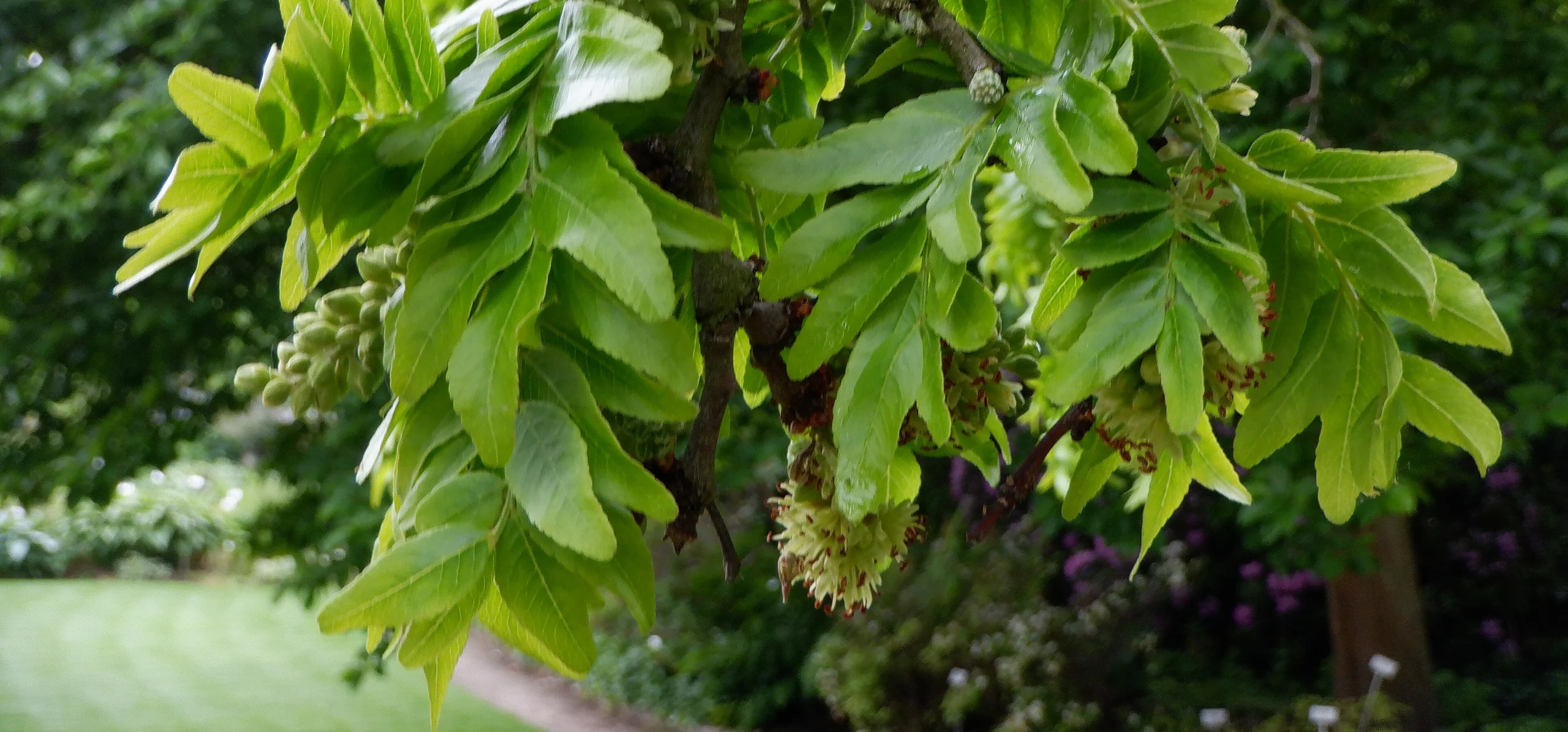
A honey locust bought today from a nursery, tagged 'Sunburst', 'Skyline' or 'Shademaster', is not the wild Gleditsia triacanthos. It is a thornless, largely fruitless selection of the botanical form f. inermis, propagated by grafting specifically to shed the two traits that made the species a liability: trunk thorns and heavy seedpods. What a buyer actually gets is a fast-growing shade tree with tiny, fern-like leaflets that filter sunlight into dappled shade and, per Missouri Botanical Garden, are too small to rake when they drop in autumn. That combination, light shade, easy cleanup, and tolerance of hard urban ground, is exactly why the species was planted so widely along streets and parking lots, and why a handful of pests have since built up on it in return.
Wild Thorns and Long Pods, or a Clean Street Tree
Species plants carry stout thorns, solitary or three-branched, to about 3 in (7.6 cm) on the trunk and lower limbs, and the RHS records spines to 15 cm (6 in) on some specimens, tough enough to puncture a tractor tire. Flowers are inconspicuous, but they are followed by flat, twisted, dark purplish-brown pods to 18 in (45 cm) long, filled with a sweet, sticky pulp that gives the tree its common name and that persist into winter before littering the ground below. Missouri Botanical Garden notes that species plants are rarely sold in commerce today for exactly this reason: the thorns and the pod litter are considered significant liabilities. Nearly everything sold as honey locust now descends from f. inermis, a naturally thornless variant first multiplied by grafting rather than a separate species.
Origin and Native Range
Plants of the World Online (Kew) gives the native range as west-central and eastern USA to Mexico, in the northwest of Nuevo Leon and Tamaulipas. Missouri Botanical Garden narrows this to central and eastern North America, from Pennsylvania to Iowa south to Georgia and Texas, and NC State Extension notes the thornless variety also occurs wild in the piedmont, mountain and coastal regions of North Carolina. That native range already spans continental winters and hot, humid summers, which explains a lot of the adaptability gardeners rely on further afield.
Choosing a Cultivar: Sunburst, Skyline and Shademaster
'Sunburst' opens with golden-yellow new growth that greens up through summer, holds an RHS Award of Garden Merit from 1993, and has been in commerce since 1957. Oregon State University's landscape plants database rates it hardy to USDA zone 3 and flags it as notably more prone than green-leaved cultivars to honeylocust pod gall midge and to Nectria canker in some regions, a trade-off for the color. 'Skyline' (sold as 'Skycole') grows into a tidy pyramid, thornless and seedless, reaching 40 to 45 ft (12 to 13.7 m) tall according to NC State Extension, and is the safer default where fruit litter cannot be tolerated at all. 'Shademaster' takes a vase-shaped, upright, symmetrical habit to about 40 ft (12 m); Cornell's Woody Plants Database notes it is thornless but does still produce some pods, and rates its drought tolerance as superior even within this drought-tolerant species.


Site, Sun and Soil
Give it full sun. Missouri Botanical Garden lists it hardy in zones 3 to 8, with a soil pH preference from neutral to alkaline, roughly 6.0 to 8.0, and NC State Extension confirms it tolerates clay, loam and sand, with the RHS adding chalk to that list. What sets the species apart from most street trees is the breadth of abuse it shrugs off: NC State Extension documents tolerance of compaction, poor soils, drought, flooding, heat, urban air pollution, road salt and even the juglone toxicity that kills many species planted near black walnut. It is also rated deer resistant. This is the profile that made it a default choice for parking lot islands and narrow street strips where an oak or maple would struggle.
Pests and Diseases That Followed the Boom
Planting the same handful of grafted clones over huge numbers of streets and lots concentrated a narrow gene pool over a wide area, and several pests moved in to exploit it. The honeylocust plant bug overwinters as eggs tucked just under the bark of two- and three-year-old twigs, hatching as buds break in spring; its feeding punctures kill the cells around each bite, leaving new leaflets dwarfed, curled and chlorotic, and heavy years can visibly retard the whole spring flush. Mimosa webworm ties leaflets together with silk and skeletonizes them from within, usually starting in the outer canopy in midsummer and browning whole branch tips by August in a bad year. Canker, recorded as Thyronectria canker on thornless honeylocust by Virginia Cooperative Extension and as Nectria canker on 'Sunburst' by Oregon State University, girdles branches and can kill an otherwise healthy tree outright rather than just disfiguring it. NC State Extension's broader list adds borers, honeylocust pod gall midge, leafhoppers, leaf miners and spider mites, plus leaf spot, powdery mildew, rust and witches' broom as recurring but generally non-fatal problems.
Invasive Status Outside North America
Outside its native range, honey locust has not stayed a well-behaved ornamental everywhere. It is a declared environmental weed in Queensland and New South Wales, where it forms dense, thorny thickets along watercourses that block stock and human access and crowd out native vegetation, and it is restricted under Queensland's biosecurity law as a result. In Europe it has long been planted with little comment, but the CABI Compendium documents naturalized populations in parts of central and southern Europe, and in 2019 researchers recorded the first clearly invasive population on the Iberian Peninsula, spreading along nearly 2 km of a river in southwestern Spain with seedlings, saplings and fruiting adults forming spiny thickets. Check local guidance before planting it near a waterway or wild land edge, even where garden centers sell it freely.
Toxicity and Common Mistakes
The ASPCA lists honey locust as non-toxic to dogs, cats and horses, so the plant itself is not the hazard; the thorns on any non-inermis seedling or root sucker are. The most common mistake is buying whatever honey locust is cheapest locally without checking whether it is a true thornless, low-fruit selection like 'Skyline', since seed-grown stock and some older plantings can revert toward thorns and heavy pods. The second is planting a golden cultivar like 'Sunburst' in a region with known canker or gall midge pressure without asking a nursery about local track record first. The third is ignoring early canker symptoms, a single wilting branch in an otherwise healthy crown, since by the time dieback is obvious the infection is usually already established through the vascular tissue and removal of the whole tree becomes the realistic outcome.
Test your plant knowledge
Tap a card to flip it and reveal the answer.
Cultivars like 'Sunburst', 'Skyline' and 'Shademaster' are thornless, unlike the wild species. Tap to reveal ✓ True
The ASPCA lists honey locust as toxic to dogs, cats and horses. Tap to reveal ✕ False
Honey locust tolerates soil compaction, drought and road salt, which is part of why it became a common street tree. Tap to reveal ✓ True
Honey locust's small leaflets are difficult to rake and commonly clog gutters in autumn. Tap to reveal ✕ False
Honey locust has become an invasive, thicket-forming tree in parts of Australia. Tap to reveal ✓ True
Sources
References consulted for this guide
- GBIF Backbone Taxonomy: Gleditsia triacanthos L.gbif.org
- ASPCA Toxic and Non-Toxic Plants: Honey Locustaspca.org
- Missouri Botanical Garden Plant Finder: Gleditsia triacanthosmissouribotanicalgarden.org
- NC State Extension Gardener Plant Toolbox: Gleditsia triacanthos var. inermisplants.ces.ncsu.edu
- CABI Compendium: Gleditsia triacanthos (honey locust)cabi.org
- Reference entity : Wikipédiaen.wikipedia.org