Eastern Redbud
Cercis canadensis
Family · Fabaceae
Eastern redbud flowers straight from bare branches and trunk, tops out around 6-9 m, and needs pruning to manage Botryosphaeria canker: siting, cultivars, care.
Cercis canadensis
Plant profile
- WateringModerateWater every 10 days
- Light exposurePartial sun
- Hardiness zoneUSDA 4–9
Growth
- Family
- Fabaceae
- Life cycle
- Perennial
- Growth speed
- 5/10
- Mature size
- 600–900 cm
- Spread
- 760–1070 cm
- Propagation
- Seed
- Cutting
- Grafting
FloweringMagenta-pink pea-like flowers clustered on bare branches and trunk (cauliflory), March to May
Dormancydeciduous, bare in winter
Time to maturityusually flowers within about 4-6 years from seed
Soil & climate
- Soil types
- clay, loam, sand
- Drought tolerance
- No
Light & Placement
- Origin
- Southeastern Canada to the eastern and central United States and east-central Mexico
- Where to place it
- open lawn or specimen planting
- woodland edge as an understory tree
- site well clear of patios, foundations and walkways
Safety
- Toxicity
- Not listed by the ASPCA as toxic or non-toxic to pets
- Pet safe
- Yes
Data fromGBIF Backbone Taxonomy: Cercis canadensiPlants of the World Online (Kew): CercisMissouri Botanical Garden Plant Finder: NC State Extension Gardener Plant ToolboClemson HGIC: Redbud
Where it grows
World distribution
Eastern Redbud is native to 2 countries: Mexico and United States.GBIF records 74,151 documented identifications across 36 countries, with the largest concentrations in United States, Canada, and Mexico.
- Mexico
- United States
Yellow to orange dots: concentration of documented identifications per country. Green countries: sourced native range. Source: GBIFNative range from POWO (Kew).
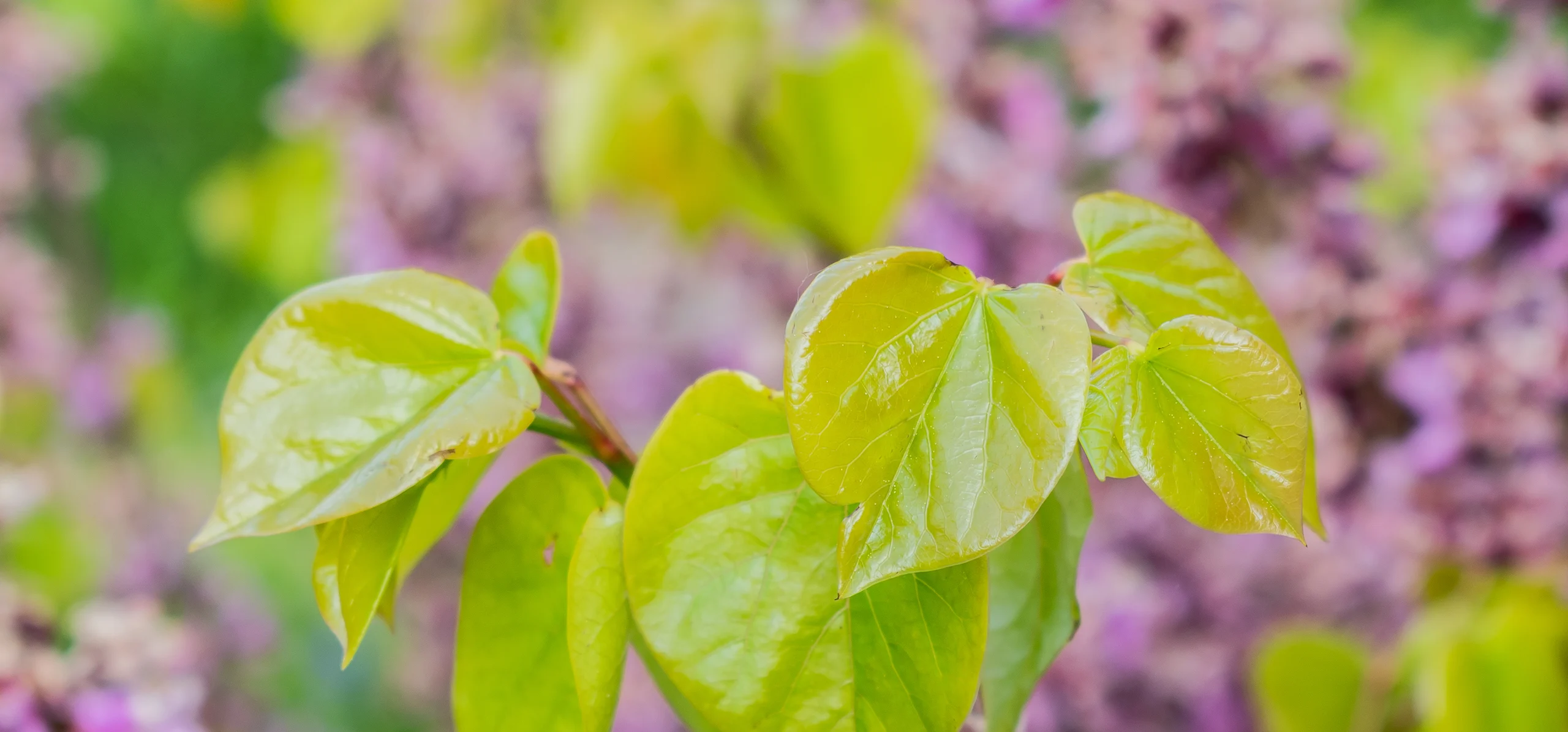
A small eastern redbud (Cercis canadensis) bought bare-root or in a container in early spring is already carrying next year's shape: a broad, often multi-trunked small tree that tops out around 6 to 9 meters (20 to 30 ft) tall with a crown nearly as wide, so the spot picked now is the spot it keeps for the rest of its life. In March or April, before a single leaf opens, the bare branches and even the trunk itself break out in small magenta-pink, pea-shaped flowers clustered directly on the bark, a trait called cauliflory that makes redbud instantly recognizable at a still-dormant woodland edge. The heart-shaped leaves that follow unfurl reddish or bronze on some cultivars, settle into glossy green (or, on purple-leaved forms, deep burgundy) through summer, then drop after a modest yellow fall show. It is a fast, forgiving tree on a young root system and a fussy, unforgiving one once mature, so most of the decisions that matter happen in its first two years in the ground.
Origin and Native Range
Plants of the World Online lists the native range of Cercis canadensis as southeastern Canada to northeastern and east-central Mexico, and the species epithet canadensis nods specifically to Pelee Island in southern Ontario, the northern edge of where it grows wild. Within that range it is an understory tree of open woodlands, thickets, woodland margins, limestone glades and the banks of rocky streams and bluffs, which explains why it tolerates a wide range of light and soil but still leans toward the edge of taller trees rather than open ground. The genus name Cercis comes from the Greek kerkis, a weaver's shuttle, a reference to the shape of the flattened seed pods that follow the flowers. In the wild it rarely forms dense, pure stands; expect it scattered as an understory or edge tree among oaks, hickories and other hardwoods.
Cauliflory and the Spring Flower Show
The defining feature of redbud is cauliflory: small pea-like flowers, roughly 1.3 cm (half an inch) across and clustered four to ten per node, open directly from buds on two-year and older wood, sometimes even from the main trunk, rather than only at the tips of new growth. Bloom runs from March into May depending on latitude, always ahead of the leaves, so for a couple of weeks the whole silhouette of the tree reads as a haze of pink-magenta against bare gray bark. Flowers give way to flattened, bean-like pods 5 to 10 cm (2 to 4 in) long that start green, ripen brown by late summer, and often hang on into winter if nothing eats them first. The flowers are an early, reliable nectar source for hummingbirds returning north, and the pods and buds feed songbirds, so the tree earns its keep even outside bloom season.
Choosing a Cultivar
The straight species has plain green leaves and pink-magenta flowers, but most redbuds sold at nurseries are named cultivars budded or grafted onto seedling rootstock, since named forms do not come true from seed. 'Forest Pansy' is the most widely planted purple-leaved form: new growth opens glossy red-purple, matures toward maroon, and often fades toward green in shade or by late summer, and it wants full sun to part shade with some afternoon shelter where summers run hot. 'Merlot' holds a similar wine-red leaf color with better heat tolerance than older purple forms, 'Hearts of Gold' opens golden-yellow in spring, and 'Ruby Falls' pairs purple foliage with a compact weeping habit; forma alba flowers in clean white instead of the species' pink-magenta. Where a self-sowing, true-to-species population matters, stick with straight species trees rather than a grafted cultivar, since seedlings under a named form will not match the parent.


Siting and Planting
Redbud does not transplant well once established: it forms a deep taproot early and resents having its roots disturbed or cut, so nursery stock does best planted small and then left alone rather than moved again later. Give it moist, well-drained soil and, where possible, buy from a source growing seedlings from locally collected seed, since redbud populations vary in cold hardiness across their wide native range and a tree grown from southern seed can struggle several zones further north. Because the mature crown eventually reaches 7.5 to 10.5 meters (25 to 35 ft) wide, keep it well clear of the house, patios, driveways and narrow beds; a young sapling in a small pot gives no hint of how much room it will eventually want. It is also one of the few ornamental trees that tolerates growing near black walnut, which poisons many other species through juglone in its root zone, making it a useful choice for a spot most flowering trees would refuse.
Sun, Soil and Watering
Full sun gives the heaviest bloom and, on purple-leaved cultivars, the deepest color, but redbud is genuinely shade-tolerant as an understory species and flowers respectably in partial shade too, just with a thinner show. It grows across acid, neutral and alkaline soils and in clay, loam or sand provided drainage is reasonable; what it will not forgive is waterlogged ground held wet for long stretches, which shows up as edema on the leaves and stresses the roots. Water new plantings regularly through the first one to two growing seasons while the taproot establishes; a mature tree in the ground rarely needs supplemental water outside real drought, though prolonged dry spells still tend to show up later as more disease trouble rather than obvious wilting.
Pruning and Canker Management
Prune to establish a single leader or a few well-spaced main branches while the tree is young, since the wood is only moderately strong and narrow, V-shaped forks split more readily as the tree ages. The main disease to watch for is Botryosphaeria canker, which girdles branches and causes scattered dieback, thinning foliage and sunken, cracked bark; there is no fungicide that reliably controls it once established, so the only real management is cutting out infected wood 15 to 20 cm (6 to 8 in) below the visible canker and disinfecting pruning tools with rubbing alcohol between cuts to avoid spreading the fungus. Because Botryosphaeria attacks stressed trees preferentially, the best prevention is avoiding drought stress, mechanical wounds and poor drainage in the first place, not fungicide sprays. Prune in late winter while the tree is dormant and canker margins are easiest to see against bare wood.
Pests and Other Problems
Beyond canker, redbud can pick up anthracnose, verticillium wilt, leaf spot, powdery mildew and, in wet soil, wood rot, though a healthy tree on a well-drained site usually shrugs these off. Leafhoppers, treehoppers, leafrollers, scale, caterpillars, Japanese beetles and various borers all feed on it at some point in the season without doing serious harm to an established tree; watch borers more closely on a tree already stressed by drought or a recent transplant, since they favor weakened wood. Yellow-bellied sapsuckers will drill neat rows of holes in the bark of some trees, which is cosmetic more than dangerous unless it happens every year on the same trunk. Avoid glyphosate herbicide use near the root zone or on nearby weeds when wind could drift spray onto leaves, since redbud is notably sensitive to glyphosate injury, showing up as twisted, stunted new growth the following season.
Common Mistakes
The most common mistake is buying a young redbud, deciding a year or two later that it is in the wrong spot, and digging it up to move it; a tree past its first season often does not recover from having its taproot cut a second time. The second is planting too close to a patio, driveway or foundation on the assumption that a tree sold in a small pot will stay small, only to end up pruning hard every year against a 7.5 to 10.5 meter (25 to 35 ft) spread that was inevitable from the start. The third is treating Botryosphaeria canker as a spraying problem: reaching for a fungicide instead of pruning out infected wood and fixing the drought stress or drainage issue that let the fungus in wastes a season while the canker keeps spreading.
Test your plant knowledge
Tap a card to flip it and reveal the answer.
Eastern redbud often flowers directly on its trunk and older branches, not just on new growth. Tap to reveal ✓ True
Cercis canadensis is native to Europe. Tap to reveal ✕ False
Eastern redbud transplants easily at any age and size once established in the ground. Tap to reveal ✕ False
There is no fungicide that reliably controls Botryosphaeria canker on redbud once it takes hold. Tap to reveal ✓ True
The purple-leaved cultivar 'Forest Pansy' keeps the exact same leaf color all through summer. Tap to reveal ✕ False
Sources
References consulted for this guide
- GBIF Backbone Taxonomy: Cercis canadensis L.gbif.org
- Plants of the World Online (Kew): Cercis canadensis L.powo.science.kew.org
- Missouri Botanical Garden Plant Finder: Cercis canadensismissouribotanicalgarden.org
- NC State Extension Gardener Plant Toolbox: Cercis canadensisplants.ces.ncsu.edu
- Clemson HGIC: Redbudhgic.clemson.edu
- Reference entity : Wikipédiaen.wikipedia.org