Bird's-Foot Trefoil
Lotus corniculatus
Family · Fabaceae
Bird's-foot trefoil roots wherever its stems touch soil, feeds common blue caterpillars, and is grazed as a non-bloating forage crop across North America.
Lotus corniculatus
Plant profile
- WateringLittleWater every 14 days
- Light exposureFull sun
- Hardiness zoneUSDA 4–9
Growth
- Family
- Fabaceae
- Life cycle
- Perennial
- Growth speed
- 7/10
- Mature size
- 10–50 cm
- Spread
- 45–76 cm
- Flowering
- Late spring to early autumn
- Propagation
- Seed
- Division
- Layering
Dormancydies back toward a low, woody crown in cold winters, regrowing from the crown and surviving rootstock each spring
Time to maturityflowers within its first year from a spring sowing and reaches a full, spreading patch by its second year
Soil & climate
- Soil pH
- pH 3.5–9
- Soil types
- chalk, loam, sand, clay
- Drought tolerance
- Yes
Light & Placement
- Where to place it
- unmown wildflower meadow
- low-input or low-mow lawn
- sunny roadside verge or bank
- rock garden or between stepping stones
OriginTemperate Eurasia, Macaronesia to NE and E tropical Africa, and the SW Arabian Peninsula (POWO), now naturalised worldwide including North America and Australia
Safety
- Pet safe
- No
ToxicityNot evaluated by the ASPCA; foliage contains small amounts of cyanogenic glycosides but is grazed as forage worldwide
Invasive speciesMissouri Botanical Garden lists it as an exotic invasive weed in parts of the United States, Canada and Australia, spreading by rooting runners and seed; Penn State Extension notes it becomes a persistent lawn weed under low-maintenance, high-cut turf management
Data fromLotus corniculatus L., GBIF Backbone TaxPOWO: Lotus corniculatus L.Lotus corniculatus (bird's foot trefoil)Lotus corniculatus 'Pleniflorus', MissouMaine Forage Facts: Birdsfoot Trefoil, U
Where it grows
World distribution
Bird's-Foot Trefoil is native to 55 countries: Afghanistan, Albania, Algeria, Austria, Belarus, Belgium, Bhutan, and Bulgaria….GBIF records 1,290,110 documented identifications across 115 countries, with the largest concentrations in United Kingdom, France, and Sweden.
- Afghanistan
- Albania
- Algeria
- Austria
- Belarus
- Belgium
- Bhutan
- Bulgaria
- Croatia
- Cyprus
- Czechia
- Denmark
Show 43 more countriesShow fewer countries
- Egypt
- Eritrea
- Estonia
- Ethiopia
- Faroe Islands
- Finland
- France
- Georgia
- Germany
- Greece
- Hungary
- India
- Iran
- Iraq
- Ireland
- Italy
- Kazakhstan
- Kenya
- Lebanon
- Libya
- Morocco
- Myanmar (Burma)
- Nepal
- Netherlands
- Norway
- Pakistan
- Palestinian Territories
- Poland
- Portugal
- Romania
- Russia
- Spain
- Sudan
- Sweden
- Switzerland
- Tajikistan
- Tanzania
- Tunisia
- Türkiye
- Ukraine
- United Arab Emirates
- United Kingdom
- Yemen
Yellow to orange dots: concentration of documented identifications per country. Green countries: sourced native range. Source: GBIFNative range from POWO (Kew).
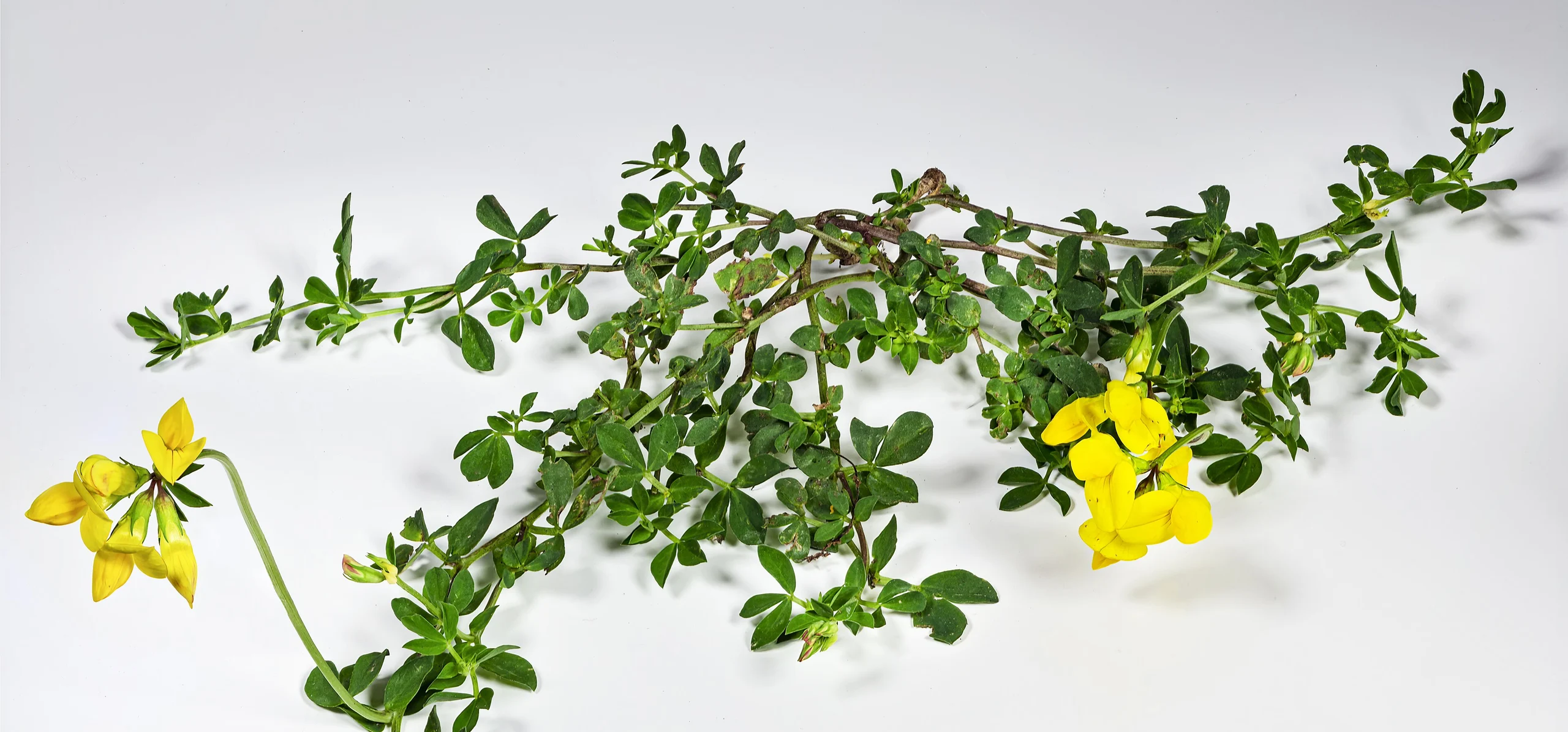
Bird's-foot trefoil earns its two folk names from opposite ends of the plant. The flower heads open bright egg-yolk yellow from buds tinged red-orange, which is where "eggs and bacon" comes from, while the ripe seed pods splay out in twos and threes from the tip of the stalk into narrow brown claws that genuinely look like a small bird's foot. It is a low, sprawling perennial pea relative whose trailing stems root wherever they touch bare soil, so a single sowing spreads into a mat within a couple of seasons rather than staying a tidy clump. Whether that spreading habit reads as a wildflower meadow asset or a lawn nuisance depends entirely on where you are growing it and how you manage the mower.
What the "Bird's Foot" Really Looks Like
Each compound leaf carries three elliptic leaflets at its tip and two more, smaller stipule-like leaflets lower down the stalk, which is why the plant is also called trefoil despite effectively showing five leaflets per leaf. Flowering umbels of two to eight small, pea-shaped flowers, each 0.25 to 0.75 inches long, open bright yellow from clusters of red-tinged buds and keep coming from late spring into early autumn. The mature seed pods, up to an inch long, narrow and brown, radiate outward from the flower stalk in a splayed cluster, and it is that shape, several thin pods fanning out from one point, that gives the whole plant its common name.
Origin, Habitat and Global Spread
Plants of the World Online gives the native range of the accepted species Lotus corniculatus as temperate Eurasia, Macaronesia to northeast and east tropical Africa, and the southwest Arabian Peninsula, where it grows wild in grassy places, verges and rough pasture. It has since been carried far beyond that range, deliberately, as a forage crop and an erosion-control seeding for roadside banks, and Missouri Botanical Garden now lists it as an exotic invasive weed in parts of the United States, Canada and Australia. The same rooting, mat-forming stems that make it a durable groundcover at home are exactly what let it escape a planned seeding and colonise ground nobody meant it to reach.
Full Sun and Poor, Dry Soil
This is not a plant that rewards rich borders. The Royal Horticultural Society lists it as needing full sun and well-drained chalk, loam or sandy soil, tolerant of acid, neutral or alkaline pH, and specifically thriving in low-nitrogen ground rather than fertile beds. University of Maine Cooperative Extension records an even wider tolerance for pH between 3.5 and 9 and for low fertility and poor drainage, alongside genuine drought tolerance once a stand is established. Missouri Botanical Garden's own trial notes describe it as a tough, foot-traffic-tolerant groundcover for full sun, useful as a low-mow lawn alternative, between stepping stones or in a rock garden, precisely because it thrives on neglect that would kill a lawn grass.


Sowing in Autumn or Spring
University of Maine Cooperative Extension recommends sowing at 5 to 6 pounds of seed per acre alone, or around 5 pounds per acre in a grass mixture, timed for early spring around May or fall around September in a temperate climate. Fall sowing faces less competition from summer weeds but carries a higher risk of seedling loss over winter, while spring sowing establishes faster but needs weeding through its first season, since the extension service notes the seedling stage does poorly if shaded out by faster-growing weeds in its first one to four months. A clear seeding, without a nurse crop of oats or barley sown alongside it, gives the young trefoil the best chance of establishing before the first mowing.
Mowing and Managing It, in a Meadow, Lawn or Pasture
What counts as good management depends on the goal. In a hay or pasture stand, University of Maine Extension advises never cutting below 4 to 6 inches and timing the first cut for when the stand is about 30 percent in bloom, with a second cut in mid to late summer; grazed rotationally, plants are left to reach about 8 inches before turning animals in, then rested for 28 to 40 days to recover. In an ordinary lawn, the opposite approach controls it: Penn State Extension notes that infestations thrive in low-maintenance turf kept at a high mowing height, and that improving turf density through fertilization and frequent, low mowing crowds it back out. Left entirely alone in a wildflower meadow, it is usually cut once, after seed has dropped in late summer, so this year's flowers become next year's seedlings.
Host Plant for the Common Blue and the Six-Spot Burnet
Beyond its own flowers, which the RHS lists as a good nectar source for bees, the foliage itself is food for insect larvae rather than just the adults. It is the principal caterpillar food plant of the common blue butterfly across its range, and one of the host plants used by the day-flying six-spot burnet moth, whose black-and-red caterpillars and adults are themselves distasteful to predators because they sequester the same class of cyanide-releasing compounds the plant produces in its own leaves. A meadow patch left unmown through summer is doing more work than it looks: it is feeding two very different insect life stages on the same chemistry that gives the trefoil its own modest defence against being eaten.
A Non-Bloating Forage Crop, and a Naturalized Weed, in North America
In North American pasture systems, birdsfoot trefoil has a specific agronomic reputation: unlike alfalfa or clover, it does not cause bloat in grazing cattle or sheep. University of Maine Cooperative Extension attributes this to condensed tannins in the foliage, compounds that bind proteins in a way that stops the rumen foaming that causes bloat in the first place, and notes that a well-managed stand can persist in a pasture for fifty years or more. That same durability, plus deliberate seeding along highway banks for erosion control, is how it moved from a forage crop into a naturalized, sometimes weedy plant far outside its native range, and Missouri Botanical Garden's own cultivation notes for the species warn that it "may not be suitable to plant in your garden" depending on where you live.
Cyanogenic Glycosides and Pet Safety
Bird's-foot trefoil is not currently listed by the ASPCA in its toxic or non-toxic plant database, for cats, dogs or horses. That is not the same as a clean bill of health: the foliage is documented in plant chemistry research to contain cyanogenic glycosides, compounds that release small amounts of cyanide when the leaf tissue is damaged, though the levels vary between individual plants and are low enough that the species is grazed as forage worldwide without routine poisoning. Treat it the way you would any wild legume around pets, fine as an incidental nibble in a meadow, not something to actively encourage a dog or cat to chew on in quantity, and keep an eye on grazing livestock during any drought stress, which is when cyanogenic compounds tend to concentrate in many forage plants.
Test your plant knowledge
Tap a card to flip it and reveal the answer.
Bird's-foot trefoil causes bloat in grazing cattle and sheep, the way alfalfa and clover often do. Tap to reveal ✕ False
The plant's common name comes from the shape of its ripe seed pods, which fan out from the flower stalk in narrow claws. Tap to reveal ✓ True
The ASPCA currently lists bird's-foot trefoil as toxic to cats, dogs and horses. Tap to reveal ✕ False
Bird's-foot trefoil prefers rich, fertile, heavily fed soil to grow well. Tap to reveal ✕ False
In parts of the United States, Missouri Botanical Garden lists this species as an exotic invasive weed. Tap to reveal ✓ True
Sources
References consulted for this guide
- Lotus corniculatus L., GBIF Backbone Taxonomygbif.org
- POWO: Lotus corniculatus L.powo.science.kew.org
- Lotus corniculatus (bird's foot trefoil), RHS Gardeningrhs.org.uk
- Lotus corniculatus 'Pleniflorus', Missouri Botanical Garden Plant Findermissouribotanicalgarden.org
- Maine Forage Facts: Birdsfoot Trefoil, University of Maine Cooperative Extensionextension.umaine.edu
- Reference entity : Wikipédiaen.wikipedia.org