Common Blue Violet
Viola sororia
Family · Violaceae
Viola sororia spreads fast by rhizome and self-seeding. How to identify common blue violet, grow it in shade beds, and manage it as a lawn weed.
Viola sororia
Plant profile
- WateringModerateWater every 5 days
- Light exposurePartial shade
- Hardiness zoneUSDA 3–7
Growth
- Family
- Violaceae
- Life cycle
- Perennial
- Growth speed
- 6/10
- Mature size
- 15–25 cm
- Spread
- 15–25 cm
- Flowering
- February to May, plus hidden self-pollinating flowers in summer
- Propagation
- Seed
DormancyHerbaceous; dies back in cold winters, regrows from rhizomes
Soil & climate
- Soil types
- clay, loam, sand, high organic matter
- Drought tolerance
- No
Light & Placement
- Origin
- Central & E. Canada to E. Mexico
- Where to place it
- Woodland edge
- Shrub border, part shade
- Lawn or meadow edge
Safety
- Toxicity
- HumansSafe
Invasive speciesAggressive self-seeder that also spreads by rhizome; considered a persistent, hard-to-eradicate lawn weed in parts of North America despite being a low-maintenance groundcover in beds
Data fromGBIF: Viola sororia Willd.POWO (Kew): Viola sororia Willd.NC State Extension Gardener Plant ToolboUniversity of Illinois Extension: ManagiUniversity of Illinois Extension, HortAn
Where it grows
World distribution
Common Blue Violet is native to 3 countries: Canada, Mexico, and United States.GBIF records 21,970 documented identifications across 26 countries, with the largest concentrations in United States, Canada, and Netherlands.
- Canada
- Mexico
- United States
Yellow to orange dots: concentration of documented identifications per country. Green countries: sourced native range. Source: GBIFNative range from POWO (Kew).
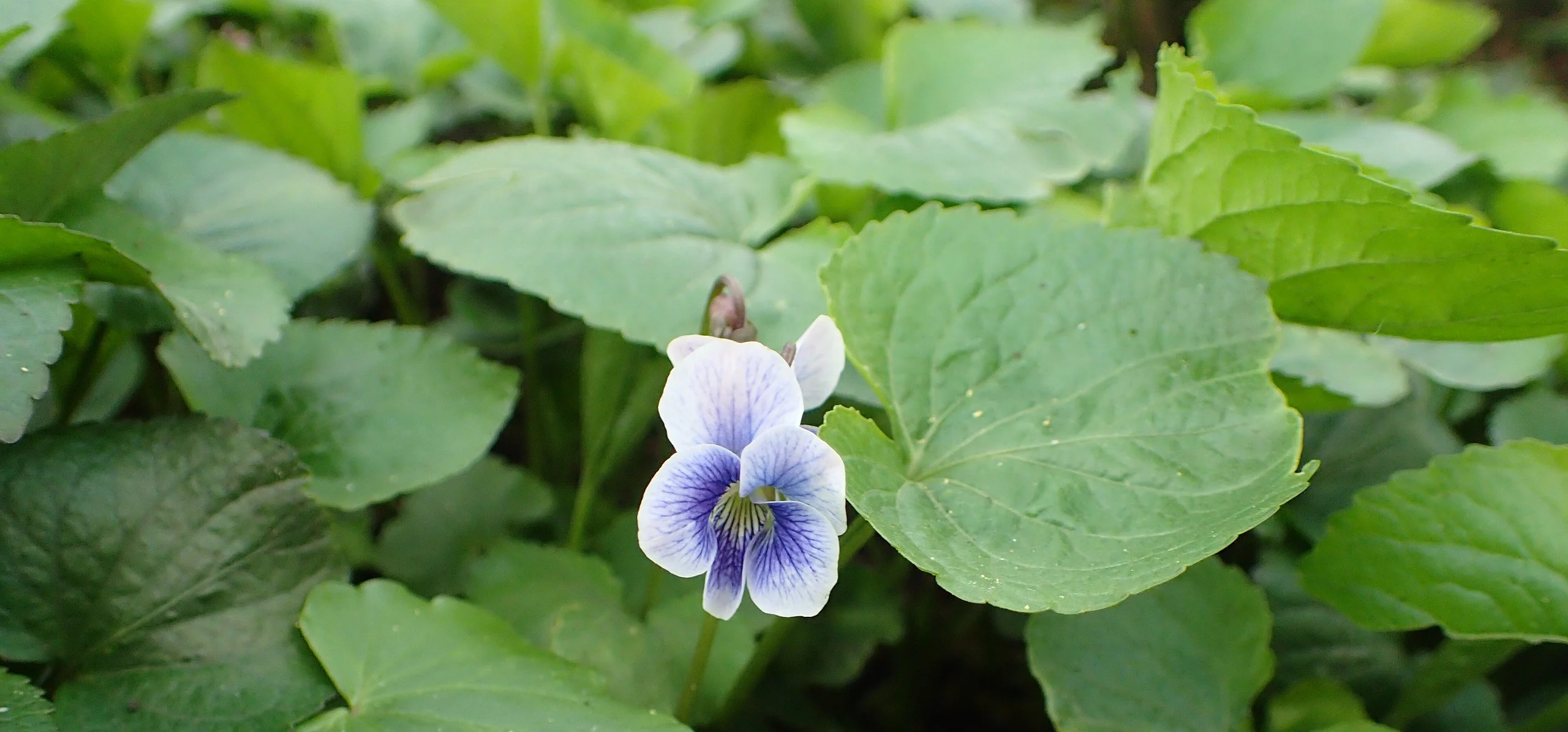
The low rosette of glossy, heart-shaped leaves topped by a single nodding, deep blue-violet flower on its own leafless stalk is almost certainly the common blue violet, Viola sororia, native to eastern and central North America. It asks for almost nothing: soil that stays lightly moist and anything from partial shade to full sun will keep it flowering from February into May, and it keeps going after that on its own, spreading by rhizome and by seed whether anyone planted it there or not. That same vigor is why this one plant turns up in two very different conversations: as a shade groundcover gardeners deliberately grow, and as the violet a homeowner is trying to get out of the lawn. The notes below cover both.
Identifying the common blue violet
Leaves are basal, heart-shaped with a scalloped, toothed edge, 3 to 6 inches long and wide, yellowish green and slightly glossy on top with fine hairs underneath. Each flower sits alone atop its own leafless stalk rather than in a cluster, and the five petals are unequal in size, a shape botanists call zygomorphic: two upper petals, two side petals with a small tuft of hairs at the base, and a lower petal marked with dark violet veins that guide pollinators toward the nectar. Flower color runs from deep blue-violet to nearly white, under an inch across. A naturally occurring white form with a purple center is sold and grown separately as the Confederate violet, but it is the same species, not a different plant.
Native range and where it grows wild
Viola sororia's native range runs from central and eastern Canada south to eastern Mexico, and it is common throughout the eastern and central United States. In the wild it favors woods, thickets, and streambanks, generally in the shadier, moister parts of a site rather than open ground. It is common enough in its native range to have been named Illinois's official state wildflower.
Two kinds of flowers, and why that matters
The showy blue-violet flowers that open in spring are only half the story. Through summer, the plant also produces cleistogamous flowers: small, closed buds low in the foliage that never open and pollinate themselves internally. These hidden flowers are typically more productive than the spring blooms, and they are what let a single plant set seed reliably even in a season with few pollinators, or a cold, wet spring that keeps bees away. If a violet patch seems to expand every year despite modest, unremarkable spring flowering, this is usually why.


Light, soil, and moisture
This violet tolerates a wide range of light, from full sun to deep shade, but performs best with adequate moisture; in dry, sunny spots it stalls and looks tired by midsummer. It grows in clay, loam, or sandy soil as long as organic matter is present and drainage is reasonable, and it tolerates acidic, neutral, or alkaline soil without complaint, so pH is rarely the limiting factor. Consistently moist, humus-rich ground, the kind found at a woodland edge or under a deciduous shrub, is what it actually prefers. It is hardy in USDA zones 3a to 7b.
Propagation
Seed is the propagation method extension sources recommend, and in practice a gardener will rarely need to sow any on purpose: an established plant self-seeds freely, which is exactly how a single clump becomes a spreading patch within a few seasons. Rhizomes extend the colony further still, so a bed of common blue violet needs no help expanding once it is established.
Pests, diseases, and what actually goes wrong
Slugs, snails, aphids, spider mites, and violet gall midge are the pests most often reported on this species. Powdery mildew and pansy leaf spot are the two diseases that show up most, usually in humid weather or crowded plantings with poor air movement. The more common problems, though, are cultural: drought stress in a plant that prefers even moisture, and edema, a waterlogging injury that shows up as corky, blistered patches on the leaves when soil stays saturated too long.
Wildlife value and edible uses
Common blue violet is a larval host plant for fritillary butterflies, and its nectar draws butterflies, bees, and specialist Andrena mining bees that visit violets specifically. Birds and small mammals eat the seed. It is also deer resistant, part of why it persists in shade gardens that lose most other groundcover to browsing. The young leaves are eaten raw in salads or cooked as greens, and the flowers are used fresh in salads or desserts; this is a food-use note from extension sources, not toxicity data, and it says nothing about whether the plant is safe for cats, dogs, or horses.
Managing it as a lawn weed
The traits that make this violet an easy, self-sufficient groundcover are the same ones that make it stubborn in turf. Fleshy rhizomes store enough energy to resprout after mowing or shallow pulling, and a waxy leaf cuticle sheds many contact herbicides before they can be absorbed. Extension turf programs recommend competitive, well-fed turf as the first line of defense: mowing high and often crowds the violet out before it can spread. Where hand-pulling is used, the entire root and rhizome has to come out, or the plant regrows from what is left behind. Postemergence broadleaf herbicides containing triclopyr give the best chemical control, applied from mid-spring to early summer or again in mid to late fall when the plant is moving nutrients into its rhizomes; a single application rarely finishes the job, and most guidance expects repeat treatment across more than one season.
Test your plant knowledge
Tap a card to flip it and reveal the answer.
Common blue violet produces two distinct types of flowers over a single growing season. Tap to reveal ✓ True
This violet spreads only by seed and never by rhizome. Tap to reveal ✕ False
It tolerates everything from full sun to deep shade, as long as the soil stays reasonably moist. Tap to reveal ✓ True
Triclopyr-based herbicides are considered largely ineffective against this species. Tap to reveal ✕ False
The young leaves and flowers of this violet are used as human food in some recipes. Tap to reveal ✓ True
Sources
References consulted for this guide
- GBIF: Viola sororia Willd.gbif.org
- POWO (Kew): Viola sororia Willd.powo.science.kew.org
- NC State Extension Gardener Plant Toolbox: Common Blue Violetplants.ces.ncsu.edu
- University of Illinois Extension: Managing Violetsextension.illinois.edu
- University of Illinois Extension, HortAnswers: Common Blue Violetweb.extension.illinois.edu
- Reference entity : Wikipédiaen.wikipedia.org