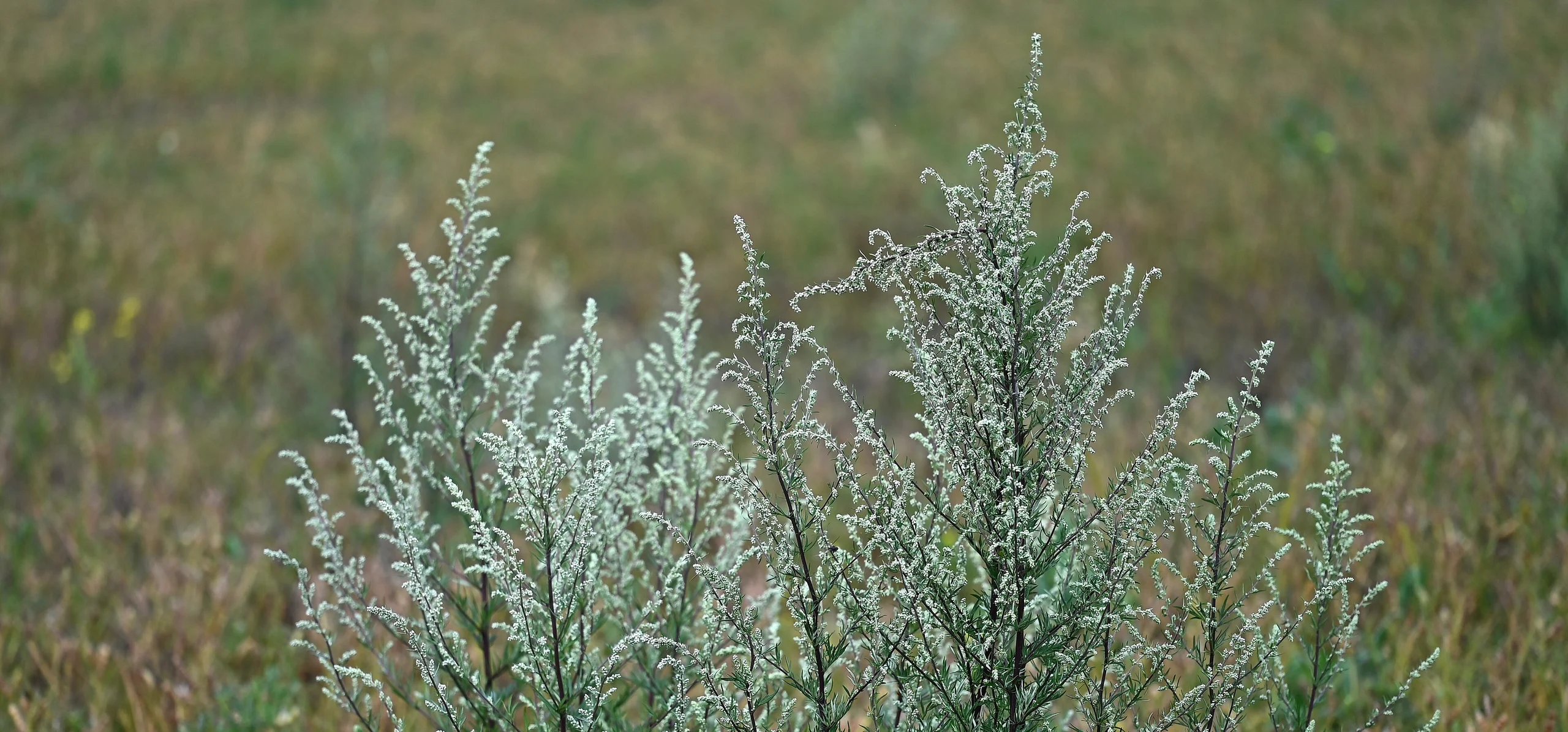
Common Mugwort
Artemisia vulgaris
Family · Asteraceae
Mugwort spreads by rhizome, resists tilling, and drives late-summer hay fever. How to tell it apart from ragweed, remove a patch, or grow it contained.
Artemisia vulgaris
Plant profile
- WateringLittleWater every 10 days
- Light exposurePartial sun
Growth
- Family
- Asteraceae
- Life cycle
- Perennial
- Growth speed
- 8/10
- Mature size
- 61–183 cm
- Spread
- 61–183 cm
- Propagation
- Division
- Seed
FloweringSmall greenish-yellow disk flowers from midsummer into early fall; grown for foliage, not for its flowers
DormancyDies back to the rootstock in winter; regrows from persistent rhizomes each spring
Time to maturityFlowers from midsummer into early fall once established
Soil & climate
- Soil types
- disturbed soil, poor soil, moderately dry to medium-moisture soil
- Drought tolerance
- Yes
Light & Placement
- Where to place it
- Disturbed ground and roadsides
- Neglected garden edges
- Contained bed with a rhizome barrier
- Large barrier-lined container with no low gaps for roots to escape
OriginNative to temperate Eurasia, Indo-China and North Africa (POWO); naturalized across much of Europe, northern Asia and North America
Safety
- Toxicity
- HumansToxic
Invasive speciesWeedy and invasive in disturbed sites across its naturalized North American range; spreads aggressively by rhizome
Data fromGBIF: Artemisia vulgaris L.Plants of the World Online (Kew): ArtemiMissouri Botanical Garden Plant Finder: NC State Extension: Mugwort or ChrysanthUniversity of Maryland Extension: Mugwor
Where it grows
World distribution
Common Mugwort is native to 44 countries: Afghanistan, Albania, Algeria, Austria, Belarus, Belgium, Bulgaria, and China….GBIF records 880,777 documented identifications across 115 countries, with the largest concentrations in France, United Kingdom, and Sweden.
- Afghanistan
- Albania
- Algeria
- Austria
- Belarus
- Belgium
- Bulgaria
- China
- Croatia
- Czechia
- Denmark
- Estonia
Show 32 more countriesShow fewer countries
- Finland
- France
- Georgia
- Germany
- Greece
- Hungary
- India
- Iran
- Iraq
- Italy
- Japan
- Kazakhstan
- Kyrgyzstan
- Laos
- Mongolia
- Myanmar (Burma)
- Netherlands
- Norway
- Pakistan
- Poland
- Portugal
- Romania
- Russia
- Spain
- Sweden
- Switzerland
- Tajikistan
- Thailand
- Tunisia
- Türkiye
- Ukraine
- Uzbekistan
Yellow to orange dots: concentration of documented identifications per country. Green countries: sourced native range. Source: GBIFNative range from POWO (Kew).
A vigorous weed with deeply cut, chrysanthemum-scented leaves that are green on top and coated in dense white hairs underneath, spreading through a bed or lawn edge faster than anything nearby, is almost certainly Artemisia vulgaris, common mugwort. It is a rhizomatous perennial, not an annual like its most common lookalike, ragweed, and it keeps coming back from root fragments even after the top growth is pulled or mown. Its pollen is a well-documented cause of hay fever wherever the plant grows in quantity, which makes correct identification more than an academic exercise. The rest of this guide covers how to tell it apart from ragweed, why it is so hard to eradicate once established, and how to keep a patch contained deliberately if you want to grow it for its traditional herbal use.
Origin and Where It Grows Now
Plants of the World Online (Kew) records the native range of Artemisia vulgaris as temperate Eurasia through Indo-China and North Africa, and the Missouri Botanical Garden describes it as native to and widespread across Europe and northern Asia, from Russia to Japan and Korea. European settlers introduced it to North America as a medicinal herb starting in the early 1600s, and it has since naturalized across southern Canada, the eastern and Midwestern United States from Maine to Minnesota south to Florida and Louisiana, and the Pacific Northwest in Washington, Oregon, Idaho and western Montana. It favors disturbed ground: roadside verges, construction fill, neglected beds and lawn edges are where it establishes fastest.
Identifying Mugwort
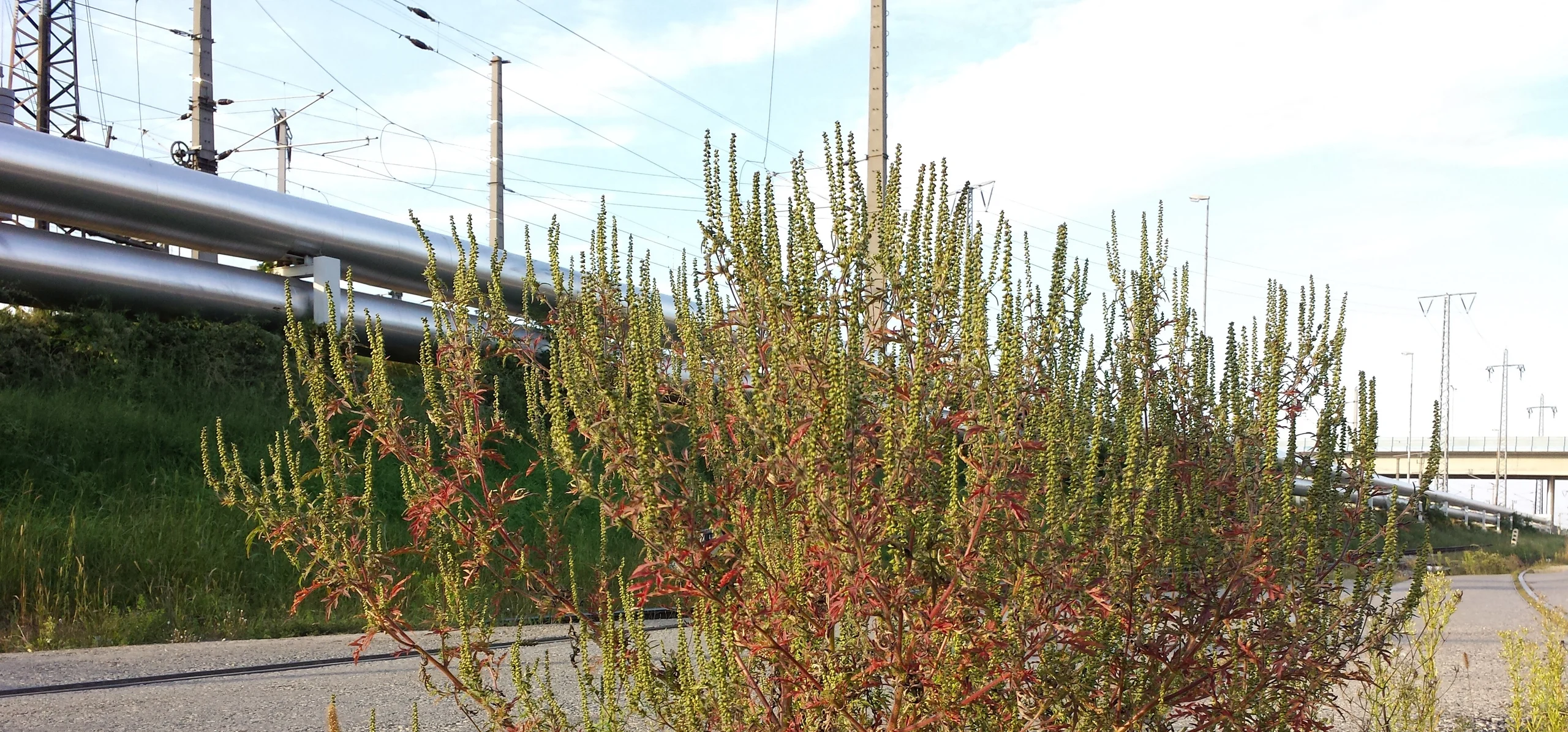
Look at the underside of the leaf first: mugwort's deeply lobed, pinnate leaves are green on the upper surface and covered in dense white to gray hairs underneath, which is the single most reliable field mark. Stems are purplish brown, branched, and lightly hairy, and the whole plant carries a chrysanthemum or sage-like scent when crushed. Plants typically reach 2 to 4 feet tall, occasionally to 6 feet under good conditions, and spread outward through rhizomes to form patches 6 feet wide or wider. Flowers are small and inconspicuous: greenish-yellow disk heads only a few millimetres across, clustered at the tops of the stems from midsummer into early fall. They carry no petals and are not something anyone grows mugwort for.
Mugwort vs Ragweed and Other Lookalikes
Ragweed, Ambrosia artemisiifolia, is the plant most often mistaken for mugwort, since both have finely divided, fern-like foliage and both produce wind-pollinated flowers that cause hay fever. The leaf underside settles it: ragweed is green on both sides, while mugwort's underside is unmistakably white-haired. Growth habit is the second clue. Ragweed is a true annual that dies at the first hard frost and returns only from seed, while mugwort is a rhizomatous perennial that survives winter underground and regrows from the same root system every spring, spreading wider each year. Garden chrysanthemums can look similar in leaf shape from a distance but lack both the white-haired underside and the aggressive spreading habit.


Why the Pollen Is a Problem
Mugwort pollen is a well-documented cause of allergic rhinitis and hay fever wherever the plant grows in quantity, and its flowering window overlaps with ragweed's, from midsummer into early fall, which is part of why the two plants get confused by people trying to work out what is triggering their symptoms. Because mugwort spreads clonally and can dominate a neglected corner of a property within a couple of seasons, a patch left unchecked near a garden or a patio adds a second source of pollen on top of any wild ragweed already nearby. Removing flowering stems before the greenish disk heads open is the only way to cut that contribution from your own property.
Why Tilling and Casual Pulling Make It Worse
The rhizomes are the whole problem: University of Maryland Extension and NC State Extension both note that mugwort reproduces readily from small fragments of its extensive root system, so tilling, rototilling, or even careless hand-pulling that snaps roots and leaves pieces behind can turn one patch into a dozen. Seed production is comparatively rare and unreliable by comparison, so the practical fight is almost entirely about the rhizome network below ground, not about seedlings.
Removing an Established Patch
Mowing works, but only with the right timing: NC State Extension recommends cutting from early summer through mid-September, with the first two weeks of September being the most effective window, since seed that is cut before it matures will not go on to germinate. Hand-pulling is only worth attempting on very young plants in spring or early summer, before rhizomes have formed, and every root fragment left in the soil needs to be treated as a new plant waiting to happen. For an established patch, smothering with black plastic or overlapping layers of cardboard or newspaper topped with mulch, sustained for a full growing season, exhausts the rhizome network without scattering fragments the way tilling does. Where herbicide is used, University of Maryland Extension and NC State Extension both point to glyphosate applied in late summer or early fall as effective, though the dense hairs coating the leaf surface slow herbicide penetration and often mean a repeat application is needed.
Growing Mugwort Deliberately in a Contained Bed
Mugwort's common name comes from its historical use flavoring beer before hops became standard, and it has a long history as a garden herb grown for its foliage and traditional use rather than for its flowers. Anyone growing it on purpose needs to treat the rhizome the way they would treat mint or bamboo: a solid physical barrier sunk well into the soil, or cultivation in a large container with no low gaps for roots to escape through, is what actually contains it, since surface mulch or a shallow edging border will not stop rhizomes running underneath. The Missouri Botanical Garden notes the leaves are technically edible but bitter, and become toxic if eaten in quantity, so this is a plant grown for its foliage and scent in a controlled bed, not a casual edible green.
Common Mistakes
The most common mistake is tilling a patch to get rid of it, which chops the rhizome network into dozens of viable fragments and turns a single patch into a spreading infestation the following year. The second is mistaking it for ragweed or the reverse based on leaf shape alone, without checking the white-haired underside that separates the two. The third is planting it directly in open ground without a rhizome barrier because the current clump looks manageable; by the second season it is usually pushing into neighboring beds. The fourth is a single mow or pull and calling the job done: because control depends on exhausting an underground root system rather than a one-time cut, follow-through over a full season, and often a second season, is what actually clears an established patch.
Test your plant knowledge
Tap a card to flip it and reveal the answer.
Mugwort can be told apart from ragweed by checking the underside of the leaf. Tap to reveal ✓ True
Tilling an established mugwort patch is an effective way to remove it. Tap to reveal ✕ False
Mugwort is a true annual that dies each year and returns only from seed. Tap to reveal ✕ False
The ASPCA lists mugwort as toxic to cats and dogs. Tap to reveal ✕ False
Mugwort spreads mainly through underground rhizomes rather than seed. Tap to reveal ✓ True
Sources
References consulted for this guide
- GBIF: Artemisia vulgaris L.gbif.org
- Plants of the World Online (Kew): Artemisia vulgarispowo.science.kew.org
- Missouri Botanical Garden Plant Finder: Artemisia vulgarismissouribotanicalgarden.org
- NC State Extension: Mugwort or Chrysanthemum Weed (Artemisia vulgaris)content.ces.ncsu.edu
- University of Maryland Extension: Mugwortextension.umd.edu
- Reference entity : Wikipédiaen.wikipedia.org