Spider Plant
Chlorophytum comosum
Family · Asparagaceae
How to grow Chlorophytum comosum: why it needs shade from direct sun, what actually causes brown tips, and the exact light cycle that triggers plantlets.
Chlorophytum comosum
Plant profile
- WateringModerateWater every 7 days
- Light exposurePartial shade
- Hardiness zoneUSDA 9–11
Growth
- Family
- Asparagaceae
- Life cycle
- Perennial
- Growth speed
- 5/10
- Mature size
- 30–45 cm
- Spread
- 30–60 cm
- Propagation
- Seed
- Division
- Offsets
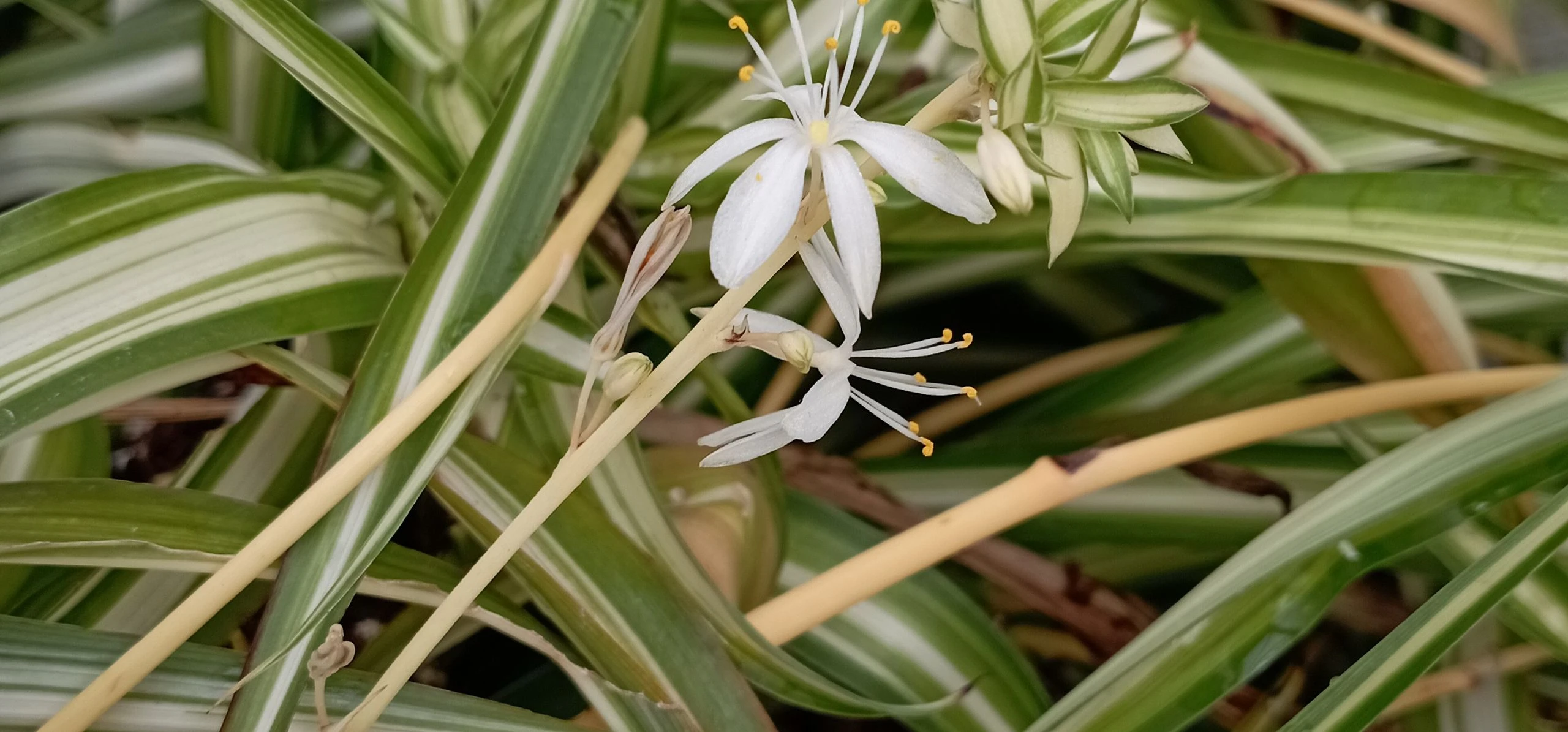
FloweringSmall white six-petaled star-shaped flowers under an inch wide, spring through winter (NC State Extension)
Time to maturityReaches mature size in about 5 to 10 years (RHS)
Soil & climate
- Soil pH
- pH 6–8
- Soil types
- loam, sand
- Drought tolerance
- Yes
Light & Placement
- Where to place it
- North- or east-facing shelf
- Bright room away from direct sun
- Hanging basket
- Shaded bed or patio in USDA zones 9 to 11
- Wide pot with drainage holes
OriginTropical West Africa to Cameroon, and Ethiopia to South Africa (POWO; NC State Extension)
Safety
- Toxicity
- CatsSafe
- DogsSafe
- HorsesSafe
Data fromChlorophytum comosum (Thunb.) Jacques, GChlorophytum comosum, Plants of the WorlRHS: Chlorophytum comosum (spider plant)ASPCA: Toxic and Non-toxic Plants, SpideNC State Extension Gardener Plant Toolbo
Where it grows
World distribution
Spider Plant is native to 19 countries: Burundi, Cameroon, Côte d’Ivoire, Equatorial Guinea, Eswatini, Ethiopia, Kenya, and Liberia….GBIF records 3,957 documented identifications across 86 countries, with the largest concentrations in Australia, Portugal, and South Africa.
- Burundi
- Cameroon
- Côte d’Ivoire
- Equatorial Guinea
- Eswatini
- Ethiopia
- Kenya
- Liberia
- Malawi
- Mozambique
- Nigeria
- São Tomé & Príncipe
Show 7 more countriesShow fewer countries
- Sierra Leone
- South Africa
- Sudan
- Tanzania
- Uganda
- Zambia
- Zimbabwe
Yellow to orange dots: concentration of documented identifications per country. Green countries: sourced native range. Source: GBIFNative range from POWO (Kew).
A Perennial from Tropical and Southern Africa
Narrow, grass-like leaves striped white or cream, arching out of the pot with baby plantlets dangling from long wiry stems, almost always mean Chlorophytum comosum, the spider plant. GBIF records the accepted name as Chlorophytum comosum (Thunb.) Jacques, placed in the asparagus family Asparagaceae rather than among true grasses. NC State Extension lists its native range as tropical West Africa to Cameroon and Ethiopia south to South Africa, a range POWO confirms as West Tropical Africa to Cameroon, Ethiopia to South Africa. That broad native band, spanning forest shade and more open ground, explains why the plant copes with such a wide spread of indoor conditions, and why the plantlets it throws out are a normal part of its life cycle rather than a stress response.
Light: Medium and Indirect, Never Full Sun
NC State Extension describes the spider plant as preferring medium light levels, tolerant of deep shade, and explicitly intolerant of direct sunlight, dappled light or fewer than two hours of direct sun a day suits it well. Strong summer sun through an unshaded window bleaches the green out of the leaves and scorches the white or cream stripes on variegated forms. A north or east facing windowsill, or a spot set back from a brighter south facing one, keeps the foliage healthy without any risk of scorch, which is also why this plant does so well under nothing but office fluorescent tubes.


Watering and the Classic Brown Tip Problem
NC State Extension's own instruction is to keep the soil evenly moist through the growing season and reduce watering in winter, letting the surface dry slightly between waterings rather than keeping it constantly wet. The thick, fleshy, tuberous roots store water, so the plant shrugs off a missed watering far more easily than it survives a pot left standing in water, which invites root rot. The single most common complaint with this species is brown leaf tips, and NC State Extension is specific about the cause: chlorine and fluoride in ordinary tap water build up in the leaf tissue and burn the tips brown over time. Switching to distilled water, rainwater, or tap water left to stand overnight, removes the problem at its source instead of just trimming away the damage.
Soil, Feeding and the Root Bound Habit
A loam based potting mix with good drainage suits it, and NC State Extension records a neutral soil pH of roughly 6.0 to 8.0 as the comfortable range. Feed sparingly during the growing season: overfeeding is one of the few genuine mistakes to make with this plant, since NC State Extension notes that too much fertiliser reduces plantlet formation, exactly the trait most growers want more of, not less. The fleshy, water storing roots grow fast and thick, and RHS recommends repotting and dividing every two to three years, or simply replacing an old, congested plant with one of its own young plantlets instead of fighting an overgrown root ball.
Propagation: the Plantlets Are the Whole Point
NC State Extension records an unusually precise trigger behind the babies that make this plant famous: stolons and plantlets develop once the parent receives short days and long, uninterrupted nights, under twelve hours of light a day, for at least three weeks running. That is why flowering and plantlet production tend to follow the shorter days of autumn and winter rather than appearing on demand under long summer light or grow lights left on too late. Each plantlet already carries tiny aerial roots and can be rooted two ways: leave it attached to the parent stem and rest it on moist soil until it roots before cutting it free, or snip it off outright and root it in water or straight into soil. Either method reliably produces a new plant within a few weeks, which is what makes this one of the easiest common houseplants to multiply for free.
Flowers and the Short List of Pests
Small white, six petaled, star shaped flowers under an inch wide open in loose panicles along the flowering stems; NC State Extension records blooming from spring through winter, with plantlets forming at the very same nodes once the flowers fade. Pest and disease pressure stays genuinely light for this species: NC State Extension lists no significant pest problems, and RHS notes it is generally disease free and, at most, occasionally susceptible to scale insects. The more common way to lose one is neglecting the roots, letting the pot sit in standing water until rot sets in, rather than any pest arriving from outside.
Is the Spider Plant Safe Around Pets?
Yes. The ASPCA's Spider Plant entry for Chlorophytum comosum lists it as non-toxic to cats, dogs and horses, one of a fairly short list of common houseplants that clears all three. NC State Extension confirms the same non-toxic status. That does not make unlimited chewing harmless: a cat that regularly eats large amounts of any plant material, spider plant included, can still end up with a mildly upset stomach from the fibre alone, so a hanging basket kept out of easy reach still protects the leaves even where it is not protecting the cat from anything toxic.
Common Mistakes
The most common misstep is direct sun on a plant NC State Extension explicitly calls intolerant of it: moved to a bare, unshaded south facing sill, a spider plant bleaches and scorches within days. The second is watering straight from the tap in an area with heavily treated or fluoridated supply, the single most cited cause of the brown tips that make so many otherwise well kept spider plants look tired. The third is expecting babies on demand: without the short, uninterrupted dark nights NC State Extension describes as the actual trigger, a spider plant kept under long artificial light all year can grow lush and still never flower or produce a single plantlet.
Test your plant knowledge
Tap a card to flip it and reveal the answer.
Spider plant babies (plantlets) form only after the parent gets short days and long, unbroken dark nights. Tap to reveal ✓ True
Chlorophytum comosum grows best in full, direct sunlight for most of the day. Tap to reveal ✕ False
Brown leaf tips on a spider plant are usually caused by chlorine or fluoride in tap water. Tap to reveal ✓ True
The ASPCA lists the spider plant as toxic to cats, dogs and horses. Tap to reveal ✕ False
Overfeeding a spider plant can reduce how many plantlets it produces. Tap to reveal ✓ True
Sources
References consulted for this guide
- Chlorophytum comosum (Thunb.) Jacques, GBIF Backbone Taxonomygbif.org
- Chlorophytum comosum, Plants of the World Online, Kew Sciencepowo.science.kew.org
- RHS: Chlorophytum comosum (spider plant)rhs.org.uk
- ASPCA: Toxic and Non-toxic Plants, Spider Plantaspca.org
- NC State Extension Gardener Plant Toolbox: Chlorophytum comosumplants.ces.ncsu.edu
- Reference entity : Wikipédiaen.wikipedia.org