Spear Thistle
Cirsium vulgare
Family · Asteraceae
Spear thistle grows a spiny rosette for a year, then bolts on a winged stem before seeding once and dying, the taproot stage where it is easiest to remove.
Cirsium vulgare
Plant profile
- WateringLittleWater every 10 days
- Light exposureFull sun
Growth
- Family
- Asteraceae
- Life cycle
- Biennial
- Growth speed
- 7/10
- Mature size
- 60–150 cm
- Propagation
- Seed
FloweringEgg-shaped, pinkish-purple heads about 1.5-2 in (4-5 cm) across, summer of the second year
DormancyOverwinters as a flat, low rosette after first-season germination
Time to maturityBolts and flowers once in its second year, generally over summer, then dies after seeding
Soil & climate
- Soil types
- disturbed, compacted, poor, pasture
- Drought tolerance
- Yes
Light & Placement
- Origin
- Europe to Siberia, the Arabian Peninsula and northwest Africa (naturalized worldwide)
- Where to place it
- pasture
- roadside verge
- disturbed or waste ground
- field margin
Safety
- Toxicity
- Not listed by the ASPCA; spines are a mechanical hazard rather than a chemical toxin
- Pet safe
- Yes
Invasive speciesNamed an injurious weed under the UK's Weeds Act 1959 and classed as a noxious weed in many US states; NC State Extension recommends a native thistle instead where cultivation is the goal.
Data fromGBIF: Cirsium vulgare (Savi) Ten.POWO: Cirsium vulgare (Savi) Ten.RHS: Cirsium vulgare (spear thistle)Penn State Extension: Bull Thistle IdentNC State Extension Gardener Plant Toolbo
Where it grows
World distribution
Spear Thistle is native to 47 countries: Afghanistan, Albania, Algeria, Austria, Belarus, Belgium, Bulgaria, and China….GBIF records 1,247,501 documented identifications across 108 countries, with the largest concentrations in United Kingdom, France, and Netherlands.
- Afghanistan
- Albania
- Algeria
- Austria
- Belarus
- Belgium
- Bulgaria
- China
- Croatia
- Cyprus
- Czechia
- Denmark
Show 35 more countriesShow fewer countries
- Estonia
- Finland
- France
- Georgia
- Germany
- Greece
- Hungary
- India
- Iran
- Iraq
- Ireland
- Italy
- Kazakhstan
- Kyrgyzstan
- Lebanon
- Morocco
- Netherlands
- Norway
- Pakistan
- Poland
- Portugal
- Romania
- Russia
- Saudi Arabia
- Spain
- Sweden
- Switzerland
- Tajikistan
- Tunisia
- Türkiye
- Turkmenistan
- Ukraine
- United Kingdom
- Uzbekistan
- Yemen
Yellow to orange dots: concentration of documented identifications per country. Green countries: sourced native range. Source: GBIFNative range from POWO (Kew).
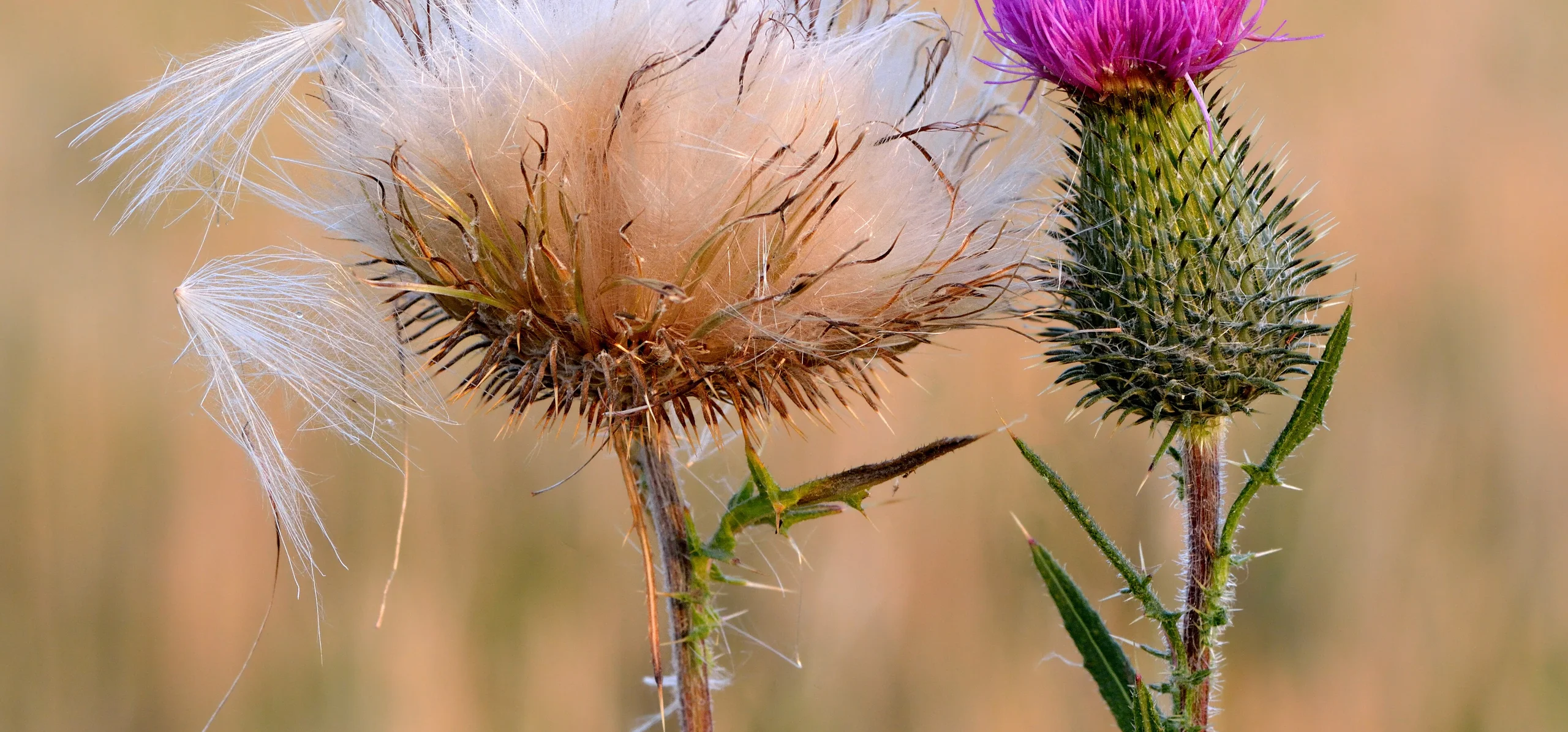
A rosette of deeply lobed, yellow-spined leaves that bolts a year later into a branched, spiny-winged stem topped with egg-shaped purple flower heads is Cirsium vulgare, the spear thistle. It is a biennial built around a single fleshy taproot, not the creeping, rhizome-spreading Cirsium arvense that shares the same pastures and is far harder to remove. Left alone it flowers once, sets seed, and dies, which is also its single point of weakness: stop it from seeding for two years running and a patch disappears on its own without any digging at all. Everything below follows from that one fact.
A Taproot and a Two-Year Clock, Not a Spreading Perennial
The two thistles gardeners confuse are built on opposite root systems. Penn State Extension notes that the spear thistle rosette produces a taproot, and that removing that root means going as deep as necessary to take it out whole. Cirsium arvense, by contrast, runs on a trailing rhizome network that can travel meters underground and resprout from any fragment left behind, which is why creeping thistle survives being dug and spear thistle generally does not. Spear thistle spends its entire first season as a flat rosette pressed to the ground, overwinters in that stage, then commits everything to one flowering stem the following summer. Penn State's guidance is blunt about the payoff: once that stem is cut before it sets seed, the plant has no rhizome to fall back on and the individual dies without producing a replacement.
Reading the Winged, Spiny Stem and the Purple Heads
The stem is the fastest field check. NC State Extension's plant profile describes bull thistle reaching roughly 2 to 5 feet tall, with spiny wings running down the stem below each leaf attachment, a texture Cirsium arvense's smooth, unwinged stem never shows. The flower heads themselves are egg-shaped and bristling with narrow spine-tipped bracts, opening into a dense pinkish-purple tuft that NC State lists at about 1.5 to 2 inches across, usually solitary or in small clusters at the stem tips rather than the flatter, smaller clustered heads of creeping thistle. RHS growing notes add that the leaves are covered in fine pale hairs on the underside, giving the whole plant a slightly grey cast that is easy to spot in a paddock from a distance, well before the spines are close enough to matter.
An Injurious Weed in the UK, a Noxious One Across the US
Spear thistle carries an unusual amount of formal paperwork for a roadside weed. In the UK it is one of five species named an injurious weed under the Weeds Act 1959, alongside common ragwort, creeping thistle, and the two common docks, a designation that lets landowners be compelled to stop it seeding onto neighbouring farmland. RHS's own growing notes for the species describe how its large spiny rosettes and rapid seed spread make it a serious agricultural weed even where it is left to grow for its wildlife value in a wilder corner of a garden. NC State Extension's profile records the same pattern from the other side of the Atlantic, noting that the species is considered a noxious weed in many areas of the United States and is treated as invasive in North Carolina specifically, alongside a general recommendation to plant a native thistle instead where one is available.


Cutting Before the Seed Sets
Because the plant only reproduces from seed and only flowers once, timing a single cut correctly does more than any repeated mowing schedule. Penn State Extension recommends mowing or cutting the flowering stem down before the purple heads open into the fluffy white seed heads, since a stem cut in bud does not have time to recover and reflower before the season ends. Cut too late, after the heads have already gone to down, and the job backfires: the seed is often ripe enough to finish maturing on the severed stem, so the cut plant should be bagged and removed rather than left to dry where it fell. A single missed plant at the edge of a field can reseed the whole clearing for several years, since spear thistle seed does not need the multi-decade seed bank of some weeds to be a nuisance, it just needs one open, dry surface to land on.
Digging Out the Rosette
For scattered plants in a border or paddock corner, digging beats mowing because it removes the taproot before it can push up a flowering stem at all. Penn State's guidance is to go after the rosette stage specifically, cutting the taproot several inches below the soil line with a spade or dandelion fork rather than pulling, since a taproot snapped off partway down can still push up a new rosette from the remaining crown. The best window is late winter into early spring, while the rosette is still low, soft, and easy to see against bare ground, and well before the plant has committed enough energy to bolt. A rosette dug whole and left on the surface to dry out is no longer a threat; one left with even a few inches of root in the ground often is not finished yet.
What It Feeds: Goldfinches and Bees
The same spines that make spear thistle unwelcome in a pasture make it valuable a few weeks later in the flowering stage. NC State Extension describes it as a high-value nectar plant for bees and butterflies, with the oil-rich seeds an important food source for seed-eating birds once the heads go to down, the same seed and thistledown that goldfinches are well known for stripping out of ripe thistle heads to eat and to line their nests. A single uncut plant left to flower at the edge of a vegetable patch or field margin, rather than in the middle of it, can support a run of pollinator visits through summer and a feeding stop for finches in early autumn, which is the usual argument for leaving one or two plants standing in a rougher corner rather than clearing every rosette on sight.
Scotland's Borrowed Emblem
Spear thistle is generally accepted as the thistle behind Scotland's national emblem, a status recorded since the reign of King Alexander III in the 13th century and tied to a well-known legend: a barefoot Norse raider supposedly stepped on a thistle while creeping up on a sleeping Scottish camp, and his cry of pain gave the ambush away. Whether or not that particular story is literally true, the plant it points to grows commonly enough across Scotland's rough grassland and roadsides that it was an obvious choice for the job, spines and all. It is a useful reminder that the same plant a farmer is legally obliged to cut before it seeds is, a few miles away on a heraldic badge, being celebrated for exactly the trait that makes it a nuisance.
Test your plant knowledge
Tap a card to flip it and reveal the answer.
Spear thistle spreads mainly through underground rhizomes, the same way creeping thistle does. Tap to reveal ✕ False
A spear thistle stem cut down while still in bud generally will not have time to reflower before the plant dies. Tap to reveal ✓ True
In the UK, spear thistle is one of five species named an injurious weed under the Weeds Act 1959. Tap to reveal ✓ True
NC State Extension lists spear thistle as a low-value plant for pollinators and seed-eating birds. Tap to reveal ✕ False
Digging out a spear thistle rosette is most effective when the taproot is pulled by hand from the top. Tap to reveal ✕ False
Sources
References consulted for this guide
- GBIF: Cirsium vulgare (Savi) Ten.gbif.org
- POWO: Cirsium vulgare (Savi) Ten.powo.science.kew.org
- RHS: Cirsium vulgare (spear thistle)rhs.org.uk
- Penn State Extension: Bull Thistle Identification and Managementextension.psu.edu
- NC State Extension Gardener Plant Toolbox: Cirsium vulgareplants.ces.ncsu.edu
- Reference entity : Wikipédiaen.wikipedia.org