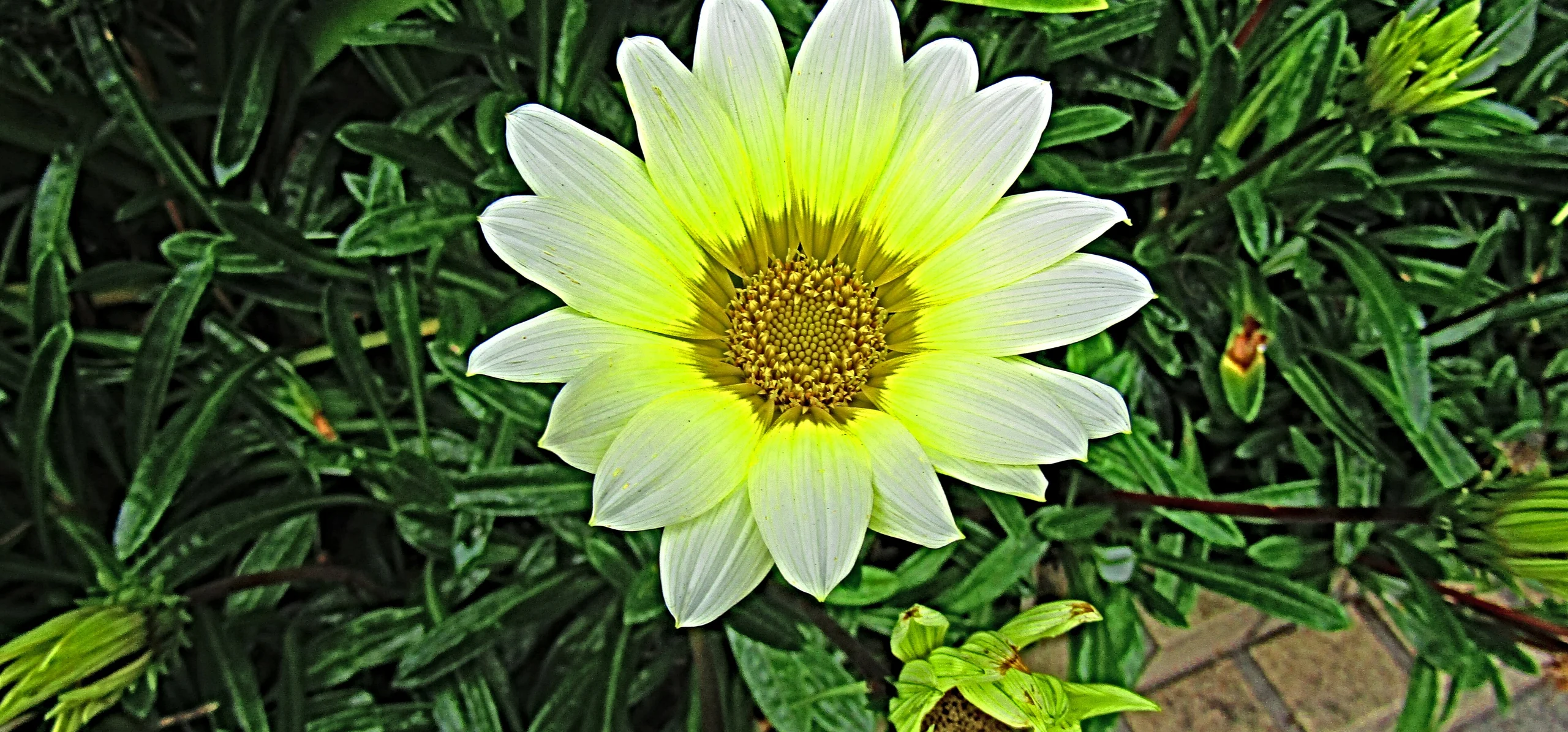
Treasure Flower
Gazania rigens
Family · Asteraceae
Gazania rigens closes its blooms in shade and at night, needs full sun and fast drainage, and self-seeds along mild coastlines from California to Australia.
Gazania rigens
Plant profile
- WateringLittleWater every 10 days
- Light exposureFull sun
- Ideal temperature1–35 °C
- Hardiness zoneUSDA 9–11
Growth
- Family
- Asteraceae
- Life cycle
- Perennial
- Growth speed
- 6/10
- Mature size
- 15–30 cm
- Spread
- 15–30 cm
- Flowering
- Spring through fall in mild climates; deadheading extends the display
- Propagation
- Seed
- Cutting
Dormancynone in frost-free climates; killed by frost where grown as an annual
Time to maturityreaches flowering size in its first growing season from seed or from a rooted cutting
Soil & climate
- Soil types
- sand, loam
- Drought tolerance
- Yes
Light & Placement
- Origin
- Coastal South Africa, from the Northern Provinces to KwaZulu-Natal
- Where to place it
- bright, sunny windowsill for overwintering cuttings
- sunny border
- coastal rock garden
- ground cover
- mass planting
- container or hanging basket filled with a fast-draining, sandy potting mix
Safety
- Toxicity
- Not listed by the ASPCA for cats, dogs or horses
- Pet safe
- No
Invasive speciesself-seeds readily in mild, well-drained coastal soil; recognized as an environmental weed in several Australian states (CABI); the related species Gazania linearis, not G. rigens, is the one currently listed on California's official invasive plant inventory
Data fromGazania rigens (L.) Gaertn., GBIF BackboPOWO: Gazania rigens (L.) Gaertn.RHS: Gazania rigens (rigid treasure flowNC State Extension Gardener Plant ToolboCABI Compendium: Gazania rigens datashee
Where it grows
World distribution
Treasure Flower is native to 3 countries: Eswatini, Mozambique, and South Africa.GBIF records 6,189 documented identifications across 57 countries, with the largest concentrations in South Africa, France, and Spain.
- Eswatini
- Mozambique
- South Africa
Yellow to orange dots: concentration of documented identifications per country. Green countries: sourced native range. Source: GBIFNative range from POWO (Kew).
Gazania rigens is a low, spreading South African daisy grown for flowers that open flat and glossy in full sun, then fold shut the moment the light fades. If a newly bought pot arrives with its blooms closed, that is not distress, it is normal behavior: check it again at midday. The plant tolerates poor, sandy soil and salt spray better than most bedding daisies, but it rots quickly if the roots sit wet, so drainage matters more than fertility when choosing a spot.
A South African Daisy Built for Sun and Salt
Plants of the World Online places the native range of Gazania rigens from South Africa's Northern Provinces to KwaZulu-Natal, where it grows as a perennial or subshrub in subtropical, coastal vegetation. That origin explains most of how it behaves in a garden: narrow, blue-grey, lance-shaped leaves built to shed heat and salt spray, a low mat-forming habit that hugs sandy ground, and flowers built to track and close against low light rather than stay open around the clock. The species has since naturalized well beyond South Africa, on the Azores, the Canary Islands, Mediterranean coasts of France, Italy, Spain and Portugal, and in Great Britain and Australia, according to POWO's distribution records.
Flowers That Close in Shade and at Night
The daisy-like flowerheads, solitary and roughly 3 to 4 inches (7.5 to 10 cm) across in orange, yellow or bicolor shades, open flat only in direct sun. NC State Extension notes the blooms close at night and may not open fully on cloudy days, a trait shared with several other sun-loving Asteraceae. A gazania planted under a porch roof or in the dappled shade of a tree will still grow and set buds, but the show disappears exactly when foliage looks its fullest, in low light. Treat closed flowers on an otherwise healthy plant as a light problem before suspecting pests or disease.


Full Sun, Heat and Drought Tolerance
Give gazania at least 6 hours of direct sun a day; NC State Extension lists full sun as the requirement for reliable flowering, and RHS growing notes specify south- or west-facing, sheltered positions for the UK climate. Once established, the plant handles heat and dry spells well, drawing on the same sandy-soil adaptations that let it colonize coastal dunes in its native range. Regular watering matters mainly while roots are establishing; after that, let the top few centimetres of soil dry out between waterings rather than keeping it constantly moist.
Well-Drained Soil and the Rot Risk in Wet Ground
NC State Extension recommends sandy to average, well-drained soil and specifically credits letting the soil dry between waterings with preventing root rot; it also notes that some cultivars show poor resistance to phytophthora root and stem rot when kept too wet. Heavy clay, low spots that collect winter rain, and container mixes that stay soggy are the most common ways a gazania dies outright rather than simply flowering poorly. In a border, raise the planting area slightly or work in grit; in a pot, use a fast-draining, sandy mix and a container with a real drainage hole.
Grown as an Annual, or Carried Over From Cuttings
Gazania rigens is reliably hardy outdoors only in USDA zones 9a to 11b, per NC State Extension; RHS rates it H2, meaning it is damaged or killed once temperatures drop to roughly 1 to 5 degrees Celsius. Everywhere colder, it is grown as a summer annual and cleared out at the first hard frost, or kept going as a houseplant on a bright windowsill. The more reliable route in a cold climate is propagation rather than protection: RHS recommends taking softwood cuttings from the base of the shoots in late summer and keeping them frost-free over winter, ready to plant out once the following spring warms up.
Choosing a Variety: Kiss and Talent Series
Modern seed-grown series have mostly replaced loose species plants in nurseries. The Kiss series is a low, spreading strain sold as single colors and flame-patterned bicolors, orange, red, yellow and white with a darker eye or stripe, bred for a tidy, uniform habit in beds and containers. The Talent series is bred instead for pot production: compact, early to flower and noticeably shorter than standard seed-grown plants, its blooms held above silvery-white foliage that reads well from a distance. Neither series changes the plant's basic needs, full sun and sharp drainage still decide whether it thrives.
Deadheading and Ongoing Care
Both RHS and NC State Extension recommend deadheading spent flowerheads regularly; the plant otherwise needs no pruning and responds by pushing out a fresh flush of buds rather than diverting energy into ripening seed. Watch for aphids and mealybugs, and for powdery mildew, or, on plants overwintered indoors, grey mould, all more likely on crowded, poorly ventilated plants. Slugs and snails are a real threat mainly at the seedling and young-transplant stage; once the leaves toughen and the plant forms its low mat, that damage drops off sharply.
An Attractive Escapee: Naturalizing Along Mild Coastlines
The same toughness that makes gazania easy in a garden lets it spread outside one. CABI's Compendium records Gazania rigens as naturalized and locally weedy well beyond cultivation, and it is recognized as an environmental weed in Victoria, Queensland, Tasmania and New South Wales, with South Australia declaring it under state invasive-plant legislation. In coastal California, gardeners regularly report gazania self-seeding out of beds into sandy verges and bluffs, though the state's official invasive plant inventory currently lists the related species Gazania linearis, not G. rigens, as a regulated weed. Deadhead before seed set in a mild coastal climate if naturalizing beyond the bed is a concern, and check local extension or invasive-plant guidance before planting near open space.
Test your plant knowledge
Tap a card to flip it and reveal the answer.
Gazania flowers close at night and may stay shut on overcast days. Tap to reveal ✓ True
Gazania rigens flowers best in soil that stays constantly moist. Tap to reveal ✕ False
Gazania rigens is reliably winter-hardy outdoors only in USDA zones 9a and warmer. Tap to reveal ✓ True
The ASPCA lists Gazania as toxic to cats and dogs. Tap to reveal ✕ False
Softwood cuttings taken in late summer can be kept frost-free indoors to carry a gazania through winter. Tap to reveal ✓ True
Sources
References consulted for this guide
- Gazania rigens (L.) Gaertn., GBIF Backbone Taxonomygbif.org
- POWO: Gazania rigens (L.) Gaertn.powo.science.kew.org
- RHS: Gazania rigens (rigid treasure flower)rhs.org.uk
- NC State Extension Gardener Plant Toolbox: Gazania rigensplants.ces.ncsu.edu
- CABI Compendium: Gazania rigens datasheetcabi.org
- Reference entity : Wikipédiaen.wikipedia.org