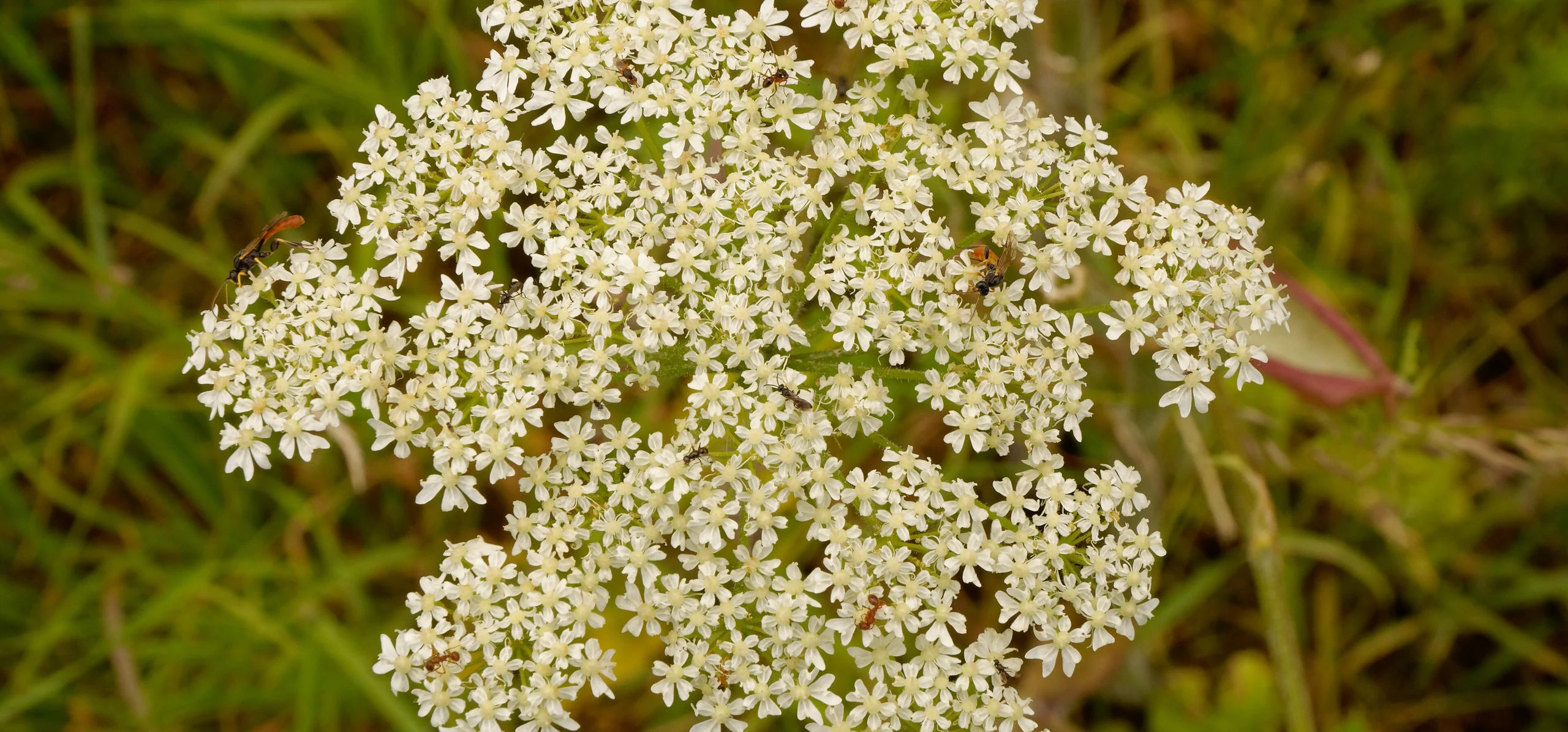
Common Hogweed
Heracleum sphondylium
Family · Apiaceae
Common hogweed forms flat white umbels on 1.5 to 2.5 m hollow stems in damp hedgerows and verges, with sap that turns phototoxic on skin in sunlight.
Heracleum sphondylium
Plant profile
- WateringModerateWater every 6 days
- Light exposurePartial sun
Growth
- Family
- Apiaceae
- Life cycle
- Biennial
- Growth speed
- 8/10
- Mature size
- 150–250 cm
- Spread
- 10–50 cm
- Flowering
- Off-white umbels, midsummer to early autumn
- Propagation
- Seed
DormancyFirst-year rosette overwinters; the flowering stem dies back once seed has set
Time to maturity2 to 5 years to first flowering (RHS)
Soil & climate
- Soil types
- clay, loam
- Drought tolerance
- No
Light & Placement
- Origin
- Europe to Türkiye, Morocco
- Where to place it
- hedgerow edge
- rough grassland
- roadside verge
- woodland margin
- wildlife corner
- not suited to long-term pot culture; the taproot dislikes confinement
Safety
- Toxicity
- HumansToxic
Invasive speciesNot flagged as invasive within its native European range; self-seeds freely and can dominate disturbed, nutrient-rich ground if left to flower unchecked.
Data fromGBIF: Heracleum sphondylium L.Plants of the World Online (Kew): HeraclRHS: Heracleum sphondylium
Where it grows
World distribution
Common Hogweed is native to 26 countries: Albania, Algeria, Austria, Belgium, Bulgaria, Croatia, Czechia, and Denmark….GBIF records 1,181,956 documented identifications across 78 countries, with the largest concentrations in United Kingdom, France, and Netherlands.
- Albania
- Algeria
- Austria
- Belgium
- Bulgaria
- Croatia
- Czechia
- Denmark
- France
- Germany
- Greece
- Hungary
Show 14 more countriesShow fewer countries
- Ireland
- Italy
- Morocco
- Netherlands
- Norway
- Poland
- Portugal
- Romania
- Spain
- Sweden
- Switzerland
- Türkiye
- Ukraine
- United Kingdom
Yellow to orange dots: concentration of documented identifications per country. Green countries: sourced native range. Source: GBIFNative range from POWO (Kew).
Heracleum sphondylium turns up in almost every rough field edge, hedgerow and roadside verge across Europe, recognisable by its flat, off-white umbels held on hollow, ridged stems 1.5 to 2.5 metres tall. Anyone who has just found a patch usually wants to know two things first: is this the notorious giant hogweed, and is it safe to touch. It is not giant hogweed, but the sap still reacts with sunlight on bare skin, so gloves matter more than most casual foragers expect. The plant needs no encouragement in damp, fertile ground; the real skill lies in identifying it correctly, controlling it where it is not wanted, and knowing when the young growth is worth cutting for the pot.
Telling Common Hogweed From Giant Hogweed
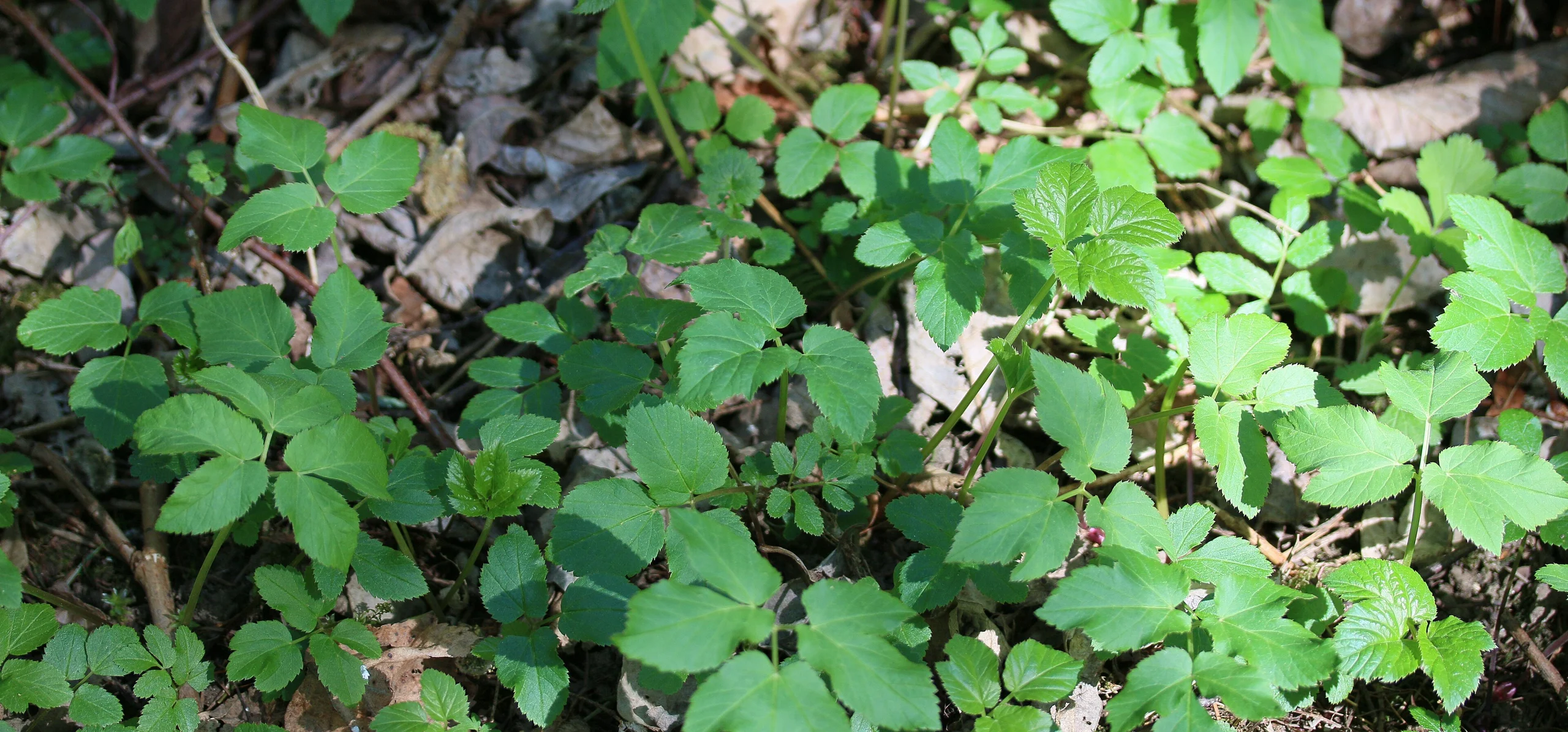
The two questions that come with almost every hogweed sighting are the same: which species is this, and is it dangerous to touch. Heracleum sphondylium stays modest by comparison with its relative, reaching about 1.5 to 2.5 metres according to the RHS, with hollow, ridged stems that are green and covered in coarse hairs rather than blotched with dark purple. Its leaves are broad and pinnately lobed, hairy on both sides, and noticeably smaller and less deeply cut than the leaves of giant hogweed (Heracleum mantegazzianum), which towers well above head height and carries stems marked with purple blotches and stiff white bristles. Common hogweed's sap is still an irritant in sunlight, covered below, but the reaction is generally milder and shorter-lived than the severe blistering giant hogweed can cause. When in doubt about which plant is in front of you, treat it with the same gloves and long sleeves either way.
Native Range and Habitat
Heracleum sphondylium belongs to the carrot family, Apiaceae, in the order Apiales, per GBIF's accepted classification. Plants of the World Online lists its native range as Europe to Türkiye, Morocco, and it has since spread well beyond that range as an introduced plant elsewhere. Within its native area, the RHS describes it growing in grassy places: rough grazing land, hedgerow bottoms, woodland edges and roadside verges, almost always somewhere disturbed or lightly managed rather than dense, undisturbed woodland. It rarely appears as an isolated specimen; find one stand and there are usually dozens of rosettes and flowering stems nearby, since a single plant can seed a wide area once it flowers.
Site, Soil and How It Spreads
Where hogweed is being kept deliberately, in a wildlife corner or a meadow planting, it asks for very little. The RHS rates it hardy to H7, tolerant of the severest European winters, growing in clay or loam soil across the full range from acid to alkaline, and happy anywhere from full sun to partial shade. What it does need is moisture: soil that stays damp but drains, rather than either baked dry or waterlogged. Left to itself, a single plant sets hundreds of seeds from its umbels, and those seeds germinate readily in bare or disturbed ground nearby, which is why a hogweed patch tends to expand outward year on year rather than staying as one clump.


Life Cycle: Rosette to Seed
A hogweed plant typically spends its first year as a low rosette of broad, hairy leaves, building up the taproot before it commits to flowering. The RHS records 2 to 5 years to maturity, after which a hollow flowering stem rises through the rosette and opens into the familiar flat umbel from midsummer into early autumn. Once seed has set, that flowering stem dies back; whether the plant behaves as a true biennial, flowering once and dying, or persists a little longer as a short-lived perennial depends on growing conditions, but either way an individual rosette does not flower indefinitely. This is worth knowing before pulling a non-flowering rosette out of curiosity: leave it a year or two and it will eventually send up the stem that makes it easy to identify with certainty.
Controlling an Unwanted Patch
Cutting the flowering stem before seed sets is the single most effective control, since a plant that never sets seed cannot spread through the ground it already occupies. Do this in gloves and covered skin, since cut stems still bleed sap. For a rosette that has not yet flowered, digging out the taproot with a fork works, though hogweed's root goes deeper than it looks and a broken off crown can resprout. On a larger patch, repeated cutting through the growing season, before any stem gets the chance to flower, exhausts the taproot's reserves over one or two seasons without needing to dig at all. Because seed remains viable in the soil, expect a few stray rosettes to keep appearing from the seed bank even after the visible plants are gone.
Foraging the Young Shoots
The young leaf shoots and stems, cut in early spring before the leaves fully unfurl, are widely foraged as a cooked vegetable with a flavour somewhere between celery and parsnip. They are gathered with gloves, since even young growth carries the same sap, and they are always cooked, steamed, boiled or sautéed, never eaten raw. Older leaves toughen and are generally left alone once the plant is clearly heading toward flowering. Anyone foraging hogweed for the first time should be entirely certain of the identification before cutting anything, given how easily an inexperienced eye can confuse young Apiaceae seedlings with one another.
Skin Contact and Phototoxicity
The sap in the stems, leaves and flower heads contains furanocoumarins, compounds that do nothing on their own but react with sunlight once they are on skin. The RHS lists Heracleum sphondylium as toxic to skin in sunlight, and the practical effect is phytophotodermatitis: reddening, burning and sometimes blistering that develops hours after contact, on the areas that were both touched and exposed to sun. Washing the area promptly and keeping it covered from sunlight for the following day or two reduces the reaction. A search of the ASPCA's toxic and non-toxic plant lists for cats, dogs and horses turns up no entry for Heracleum sphondylium, so there is no official ASPCA verdict on animal toxicity, though the same sunlight triggered sap reaction can affect a pet's skin as readily as a person's, independent of any formal rating.
Pollinators and Wildlife Value
The flat umbels are a magnet for a wide range of insects, precisely because the small flowers sit in an open, accessible cluster rather than a deep tube. The RHS names beetles, flies, hoverflies, bees and wasps among the visitors a stand of hogweed regularly attracts, making it one of the more generous nectar sources in a hedgerow through mid and late summer. That value is one of the strongest arguments for leaving a controlled patch standing somewhere out of the way, rather than removing every plant on sight: cut flowering stems before seed sets if spread is the concern, but a stand allowed to bloom for a season earns its keep with the insects it feeds.
Test your plant knowledge
Tap a card to flip it and reveal the answer.
Common hogweed can be told apart from giant hogweed by its stems, which are green and hairy rather than purple-blotched. Tap to reveal ✓ True
Heracleum sphondylium's sap only irritates skin when there is no sunlight involved. Tap to reveal ✕ False
According to Plants of the World Online, Heracleum sphondylium is native to Europe, extending to Türkiye and Morocco. Tap to reveal ✓ True
The ASPCA lists Heracleum sphondylium as toxic to cats and dogs. Tap to reveal ✕ False
Young hogweed shoots must be cooked before eating and should never be eaten raw. Tap to reveal ✓ True
Sources
References consulted for this guide
- GBIF: Heracleum sphondylium L.gbif.org
- Plants of the World Online (Kew): Heracleum sphondylium L.powo.science.kew.org
- RHS: Heracleum sphondyliumrhs.org.uk
- Reference entity : Wikipédiaen.wikipedia.org