Easter Lily
Lilium longiflorum
Family · Liliaceae
Easter lily bulbs need deep planting in well-drained soil, sun on top and shaded roots. Every part, even pollen and vase water, is toxic to cats.
Lilium longiflorum
Plant profile
- WateringHighWater every 5 days
- Light exposurePartial sun
- Hardiness zoneUSDA 4–8
Growth
- Family
- Liliaceae
- Life cycle
- Perennial
- Growth speed
- 5/10
- Mature size
- 60–90 cm
- Spread
- 23–30 cm
- Propagation
- Bulb
FloweringFragrant white trumpet flowers, naturally June to August; forced earlier for Easter sales
DormancyFoliage dies back after flowering; the bulb overwinters dormant in the ground
Time to maturityFlowers the same year from a mature bulb, naturally in June to August (Missouri Botanical Garden)
Soil & climate
- Drought tolerance
- No
Soil typesWell-drained soil enriched with organic matter, Average to rich, moisture-retentive garden soil
Light & Placement
- Origin
- Southern Japan and Taiwan (Missouri Botanical Garden, POWO)
- Where to place it
- Bright spot out of direct midday sun, for a forced gift pot
- Border in full sun to part shade, sheltered from strong wind
- Deep container matching the outdoor planting depth, with drainage holes
Safety
- Toxicity
- CatsToxic
- DogsSafe
- HorsesSafe
Data fromLilium longiflorum Thunb., GBIF BackboneLilium longiflorum var. longiflorum | PlHow to grow lilies, RHS Growing GuideLilium longiflorum, Plant Finder, MissouEaster Lily, Toxic and Non-Toxic Plants,Lily Leaf Beetle, Home & Garden IPM, Uni
Where it grows
World distribution
Easter Lily is native to 3 countries: Japan, Philippines, and Taiwan.GBIF records 1,612 documented identifications across 38 countries, with the largest concentrations in Taiwan, Japan, and China.
- Japan
- Philippines
- Taiwan
Yellow to orange dots: concentration of documented identifications per country. Green countries: sourced native range. Source: GBIFNative range from POWO (Kew).
A lily arriving as a gift around Easter is on a forcing schedule that has nothing to do with its natural calendar: growers chill and warm Lilium longiflorum bulbs on a controlled cycle so the white trumpets open in a pot in March or April, months before this species blooms outdoors where it grows wild. It is native to the southern islands of Japan and to Taiwan, where it flowers in summer, and the same bulb, once planted in the ground, settles back onto that ordinary June to August schedule the following year. The pot that came home from a supermarket does not need to be thrown out once the flowers fade: cut the spent stems, keep the leaves growing in a bright spot, and plant the bulb outside once the soil has warmed.
Keeping the gift plant going after Easter
Once the flowers on a forced pot collapse, cut the flower stalk back but leave the leaves and stem alone, they are still feeding the bulb for next year. Keep the plant in a bright, cool spot and continue watering and light feeding, the same advice Missouri Botanical Garden gives for garden-grown plants, until the foliage yellows on its own. Resist the urge to cut everything down early just because the display is over; a lily forced to stop growing before it is ready produces a smaller, weaker bulb and often skips flowering the following year.
Planting the bulb outdoors
Lilium longiflorum is a stem-rooting lily, meaning it grows roots both from the base of the bulb and along the buried part of the stem, so the Royal Horticultural Society recommends planting it noticeably deeper than a basal-rooting bulb, roughly 15cm down. Choose a spot with well-drained soil; the bulb rots quickly if water sits around it, one of the two problems Missouri Botanical Garden lists for this species alongside botrytis. The classic arrangement for this lily is full sun on the top growth with the root zone kept shaded and cool, either by planting behind lower groundcover or by mulching over the bulb once it is in, exactly what Missouri Botanical Garden's own growing notes describe.


Watering
Keep the soil around the bulb consistently moist through the growing season: this is not a drought-hardy bulb, and Missouri Botanical Garden is specific that the soil should not be allowed to dry out at any point in the year. In a pot, check the compost a few centimetres below the surface and water when it starts to dry there rather than on a fixed schedule; in the ground, an established plant generally only needs supplemental watering during a dry summer stretch. The failure runs both ways: a lily kept too dry stalls and drops buds, one kept waterlogged develops the soft, discoloured stem base that signals bulb rot underway.
Deadheading, staking and removing the anthers
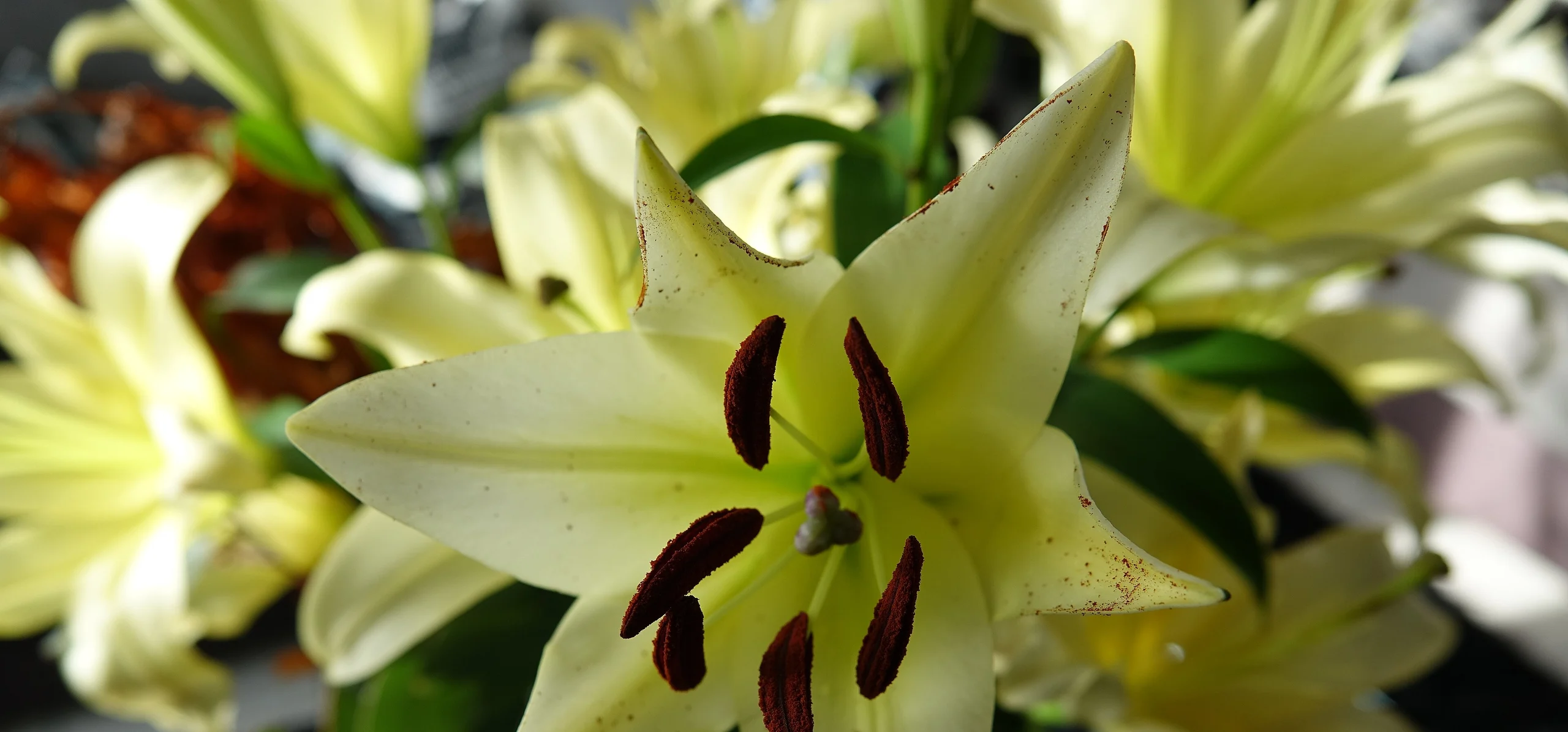
Cut each flower off just below the fading bloom as it goes over, but keep watering and feeding the plant afterward so the remaining leaves can keep building the bulb; only cut the whole stem down once it has yellowed and died back naturally. Tall stems can flop, especially on plants grown in a bit too much shade or in an exposed, windy spot, so push in a stake at planting time rather than afterward, when it risks spearing the bulb. As soon as the flowers open, most growers snip off the anthers, the dark, pollen-laden tips inside each bloom, with fingers or scissors: the rust-coloured pollen stains petals, skin and fabric on contact and is one of the ways cats pick up a toxic dose, so removing it is worth doing even on a plant with no interest in cut-flower use.
Pests and diseases
The scarlet lily beetle, Lilioceris lilii, an 8mm bright red beetle with a black head, is the pest to watch for: both the adults and their black, excrement-covered larvae strip foliage fast enough to leave a plant defoliated within days and undersized the following year. It reached North America through imported bulbs, first recorded in Montreal in 1945 and in Massachusetts in 1992, and university extension services now report it across most of Canada and more than a dozen US states, alongside its long-established range through much of Europe. Checking leaf undersides for beetles and their orange egg clusters and removing them by hand is more reliable on a garden scale than most sprays. Aphids matter less for the direct damage they do and more for what they spread: they are the main vector for the lily mosaic virus that Missouri Botanical Garden lists as a problem with no cure once a plant is infected, so keeping aphid numbers down is really about preventing that infection rather than protecting the leaves they feed on.
Hardiness and winter protection
Missouri Botanical Garden rates this species hardy from USDA zone 4 to zone 8, wider than its subtropical native range would suggest, since the bulb tolerates more cold than the plant's origin implies. In the coldest part of that range, or in any garden that gets hard frost without reliable snow cover, university extension advice is to lay a thick mulch of straw, pine needles or leaves over the bed once the foliage has died back in autumn, then pull the mulch back in spring as new shoots appear.
Toxicity to cats
The ASPCA lists the Easter lily as toxic to cats specifically, not to dogs or horses, and the warning is unusually absolute for a garden plant: every part is dangerous, including the pollen and even water from a vase that has held cut stems, and it takes only a small exposure to cause acute kidney injury. A cat that grooms pollen off its fur, chews a leaf, or drinks from that vase water can go into kidney failure within days, and treatment started more than about 18 hours after exposure is often too late to prevent it. In a household with cats, removing the anthers and keeping the plant out of reach altogether is not optional caution, it is the difference between a houseplant and a veterinary emergency.
Test your plant knowledge
Tap a card to flip it and reveal the answer.
Easter lily bulbs should be planted shallow, just under the soil surface. Tap to reveal ✕ False
Growers often snip off the anthers to stop pollen from staining petals and fabric. Tap to reveal ✓ True
The lily beetle, Lilioceris lilii, is found only in Europe and has never reached North America. Tap to reveal ✕ False
Every part of this lily, including the pollen and water from a vase of cut stems, is toxic to cats. Tap to reveal ✓ True
A pot forced to flower at Easter is blooming on this lily's normal outdoor schedule. Tap to reveal ✕ False
Sources
References consulted for this guide
- Lilium longiflorum Thunb., GBIF Backbone Taxonomygbif.org
- Lilium longiflorum var. longiflorum | Plants of the World Online, Kew Sciencepowo.science.kew.org
- How to grow lilies, RHS Growing Guiderhs.org.uk
- Lilium longiflorum, Plant Finder, Missouri Botanical Gardenmissouribotanicalgarden.org
- Easter Lily, Toxic and Non-Toxic Plants, ASPCA Animal Poison Controlaspca.org
- Lily Leaf Beetle, Home & Garden IPM, University of Maine Cooperative Extensionextension.umaine.edu
- Reference entity : Wikipédiaen.wikipedia.org