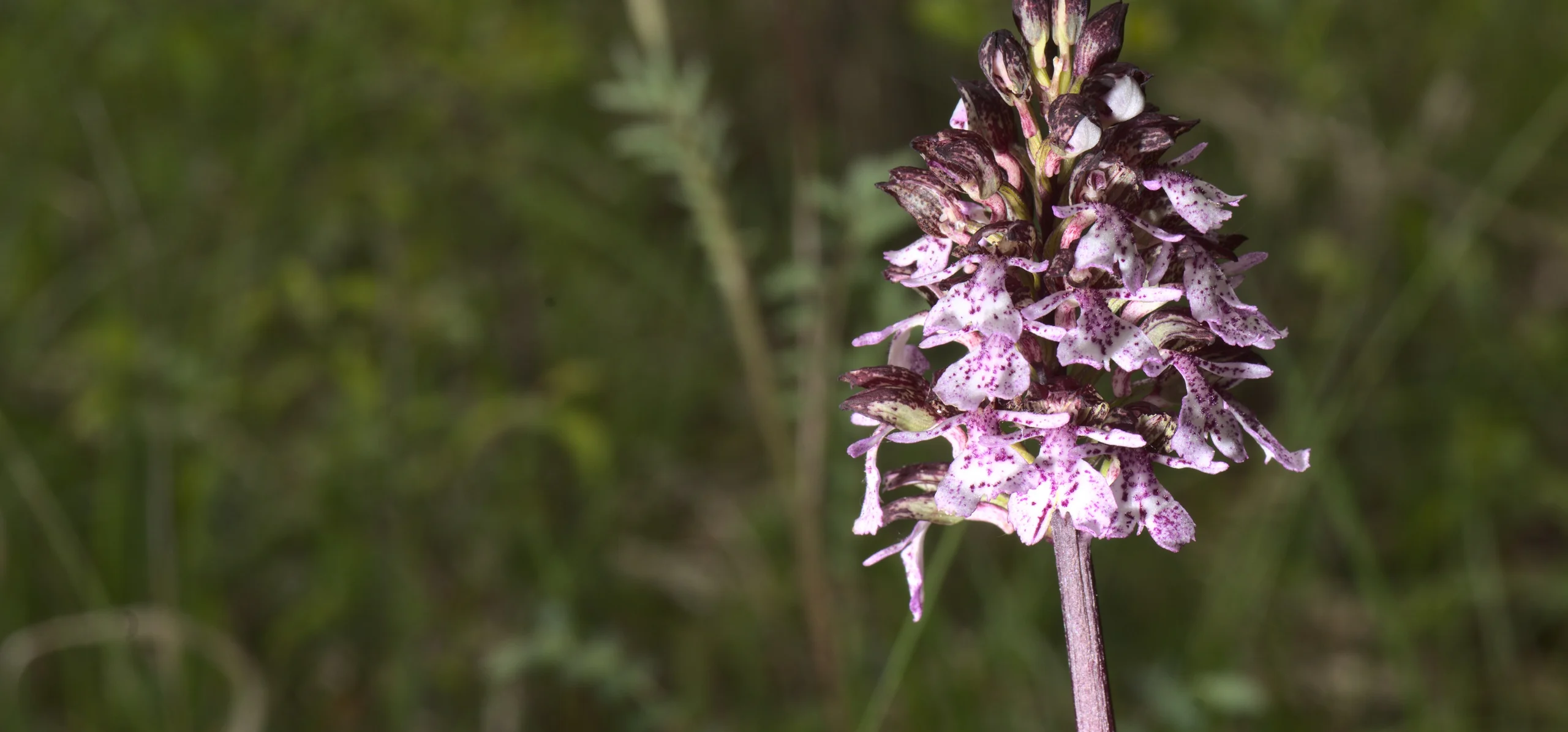
Lady Orchid
Orchis purpurea
Family · Orchidaceae
Orchis purpurea, the Lady Orchid, needs alkaline chalk soil, pH 7 to 8.5, and a specific soil fungus to germinate, rarely thriving outside nursery stock.
Orchis purpurea
Plant profile
- WateringLittleWater every 14 days
- Light exposureIndirect light
Growth
- Family
- Orchidaceae
- Life cycle
- Perennial
- Growth speed
- 2/10
- Mature size
- 30–100 cm
- Flowering
- Leaf rosette from February; flowers May to June in Britain, from April further south
- Propagation
- Seed
Dormancyleafless underground from about mid-August to February
Soil & climate
- Soil pH
- pH 7–8.5
- Soil types
- chalk, limestone, clay
- Drought tolerance
- Yes
Light & Placement
- Origin
- Europe to the Caucasus and northeast Algeria
- Where to place it
- unimproved chalk or limestone grassland
- lightly shaded woodland edge (beech, ash or hazel)
Safety
- Toxicity
- Not evaluated by ASPCA; no toxicity documented in the sources consulted
- Pet safe
- Yes
Invasive speciesNot invasive; a rare, legally protected species in parts of its range, in decline from historic habitat loss and collection
Data fromOrchis purpurea Huds., GBIF Backbone TaxOrchis purpurea Huds., Plants of the WorOrchis purpurea (lady orchid), RHS GardeOrchis purpurea Huds., 1762, INPN (InvenFlaune episode 36: Orchis purpurea, Orch
Where it grows
World distribution
Lady Orchid is native to 23 countries: Albania, Algeria, Austria, Belgium, Bulgaria, Croatia, Czechia, and Denmark….GBIF records 187,865 documented identifications across 41 countries, with the largest concentrations in France, Germany, and Italy.
- Albania
- Algeria
- Austria
- Belgium
- Bulgaria
- Croatia
- Czechia
- Denmark
- France
- Georgia
- Germany
- Greece
Show 11 more countriesShow fewer countries
- Hungary
- Italy
- Netherlands
- Poland
- Romania
- Russia
- Spain
- Switzerland
- Türkiye
- Ukraine
- United Kingdom
Yellow to orange dots: concentration of documented identifications per country. Green countries: sourced native range. Source: GBIFNative range from POWO (Kew).
A Lady Orchid rarely turns up as an impulse purchase at a garden centre. Almost every plant offered for sale is a seedling raised by a specialist nursery from seed grown in symbiotic culture with a soil fungus, because Orchis purpurea will barely germinate, let alone establish, without that specific fungal partner present in the ground. Native from Britain and Denmark south to Spain and North Africa and east through the Caucasus, it spends most of the year as a dormant tuber and shows itself only from February, when a rosette of broad, glossy leaves breaks the surface ahead of a dense, sometimes 200-flowered spike in late spring. Treat it as a long-term project tied to soil chemistry and an underground fungus rather than a conventional border perennial, and the plant rewards patience rather than routine care.
Native Range and Habitat
Kew's Plants of the World Online places the native range of Orchis purpurea across Europe to the Caucasus and northeast Algeria, with a separate subspecies, caucasica, confined to northeastern Turkey and the Caucasus. Across that range it grows on calcareous ground: open woodland with beech, ash or hazel, chalk and limestone grassland, and disturbed sites such as old vineyard banks. In Britain it survives almost exclusively as a woodland-edge plant on a handful of chalk sites in Kent and Oxfordshire, a much narrower niche than it occupies on the European mainland. RHS records also list it under the old synonym Orchis fusca and the alternate common name Tawny Orchid, alongside the far more widely used Lady Orchid.
Why It Resists Ordinary Cultivation
The single biggest obstacle to growing a Lady Orchid is underground. Seed this fine, with almost no food reserve of its own, cannot germinate at all unless it lands beside the right soil-borne fungus, and populations tend to cluster wherever that fungus is already established rather than spreading evenly across suitable ground. The plant also carries only two tubers at a time, and the older one is entirely used up and replaced by a new one each year, so there is no clump to lift and divide the way a hosta or daylily can be split. Pollination is just as precarious: small flies do most of the work, with bumblebees and beetles helping on the continent, and even in a healthy colony fewer than one flower in ten typically sets seed. Older taxonomic treatments sometimes folded this species into the related Military Orchid, and GBIF's synonymy for the accepted name still lists names such as Orchis militaris subsp. purpurea among those once applied to it, a sign the two were only clearly separated relatively recently.


Soil and Site
Match the wild habitat as closely as possible: a shallow, infertile, sharply drained soil over chalk, limestone or heavy clay, never one that has been dug over, limed unevenly or enriched with garden compost. Aim for an alkaline pH, roughly 7 to 8.5, and resist the urge to feed the bed, since the plant's wild sites are notably low in nutrients and rich soil favours coarse grasses that crowd the orchid out. Light matters as much as soil chemistry: a lightly shaded woodland edge or an open, sunny bank both work, but a wood that closes over into deep, dense shade will see the plant fade out, while opening the canopy again often brings a sudden reappearance from tubers that had stopped flowering.
The Leaf Rosette and Growing Season
Growth begins underground and out of sight for most of the year. The basal rosette of broad, unspotted, glossy leaves pushes up in February, well ahead of most other European orchids, and the flowering spike follows in May and June in Britain, a few weeks earlier further south in its range. By late summer the display is already over: seed capsules ripen and split through August and September, and by mid-August no green leaf is left above ground, the plant having pulled everything of value back down into next year's tuber. That long, leafless dormancy from late summer through the following January is normal, not a sign the plant has died.
Watering and Feeding
While the rosette and flower spike are above ground, keep the soil evenly on the dry side of moist and never let it sit wet, since the free drainage of its native chalk and limestone sites is central to its survival. Once the leaves die back in high summer, stop watering altogether and let the ground dry out around the resting tuber. Skip fertiliser entirely: this is a plant of infertile ground, and the fine root and mycorrhizal system that keeps it alive is easily disrupted by soluble feeds intended for hungrier garden plants.
Common Mistakes
The most damaging mistake is trying to speed the plant up: digging in compost or fertiliser, watering through its summer dormancy, or lifting and moving an established plant all disturb the fungal network the orchid depends on and rarely end well. In open grassland, grazing or trampling between February and the end of flowering can crush the rosette before it has bloomed, and where rabbits or deer have access, browsing on the flower spike alone is enough to prevent any seed from setting that year. A shrinking colony is more often a sign that scrub or tree canopy has closed in overhead than a watering problem, and thinning that shade usually helps more than any change to feeding or irrigation.
A Rare and Regulated Species
Orchis purpurea has declined across parts of its range through the twentieth century as chalk woodland was cleared and grubbed out and unimproved grassland was ploughed or fertilised, a decline made worse in places by plants being dug up or picked. France's national biodiversity inventory, INPN, records populations under regional protection in parts of the country, such as Franche-Comte, and lists the species among those covered by CITES trade controls, and comparable wild-plant protections apply across much of its European range. Any plant grown in a garden should come from a nursery that raises its own stock from seed under licence, with paperwork to prove it, never from a tuber lifted out of a wood or a roadside bank.
Test your plant knowledge
Tap a card to flip it and reveal the answer.
Orchis purpurea seed usually cannot germinate without a specific soil fungus present. Tap to reveal ✓ True
An established Lady Orchid can be dug up and divided into several new plants. Tap to reveal ✕ False
In Britain, this orchid's leaf rosette typically appears in autumn, before winter sets in. Tap to reveal ✕ False
Orchis purpurea grows best in acidic, humus-rich soil. Tap to reveal ✕ False
Wild colonies of this species receive legal protection in parts of its European range. Tap to reveal ✓ True
Sources
References consulted for this guide
- Orchis purpurea Huds., GBIF Backbone Taxonomygbif.org
- Orchis purpurea Huds., Plants of the World Online (Kew)powo.science.kew.org
- Orchis purpurea (lady orchid), RHS Gardeningrhs.org.uk
- Orchis purpurea Huds., 1762, INPN (Inventaire National du Patrimoine Naturel)inpn.mnhn.fr
- Flaune episode 36: Orchis purpurea, Orchis pourpre, Tela Botanicatela-botanica.org
- Reference entity : Wikipédiaen.wikipedia.org