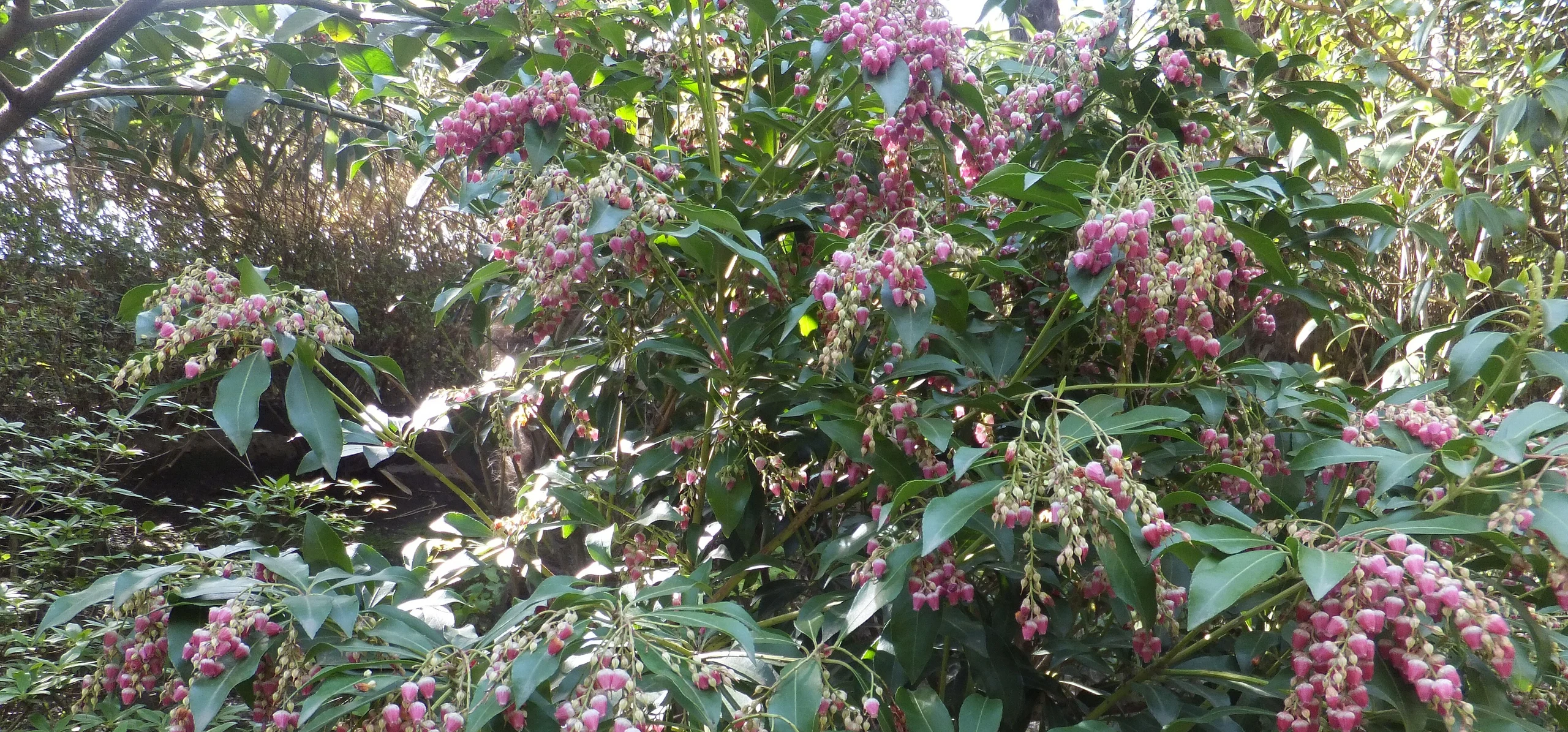
Japanese Pieris
Pieris japonica
Family · Ericaceae
Pieris japonica needs acidic soil below pH 6, steady moisture, and pruning right after bloom; toxic to pets, horses, and people if eaten.
Pieris japonica
Plant profile
- WateringHighWater every 7 days
- Light exposureIndirect light
- Hardiness zoneUSDA 4–8
Growth
- Family
- Ericaceae
- Life cycle
- Perennial
- Growth speed
- 3/10
- Mature size
- 244–305 cm
- Spread
- 183–244 cm
- Flowering
- Drooping white to pink flower clusters, late winter to spring
- Propagation
- Cutting
- Layering
- Grafting
- Seed
DormancyEvergreen, no true leaf drop; growth pauses in cold months
Time to maturityMany years, slow growth to full size
Soil & climate
- Soil pH
- pH 4.5–6
- Soil types
- Acidic, humus-rich loam, Ericaceous or pine-bark-amended compost in containers
- Drought tolerance
- No
Light & Placement
- Origin
- SE China (to Hubei), Central & S. Japan, and Taiwan
- Where to place it
- Not a houseplant; grown outdoors only
- Partial shade sheltered from wind
- Morning sun with afternoon shade in hot climates
- Under the filtered canopy of taller trees
- Large container with acidic, well-draining ericaceous compost
Safety
- Toxicity
- CatsToxic
- DogsToxic
- HorsesToxic
- HumansToxic
Data fromGBIF Backbone Taxonomy: Pieris japonica Plants of the World Online (Kew): PierisASPCA: Toxic and Non-Toxic Plants, PieriNC State Extension Gardener Plant ToolboNC State Extension Publications: Androme
Where it grows
World distribution
Japanese Pieris is native to 3 countries: China, Japan, and Taiwan.GBIF records 9,564 documented identifications across 34 countries, with the largest concentrations in Japan, Taiwan, and United States.
- China
- Japan
- Taiwan
Yellow to orange dots: concentration of documented identifications per country. Green countries: sourced native range. Source: GBIFNative range from POWO (Kew).
A Native of Japan and China Behind the Garden Staple
Pieris japonica reaches garden centres as an easy evergreen, but GBIF records its accepted name as Pieris japonica (Thunb.) D.Don ex G.Don, placed in the heath family Ericaceae alongside rhododendrons, blueberries, and heathers. Plants of the World Online traces its native range to SE China (to Hubei), central and southern Japan, and Taiwan, where it grows as an understory shrub in cool, humid mountain forest. That native habitat, dappled light under a tree canopy, on soil that never fully dries but never sits wet either, is the template for every placement decision you make with this plant. English names for it stack up almost as fast as its synonyms on GBIF: Japanese pieris, Japanese andromeda, lily-of-the-valley bush, and, in the American South, fetterbush.
Choosing a Variety
The straight species carries white, urn-shaped flowers in drooping racemes from late winter into spring, but most nurseries stock named cultivars bred for compact size or coloured new growth. 'Mountain Fire' pushes vivid red young leaves that fade to glossy green over a few weeks. 'Valley Valentine' and other pink-flowered selections swap the species' white racemes for deep rose. Compact forms such as 'Prelude' stay under a metre and suit a foundation planting or a large container far better than the species, which eventually reaches 2.4 to 3 m. Where the andromeda lace bug is a known problem, Pieris floribunda, mountain andromeda, is a close relative that resists it far better and is worth planting instead of, or alongside, P. japonica.
Soil and Planting
This is an acid lover in the strict sense: North Carolina State Extension puts the ceiling at pH 6.0, and in practice it performs best in the 4.5 to 6.0 range typical of Ericaceae. Above that, iron and manganese become unavailable in the root zone and leaves yellow between the veins within a season, the same chlorosis seen on azaleas and blueberries planted in soil that is too alkaline. Work several centimetres of pine bark fines, leaf mould, or an ericaceous compost into the planting hole, and set the shrub at the same depth it sat in its nursery pot, root flare visible, never buried. Choose a site sheltered from prevailing wind: Missouri Botanical Garden notes that Japanese pieris struggles in exposed positions, with summer foliage decline and thinning that weaken the plant heading into winter.
Light and Placement
Give it full sun to partial shade in cool, humid climates, and lean toward part shade, morning sun with afternoon cover, anywhere summers run hot. Too much direct afternoon sun scorches the leaf margins and bleaches flower colour; too much shade thins the canopy and cuts the spring bloom count. Growing it under the high, filtered canopy of taller trees, or against an east-facing wall out of the worst wind, mirrors the understory habitat this species comes from and is the classic successful placement in both American and Japanese gardens.


Watering
Keep the root zone evenly moist. Extension guidance describes the ideal soil as well-drained yet consistently moist, and this species does not forgive either extreme: a rootball that dries out even once can scorch leaf edges and abort the coming flower flush, while soil that stays saturated invites the phytophthora root rot that is its single biggest killer in poorly drained gardens. Water deeply whenever the top few centimetres of soil start to dry, more often through the first two seasons after planting while roots are still establishing, and mulch with 5 to 8 cm of pine bark or leaf mould to buffer both moisture swings and summer soil temperature.
Pruning
Next year's flower buds form on the current season's wood soon after this year's blooms fade, so the pruning window is narrow: shape the shrub and remove spent flower clusters within a few weeks of the last flower dropping, not in autumn or winter. A late cut removes next year's buds along with the stem, and the plant simply skips a season of bloom. Established plants generally need only light shaping plus removal of dead or crossing wood; because regrowth from old, leafless wood is slow, avoid cutting back hard except to rejuvenate a badly overgrown, leggy specimen, and accept a lighter bloom for a year or two afterward.
Pests and Diseases
The andromeda lace bug, Stephanitis takeyai, is the pest growers in the eastern United States contend with most. North Carolina State Extension records at least four generations a year in the region, active from May through September, with the first generation doing the most damage. Adults and nymphs feed on the underside of the leaf, piercing and sucking sap, which shows up on top as fine yellow-to-grey stippling; check leaf undersides through the growing season rather than waiting for stippling to become obvious from above, and treat with horticultural oil or insecticidal soap applied to the underside of the foliage. Root and crown problems trace almost entirely back to drainage: phytophthora root rot, leaf spot, and dieback all take hold fastest in soil that stays soggy, the strongest argument for the raised, well-drained planting bed described above.
Toxic to Pets and People
Every part of this plant carries grayanotoxins, also called andromedotoxin, and North Carolina State Extension rates the poisoning risk as high for humans, cats, dogs, and horses alike, singling out the leaves and nectar as the most concentrated sources. The ASPCA lists it as toxic to cats, dogs, and horses. Reported symptoms include tingling in the mouth, salivation, nausea, vomiting, diarrhoea, and in severe cases cardiac failure and convulsions; honey made from Pieris and related Ericaceae nectar has a documented history of causing this kind of poisoning in people. Keep pruned material, fallen flowers, and leaf litter out of reach of pets, grazing animals, and small children, and treat this as a plant to admire rather than to nibble.
Test your plant knowledge
Tap a card to flip it and reveal the answer.
Pieris japonica needs acidic soil with a pH below 6.0 to thrive. Tap to reveal ✓ True
This shrub tolerates dry soil well once it is established. Tap to reveal ✕ False
The andromeda lace bug can produce at least four generations a year in warm climates. Tap to reveal ✓ True
New leaves on Pieris japonica emerge glossy dark green from the start. Tap to reveal ✕ False
The ASPCA lists Pieris as toxic to cats, dogs, and horses. Tap to reveal ✓ True
Sources
References consulted for this guide
- GBIF Backbone Taxonomy: Pieris japonica (Thunb.) D.Don ex G.Dongbif.org
- Plants of the World Online (Kew): Pieris japonicapowo.science.kew.org
- ASPCA: Toxic and Non-Toxic Plants, Pierisaspca.org
- NC State Extension Gardener Plant Toolbox: Pieris japonica (Japanese Pieris)plants.ces.ncsu.edu
- NC State Extension Publications: Andromeda Lace Bugcontent.ces.ncsu.edu
- Reference entity : Wikipédiaen.wikipedia.org