Annual Bluegrass
Poa annua
Family · Poaceae
Annual bluegrass sprouts from cool soil each autumn, seeds within weeks, and dies back by summer. How to identify it and keep it out of a lawn.
Poa annua
Plant profile
- WateringHighWater every 4 days
- Light exposurePartial sun
- Hardiness zoneUSDA 4–8
Growth
- Family
- Poaceae
- Life cycle
- Annual
- Growth speed
- 8/10
- Mature size
- 10–50 cm
- Spread
- 10–50 cm
- Propagation
- Seed
FloweringPale, pyramid-shaped seed heads within about six weeks of germination, mainly spring (RHS, UC IPM)
DormancyDies back as temperatures rise in late spring or early summer; a new generation germinates from seed in autumn (UC IPM)
Time to maturitySeed heads can form within six weeks of germination; ultimate size reached within one year (UC IPM, RHS)
Soil & climate
- Soil types
- Chalk, Clay, Loam, Sand
- Drought tolerance
- No
Light & Placement
- Origin
- Temperate Old World to Tropical Mountains, now naturalized worldwide (POWO)
- Where to place it
- Lawns and turf
- Garden borders and vegetable beds
- Cracks in paving and gravel paths
- Golf course fairways and greens
Safety
- Toxicity
- Not evaluated by the ASPCA; toxicity undetermined
- Pet safe
- No
Invasive speciesNot on an official invasive list checked here, but described by RHS and UC IPM as an aggressive, difficult to control weed of turf, found from sea level to mountain elevations on most continents.
Data fromPoa annua L., GBIF Backbone TaxonomyPoa annua L., Plants of the World OnlinePoa annua (annual meadow-grass), RHSPoa annua (Annual Bluegrass), NC State EAnnual Bluegrass, UC IPM (University of
Where it grows
World distribution
Annual Bluegrass is native to 72 countries: Afghanistan, Albania, Algeria, Austria, Belarus, Belgium, Bhutan, and Bulgaria….GBIF records 976,588 documented identifications across 158 countries, with the largest concentrations in United Kingdom, France, and Netherlands.
- Afghanistan
- Albania
- Algeria
- Austria
- Belarus
- Belgium
- Bhutan
- Bulgaria
- Burundi
- Cameroon
- China
- Croatia
Show 60 more countriesShow fewer countries
- Cyprus
- Czechia
- Denmark
- Egypt
- Eritrea
- Estonia
- Ethiopia
- Faroe Islands
- Finland
- France
- Georgia
- Germany
- Greece
- Hungary
- Iceland
- India
- Iran
- Iraq
- Ireland
- Italy
- Japan
- Kazakhstan
- Kenya
- Kuwait
- Kyrgyzstan
- Lebanon
- Libya
- Mongolia
- Morocco
- Myanmar (Burma)
- Nepal
- Netherlands
- Norway
- Pakistan
- Palestinian Territories
- Poland
- Portugal
- Romania
- Russia
- Rwanda
- São Tomé & Príncipe
- Saudi Arabia
- South Korea
- Spain
- Sri Lanka
- Sweden
- Switzerland
- Taiwan
- Tajikistan
- Tanzania
- Tunisia
- Türkiye
- Turkmenistan
- Uganda
- Ukraine
- United Arab Emirates
- United Kingdom
- Uzbekistan
- Vietnam
- Yemen
Yellow to orange dots: concentration of documented identifications per country. Green countries: sourced native range. Source: GBIFNative range from POWO (Kew).
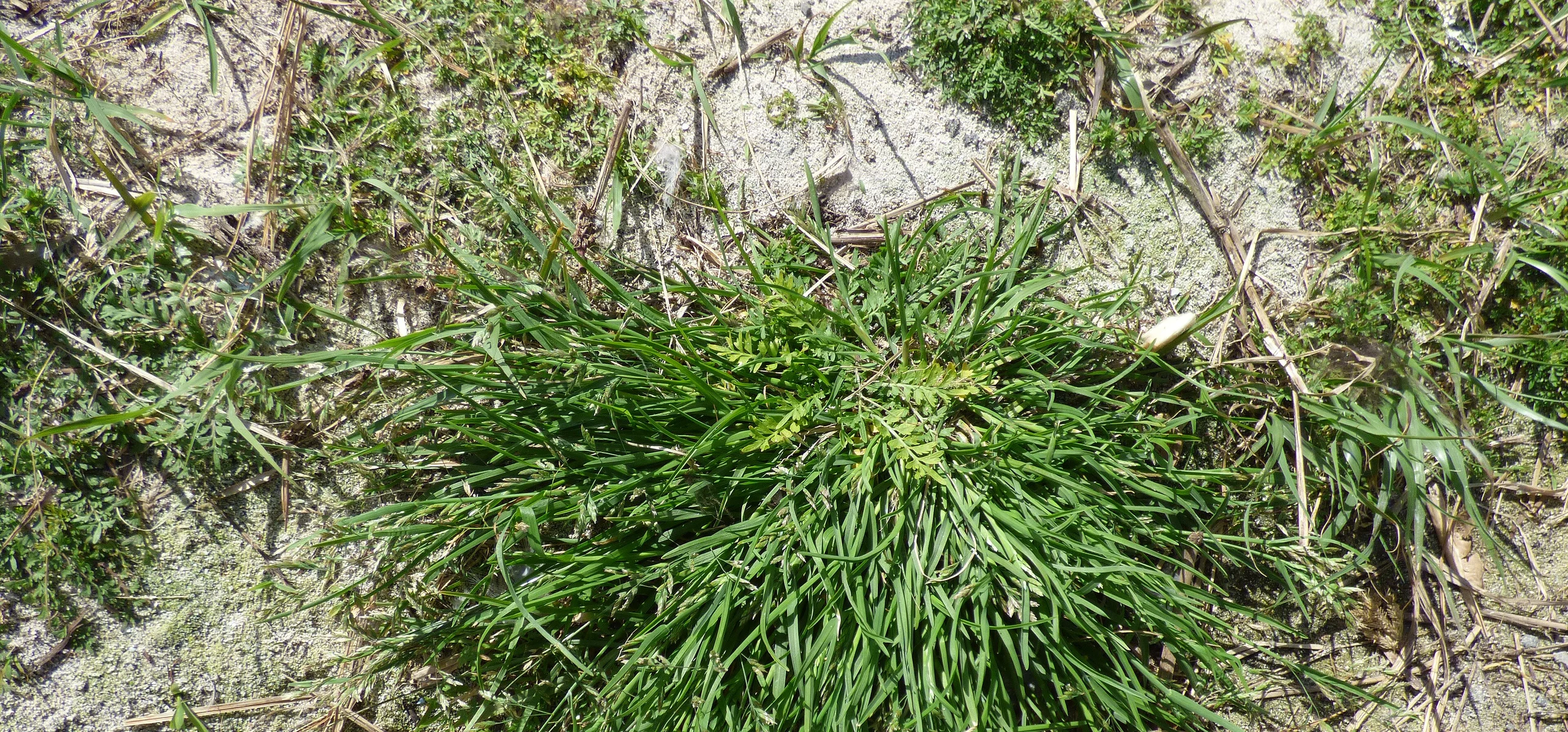
A patch of pale, almost apple-green grass that stays low, forms dense tufts, and throws up whitish, boat-shaped seed heads within weeks of appearing is very likely Poa annua, known as annual bluegrass or annual meadow grass. It turns up in lawns, borders, vegetable beds, and cracks in paving across temperate regions worldwide, and it is unusual among lawn weeds in that some golf courses fight it in the rough while tolerating, even favoring, it on the putting green. New seedlings can go from germination to visible seed head in about six weeks, which is why a single missed mowing cycle in spring can leave a lawn peppered with white flecks almost overnight.
Identification: Boat-Shaped Tips and Yellow-Green Clumps
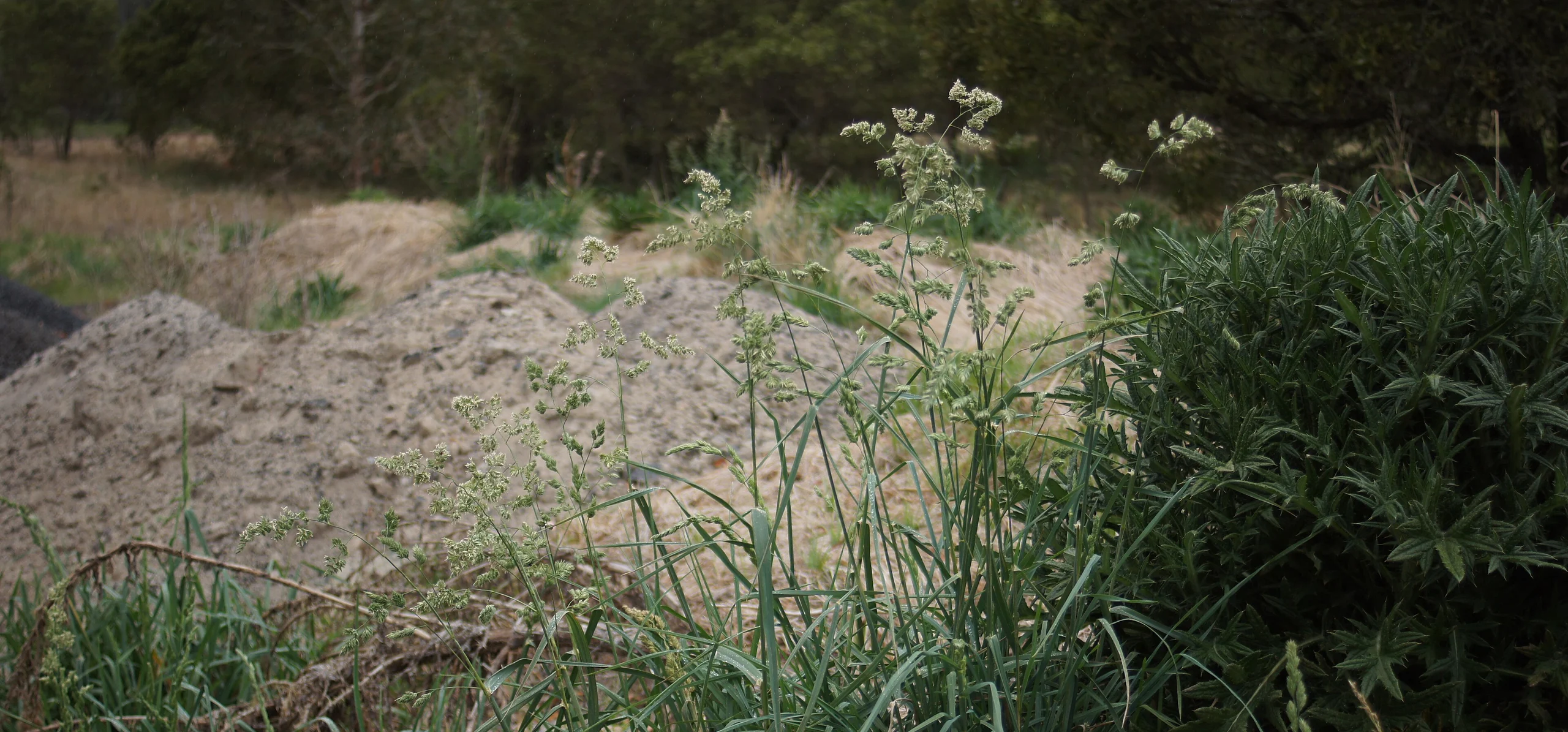
Poa annua stands out from surrounding turf by color alone, a brighter, more yellow-green than the darker grasses around it. The leaf blades are flat, hairless, and often transversely wrinkled partway down, ending in the boat-shaped, or prow-shaped, tip typical of the whole Poa genus. Stems are flattened and bent at the base, frequently rooting at the lower joint where they touch soil, and left unmown the plant reaches about 6 to 8 inches tall, with pale, pyramid-shaped flower sprays, or panicles, extending 1 to 4 inches above the foliage.
Origin and How It Became a Global Weed
Plants of the World Online lists the native range as Temperate Old World to Tropical Mountains, and RHS records it as native to Great Britain and Ireland as well. From that base it has become cosmopolitan, reported from sea level up to roughly 1,200 meters in elevation and from near-Arctic to near-Antarctic latitudes, and it is listed as a weed in dozens of crops across more than 80 countries. GBIF records the accepted name as Poa annua L., with a long list of synonyms, including several built on the segregate genus Ochlopoa, reflecting past attempts to split it away from other Poa species.
Life Cycle: A Cool-Season Annual on Repeat
Most populations behave as a winter annual: seed germinates as soil temperatures fall below about 70 degrees Fahrenheit in late summer or fall, with further flushes continuing through the cooler months. Seed heads can appear within roughly six weeks of germination, and a single plant can produce on the order of 100 seeds in as few as eight weeks, with newly formed seed capable of germinating just days after pollination. Growth slows and the plant dies back as heat returns in late spring or early summer, but RHS notes seed can remain viable in the soil for at least four years, which is what keeps a treated lawn reinfesting itself season after season. RHS also lists a creeping, short-lived perennial variant, sold and studied as var. reptans, that persists longer in consistently moist ground by rooting at its lower stem nodes.


Why It Thrives in Lawns and Garden Beds
RHS lists chalk, clay, loam, and sand among tolerated soils, moisture ranging from well-drained to poorly-drained, and both full sun and partial shade as acceptable exposure, a spread of conditions few desirable turf grasses can match. NC State Extension narrows this down further, noting a preference for partial shade, roughly 2 to 6 hours of direct sun, and moist, often shaded ground, with a soil pH tolerance spanning acidic conditions below 6.0 up to a neutral 8.0. Compacted, frequently irrigated turf, the kind produced by heavy foot traffic paired with daily watering, suits it particularly well, since its shallow, fibrous root system only needs the top few centimeters of soil to stay damp.
The Paradox on Golf Courses
UC IPM flags annual bluegrass as a particular problem on golf course greens and fairways: scattered seed heads roughen a putting surface, and an irregular, bumpy texture can show up within as little as two days after mowing once heads start forming. At the same time, the perennial form commonly ends up making a large share of the turf on greens that have been mowed short for years, since repeated close cutting favors Poa annua over the bentgrass it was meant to replace. Rather than pay for a full renovation, some course managers end up treating Poa annua as the putting surface itself, working around its paler midsummer color and weaker footing instead of fighting it outright.
Cultural and Mechanical Control
RHS recommends pulling plants by hand with a hand fork before they flower and set seed, since one missed plant can reseed an area for years afterward, and lightly raking a lawn before mowing lifts the low, flattened stems so the mower blade actually cuts them rather than skipping over. Mulching beds thickly enough to block light from reaching the soil helps too, since RHS notes Poa annua seed needs light exposure to germinate. UC IPM adds turf-specific tactics: deep, infrequent irrigation rather than light daily watering, avoiding aeration during the main autumn germination window, and overseeding thin patches so little bare soil is left for new seedlings to colonize.
Chemical Control Options
Where cultural methods fall short, UC IPM lists pre-emergent herbicides, including benefin, dithiopyr, prodiamine, and oryzalin, applied in late summer or early fall before germination gets underway. Once plants are already established, post-emergent choices are far more limited; UC IPM names foramsulfuron, sulfosulfuron, and ethofumesate among the options, while noting that repeated reliance on a single herbicide class has already produced resistant biotypes in some regions. A full renovation, killing off existing turf with a nonselective herbicide and reseeding from scratch, is the route UC IPM points to once a lawn is dominated by Poa annua rather than just spotted with it.
Similar Grasses, Pollen, and Pet Safety
The boat-shaped leaf tip shared across the Poa genus means annual bluegrass is easy to mistake for Kentucky bluegrass, Poa pratensis, at a glance; the practical tells are its lighter, more yellow-green color, its lower and flatter growth habit, and the pale seed heads it throws up within weeks rather than the deeper green, upright habit of desirable lawn grasses. NC State Extension notes its pollen is a known allergen and a contributor to hay fever, worth knowing if seed heads are left to mature near a patio or open window. The species does not appear on the ASPCA's toxic or non-toxic plant lists for cats, dogs, or horses, so no official toxicity rating exists either way; that absence of a listing is a reason for caution rather than an assumption of safety.
Test your plant knowledge
Tap a card to flip it and reveal the answer.
Annual bluegrass typically completes its life cycle within about a year, as its common name suggests. Tap to reveal ✓ True
Poa annua seeds lose the ability to sprout within a few weeks of hitting the soil. Tap to reveal ✕ False
Every golf course treats annual bluegrass strictly as a weed to be eliminated from putting greens. Tap to reveal ✕ False
Mulching a bed thickly enough to block light from reaching the soil can reduce annual bluegrass germination. Tap to reveal ✓ True
New annual bluegrass seed heads can appear within roughly six weeks of a seedling germinating. Tap to reveal ✓ True
Sources
References consulted for this guide
- Poa annua L., GBIF Backbone Taxonomygbif.org
- Poa annua L., Plants of the World Online (Kew)powo.science.kew.org
- Poa annua (annual meadow-grass), RHSrhs.org.uk
- Poa annua (Annual Bluegrass), NC State Extension Gardener Plant Toolboxplants.ces.ncsu.edu
- Annual Bluegrass, UC IPM (University of California)ipm.ucanr.edu
- Reference entity : Wikipédiaen.wikipedia.org