Black-Eyed Susan
Rudbeckia hirta
Family · Asteraceae
Rudbeckia hirta flowers the first year from an early sowing. Covers deadheading, self-seeding, powdery mildew, aphids and how it differs from Goldsturm.
Rudbeckia hirta
Plant profile
- WateringModerateWater every 7 days
- Light exposurePartial sun
- Hardiness zoneUSDA 3–8
Growth
- Family
- Asteraceae
- Life cycle
- Biennial
- Growth speed
- 8/10
- Mature size
- 60–120 cm
- Spread
- 30–60 cm
- Flowering
- June to first frost, longer with regular deadheading
- Propagation
- Seed
Dormancya spring-sown plant often flowers and sets seed in its first year; where it survives winter, it dies back to a basal rosette and regrows for one or two more seasons before fading
Time to maturityblooms in its first year from an early sowing, as soon as the same summer
Soil & climate
- Soil pH
- pH 5–8
- Soil types
- clay, loam, sand
- Drought tolerance
- Yes
Light & Placement
- Origin
- Central and eastern Canada to the United States
- Where to place it
- sunny border or bed
- meadow or prairie planting
- cottage garden
- cut flower row
- large container with a well-drained potting mix
Safety
- Pet safe
- Yes
ToxicityNot listed in the ASPCA toxic or non-toxic plant database; no toxic principle documented, though the bristly foliage can mechanically irritate skin or mouths on contact
Invasive speciesself-seeds freely and can naturalize into open, disturbed ground; not documented as invasive outside its native North American range
Data fromRudbeckia hirta L., GBIF Backbone TaxonoPOWO: Rudbeckia hirta L.Missouri Botanical Garden Plant Finder: NC State Extension Gardener Plant ToolboClemson HGIC Factsheet: Rudbeckia
Where it grows
World distribution
Black-Eyed Susan is native to 2 countries: Canada and United States.GBIF records 81,446 documented identifications across 64 countries, with the largest concentrations in United States, Canada, and Germany.
- Canada
- United States
Yellow to orange dots: concentration of documented identifications per country. Green countries: sourced native range. Source: GBIFNative range from POWO (Kew).
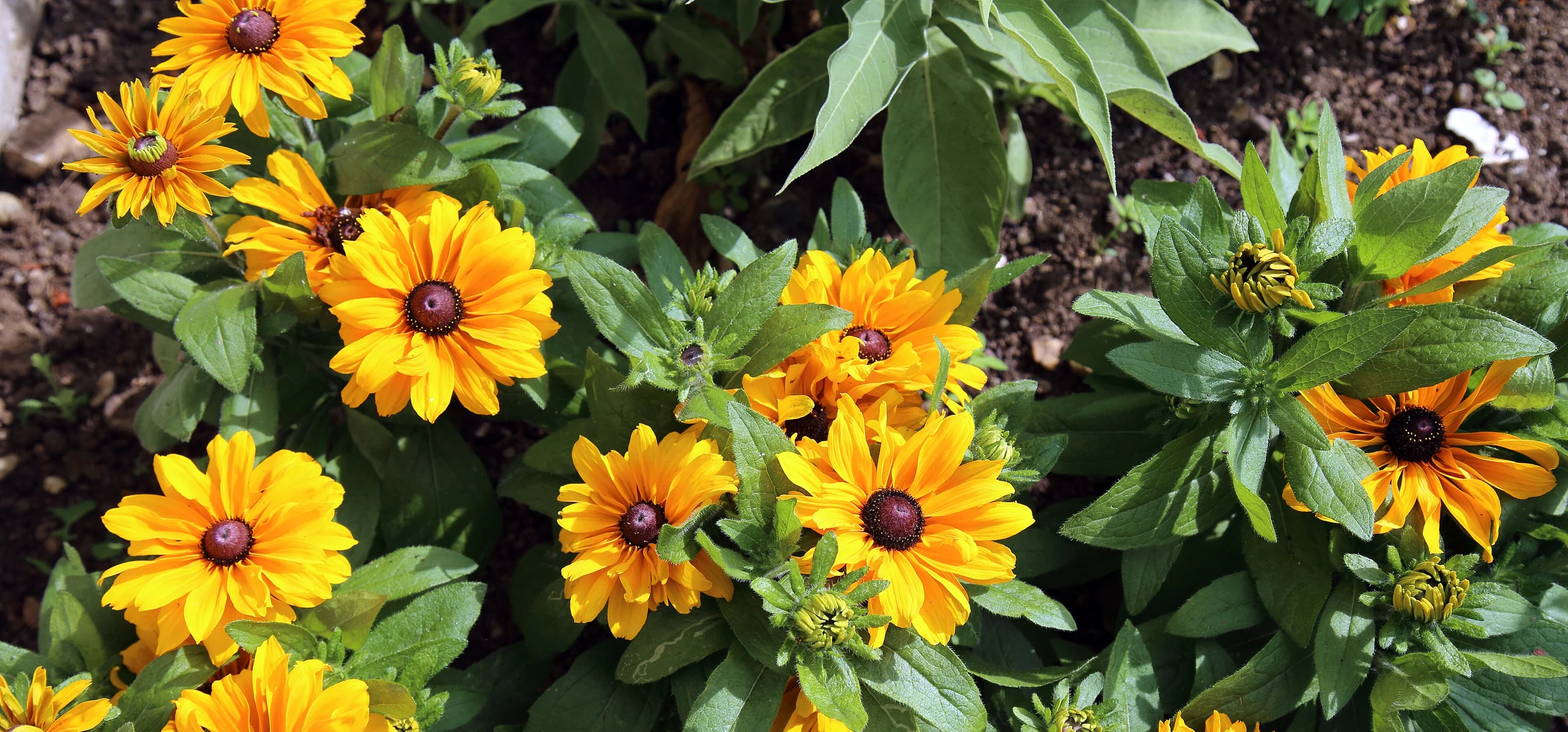
Black-eyed Susan, Rudbeckia hirta, is the coarse, hairy-leaved daisy of North American prairies, open woods and roadsides: golden-yellow rays wrapped around a domed, dark brown cone, held on stiff, branching stems from June to the first frost. Sown early, it flowers in its very first year and is usually grown as an annual, though a plant that makes it through winter can carry on as a biennial or short-lived perennial for a season or two more. It is not the same plant as the true perennial sold as 'Goldsturm'. Give it full sun and soil that drains, and it asks for almost nothing else.
An Annual by Habit, a Biennial or Perennial by Nature
The species epithet hirta means hairy, a reference to the short, stiff bristles covering its leaves and stems, and it is this rough texture, not the flower, that separates it at a glance from smoother relatives. Sown indoors in late winter or direct in the garden in spring, plants bloom the same year and are treated as annuals in most beds. Where winters are mild enough, a plant can survive to flower again as a biennial or short-lived perennial, though it rarely persists for more than two or three years on its own roots. It is easy to confuse with Rudbeckia fulgida, especially the cultivar 'Goldsturm': that plant is a genuinely long-lived herbaceous perennial that spreads by underground rhizomes into permanent clumps, with smoother foliage and smaller, more numerous flowers, rather than a species that renews itself mainly through seed.
Sun, Soil and Drought Tolerance
Full sun gives the fullest flower show; in partial shade the plant survives but blooms less freely. It grows in clay, loam or sandy soil and tolerates a wide pH range from acid to alkaline, so a native or wildflower bed rarely needs amending for it. Moist, well-drained, moderately fertile ground suits it best: rich, heavily fertilized soil, such as the strip along a lawn edge that catches turf fertilizer, pushes soft growth at the expense of flowers. Once established, plants tolerate heat and drought well and need supplemental water only in extended dry spells; new transplants and seedlings are the exception; they need regular watering until their roots take hold.
Sowing Indoors in Late Winter or Direct in Spring
For bloom the same summer, start seed indoors in late winter, roughly six to eight weeks before the last frost, and set young plants out once the frost danger has passed. Seed can also be sown directly in the garden at the last frost date, which delays flowering slightly compared with an indoor head start but avoids transplant shock altogether. Both routes work; the choice is mostly about how early you want color, since a late direct sowing still reaches bloom well within the same growing season.


Deadheading for Months of Flowers, or Leaving Seed for Goldfinches
Snip off spent flowers as they fade and the plant keeps pushing out new buds instead of ripening seed, stretching a bloom season that would otherwise taper off in midsummer out toward the first frost. The trade-off is that deadheading also cuts down on self-seeding, which is how this species usually persists in a bed from year to year. A middle path works well: deadhead most flowers through summer, then stop in early fall and let a final flush of seed heads ripen. Left standing, those heads draw American goldfinches and other seed-eating birds through fall and into winter, and the seed they miss is what keeps a planting going without replanting. Cutting the whole planting back to the ground after frost tidies the bed and removes overwintering sites for some leaf-spot pathogens, though leaving a few seed heads through winter is worth the trade for the birds.
Powdery Mildew and Leaf Spot in Humid Weather
The main disease risks are fungal: powdery mildew coats leaves in a pale film during humid stretches, and bacterial or fungal leaf spots, stem rots and rusts can all appear where foliage stays wet for long periods. None of these are usually serious enough to kill an established planting, but they disfigure leaves and spread fastest in crowded plantings with poor air movement. Space plants so air can move between them, water at the soil rather than overhead, and clear away spent foliage at the end of the season rather than letting it sit through winter.
Slugs on Seedlings, Aphids and Other Pests
Young seedlings are the most vulnerable stage: slugs and snails can strip a newly emerged plant overnight, so it is worth checking direct-sown patches in damp spring weather. Established plants deal with aphids, which cluster on new growth but are usually kept in check by lacewing larvae and parasitic wasps without any spraying; insecticidal soap or a light horticultural oil handles a bad outbreak. Caterpillars and Japanese beetles turn up occasionally but rarely do more than cosmetic damage, and deer tend to leave the bristly, aromatic foliage alone, which makes this a reasonably reliable choice near a browsed border.
Pollinators, Cut Flowers, Cultivars and Pet Safety
The open, daisy-form flowers draw bees and butterflies over a long season, and the foliage serves as a larval host for the wavy-lined emerald and silvery checkerspot moths. As a cut flower it holds up well in a vase, one reason it turns up so often in cutting gardens alongside its many cultivars. 'Indian Summer' produces huge flowerheads, 6 to 9 inches across, on plants otherwise similar to the species; 'Cherry Brandy' trades the usual yellow for red to maroon petals around a dark cone on a compact, roughly two-foot plant; and 'Prairie Sun' stands out with orange rays tipped in lemon yellow around a green, rather than brown, center disk, a break from the species look distinctive enough that it won an All-America Selections award in 2003. Black-eyed Susan does not appear in the ASPCA's toxic or non-toxic plant database at all, so no toxic principle is documented for it either way; the stiff hairs on its leaves and stems can still cause mild mechanical irritation to skin or a curious pet's mouth on contact.
Test your plant knowledge
Tap a card to flip it and reveal the answer.
Rudbeckia hirta usually flowers in its very first year when sown early, which is why it is often grown as an annual. Tap to reveal ✓ True
Rudbeckia hirta and the perennial cultivar 'Goldsturm' are the same plant. Tap to reveal ✕ False
Deadheading spent flowers extends the bloom season into fall. Tap to reveal ✓ True
The ASPCA lists black-eyed Susan as toxic to cats and dogs. Tap to reveal ✕ False
Powdery mildew and leaf spot are more likely in humid weather with poor air movement. Tap to reveal ✓ True
Sources
References consulted for this guide
- Rudbeckia hirta L., GBIF Backbone Taxonomygbif.org
- POWO: Rudbeckia hirta L.powo.science.kew.org
- Missouri Botanical Garden Plant Finder: Rudbeckia hirtamissouribotanicalgarden.org
- NC State Extension Gardener Plant Toolbox: Rudbeckia hirtaplants.ces.ncsu.edu
- Clemson HGIC Factsheet: Rudbeckiahgic.clemson.edu
- Reference entity : Wikipédiaen.wikipedia.org