Bitter Dock
Rumex obtusifolius
Family · Polygonaceae
Bitter dock regrows from a thick taproot mowing never touches. Identify its heart-shaped leaves, remove a patch by hand, and keep pets safe from its oxalates.
Rumex obtusifolius
Plant profile
- WateringModerateWater every 10 days
- Light exposurePartial sun
Growth
- Family
- Polygonaceae
- Life cycle
- Perennial
- Growth speed
- 7/10
- Mature size
- 100–150 cm
- Spread
- 50–100 cm
- Flowering
- Small green and red flowers in summer, ripening to russet-brown seed spikes
- Propagation
- Seed
- Division
Dormancydeciduous, overwinters as a rootstock
Time to maturity2 to 5 years to full size
Soil & climate
- Soil types
- chalk, clay, loam, sand
- Drought tolerance
- Yes
Light & Placement
- Origin
- Native to Europe, Central Siberia, Iran and NW Africa (POWO)
- Where to place it
- disturbed ground and waste areas
- pasture and grassland edges
- damp ditches and marshy patches
Safety
- Toxicity
- CatsToxic
- DogsToxic
- HorsesToxic
- HumansToxic
Invasive speciesspreads by seed and regenerates from root fragments left in the ground
Data fromRumex obtusifolius L., GBIF Backbone TaxRumex obtusifolius L., Plants of the WorRumex obtusifolius, broad-leaved dock / Toxic and Non-toxic Plants: Dock, ASPCABroadleaf Dock, Cornell Turfgrass and La
Where it grows
World distribution
Bitter Dock is native to 34 countries: Albania, Algeria, Austria, Belarus, Belgium, Bulgaria, Croatia, and Czechia….GBIF records 945,647 documented identifications across 100 countries, with the largest concentrations in United Kingdom, France, and Netherlands.
- Albania
- Algeria
- Austria
- Belarus
- Belgium
- Bulgaria
- Croatia
- Czechia
- Denmark
- Estonia
- Finland
- France
Show 22 more countriesShow fewer countries
- Georgia
- Germany
- Greece
- Hungary
- Iran
- Ireland
- Italy
- Lebanon
- Netherlands
- Norway
- Palestinian Territories
- Poland
- Portugal
- Romania
- Russia
- Spain
- Sweden
- Switzerland
- Tunisia
- Türkiye
- Ukraine
- United Kingdom
Yellow to orange dots: concentration of documented identifications per country. Green countries: sourced native range. Source: GBIFNative range from POWO (Kew).
Rumex obtusifolius, bitter dock or broad-leaved dock, is the coarse perennial weed with paddle-shaped leaves and rust-red seed spikes that shows up in pastures, gravel drives and the compacted edge of a vegetable bed. GBIF's Backbone Taxonomy accepts this name outright, with no subspecies split, and Kew's Plants of the World Online traces its native range to Europe, Central Siberia, Iran and northwest Africa, though it now grows on every temperate continent. The plant most people meet first is a rosette of broad leaves sitting on a single thick taproot, and that taproot, not the leaves, is the reason a plant pulled last month is usually back by now. Whether the goal is to remove it or simply understand what has colonized a patch of ground, the root and the seed head are where the real story is.
Identifying Bitter Dock: Leaves, Flowers and Seed Spikes
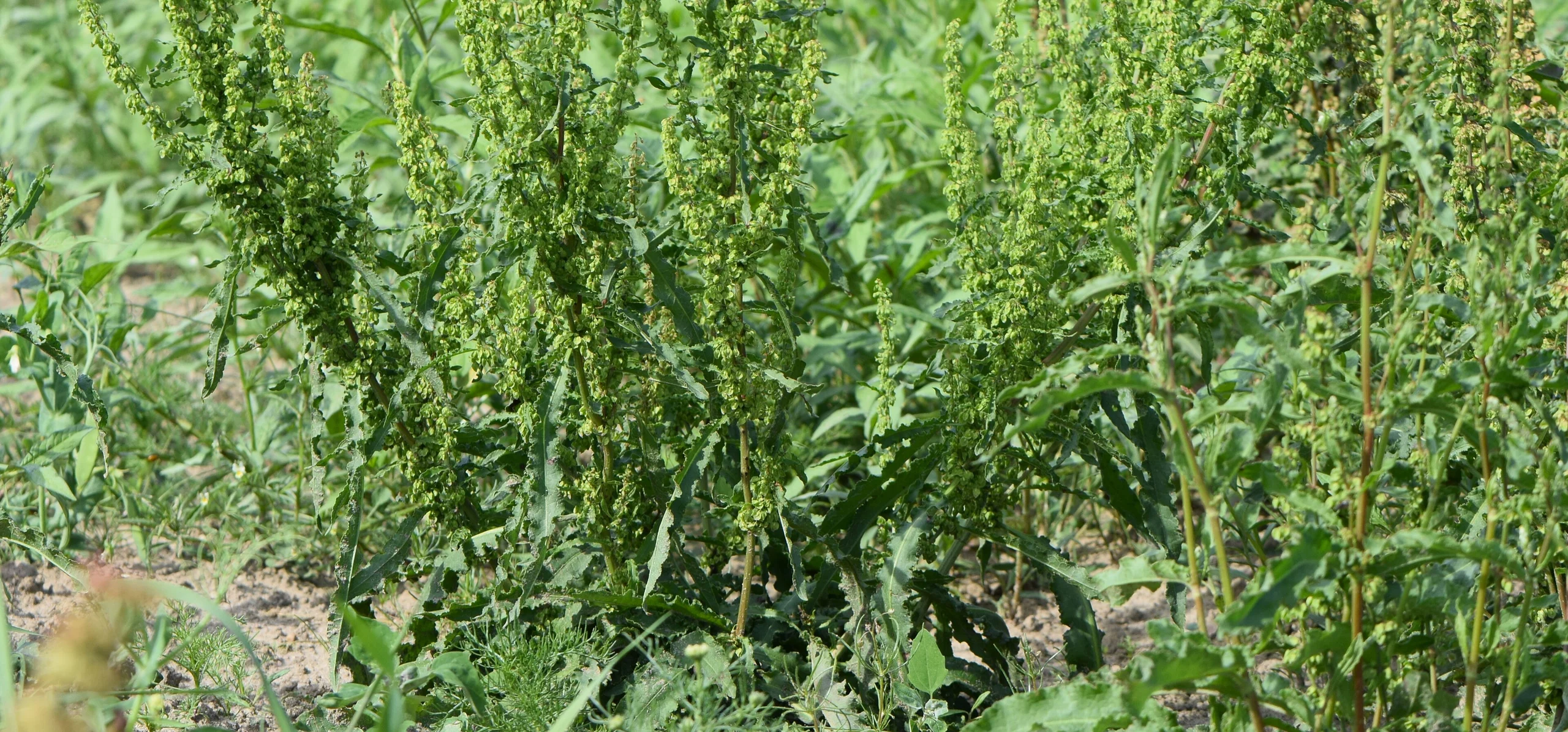
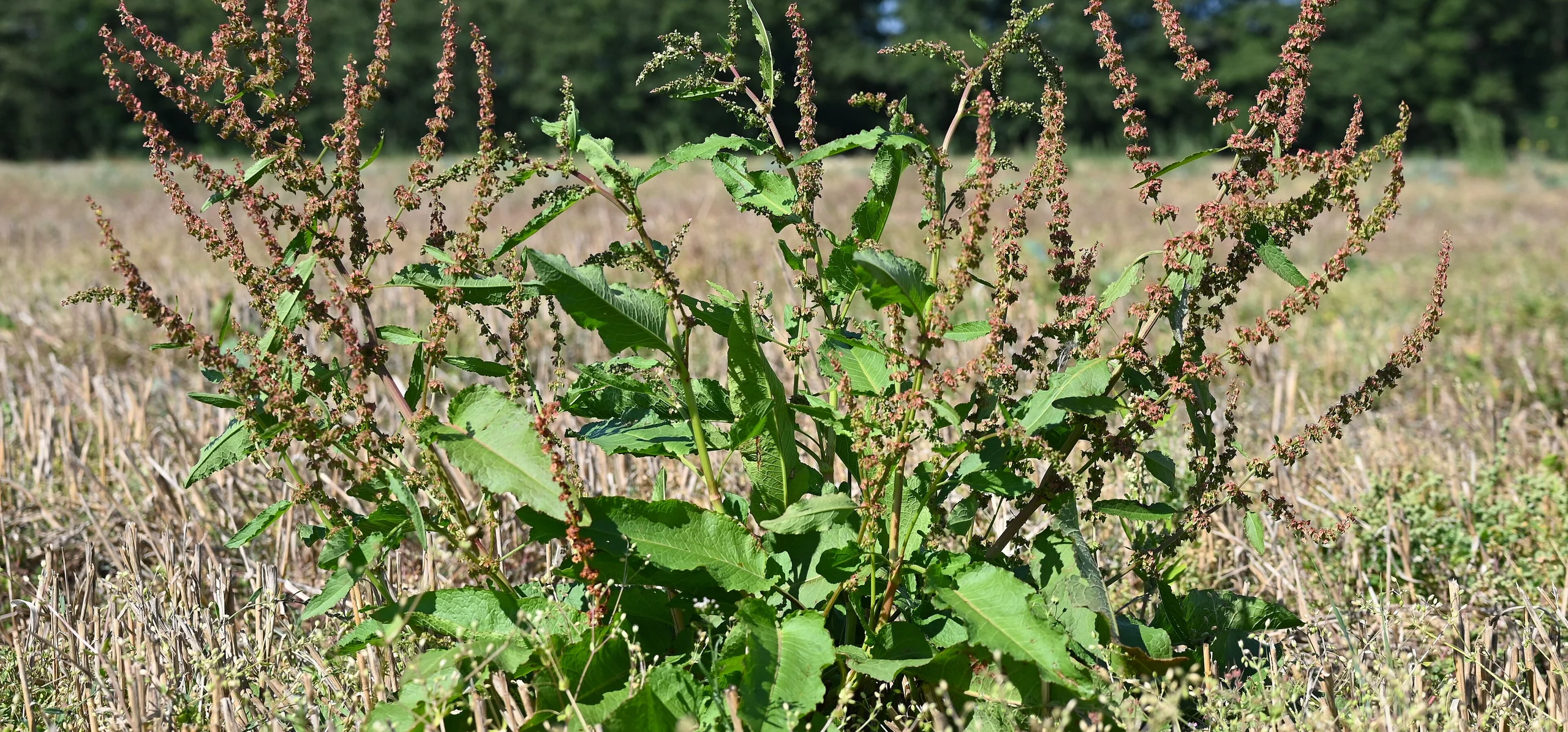
The basal leaves are broad, oblong and long-stalked, smooth-textured, with a base that narrows into a shallow heart shape and veins that often run red against the green blade, according to Cornell's turfgrass and landscape weed identification program. Leaves further up the flowering stem are narrower and shrink in size as they climb, and the whole plant grows as an upright clump rather than sprawling outward. From early summer, dense whorls of small green and red flowers rise on branched spikes above the foliage; the Royal Horticultural Society describes the fruit that follows as the same green and red colour at first, ripening to a russet-brown that persists on the dried stem well into winter. That rust-coloured seed spike, still standing over bare pasture in December, is often the detail people notice before they ever look closely at the leaves.
Origin and Where It Naturalizes Now
Kew's Plants of the World Online lists bitter dock's native range as Europe to Central Siberia and Iran, with a further foothold in northwest Africa, a broad temperate band that explains why it tolerates such a wide swing of climates elsewhere. Outside that range it has followed disturbed and cultivated ground wherever people have gone, and it is now a familiar volunteer far beyond Eurasia. It rarely appears because someone planted it; a patch usually marks ground that was recently dug, overgrazed, or left bare long enough for windborne and animal-carried seed to land and take hold.
Soil, Sun and Moisture It Actually Needs
RHS growing data lists chalk, clay, loam and sand as all acceptable, at any pH from acid through neutral to alkaline, which is close to saying the species is not fussy about soil chemistry at all. It grows in full sun or partial shade, on any aspect, and tolerates ground that is moist but well-drained, poorly drained, or simply well-drained, a spread of tolerance that few deliberately planted garden perennials can match. That flexibility, more than any single preference, is what lets one plant establish equally well in gravel, heavy clay and a boggy pasture corner.


The Taproot: Why Cutting It Back Never Finishes the Job
Underneath every rosette is a single, thick, fusiform taproot that runs well down into the soil before branching, and the RHS notes explicitly that the species spreads by both seed and root regeneration. Mowing or strimming removes the visible leaves and flower spikes but leaves that root untouched, and a fresh rosette pushes back up from the crown within weeks. Even hand-pulling often shears the root at a shallow point, leaving enough tissue behind to regenerate; the crown and the first several centimetres of root are what actually need to come out, not just the top growth.
Bitter Dock vs Curly Dock and Sorrel
The plant most often confused with bitter dock is curly dock, Rumex crispus, whose narrower leaves have a distinctly wavy, crimped margin rather than the broad, smooth, heart-based blade described above; the two species grow in the same disturbed ground and readily hybridize, so intermediate leaf shapes do turn up in the field. True sorrel, Rumex acetosa, is smaller still, with arrow-shaped leaf bases and a sharper, more citrus tang, and it is grown deliberately as a culinary herb rather than treated as a weed. Checking the leaf base, heart-shaped and smooth on bitter dock, wavy-edged and narrower on curly dock, settles most identifications on sight.
Removing a Plant or Patch By Hand
Young plants in loose, damp soil can be levered out whole with a garden fork worked in a full circle around the crown, angled inward to sever the taproot cleanly below the point where it branches. On established plants, a dedicated dock weeder or a narrow spade does the same job with less soil disturbance, and the goal each time is the same: take the crown and the first several centimetres of root, not just the leaves. Any root fragment left behind with a growing point can resprout, so a patch that keeps returning after pulling usually means the tool stopped too shallow rather than that hand-removal has failed outright.
Herbicide and Low-Impact Control Options
Where mechanical removal is not practical across a larger patch or pasture, Cornell's weed identification program lists clopyralid, dicamba, fluroxypyr and glyphosate as post-emergent herbicides used against broadleaf dock, and notes that dicamba controls curly dock more reliably than it controls this broader-leaved relative. The same source lists lower-impact post-emergent options, including pelargonic acid, potassium salts of fatty acids, and clove or lemongrass oil, plus pre-emergent corn gluten meal to slow new seedlings; all of these still require following label directions for the specific product and site. Whatever the method, cutting the flower spikes before the fruit turns russet-brown stops that season's seed from reaching the ground, which matters more over time than any single treatment.
Toxicity to Pets, Livestock and People
The ASPCA lists dock, Rumex species, as toxic to dogs, cats and horses, with soluble calcium oxalates as the toxic principle and drooling, tremors and, rarely, kidney failure as the clinical signs of ingestion. RHS growing advice for this species is consistent with that: gardeners are told to wear protective gloves when handling it and warned it is harmful if eaten in large amounts, a caution that applies to people as much as pets. None of this makes the plant dangerous to touch or to have nearby; the risk is specifically tied to eating a meaningful quantity, which is mostly a concern for grazing livestock and curious dogs rather than anyone simply digging one out of a flower bed.
Test your plant knowledge
Tap a card to flip it and reveal the answer.
Mowing or strimming bitter dock kills the plant because it removes the growing point. Tap to reveal ✕ False
Bitter dock's broad basal leaves have a base that narrows into a shallow heart shape. Tap to reveal ✓ True
Bitter dock only grows well in acidic, sandy soil. Tap to reveal ✕ False
The ASPCA lists dock (Rumex species) as toxic to dogs, cats and horses. Tap to reveal ✓ True
Bitter dock and curly dock are the same species with two different common names. Tap to reveal ✕ False
Sources
References consulted for this guide
- Rumex obtusifolius L., GBIF Backbone Taxonomygbif.org
- Rumex obtusifolius L., Plants of the World Online (Kew)powo.science.kew.org
- Rumex obtusifolius, broad-leaved dock / bitter dock, RHSrhs.org.uk
- Toxic and Non-toxic Plants: Dock, ASPCAaspca.org
- Broadleaf Dock, Cornell Turfgrass and Landscape Weed IDturfweeds.cals.cornell.edu
- Reference entity : Wikipédiaen.wikipedia.org