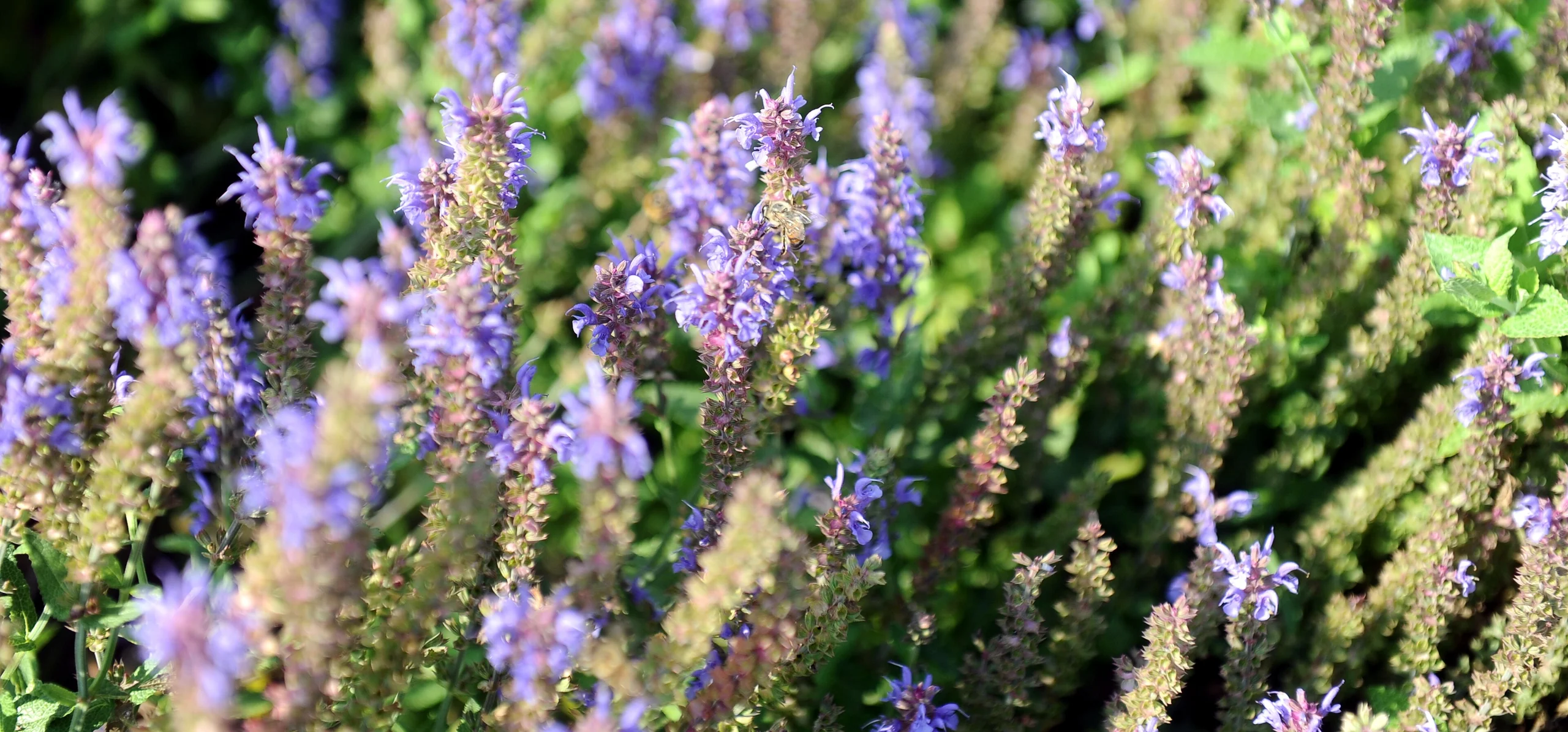
Woodland Sage
Salvia nemorosa
Family · Lamiaceae
Woodland sage needs full sun, lean well-drained soil, and a hard cutback after the first flush of flowers to rebloom into September.
Salvia nemorosa
Plant profile
- WateringLittleWater every 10 days
- Light exposureFull sun
- Hardiness zoneUSDA 4–8
Growth
- Family
- Lamiaceae
- Life cycle
- Perennial
- Growth speed
- 6/10
- Mature size
- 45–90 cm
- Spread
- 15–60 cm
- Flowering
- June to September, with a second flush after cutback
- Propagation
- Seed
- Cutting
- Division
Dormancydies back in winter
Time to maturity2-5 years
Soil & climate
- Soil types
- sandy, loamy, chalky
- Drought tolerance
- Yes
Light & Placement
- Origin
- Europe to western Siberia and Afghanistan
- Where to place it
- sunny border
- gravel garden
- raised bed
- large sunny container
Safety
- Toxicity
- Not listed by the ASPCA for cats, dogs or horses
- Pet safe
- No
Data fromGBIF Backbone Taxonomy: Salvia nemorosa Plants of the World Online (Kew): SalviaRHS: Salvia nemorosa (Balkan clary)Missouri Botanical Garden Plant Finder: NC State Extension Gardener Plant Toolbo
Where it grows
World distribution
Woodland Sage is native to 22 countries: Afghanistan, Albania, Austria, Bulgaria, Croatia, Czechia, France, and Georgia….GBIF records 21,949 documented identifications across 62 countries, with the largest concentrations in Ukraine, Russia, and Germany.
- Afghanistan
- Albania
- Austria
- Bulgaria
- Croatia
- Czechia
- France
- Georgia
- Germany
- Greece
- Hungary
- Iran
Show 10 more countriesShow fewer countries
- Italy
- Kazakhstan
- Poland
- Romania
- Russia
- Spain
- Switzerland
- Tajikistan
- Ukraine
- Uzbekistan
Yellow to orange dots: concentration of documented identifications per country. Green countries: sourced native range. Source: GBIFNative range from POWO (Kew).
Identifying Salvia nemorosa
If you've just brought home a woodland sage, or found one already established and blooming in a border, what you have is a clump-forming perennial in the mint family, closely related to culinary sage but grown for its flower spikes rather than its leaves. Native to a broad band running from Europe to western Siberia and Afghanistan, it forms a woody-based mound of gray-green, wrinkled foliage from which upright spikes of violet-blue flowers rise in early summer. The flowers themselves are small, about half an inch long, but they sit inside persistent reddish-purple bracts that keep the spikes colorful even after the petals drop, which is why a mature clump reads as a solid block of purple from a distance rather than individual blooms.
Named cultivars dominate the trade because the wild species can be leggy: 'Caradonna' pairs near-black flower stems with violet-blue flowers on compact plants, 'Ostfriesland' (East Friesland) is denser and earlier to bloom, and 'Blue Hill' and 'Rugen' both stay low with a truer blue cast. If your plant came without a tag, flower color and stem darkness are the easiest way to guess which cultivar you have; the species type tends to be a looser, taller plant than any of the named selections.
Sun, Site and Soil
Woodland sage wants at least six hours of direct sun. It will grow in light partial shade, but the flower spikes thin out and the stems lean toward the light, so a genuinely sunny border or gravel bed gives the best show. Soil matters more than most gardeners expect for a plant this tough: it tolerates chalk, loam or sand and copes with poor, shallow, rocky ground, but what actually kills it isn't cold, it's standing water. Raise the planting area or work grit into heavy clay before you plant, because a woodland sage sitting in wet soil over winter is far more likely to rot than one that simply freezes.
Space plants roughly 30 to 45 cm apart to give the clump room to widen without crowding, and skip the compost-rich bed you'd prepare for something like a rose. Average to lean soil produces sturdier, more upright stems; overly rich ground produces floppy growth that ends up needing staking.


Watering and Establishment
For the first four to six weeks after planting, water two or three times a week so the roots can knit into the surrounding soil. Once established, usually by the second season, woodland sage is genuinely drought-tolerant and prefers to dry out between waterings rather than stay evenly moist. In most temperate gardens that means little to no supplemental water once the plant is settled, except during an extended summer dry spell, when a deep soak every week or two is enough. Container-grown plants need more frequent checks since pots dry out faster than open ground; let the top few centimetres of mix dry before watering again.
The Summer Cutback That Keeps It Blooming
This is the one piece of maintenance that separates a woodland sage that blooms once and fades from one that flowers from June into September. When the first flush of flower spikes browns and drops its petals, usually four to six weeks after blooming started, cut the entire clump back hard, down to the basal rosette of leaves near the ground, rather than deadheading the spent spikes one by one. Within two to three weeks fresh foliage fills in, and a second, usually lighter, flush of spikes follows. Skip the cutback and the plant will still rebloom sporadically, but nowhere near as heavily, and by midsummer it tends to sprawl and look tired. This is the step most new growers miss: they deadhead individual spikes the way they would with a rose, when what the plant actually needs is a hard, whole-clump haircut.
Winter Hardiness
Woodland sage is reliably hardy through USDA zones 4 to 8, and the RHS rates it H7, hardy in even the severest European continental winters, below −20 °C. In cold-winter regions the top growth dies back completely after the first hard frost, and that's normal, not a sign the plant has died: the crown and root system survive underground and send up new shoots in spring. What actually threatens the plant over winter is wet feet rather than cold itself, so if your soil tends to stay saturated through winter, improving drainage matters more than mulching or covering. Leave the dead stems in place until early spring rather than cutting them back in fall; they offer a little frost protection to the crown and give overwintering insects somewhere to shelter.
Propagation: Division, Cuttings and Seed
Division in spring is the fastest way to multiply an established clump and the most reliable way to keep a named cultivar true, since seed-grown plants can vary in flower color and habit. Lift the clump as new growth begins, split it into sections with a spade or knife so each piece keeps its own roots and shoots, and replant immediately at the same depth. Semi-ripe cuttings taken from non-flowering shoots in summer root readily in a free-draining mix within a few weeks. Growing from seed works for the species type but is a poor choice for named cultivars like 'Caradonna' or 'Blue Hill', since their seedlings won't come true to the parent plant.
Pests, Diseases and Common Mistakes
Woodland sage has few serious problems, which is part of its appeal. Powdery mildew, leaf spot and rust show up occasionally, usually on plants crowded too close together or sitting in soil that stays too wet; better spacing and drainage solve most of it without spraying. Aphids, whitefly and scale appear from time to time but rarely at damaging levels, and slugs and snails will graze new spring growth in wet climates. The most common mistake is planting it in rich, regularly irrigated soil meant for thirstier perennials, which produces soft, floppy stems and shortens the plant's life; the second most common is skipping the post-bloom cutback and then wondering why the flowering has stopped by July.
Test your plant knowledge
Tap a card to flip it and reveal the answer.
Woodland sage is more likely to die from winter cold than from wet soil. Tap to reveal ✕ False
Salvia nemorosa tolerates lean, poor soil better than rich, heavily fed soil. Tap to reveal ✓ True
Deadheading single spent flower spikes works as well as cutting the whole clump back. Tap to reveal ✕ False
Named cultivars like 'Caradonna' come true from seed. Tap to reveal ✕ False
Woodland sage needs at least six hours of direct sun to flower well. Tap to reveal ✓ True
Sources
References consulted for this guide
- GBIF Backbone Taxonomy: Salvia nemorosa L.gbif.org
- Plants of the World Online (Kew): Salvia nemorosapowo.science.kew.org
- RHS: Salvia nemorosa (Balkan clary)rhs.org.uk
- Missouri Botanical Garden Plant Finder: Salvia nemorosamissouribotanicalgarden.org
- NC State Extension Gardener Plant Toolbox: Salvia nemorosaplants.ces.ncsu.edu
- Reference entity : Wikipédiaen.wikipedia.org