Green Foxtail
Setaria viridis
Family · Poaceae
Green foxtail forms bristly seed heads by midsummer and reseeds fast. How to identify Setaria viridis, its life cycle, and how to keep it out of beds.
Setaria viridis
Plant profile
- WateringLittleWater every 10 days
- Light exposurePartial sun
Growth
- Family
- Poaceae
- Life cycle
- Annual
- Growth speed
- 8/10
- Mature size
- 60–180 cm
- Spread
- 30–60 cm
- Flowering
- Bristly green seed heads from early summer through the first frost
- Propagation
- Seed
DormancyNone; the plant dies completely at the first hard frost and overwinters only as seed
Time to maturityFlowers and sets seed within weeks of germination, often producing several generations in one season (Iowa State University Extension and Outreach)
Soil & climate
- Soil types
- clay, sand, shallow rocky soil, poor or disturbed ground
- Saline soil
- Not tolerated
- Drought tolerance
- Yes
Light & Placement
- Origin
- Old World, native range extending to central and southeastern Australia (POWO)
- Where to place it
- bed edges and path margins
- compacted or bare soil
- vegetable garden rows
- field and roadside margins
Safety
- Pet safe
- No
ToxicityNot listed by the ASPCA for cats, dogs or horses; the barbed seed head awns are a mechanical injury risk, not a poisoning risk
Invasive speciesA common agricultural and garden weed across the temperate world; not regulated as noxious in most jurisdictions but capable of several generations of reseeding per year
Data fromSetaria viridis (L.) P.Beauv., Plants ofSetaria viridis, GBIF Backbone TaxonomySetaria viridis, North Carolina ExtensioGreen foxtail, Iowa State University ExtKnow Your Foxtails, University of Maryla
Where it grows
World distribution
Green Foxtail is native to 63 countries: Afghanistan, Albania, Algeria, Australia, Austria, Bangladesh, Belgium, and Bhutan….GBIF records 172,362 documented identifications across 133 countries, with the largest concentrations in France, Germany, and United States.
- Afghanistan
- Albania
- Algeria
- Australia
- Austria
- Bangladesh
- Belgium
- Bhutan
- Bulgaria
- Cambodia
- Chad
- China
Show 51 more countriesShow fewer countries
- Croatia
- Cyprus
- Czechia
- Egypt
- France
- Georgia
- Germany
- Greece
- Hungary
- India
- Indonesia
- Iran
- Iraq
- Italy
- Japan
- Kazakhstan
- Kuwait
- Kyrgyzstan
- Lebanon
- Libya
- Mauritania
- Mongolia
- Morocco
- Myanmar (Burma)
- Nepal
- Netherlands
- Niger
- Oman
- Pakistan
- Palestinian Territories
- Papua New Guinea
- Philippines
- Poland
- Portugal
- Romania
- Russia
- Saudi Arabia
- South Korea
- Spain
- Sudan
- Switzerland
- Taiwan
- Tajikistan
- Thailand
- Tunisia
- Türkiye
- Turkmenistan
- Ukraine
- United Arab Emirates
- Uzbekistan
- Vietnam
Yellow to orange dots: concentration of documented identifications per country. Green countries: sourced native range. Source: GBIFNative range from POWO (Kew).
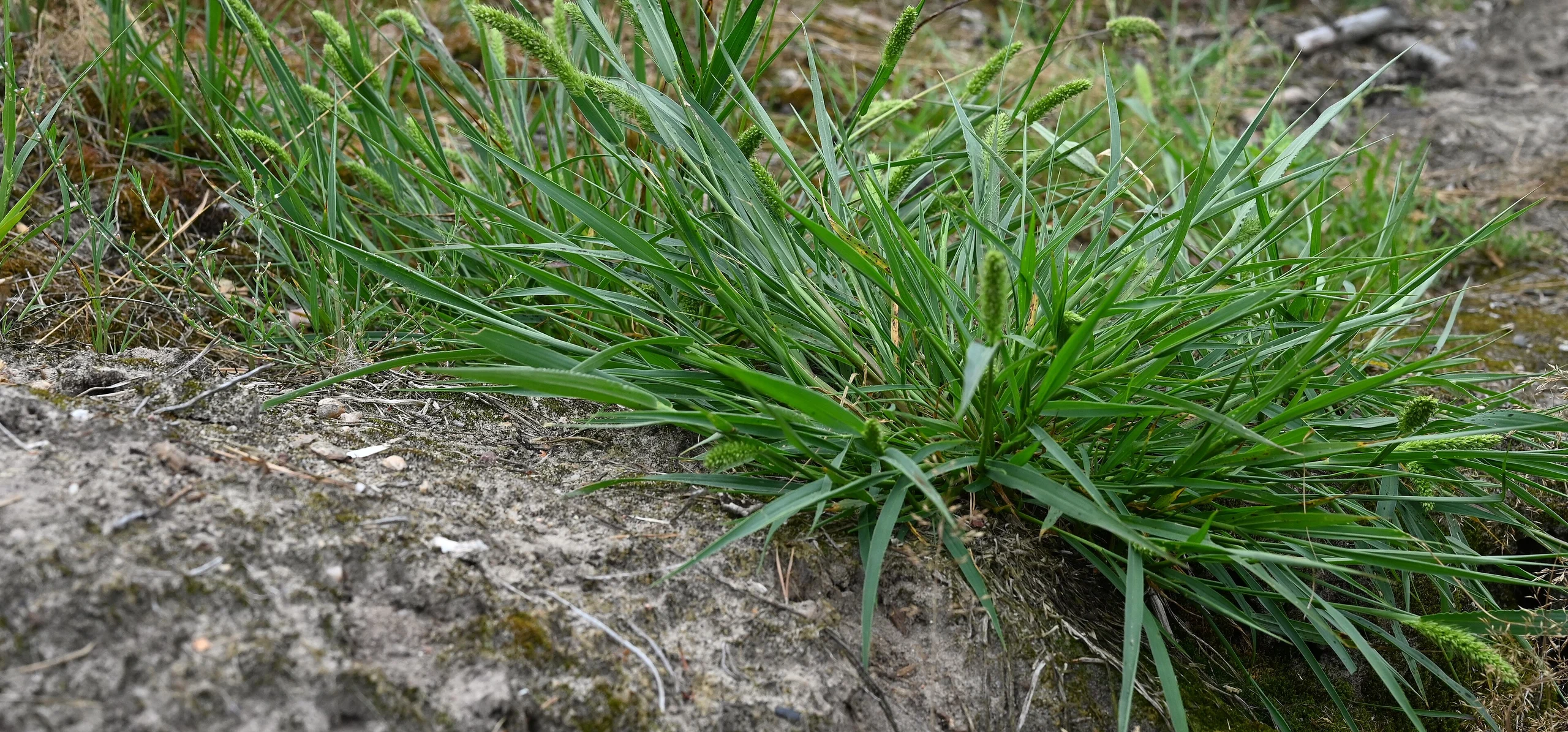
If you have found a low clump of grass topped with a fuzzy, bottlebrush-shaped seed head along a path, in a raised bed, or at the edge of a vegetable patch, you are almost certainly looking at green foxtail, Setaria viridis. It is one of the most common weedy grasses in temperate gardens and farm fields, and it is easy to confirm: run a finger up the seed head and it will feel soft and bristly rather than sharp, and the leaf blades themselves are hairless, unlike its close relative yellow foxtail. This guide covers identification, its one-season life cycle, and how to stop it from reseeding rather than how to grow it as an ornamental.
Identifying green foxtail
Green foxtail grows as an upright, clumping grass from a fibrous root system, typically 2 to 6 feet (about 60 to 180 cm) tall according to the North Carolina State Extension Gardener Plant Toolbox, though many garden plants stay well under 3 feet. The leaf blades are light green, flat, hairless on both surfaces, and up to about 10 inches long. The giveaway is the seed head: a dense, spike-like green panicle 1 to 4 inches long, covered in soft bristles that give it the bottlebrush look the common name describes. The tip of the seed head has a slight downward bend at maturity, and the ligule, the small fringe of hairs where the leaf blade meets the stem, is hairy rather than a membrane, a detail worth checking with a hand lens if you are unsure of the identification.
Green foxtail vs. yellow and giant foxtail
Three foxtails turn up in the same disturbed ground and are easy to confuse. Green foxtail has a round stem base and hairless leaves that Iowa State University Extension and Outreach notes carry the smallest seeds of the three. Yellow foxtail (Setaria pumila) has a flattened stem base and long, sparse hairs on the upper leaf surface near the base, and its seed head ripens to a yellowish or orange tint with shorter bristles. Giant foxtail (Setaria faberi) is the tallest of the group, with a seed head that droops noticeably and leaf blades that are hairy on the upper surface. When in doubt, the leaf surface is the fastest check: bare in green foxtail, hairy in the other two.
Native range and how it became a global weed
Plants of the World Online lists the native range of Setaria viridis as the Old World, extending to central and southeastern Australia, and Iowa State University Extension and Outreach notes it was introduced to North America from Asia. It now grows across most of the temperate world in cultivated fields, gardens, roadsides, and any patch of bare or disturbed soil, which is exactly the habitat it evolved to exploit.


A fast, single-season life cycle
Green foxtail is a summer annual: it germinates from seed, not from any surviving root or crown. University of Maryland Extension records emergence from mid-spring into early summer, with germination continuing in flushes through the growing season whenever the soil stays warm and moist. Iowa State University Extension and Outreach describes it producing several generations within a single season where conditions allow, and the plant sets seed quickly once it flowers, so a clump that looked harmless in June can be scattering thousands of seeds by August. The first hard frost kills the whole plant outright, since it has no cold tolerance and no perennial structure to protect.
Soil, sun, and the conditions it favors
Green foxtail is not fussy. It tolerates clay, sandy, and shallow rocky soils and, per North Carolina State Extension, actually prefers poor, disturbed ground over rich cultivated beds, which is why it shows up first in compacted paths and the thin soil at bed edges. University of Maryland Extension adds that its presence can point to acidic soil. It grows in full sun or partial shade and tolerates both consistently moist ground and short dry spells, an adaptable combination that lets a single seed head colonize almost any open patch of a vegetable garden or ornamental bed.
Managing it in the vegetable garden and lawn
Because every plant depends entirely on seed, the single most effective control is timing: pull or hoe clumps before the seed head hardens and browns, ideally while it is still green and soft. A established clump lifts cleanly with a hand fork thanks to its fibrous, non-spreading roots, unlike a rhizomatous weed. In vegetable beds, a shallow hoeing pass every couple of weeks through late spring intercepts new flushes before they set seed. In lawns, thick, well-fed turf mowed at a taller height crowds out new seedlings faster than any spot treatment; bare or scalped patches are where it re-establishes. Because seed can persist in soil for several seasons, one clean summer rarely finishes the job, plan on repeating the same early removal the following year.
Awns and the injury risk to pets and livestock
Green foxtail is not on the ASPCA's toxic or non-toxic plant lists for cats, dogs, or horses, so this is a mechanical hazard rather than a poisoning risk. University of Maryland Extension warns that the barbed awns on foxtail seed heads can lodge in the mouths and gums of grazing livestock and horses when eaten in dry hay, causing real discomfort. The same bristles are a known problem for dogs that push through seeding grass in summer: the awns are shaped to travel only forward once they catch on fur, skin, or paw webbing, so they burrow in rather than fall out. Checking a dog's paws, ears, and coat after a walk through seeded grass, and mowing paths before the seed heads dry, avoids most of the trouble.
Wildlife value and its cultivated cousin, foxtail millet
Left standing, green foxtail is not without benefit: North Carolina State Extension notes that small mammals and grazing animals will eat the plant, and its abundant small seeds are a minor food source for seed-eating birds through late summer. The species is also the wild ancestor of foxtail millet (Setaria italica), a grain crop domesticated from it in China thousands of years ago and still grown for human food and birdseed today, a reminder that the same bristly seed head causing trouble in a flower bed is, in its cultivated form, feeding people on another continent.
Test your plant knowledge
Tap a card to flip it and reveal the answer.
Green foxtail is a perennial that regrows from the same roots every year. Tap to reveal ✕ False
The fastest way to tell green foxtail from yellow and giant foxtail is to check whether the leaf blades are hairy. Tap to reveal ✓ True
Green foxtail is listed as toxic to dogs, cats, and horses by the ASPCA. Tap to reveal ✕ False
Pulling or hoeing green foxtail before its seed head hardens is more effective than removing it after the seed has dried. Tap to reveal ✓ True
Green foxtail only grows in rich, well-cultivated garden soil. Tap to reveal ✕ False
Sources
References consulted for this guide
- Setaria viridis (L.) P.Beauv., Plants of the World Online (Kew)powo.science.kew.org
- Setaria viridis, GBIF Backbone Taxonomygbif.org
- Setaria viridis, North Carolina Extension Gardener Plant Toolboxplants.ces.ncsu.edu
- Green foxtail, Iowa State University Extension and Outreach, Integrated Crop Managementcrops.extension.iastate.edu
- Know Your Foxtails, University of Maryland Extensionextension.umd.edu
- Reference entity : Wikipédiaen.wikipedia.org