Peace Lily
Spathiphyllum wallisii
Family · Araceae
Peace lily (Spathiphyllum wallisii) needs bright indirect light, evenly moist soil and high humidity; here is why it droops, browns and will not flower.
Spathiphyllum wallisii
Plant profile
- WateringHighWater every 6 days
- Light exposurePartial shade
- Ideal temperature16–29 °C
Growth
- Family
- Araceae
- Life cycle
- Perennial
- Growth speed
- 3/10
- Mature size
- 10–50 cm
- Spread
- 10–50 cm
- Propagation
- Division
FloweringWhite spathe wrapped around a central spadix; needs bright indirect light to bloom well
DormancyNo true winter dormancy; growth slows and cold damage risk rises below about 15.6°C (60°F) (Clemson HGIC)
Time to maturity5 to 10 years to reach full height and spread (RHS)
Soil & climate
- Soil types
- chalk, loam, sand
- Drought tolerance
- No
Light & Placement
- Origin
- Native to Colombia and Venezuela (POWO)
- Where to place it
- East-facing windowsill out of direct sun (UMN Extension)
- Office desk under fluorescent light, though flowering is rare there (UMN Extension)
- Bright bathroom with steady humidity
- Sheltered, shaded patio in summer only, moved indoors before frost (RHS, H1B)
- Pot with drainage holes, peat-free compost (RHS)
Safety
- Toxicity
- CatsToxic
- DogsToxic
- HorsesToxic
- HumansToxic
Data fromSpathiphyllum wallisii Regel, GBIF BackbPOWO: Spathiphyllum wallisiiRHS: Spathiphyllum wallisii (Wallis peacASPCA: Toxic and Non-toxic Plants, PeaceClemson HGIC Factsheet: Peace Lily
Where it grows
World distribution
Peace Lily is native to 2 countries: Colombia and Venezuela.GBIF records 585 documented identifications across 62 countries, with the largest concentrations in Brazil, Costa Rica, and United States.
- Colombia
- Venezuela
Yellow to orange dots: concentration of documented identifications per country. Green countries: sourced native range. Source: GBIFNative range from POWO (Kew).
A Spathiphyllum wallisii arriving from the nursery with tight buds and glossy, dark green leaves is about to become one of the most forgiving houseplants in the home, as long as it never sits in direct sun or in soggy, waterlogged soil. Despite the common name, peace lily, GBIF places the species in the arum family Araceae, not among true lilies, and POWO records its native range as Colombia to Venezuela, where it grows on shaded, humid forest floors. The RHS calls it the Wallis peace lily and notes it is the most widely sold and popular of the peace lilies grown as houseplants. Within days of a dry spell the whole plant collapses dramatically over the rim of its pot, which looks alarming the first time but is in fact the clearest watering signal any houseplant gives.
Light and placement
Clemson HGIC describes the ideal spot as bright, indirect light, while the RHS classifies the species for partial shade and notes that flowering drops off in deep shade. In practice that means an east-facing windowsill, or a position a few feet back from a south- or west-facing window where a curtain filters the light. University of Minnesota Extension lists peace lily among the plants that tolerate the steady fluorescent light of an office, which is why it survives on desks with no natural light at all, though it rarely flowers there. Direct midday sun is the one condition to avoid: Clemson notes it will scorch the foliage, leaving pale, bleached patches that do not recover. Clemson also recommends daytime temperatures of 68 to 85°F, about 20 to 29°C, and warns against letting the plant sit below 60°F, about 15.6°C; the RHS rates the species H1B, needing a minimum of 10 to 15°C and frost-free conditions if the pot spends summer outdoors.
Watering the right way
Clemson HGIC's guidance is to keep the potting mix moist but not soggy, letting the top dry out slightly between waterings, and to use room-temperature water rather than water straight from a cold tap. The plant should never be left standing in the water that collects in a saucer, since Clemson warns this leads to root and stem rot. What makes Spathiphyllum wallisii unusual among houseplants is how clearly it announces thirst: the leaves and stems go limp and the whole plant droops over the pot within a day or two of drying out, then stand back up within hours of a thorough watering. That dramatic recovery is convenient but not something to rely on every week, since repeated wilting stresses the roots over time. The RHS instructs growers to water and mist freely during active growth, which for most homes means checking the pot roughly once a week rather than on a fixed schedule.
How often to water your Peace Lily
Soil, potting mix and feeding
The RHS lists chalk, loam and sand as suitable soil types, used as a moist but well-drained, peat-free compost, while Clemson notes the plant flourishes in almost any well-drained potting mix as long as it never turns waterlogged. A standard houseplant or aroid mix in a pot with drainage holes satisfies both recommendations. Feeding needs are modest: Clemson recommends a balanced liquid houseplant fertiliser, such as a 20-20-20 formula, diluted to one-quarter strength and applied every six to eight weeks through the spring and summer growing season, with none in winter. Overfeeding is a common mistake, and Clemson is specific about the result: leaf tips and roots burn and turn brown when fertiliser builds up faster than the plant can use it.
Humidity and brown leaf tips
As a rainforest floor plant, Spathiphyllum wallisii is happiest with steady humidity, and the RHS instructs growers to maintain high humidity alongside frequent misting during active growth. Dry indoor air, particularly from central heating in winter, is the most common cause of crisp brown tips on otherwise healthy leaves. Grouping plants together, standing the pot on a tray of damp pebbles, or running a small humidifier nearby all help. Clemson also flags overfertilising and mineral buildup from hard tap water as separate causes of the same brown-tip symptom, so a plant that keeps browning despite even watering and good humidity is worth checking on the fertiliser schedule first.
Getting it to flower
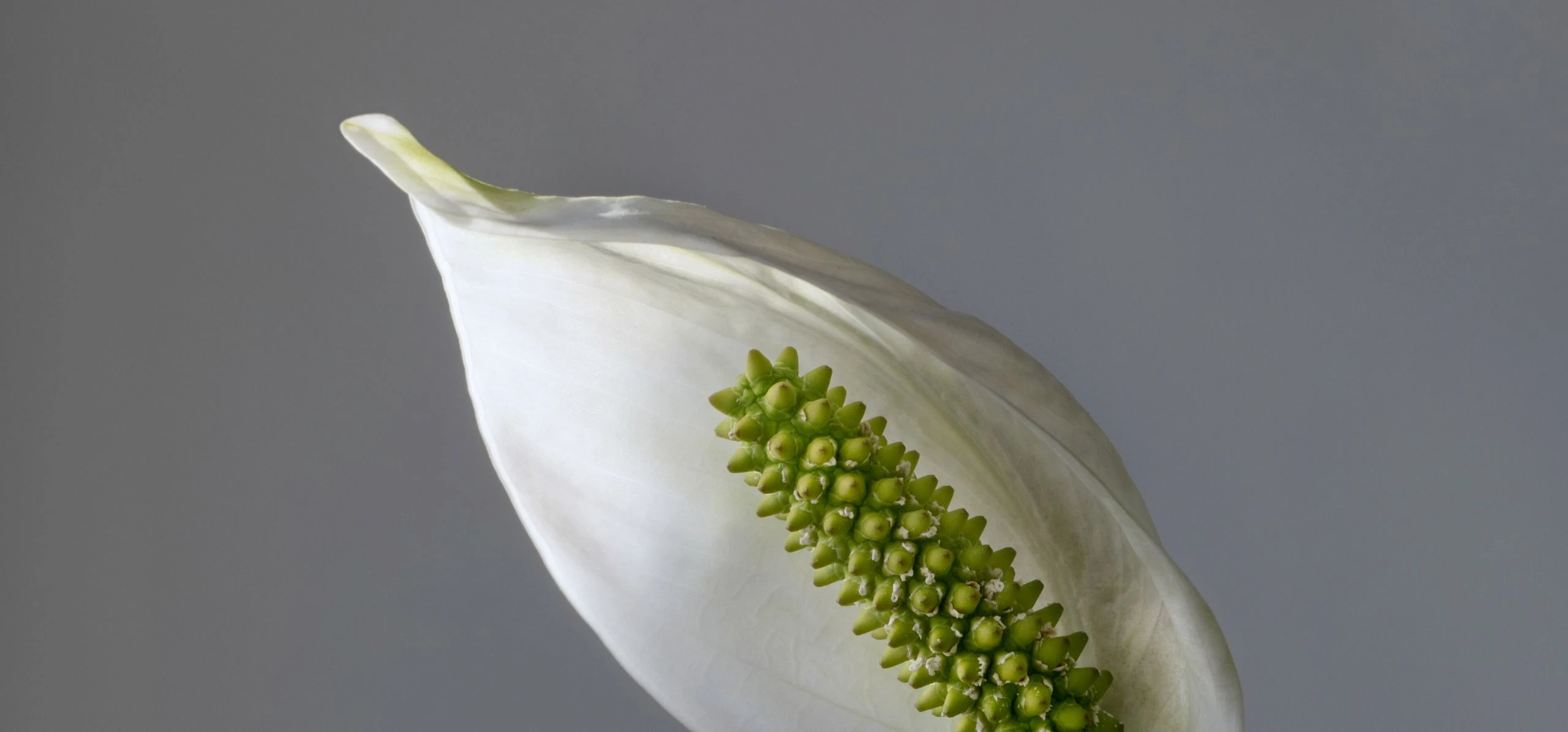
Those upright white blooms are not petals at all: what looks like a single white flower is a spathe, a modified leaf that wraps around the true flower spike, the spadix, at its centre. RHS-listed cultivars sold under the wallisii name vary a great deal in size, from compact thirty-centimetre forms bred for small pots up to roughly one-metre selections with spathes about ten centimetres long. Across all of them the same rule applies: Clemson and the RHS both point to insufficient light as the main reason a healthy, leafy plant refuses to bloom, since flowering drops off sharply in deep shade. Move a non-flowering plant to a brighter, indirectly lit spot before assuming anything else is wrong. Once a bloom fades and turns green, cut its stalk back to the base to tidy the plant and redirect energy into the next flower spike.
Repotting and propagation by division
The RHS lists division, carried out in winter or immediately after flowering, as the propagation method for Spathiphyllum wallisii; it does not grow from leaf or stem cuttings. Repotting is the natural moment to divide a mature plant: tip it out of its pot and the rootball will usually separate into several distinct crowns, each with its own leaves and roots. Gently pull or cut a crown away with healthy roots attached and pot it into fresh, well-drained compost of its own. The RHS records that Spathiphyllum wallisii takes five to ten years to reach its full ten-to-fifty-centimetre height and spread, so a newly divided crown will take time to bulk back up to flowering size.
Common problems, pests and toxicity
Clemson HGIC lists fungus gnats, mealybugs, spider mites and scale as the pests most likely to turn up on an indoor peace lily, alongside root and stem disease that follows overwatering. Yellowing leaves usually trace back to letting the pot dry out too far between waterings, while Clemson notes that a magnesium deficiency shows up differently, as yellow tissue between leaf veins that stay green. Safety is worth taking seriously: the ASPCA lists Spathiphyllum as toxic to cats, dogs and horses, since the leaves and stems contain insoluble calcium oxalate crystals that irritate the mouth and throat if chewed, and the RHS separately warns the sap is harmful if eaten and can irritate skin and eyes, so gloves are worth wearing when dividing or repotting a large clump. Keep the plant out of reach of pets and small children.


Test your plant knowledge
Tap a card to flip it and reveal the answer.
Peace lilies flower better in bright, indirect light than in deep shade. Tap to reveal ✓ True
The white part of a peace lily bloom is a petal. Tap to reveal ✕ False
A drooping peace lily is a reliable sign that it needs water. Tap to reveal ✓ True
Peace lilies propagate readily from leaf cuttings. Tap to reveal ✕ False
Peace lilies are safe for cats, dogs and horses to chew. Tap to reveal ✕ False
Sources
References consulted for this guide
- Spathiphyllum wallisii Regel, GBIF Backbone Taxonomygbif.org
- POWO: Spathiphyllum wallisiipowo.science.kew.org
- RHS: Spathiphyllum wallisii (Wallis peace lily)rhs.org.uk
- ASPCA: Toxic and Non-toxic Plants, Peace Lilyaspca.org
- Clemson HGIC Factsheet: Peace Lilyhgic.clemson.edu
- Reference entity : Wikipédiaen.wikipedia.org