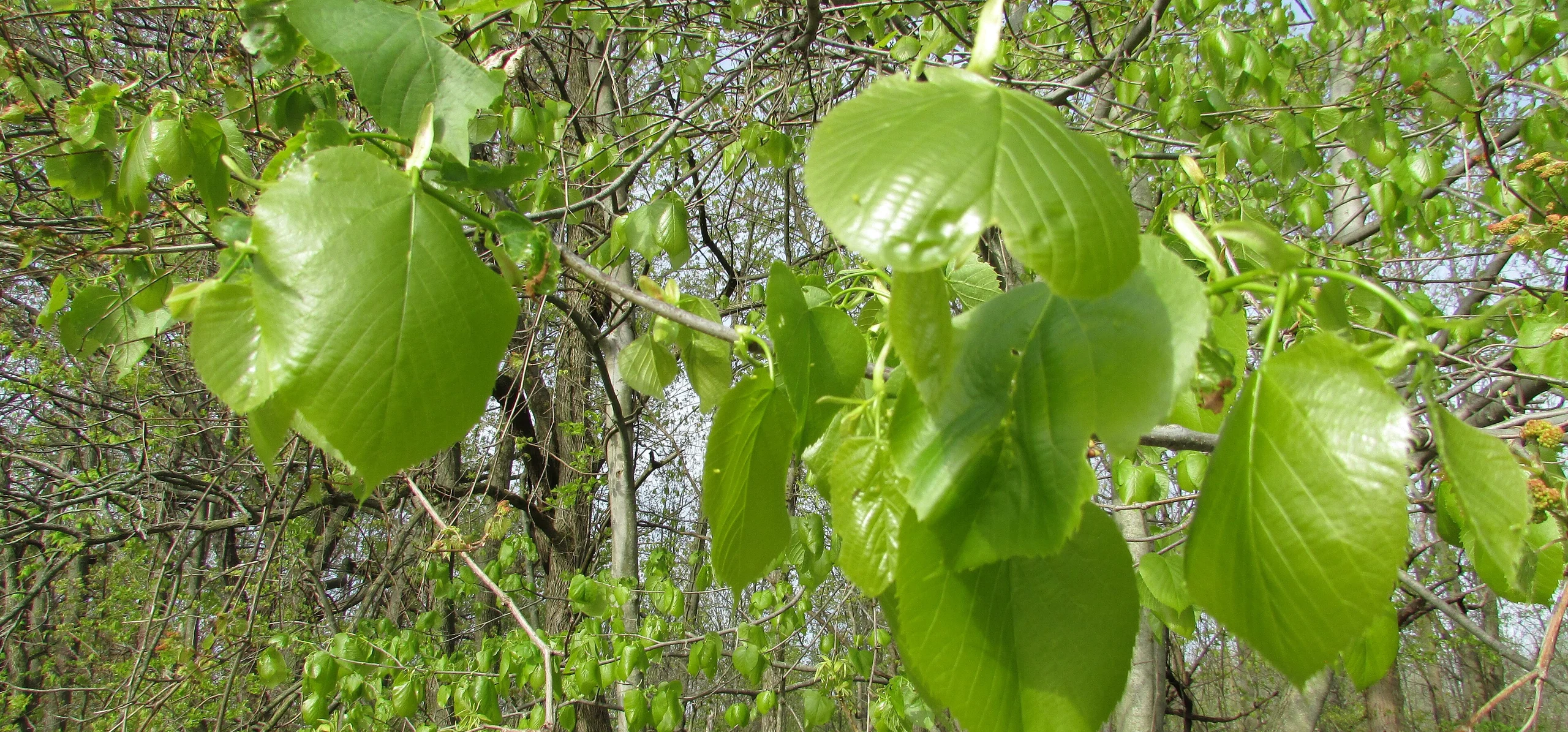
American Basswood
Tilia americana
Family · Malvaceae
American basswood tolerates sun or shade, adapts to clay, loam, or sandy soil, and draws more bees to its fragrant flowers than almost any hardwood.
Tilia americana
Plant profile
- WateringModerateWater every 7 days
- Light exposurePartial sun
- Hardiness zoneUSDA 3–8
Growth
- Family
- Malvaceae
- Life cycle
- Perennial
- Growth speed
- 5/10
- Mature size
- 1830–2440 cm
- Spread
- 910–1830 cm
- Flowering
- Fragrant cream to pale yellow flowers, late spring to midsummer
- Propagation
- Seed
Dormancydeciduous, dormant in winter
Soil & climate
- Soil types
- clay, loam, sand
- Drought tolerance
- Yes
Light & Placement
- Origin
- Central and eastern Canada to Mexico (POWO)
- Where to place it
- open lawn
- park
- shade tree
- street or boulevard planting
Safety
- Toxicity
- CatsSafe
- DogsSafe
- HorsesSafe
Data fromGBIF Backbone Taxonomy: Tilia americana Plants of the World Online (Kew): Tilia ASPCA: Toxic and Non-Toxic Plants, LindeNC State Extension Gardener Plant ToolboUniversity of Nebraska-Lincoln Forestry:
Where it grows
World distribution
American Basswood is native to 3 countries: Canada, Mexico, and United States.GBIF records 70,819 documented identifications across 42 countries, with the largest concentrations in United States, Germany, and Canada.
- Canada
- Mexico
- United States
Yellow to orange dots: concentration of documented identifications per country. Green countries: sourced native range. Source: GBIFNative range from POWO (Kew).
American basswood (Tilia americana) is a big, fast-growing native shade tree that reaches 60 to 80 feet tall with a 30 to 60 foot spread once mature, and it earns that space with fragrant, pale yellow flowers that bees work harder for than almost any other North American hardwood. It tolerates full sun or partial shade, grows in clay, loam, or sandy soil across a wide pH range, and survives winters down to roughly -35F once established, which puts it comfortably in USDA hardiness zones 3a to 8b. The one thing it will not forgive is a site with compacted, poorly drained soil hemmed in by pavement: give the roots open ground and this tree needs almost nothing else from a gardener.
Native Range and Where It Fits Botanically
Plants of the World Online (Kew) lists the native range of Tilia americana as central and eastern Canada to Mexico, a spread that runs from the boreal edge of Ontario and Quebec down through the hardwood forests of the eastern and central United States. GBIF places the species in the family Malvaceae, the mallow family, alongside hibiscus and okra, rather than the older Tiliaceae classification still printed in some field guides and extension bulletins; the flowers and mucilaginous inner bark that once defined a standalone linden family are now understood as one branch of a much larger mallow lineage. In the wild, basswood grows in rich, moist woods, along stream banks, and on slopes with other hardwoods such as sugar maple, a useful clue to the site it wants in a garden: not a dry, exposed corner, but ground that holds some moisture and organic matter.
Choosing a Site: Light, Soil, and Space
North Carolina State Extension rates basswood for full sun or partial shade and for clay, loam, or sandy soil across acid, neutral, and alkaline pH, which in practice means it is not a fussy tree about what is underfoot. What it does want is room: a mature specimen reaches 60 to 80 feet tall and 30 to 60 feet wide, so plant it well clear of the house, driveway, other large trees, and overhead wires. Full sun produces the densest crown and the heaviest flowering; a partly shaded site still grows a healthy tree, just a slightly more open one that leans toward the light.
Planting and the First Few Years
Plant a young basswood in spring or fall, setting the root flare level with or just above the surrounding soil so the trunk does not end up buried under a mound of mulch, a mistake that slowly girdles a tree over years rather than killing it outright. Water deeply and regularly through the first two growing seasons while the root system establishes, then taper off as the canopy fills in. Once it is settled, basswood is genuinely drought-tolerant and asks for supplemental water only in extended dry spells; a ring of mulch kept back from the bark does more for a young tree's root growth than any amount of fertilizer.


Pruning: Shape Early, Then Leave It Alone
The pruning that matters most on basswood happens while the tree is young, before a single dominant leader and well-spaced scaffold branches harden into place; a sapling left to fork low and multi-stemmed tends to stay that way, and old, weak-angled unions are the first thing to fail in an ice storm. Prune in late winter, while the tree is dormant and the branch structure is easy to see, removing crossing, rubbing, or damaged wood rather than reshaping the whole crown at once. Basswood wood decays readily once damaged or heavily wounded, so avoid large cuts on a mature tree; old street and park specimens commonly develop hollow trunks and cavities over the decades, a trait that is genuinely valuable to cavity-nesting wildlife even as it limits how hard an arborist should ever cut one back.
Flowering, Bees, and the Honey Connection
Basswood flowers in late spring to midsummer, opening small, fragrant, cream to pale yellow flowers in drooping clusters around five inches long, each cluster oddly fused partway along a pale bract that later acts as a wing for the seed. The scent alone marks the tree from a distance for a week or two, and it is not just pleasant: basswood is a genuinely prolific nectar producer, prized enough by beekeepers that basswood honey is sold as its own light, distinctively flavored varietal. The small, downy, pea-sized nutlets that follow ripen brown by late summer and are eaten by squirrels and birds into fall.
Pests, Diseases, and Common Mistakes
Basswood is a relatively trouble-free tree, but it is not pest-free. Linden aphids build up on the undersides of leaves in warm weather and drip sticky honeydew onto whatever is parked or sitting underneath, Japanese beetles skeletonize leaves in midsummer where that beetle is established, and spider mites can flare up during hot, dry stretches. Verticillium wilt is uncommon but can kill a stressed tree outright, while powdery mildew and leaf spot diseases are mostly cosmetic. The tree is also sensitive to heat stress and soil compaction, which is exactly the combination found in a narrow strip between a sidewalk and a street, so the most common mistake with basswood is not really a care error at all: it is planting a tree built for open, moist woodland into a hot, compacted urban strip where it was never going to thrive.
Wildlife Value in the Landscape
Beyond the bees, basswood is a larval host plant for the Eastern tiger swallowtail butterfly, and its seeds and buds feed songbirds and small mammals through the colder months. Older trees with hollow trunks and branch cavities, the same decay that limits heavy pruning, become nest sites for cavity-nesting birds and den trees for mammals, a benefit worth weighing against the tidy instinct to remove every damaged limb on an old specimen. Planted as a shade tree over a lawn or along a wide boulevard, basswood does double duty: fast, dense summer shade, and a stretch of early summer when the whole tree hums with bees.
Toxicity and Pet Safety
The ASPCA lists linden (Tilia americana) as non-toxic to dogs, cats, and horses, so there is no need to fence a basswood off from pets that chew on fallen leaves or low branches. That safety record, combined with its low-maintenance habit and wildlife value, is a large part of why basswood keeps turning up as a street and park tree recommendation across its hardiness range, despite being overshadowed in nurseries by faster-selling ornamental cultivars.
Test your plant knowledge
Tap a card to flip it and reveal the answer.
American basswood tolerates both full sun and partial shade. Tap to reveal ✓ True
Basswood is toxic to dogs and cats. Tap to reveal ✕ False
Basswood flowers are a major nectar source and are used to produce a distinct varietal honey. Tap to reveal ✓ True
Basswood needs consistently soggy soil and struggles with any dry spells. Tap to reveal ✕ False
Basswood is only cold-hardy in warm climates, from USDA zone 9 upward. Tap to reveal ✕ False
Sources
References consulted for this guide
- GBIF Backbone Taxonomy: Tilia americana L.gbif.org
- Plants of the World Online (Kew): Tilia americana L.powo.science.kew.org
- ASPCA: Toxic and Non-Toxic Plants, Lindenaspca.org
- NC State Extension Gardener Plant Toolbox: Tilia americanaplants.ces.ncsu.edu
- University of Nebraska-Lincoln Forestry: American Linden (Basswood)nfs.unl.edu
- Reference entity : Wikipédiaen.wikipedia.org