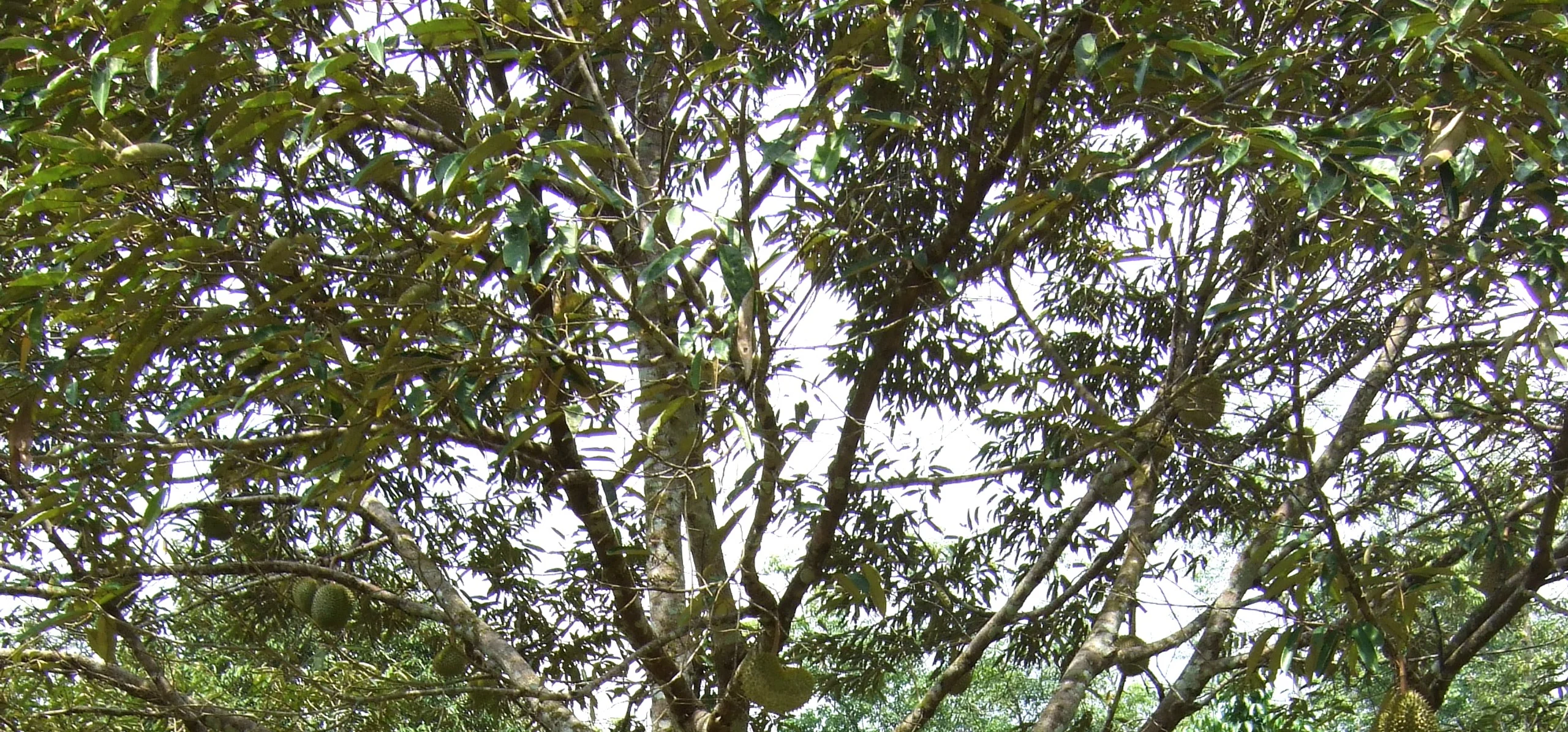
Durian
Durio zibethinus
Family · Malvaceae
A durian seed sprouts within days, but the tree needs equatorial heat, constant humidity and 7 to 12+ years before it ever fruits from seed.
Durio zibethinus
Plant profile
- WateringHighWater every 6 days
- Light exposureFull sun
- Ideal temperature7–35 °C
- Humidity80–90 %
- Hardiness zoneUSDA 11–12
Growth
- Family
- Malvaceae
- Life cycle
- Perennial
- Growth speed
- 4/10
- Mature size
- 2700–4000 cm
- Flowering
- Fruit matures roughly 3.5 to 4.5 months after successful pollination
- Propagation
- Seed
- Grafting
Dormancyno true dormancy; evergreen, growth only slows well outside its tropical optimum
Time to maturityseed-grown trees typically first flower after 9 to 12+ years (as fast as 7 in ideal conditions); grafted trees fruit in about 4 to 8 years
Soil & climate
- Soil types
- loam
- Drought tolerance
- No
Light & Placement
- Origin
- Sumatra and Borneo (POWO); widely cultivated across tropical Southeast Asia
- Where to place it
- Brightest available window with several hours of direct sun
- Heated greenhouse with supplemental grow light
- Full sun in a frost-free equatorial lowland orchard, below about 800 m elevation
- Large, deep, well-draining container, understood as housing a foliage seedling rather than a future fruiting tree
Safety
- Toxicity
- Not evaluated by the ASPCA; toxicity to pets undetermined
- Pet safe
- No
Invasive speciesnot generally listed as invasive; cultivation stays confined to humid tropical lowlands
Data fromDurio zibethinus Murray, GBIF Backbone TDurio zibethinus L., Plants of the WorldDurian, in Fruits of Warm Climates (J. MDurian for Hawai'i, University of Hawaii
Where it grows
World distribution
Durian is native to 2 countries: Indonesia and Malaysia.GBIF records 1,353 documented identifications across 32 countries, with the largest concentrations in Malaysia, Indonesia, and Thailand.
- Indonesia
- Malaysia
Yellow to orange dots: concentration of documented identifications per country. Green countries: sourced native range. Source: GBIFNative range from POWO (Kew).
A durian seed pulled fresh from the custard-like flesh looks like a small, glossy chestnut, and it is tempting to push it straight into a pot. That instinct is not wrong: Durio zibethinus germinates quickly when the seed is fresh, often in three to eight days, but the seed is short-lived and loses the ability to sprout within about a week unless it is specially treated. What follows the sprout is the real commitment: a forest tree that can reach 27 to 40 meters (90 to 130 feet) in its native Sumatra and Borneo, needs a decade or more before a seed-grown specimen ever flowers, and produces a fruit better known for its smell and its weight than for anything else about it.
Germinating a Durian Seed at Home
Rinse the clinging pulp off the seed and plant it right away in loose, moist, well-draining medium; waiting even a few days lowers the odds, since durian seed is recalcitrant and cannot be dried or stored like a bean or a squash seed. In cool storage a seed stays viable for only about a week, though surface-sterilizing it and sealing it in an airtight container at around 20 degrees Celsius (68 degrees Fahrenheit) can stretch that to roughly a month. Germination itself is fast, typically three to eight days, and drying the seed for a day or two before sowing has been shown to improve the germination rate rather than harm it. The common mistake is treating the seed like a keepsake, tucking it in a drawer or the refrigerator for later: by the time it is finally planted, it is usually dead.
What Durio zibethinus Actually Needs to Thrive
This is a lowland equatorial species, not a general tropical one: it is cultivated up to about 600 meters in Sri Lanka, 700 meters in the Philippines and 800 meters in Malaysia, and above those altitudes the climate simply is not warm and wet enough. It wants abundant, year-round rainfall, relative humidity of at least 80 percent, and deep, well-draining alluvial or loamy soil that never lets the root zone dry out. Cold is the hard limit: growth already suffers once temperatures drop toward 10 degrees Celsius (50 degrees Fahrenheit), and the species has been recorded surviving briefly down to about 7 degrees Celsius (45 degrees Fahrenheit) only by losing its leaves and struggling afterward. There is no frost tolerance at all, which rules out durian as an outdoor tree anywhere outside the true wet tropics.
From Flower to Fruit: Why It Takes So Many Years
Seedling trees are slow and unpredictable: in Malaya some have flowered in as little as seven years, but nine to twelve years is more typical, and in marginal growing climates trees have taken thirteen to twenty-one years to reach first bloom. Grafted trees skip most of that wait, commonly fruiting in about four to eight years, which is exactly why nearly every commercial orchard plants grafted stock instead of raising trees from seed.


The Smell and the Danger of Standing Under a Fruiting Tree
Ripe durian releases a heavy, pervasive smell that people often describe as a mix of rotting onion, pungent cheese and turpentine, strong enough that it is barred from hotel rooms, buses and other enclosed public spaces across parts of Southeast Asia. The fruit adds a second, more physical hazard: it is not cut from the branch but left to drop on its own once the ripening stem tissue weakens, and a spine-covered fruit weighing up to 8 kilograms falling from a tree that can top 30 meters is a genuine risk to anyone standing underneath. Orchard workers harvest around this by netting productive trees or tying individual fruits to the branch, but a mature durian standing in open ground is not somewhere to linger during fruiting season.
Pollinated by Bats After Dark
Durian flowers open and become receptive from late afternoon through the night, shedding their pollen around early evening, on a schedule built around nocturnal visitors rather than daytime insects. The main pollinators are bats, chiefly the cave nectar bat (Eonycteris spelaea) and the lesser dog-faced fruit bat (Cynopterus brachyotis), with moths, ants and large beetles playing a smaller supporting role. The flowers are largely self-incompatible, and natural fruit set without effective cross-pollination has been measured at only around 20 to 25 percent in peninsular Malaya, which is one reason bat conservation is directly tied to durian yields in the region.
'Musang King', 'Monthong', and Why Named Varieties Dominate
Because seedling trees are so slow and their fruit quality so inconsistent, almost everything sold as durian today comes from grafted, named cultivars rather than trees grown from seed. Malaysia's 'Musang King' and Thailand's 'Monthong' are the two varieties most widely exported and recognized outside their home countries, prized for markedly different flesh: one dense, bitter-sweet and custardy, the other milder and sweeter. Thailand alone has named several hundred durian varieties over the decades, a testament to how much selection has shaped the fruit found in markets compared with an unselected seedling tree.
Growing a Durian in a Pot Indoors: A Reality Check
No home comes close to equatorial lowland conditions: sustained heat, humidity above 80 percent, intense light and, eventually, the deep root run of a tree that reaches tens of meters outdoors. A potted seedling kept indoors can survive for years as a foliage plant if it gets the brightest window available or a grow light, a constant source of humidity, and a temperature that never drops near the 10 degree Celsius danger line, but it will not flower or fruit confined to a container. Treat an indoor durian as a long-term curiosity, not a future source of fruit, and expect to eventually need a heated greenhouse or a genuinely tropical climate if fruiting is the goal.
Toxicity and Pet Safety
Durio zibethinus does not currently appear as its own entry in the ASPCA's toxic and non-toxic plant database, so there is no official determination for cats, dogs or horses either way. Treat the plant as unassessed rather than confirmed safe, and keep pets away from the fallen husk regardless of toxicity: the woody spines are a real puncture and choking hazard on their own.
Test your plant knowledge
Tap a card to flip it and reveal the answer.
A durian seed saved in the refrigerator for a few weeks will still sprout when you plant it. Tap to reveal ✕ False
Durio zibethinus can tolerate a light, brief frost without lasting damage. Tap to reveal ✕ False
A tree grown from durian seed can take a decade or more before it ever flowers. Tap to reveal ✓ True
The durian's flowers rely mainly on nectar-feeding bats visiting after dark for pollination. Tap to reveal ✓ True
A ripe durian fruit is always cut from the branch and never left to fall on its own. Tap to reveal ✕ False
Sources
References consulted for this guide
- Durio zibethinus Murray, GBIF Backbone Taxonomygbif.org
- Durio zibethinus L., Plants of the World Online (Kew)powo.science.kew.org
- Durian, in Fruits of Warm Climates (J. Morton), Purdue University Center for New Cropshort.purdue.edu
- Durian for Hawai'i, University of Hawaii CTAHRctahr.hawaii.edu
- Reference entity : Wikipédiaen.wikipedia.org