Velvetleaf
Abutilon theophrasti
Family · Malvaceae
Velvetleaf is a fast-growing Malvaceae annual best known as a farm weed: how to spot it, why it invades fields, and how to grow or remove it safely.
Abutilon theophrasti
Plant profile
- WateringLittleWater every 10 days
- Light exposureFull sun
Growth
- Family
- Malvaceae
- Life cycle
- Annual
- Growth speed
- 7/10
- Mature size
- 60–210 cm
- Flowering
- Midsummer into fall, until the first frost
- Propagation
- Seed
DormancyNone; overwinters only as seed
Time to maturityOne growing season
Soil & climate
- Soil types
- disturbed soil, cultivated garden beds, loamy soil
- Drought tolerance
- Yes
Light & Placement
- Origin
- Central Asia to China
- Where to place it
- Full sun bed
- Vegetable garden edge
- Open ground
Safety
- Toxicity
- Not evaluated by the ASPCA; toxicity undetermined
- Pet safe
- No
Invasive speciesNaturalized as a common farmland weed across temperate cropland; treated as a regulated or noxious weed in several regions
Data fromGBIF: Abutilon theophrasti Medik.POWO (Kew): Abutilon theophrasti Medik.Cornell CALS Weed Science: Velvetleaf prIowa State University Extension: Velvetl
Where it grows
World distribution
Velvetleaf is native to 8 countries: China, Kazakhstan, Kyrgyzstan, Mongolia, Taiwan, Tajikistan, Turkmenistan, and Uzbekistan.GBIF records 43,161 documented identifications across 97 countries, with the largest concentrations in United States, Italy, and France.
- China
- Kazakhstan
- Kyrgyzstan
- Mongolia
- Taiwan
- Tajikistan
- Turkmenistan
- Uzbekistan
Yellow to orange dots: concentration of documented identifications per country. Green countries: sourced native range. Source: GBIFNative range from POWO (Kew).
The waist-high plant with heart-shaped leaves soft as felt and small orange-yellow flowers tucked in the leaf joints is almost certainly velvetleaf, Abutilon theophrasti. It belongs to the mallow family, Malvaceae, the same family as hibiscus and cotton, and it completes its entire life cycle, seed to seed, in a single growing season. Most people meet it as an uninvited volunteer at the edge of a vegetable bed or a cornfield rather than as something they planted, and that history matters: it is genuinely easy to grow, but the seeds it drops can sit dormant in soil for decades. The identification details below settle, in under a minute, whether the seedling in your border is this plant.
Identifying velvetleaf in the garden
Every part of the plant above ground is covered in short, soft, star-shaped hairs, which is where both the common name and the velvety texture come from. Leaves are broadly heart-shaped, alternate along an upright, single main stem, and can reach 10 to 20 cm long on a mature plant. Seedlings give themselves away early: the first cotyledon leaves are already small and heart-shaped, hairy, and rounded, well before the true leaves appear. Left alone, a plant will stand anywhere from 0.6 to 2 m tall by late summer, branching as it grows rather than trailing or climbing. Flowers open singly from the upper leaf axils, five yellow to orange-yellow petals around a central column of fused stamens, a family trait shared with hollyhock and okra.
Native range and how it became a farmland fixture
Velvetleaf's native range runs from Central Asia to China. It was carried west long ago as a fiber crop: the stem's inner bark yields a coarse, jute-like fiber once used for cordage and coarse cloth, which is why one of its common names is China jute. Cultivation didn't take hold commercially outside Asia, but the plant escaped and naturalized, and it is now a familiar volunteer across temperate cropland, most visibly in corn and soybean fields, where its broad leaves shade out young crop seedlings.


Growing conditions, if you are keeping it
Velvetleaf asks for almost nothing. Full sun is what it wants, the same open exposure that makes it such a persistent problem along field margins and disturbed ground. It tolerates poor, compacted, or recently cultivated soil without complaint and is not fussy about pH. Once past the seedling stage it needs little supplemental water: this is a plant built to colonize bare ground fast, not to be pampered. No routine feeding is required in ordinary garden soil.
Starting velvetleaf from seed
Sow directly outdoors once the soil has warmed; germination is fastest in warm soil, in the roughly 24 to 30 degrees Celsius range. The seed coat is hard, and only a fraction of freshly shed seed, somewhere between 3 and 62 percent depending on the batch, is dormant at the time it drops. That built-in variability is a survival strategy: it spreads germination across several seasons instead of risking everything on one. A light scarification, a nick with a file or an overnight soak, speeds and evens out germination if you are sowing on purpose rather than waiting for volunteers.
Flowers, seed pods, and the fiber connection
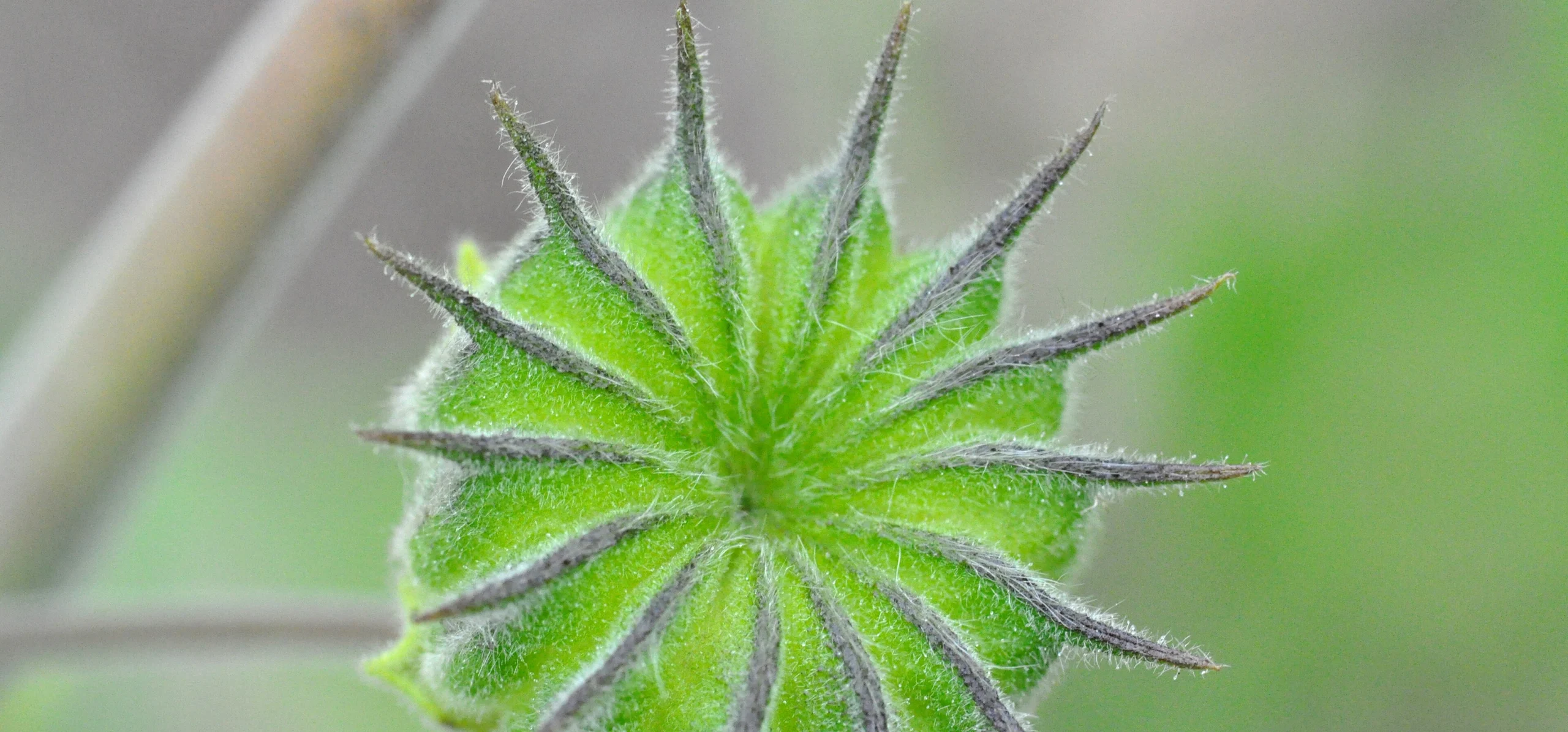
Each pollinated flower develops into a distinctive capsule: circular, cup-shaped, and split into segments like a small pinwheel or a seeded pod, holding between 15 and 45 seeds. A single unhindered plant can produce anywhere from 700 to as many as 17,000 seeds over one season, which is the real reason a handful of volunteers left standing in August becomes a border-wide problem the following spring. The capsules stay green and hairy while immature, drying to a papery brown that eventually splits and scatters the seed close to the parent plant.
The seed bank: why one plant becomes a decades-long problem
This is the detail that changes how you should treat velvetleaf. Buried seed can remain viable in soil for several decades, and annual loss rates depend heavily on how the ground is managed: roughly 11 to 17 percent of buried seed dies off per year under stable, undisturbed conditions, rising to 32 to 53 percent per year where the soil is tilled annually. Depth matters too, seed left on the surface loses viability far faster than seed buried a few centimetres down, so tillage that buries fresh seed can actually extend how long it stays a threat, even as it kills more of the existing bank. In practice, every capsule you let mature is a small deposit into a seed bank that will keep producing seedlings long after you've forgotten planting the parent.
Removing it before it seeds
If you are managing velvetleaf as a weed rather than growing it deliberately, timing beats effort. Very shallow cultivation that cuts seedlings and young plants off right at, or just below, the soil surface is highly effective and far more reliable than pulling by hand on established plants with a tough taproot. Do this before flowers open. Mowing alone is not enough, because low axillary flowers can still set seed on a cut-back plant. Avoid tilling in autumn if you can: leaving surface seed undisturbed over winter exposes it to natural predation by rodents and insects, which draws down the seed bank faster than burying it for spring. Rotating what and when you plant in that bed from year to year disrupts the annual cycle the same way crop rotation does in a field.
Test your plant knowledge
Tap a card to flip it and reveal the answer.
Velvetleaf seeds can remain viable in the soil for several decades. Tap to reveal ✓ True
Velvetleaf is a perennial that regrows from the same root every year. Tap to reveal ✕ False
A single velvetleaf plant can produce over 700 seeds in one season. Tap to reveal ✓ True
Mowing velvetleaf once is enough to prevent it from setting seed. Tap to reveal ✕ False
The plant's stem fibers were historically used to make cordage and cloth. Tap to reveal ✓ True
Sources
References consulted for this guide
- GBIF: Abutilon theophrasti Medik.gbif.org
- POWO (Kew): Abutilon theophrasti Medik.powo.science.kew.org
- Cornell CALS Weed Science: Velvetleaf profilecals.cornell.edu
- Iowa State University Extension: Velvetleafcrops.extension.iastate.edu
- Reference entity : Wikipédiaen.wikipedia.org