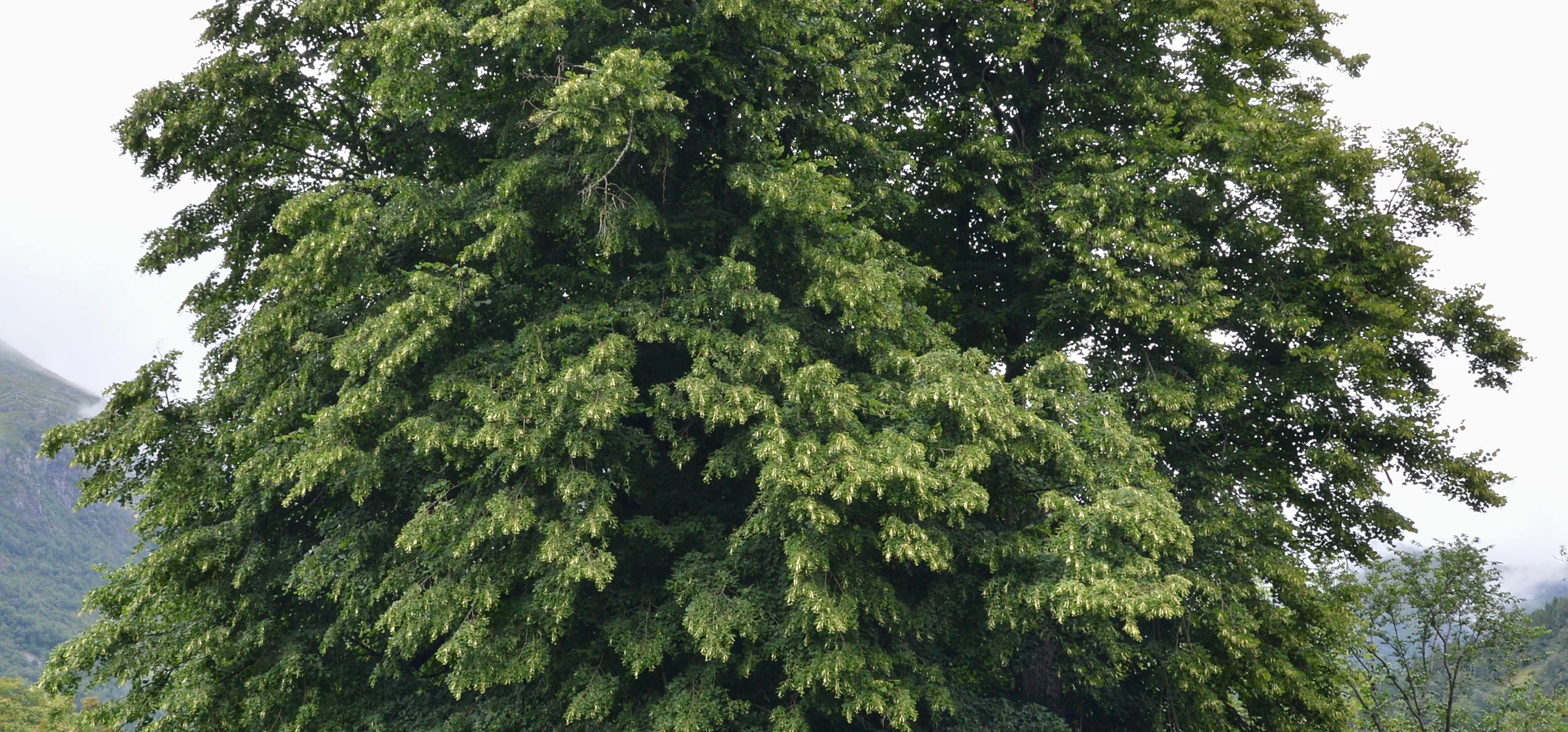
Large-Leaved Lime
Tilia platyphyllos
Family · Malvaceae
Tilia platyphyllos grows into an 18 to 24 metre shade tree with fragrant June flowers. Here is how to site, plant, water and prune a large-leaved lime.
Tilia platyphyllos
Plant profile
- WateringModerateWater every 10 days
- Light exposurePartial sun
- Hardiness zoneUSDA 3–7
Growth
- Family
- Malvaceae
- Life cycle
- Perennial
- Growth speed
- 6/10
- Mature size
- 1800–2400 cm
- Spread
- 900–1500 cm
- Flowering
- Fragrant, pale yellow flowers in June
- Propagation
- Seed
- Cutting
Dormancydeciduous, bare in winter with dark red winter buds
Time to maturityreaches much of its ultimate height over 20 to 50 years (RHS)
Soil & climate
- Soil pH
- pH 6–8
- Soil types
- chalk, clay, loam, sand
- Saline soil
- Tolerated
- Drought tolerance
- Yes
Light & Placement
- Origin
- Europe to northern Iran
- Where to place it
- large park, avenue or street tree planting
- big garden with room for full spread
- specimen tree pollarded or pleached for smaller spaces
Safety
- Toxicity
- Not specifically listed by the ASPCA; the related Tilia americana is rated non-toxic
- Pet safe
- No
Data fromTilia platyphyllos Scop., GBIF Backbone Tilia platyphyllos Scop., Plants of the Tilia platyphyllos (large-leaved lime), Tilia platyphyllos, Missouri Botanical GTilia platyphyllos, NC State Extension P
Where it grows
World distribution
Large-Leaved Lime is native to 24 countries: Albania, Austria, Belgium, Bulgaria, Croatia, Czechia, Denmark, and France….GBIF records 190,444 documented identifications across 63 countries, with the largest concentrations in Germany, France, and United Kingdom.
- Albania
- Austria
- Belgium
- Bulgaria
- Croatia
- Czechia
- Denmark
- France
- Georgia
- Germany
- Greece
- Hungary
Show 12 more countriesShow fewer countries
- Iran
- Italy
- Netherlands
- Poland
- Romania
- Russia
- Spain
- Sweden
- Switzerland
- Türkiye
- Ukraine
- United Kingdom
Yellow to orange dots: concentration of documented identifications per country. Green countries: sourced native range. Source: GBIFNative range from POWO (Kew).
Tilia platyphyllos is the large-leaved lime, a deciduous tree that starts modestly from a nursery whip and, within two or three decades, becomes a broad, densely leaved shade tree taller than most houses. The leaves are the fastest way to know you have this species rather than the more commonly planted small-leaved lime, Tilia cordata: they are noticeably larger, roughly 6 to 10 cm across, and both the blade and the young shoots carry a soft down that T. cordata lacks. Give it a permanent site with real room to spread, because this is not a tree to plant against a wall or under power lines and expect to keep small. In return it produces a dense, cooling canopy, clouds of fragrant cream flowers in early summer, and needs remarkably little attention once its roots are established.
Telling Tilia platyphyllos Apart from Other Limes
European gardens plant three limes routinely, and they get confused constantly. Tilia platyphyllos carries the largest leaves of the group, up to about 10 cm long, downy on both the upper surface and underneath, on young shoots that are themselves hairy rather than smooth. Tilia cordata, the small-leaved lime, has smaller, hairless leaves with only small tufts of orange hair in the vein axils underneath. Where the two grow near each other they hybridise freely into Tilia x europaea, the common lime, which combines features of both parents and is notorious for dripping sticky aphid honeydew onto anything parked beneath it and for throwing up thickets of basal suckers. If you inherited an unlabelled lime and the leaves feel soft and slightly fuzzy in your hand rather than smooth, you are very likely looking at Tilia platyphyllos rather than one of its relatives. Plants of the World Online lists its native range as Europe through to northern Iran, and it has been planted well beyond that range as an amenity and avenue tree for centuries.
Choosing a Site for a Tree This Size
This is a big tree by any garden's standard: the RHS lists it as regularly exceeding 12 metres, and detailed measurements from North American plantings put mature specimens at 18 to 24 metres tall with a spread of 9 to 15 metres, reached over roughly 20 to 50 years. Before planting, walk the site and picture that full grown crown and root spread, well clear of the house, drains, and any structure you are not prepared to have shaded or undermined by roots decades from now. It takes full sun to partial shade and copes with an exposed spot once established, though the RHS recommends some shelter while young. Where space is genuinely limited, large-leaved lime is one of the few big shade trees that tolerates formal training: it takes to pollarding, coppicing, and pleaching, training into a flat hedge on stilts, better than most broadleaf trees, which is why you see it lining streets and avenues clipped into tight, geometric shapes across European cities.
Soil and Planting
Large-leaved lime is unfussy about soil type: chalk, clay, loam, and sand all suit it, and it grows equally well in neutral or alkaline ground, which makes it one of the more forgiving choices for gardens sitting over limestone or chalk that frustrate acid-loving species. What it does want is soil that stays moist but drains, rather than either baking dry or standing wet through winter. Plant a bare-root or container-grown tree while dormant between autumn and early spring, digging a hole only as deep as the root ball and at least twice its width, and stake loosely for the first year or two until the roots anchor it. Water in thoroughly after planting and mulch around the base, keeping the mulch clear of the trunk itself.


Watering, from Establishment to Maturity
A newly planted lime needs consistent watering through its first two or three growing seasons: a deep soak whenever the top few centimetres of soil dry out, more often in hot spells, tapering off as autumn arrives. Once its root system is established, this species copes well with a typical dry summer, and North Carolina State Extension rates it both drought and salt-spray tolerant, useful information if you are choosing a tree for a roadside or coastal position. That tolerance is not unlimited: a multi-week drought on newly disturbed or compacted urban soil still stresses even a mature lime, showing up as early leaf scorch or premature yellowing at the margins. A thick mulch ring does more for a large tree's water needs than any watering can, buffering soil temperature and cutting evaporation across the whole root zone rather than a small circle at the trunk.
Flowering and the Summer Nectar Flow
Clusters of small, pale yellow flowers open in June, hanging from a distinctive pale green bract that later helps carry the winged nutlets away on the wind. The scent carries a long way on a warm evening, and the flowers are heavily worked by bees, moths, wasps, and other pollinating insects while they last, usually two to three weeks. In parts of Europe the dried flowers are also used to make a traditional herbal tea, reported by North Carolina State Extension to have a mild, calming effect. Fall colour is a quiet, undistinguished pale green fading to yellow rather than a showy display, so plant this tree for its shape, shade, and June flowering rather than autumn interest.
Pruning, Pollarding and Suckers
Large-leaved lime needs very little routine pruning: the RHS places it in its lightest pruning group, meaning the job is mostly limited to removing dead, damaged, or crossing wood as you find it rather than working to an annual schedule. The one recurring task is dealing with suckers, the thin shoots this species throws up from the base of the trunk and sometimes along surface roots; cut them off cleanly at their point of origin as soon as you notice them, since left alone they thicken into an unwanted grove around the main trunk. If you are training the tree as a pollard or a pleached screen, start that formative work while the tree is young and repeat it on a consistent cycle, because an older, untrained lime does not respond as well to being cut back hard for the first time.
Pests, Diseases and a Note on Safety
Established trees are generally trouble-free, but a long list of minor pests turns up over a tree's lifetime: aphids, whose honeydew coats cars and pavements beneath the canopy and often attracts sooty mould in turn, along with gall mites, caterpillars, sawflies, and scale insects. None of these usually threaten a healthy tree's survival, and most need no treatment beyond tolerating the mess or hosing off a badly affected low branch. The more serious risks are root and trunk diseases: honey fungus and Phytophthora root rot can kill a tree outright, and verticillium wilt, while uncommon, is capable of doing the same, so a mature lime that declines suddenly and unevenly across the crown is worth having assessed rather than pruned and hoped for. On safety, the ASPCA's plant database does not carry a specific entry for Tilia platyphyllos, only for the American basswood, Tilia americana, which it lists as non-toxic to cats, dogs and horses; treat that as a reasonable indication for the wider lime genus rather than a confirmed rating for this exact species, and keep pets from chewing on fallen prunings as routine good sense with any tree.
Test your plant knowledge
Tap a card to flip it and reveal the answer.
Tilia platyphyllos leaves and young shoots are covered in a soft down, unlike the mostly hairless leaves of Tilia cordata. Tap to reveal ✓ True
Once established, this tree cannot survive a dry summer without regular watering. Tap to reveal ✕ False
Large-leaved lime often needs suckers removed from the base of its trunk. Tap to reveal ✓ True
Tilia platyphyllos is native only to Britain and Scandinavia. Tap to reveal ✕ False
The tree's June flowers are an important nectar source for bees and other pollinators. Tap to reveal ✓ True
Sources
References consulted for this guide
- Tilia platyphyllos Scop., GBIF Backbone Taxonomygbif.org
- Tilia platyphyllos Scop., Plants of the World Online (Kew)powo.science.kew.org
- Tilia platyphyllos (large-leaved lime), RHSrhs.org.uk
- Tilia platyphyllos, Missouri Botanical Garden Plant Findermissouribotanicalgarden.org
- Tilia platyphyllos, NC State Extension Plant Toolboxplants.ces.ncsu.edu
- Reference entity : Wikipédiaen.wikipedia.org