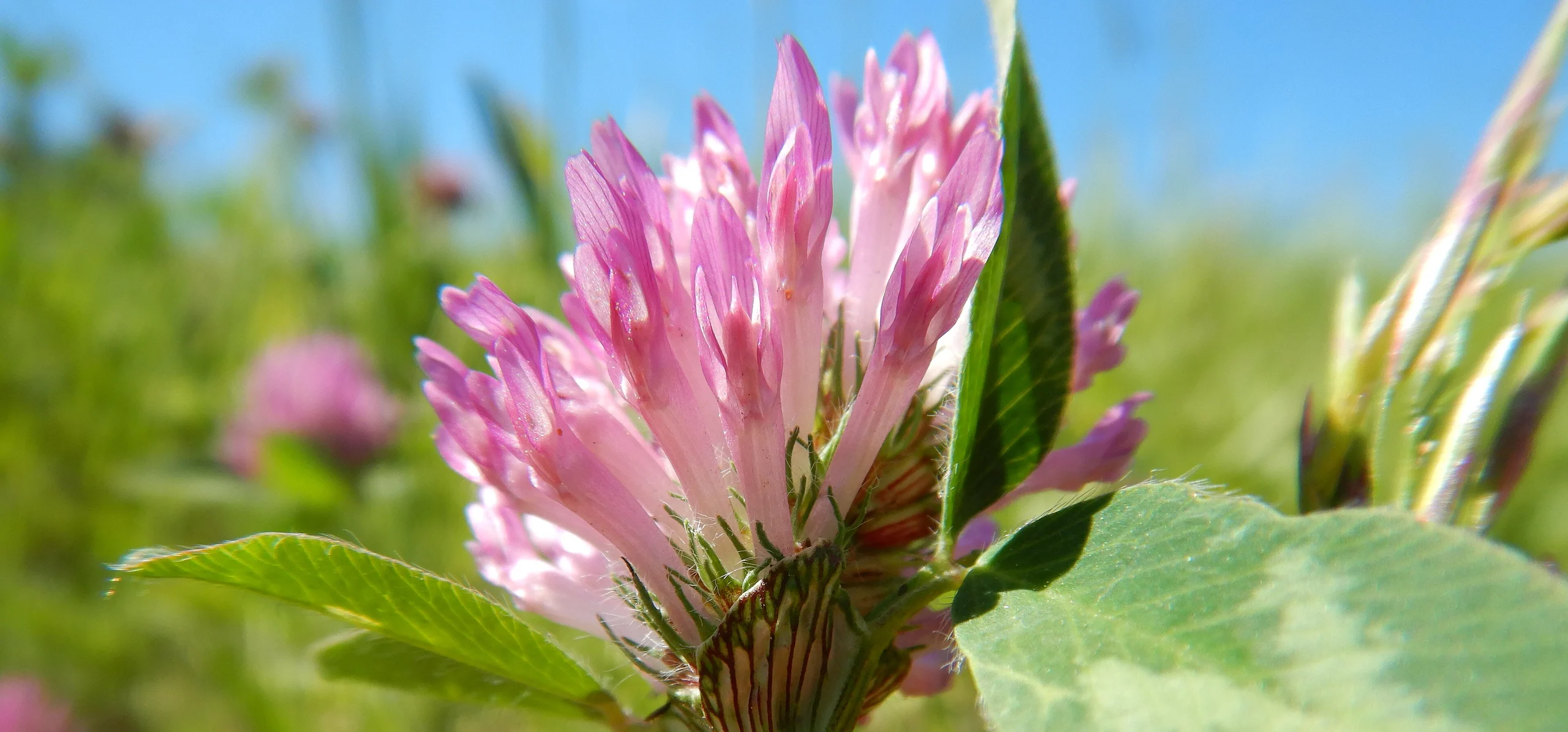
Red Clover
Trifolium pratense
Family · Fabaceae
Red clover grows upright on a deep taproot, fixes its own nitrogen and tolerates cutting for hay. Covers soil pH, sowing, watering, mowing and pet safety.
Trifolium pratense
Plant profile
- WateringModerateWater every 7 days
- Light exposureFull sun
- Hardiness zoneUSDA 3–9
Growth
- Family
- Fabaceae
- Life cycle
- Perennial
- Growth speed
- 8/10
- Mature size
- 50–100 cm
- Spread
- 10–50 cm
- Flowering
- May to October
- Propagation
- Seed
Dormancyfoliage dies back in hard frost; new growth resprouts from the crown and taproot in spring
Time to maturity2-5 years
Soil & climate
- Soil pH
- pH 6–7
- Soil types
- clay, loam, sand
- Saline soil
- Not tolerated
- Drought tolerance
- Yes
Light & Placement
- Origin
- Macaronesia, NW Africa, Europe to Mongolia and Himalaya
- Where to place it
- sunny hay meadow or pasture
- wildflower meadow mix
- green manure or cover-crop bed
- pollinator border
- deep trough or large planter with free-draining soil, to accommodate the taproot
Safety
- Toxicity
- Not listed by the ASPCA as toxic or non-toxic
- Pet safe
- No
Invasive speciesself-seeds readily and regrows vigorously after cutting; NC State Extension lists it as invasive or noxious in West Virginia and Kentucky
Data fromTrifolium pratense L., GBIF Backbone TaxRHS: Trifolium pratense (red clover)Penn State Extension: Red CloverPenn State Extension: Lawn and TurfgrassNC State Extension: Trifolium pratense
Where it grows
World distribution
Red Clover is native to 47 countries: Afghanistan, Albania, Algeria, Austria, Belarus, Belgium, Bhutan, and Bulgaria….GBIF records 1,636,420 documented identifications across 120 countries, with the largest concentrations in United Kingdom, France, and Netherlands.
- Afghanistan
- Albania
- Algeria
- Austria
- Belarus
- Belgium
- Bhutan
- Bulgaria
- China
- Croatia
- Czechia
- Denmark
Show 35 more countriesShow fewer countries
- Estonia
- Faroe Islands
- Finland
- France
- Georgia
- Germany
- Greece
- Hungary
- India
- Iran
- Iraq
- Ireland
- Italy
- Kazakhstan
- Kyrgyzstan
- Mongolia
- Morocco
- Nepal
- Netherlands
- Norway
- Pakistan
- Poland
- Portugal
- Romania
- Russia
- Spain
- Sweden
- Switzerland
- Tajikistan
- Tunisia
- Türkiye
- Turkmenistan
- Ukraine
- United Kingdom
- Uzbekistan
Yellow to orange dots: concentration of documented identifications per country. Green countries: sourced native range. Source: GBIFNative range from POWO (Kew).
A stand of stout, upright clover with football-shaped pink-purple flower heads and oval leaflets marked by a pale chevron is almost certainly red clover, Trifolium pratense, a short-lived perennial legume native to Macaronesia, Northwest Africa and Europe through to Mongolia and the Himalaya. Unlike its low, creeping relative white clover, it grows upright to about a meter and sends down a taproot that can reach 60 to 90 cm, which is why an established stand shrugs off short dry spells that would wilt a shallower-rooted lawn weed. Farmers have sown it for centuries as a hay and pasture legume because bacteria living in its root nodules fix nitrogen straight from the air, and gardeners now use the same trait to rebuild soil in a vegetable bed or wildflower patch. It is not fussy about position as long as the site gets full sun, but it will not tolerate the constant close mowing that keeps white clover thriving in a lawn.
Family, Habit and Telling It Apart From White Clover
Red clover sits in Fabaceae, the pea and bean family, in the genus Trifolium. Its stems are noticeably hairy, its trifoliate leaflets grow up to about 5 cm long with a pale inverted-V watermark near the base, and its flower heads open as dense, roughly spherical clusters 2 to 3 cm across in shades of pink to dark red. Penn State Extension gives the clearest field distinction from white clover, Trifolium repens: red clover grows upright on branching stems rather than creeping along the ground on rooting stolons, and both its leaves and its flower heads run noticeably larger. The GBIF backbone taxonomy lists Trifolium pratense L. as the accepted name, with no widely used synonym causing the confusion seen in some other genera.
Native Range and Where It Grows Wild Today
Kew's Plants of the World Online gives the native range of Trifolium pratense as Macaronesia, Northwest Africa, and Europe through to Mongolia and the Himalaya. It has since naturalized across most of temperate North America and beyond. In the wild and in unmown ground it favors open grassland and hay meadows over deep shade or dense woodland, and low-nitrogen, slightly acid soil suits it better than a heavily fertilized bed.
Site, Sun and Soil
Full sun is close to non-negotiable: NC State Extension lists red clover as shade intolerant, needing several hours of direct light a day to flower and grow well. It grows in clay, loam or sandy soil according to the RHS, and prefers ground that is moist but well-drained rather than waterlogged. On pH, Penn State Extension recommends 6.5 or higher for maximum forage yield, though the plant tolerates more acidic ground than alfalfa; NC State's growing guide brackets it between acidic soil below pH 6 and neutral soil up to pH 8. In practice, aim for pH 6 to 7 and skip nitrogen fertilizer altogether, since heavy nitrogen feeding suppresses the very root nodules that make the plant useful.


Sowing and Establishing From Seed
Seed is the only realistic way to start red clover; it does not divide or root from stem cuttings the way white clover's stolons do. Penn State Extension recommends drilling seed no deeper than a quarter inch, with spring sowings from April into early May the most reliable window in temperate climates, often nursed under an oat companion crop. Because the plant fixes its own nitrogen through bacteria living in root nodules, seed should be inoculated with Rhizobium trifolii before sowing wherever the ground has not grown clover recently; without the right bacteria present in the soil, nodulation and nitrogen fixation simply will not happen.
Watering and the Taproot
Give new seedlings consistent moisture until they root; the young, shallow root system dries out fast in bare soil. Once established, red clover develops a thick taproot reaching roughly 60 to 90 cm deep with most lateral roots concentrated in the top 13 cm of soil, according to Penn State Extension, and that taproot is what lets a mature stand ride out short dry spells that would stress a shallower-rooted plant like white clover.
Mowing, Grazing and Cutting for Hay
Red clover tolerates being cut two or three times a season for hay, regrowing readily from the crown between cuts. It has a lower tolerance for constant, heavy grazing pressure than white clover does, so pasture stands do best under rotational rather than continuous grazing. Left unmown, it flowers from May to October in temperate gardens, in long flushes rather than one single bloom, which keeps a patch productive for bees over a long season.
Pests and Diseases
Powdery mildew and southern anthracnose show up often enough in red clover to be worth watching for, and Penn State Extension names crown and root rot complexes as the main reason a stand thins out after two or three years. NC State Extension also lists clover rot as a recurring issue. None of this usually calls for spraying in a garden setting; the standard response from forage agronomists is to rotate the planting to fresh ground every few years rather than nursing an old, thinning stand along.
Toxicity and Pet Safety
As of this writing, the ASPCA's toxic and non-toxic plant database carries no dedicated entry for Trifolium pratense itself. The ASPCA does list the related alsike clover, Trifolium hybridum, as toxic to horses, a distinction worth knowing if both grow in the same pasture or seed mix. Because red clover has no ASPCA record either way, treat it with the same caution given to any unlisted plant around pets and grazing animals, and watch for digestive upset if an animal eats a large quantity.
Test your plant knowledge
Tap a card to flip it and reveal the answer.
Red clover fixes its own nitrogen through bacteria living in nodules on its roots. Tap to reveal ✓ True
Red clover has a shallow, spreading root system similar to white clover. Tap to reveal ✕ False
The RHS rates red clover H7, hardy to below -20 degrees C. Tap to reveal ✓ True
Red clover flowers only once, in early summer, and will not rebloom after cutting. Tap to reveal ✕ False
The ASPCA's toxic and non-toxic plant database has no dedicated listing for red clover. Tap to reveal ✓ True
Sources
References consulted for this guide
- Trifolium pratense L., GBIF Backbone Taxonomygbif.org
- RHS: Trifolium pratense (red clover)rhs.org.uk
- Penn State Extension: Red Cloverextension.psu.edu
- Penn State Extension: Lawn and Turfgrass Weeds, Red Cloverextension.psu.edu
- NC State Extension: Trifolium pratenseplants.ces.ncsu.edu
- Reference entity : Wikipédiaen.wikipedia.org