Borage
Borago officinalis
Family · Boraginaceae
Borage direct-sown near tomatoes and strawberries keeps bees working the bed for weeks, self-seeds hard, and needs care around its pyrrolizidine alkaloids.
Borago officinalis
Plant profile
- WateringLittleWater every 7 days
- Light exposureFull sun
- Hardiness zoneUSDA 2–11
Growth
- Family
- Boraginaceae
- Life cycle
- Annual
- Growth speed
- 6/10
- Mature size
- 48–97 cm
- Spread
- 30–41 cm
- Flowering
- Summer into fall, continuous if deadheaded
- Propagation
- Seed
Soil & climate
- Soil pH
- pH 5.5–8.5
- Soil types
- clay, loam, sand, well-drained
- Drought tolerance
- Yes
Light & Placement
- Origin
- Western and Central Mediterranean
- Where to place it
- vegetable garden
- herb bed
- border edge, near tomatoes or strawberries
- large container with drainage
Safety
- Toxicity
- CatsToxic
- DogsToxic
- HorsesToxic
- HumansToxic
Invasive speciesNot documented as invasive; spreads within garden beds by self-seeding rather than into wild habitats.
Data fromGBIF: Borago officinalis L.Plants of the World Online (Kew): BoragoASPCA: Toxic and Non-Toxic Plants, BoragNC State Extension: Borago officinalis
Where it grows
World distribution
Borage is native to 10 countries: Algeria, Croatia, France, Greece, Italy, Libya, Morocco, and Portugal….GBIF records 181,699 documented identifications across 108 countries, with the largest concentrations in France, Germany, and United Kingdom.
- Algeria
- Croatia
- France
- Greece
- Italy
- Libya
- Morocco
- Portugal
- Spain
- Tunisia
Yellow to orange dots: concentration of documented identifications per country. Green countries: sourced native range. Source: GBIFNative range from POWO (Kew).
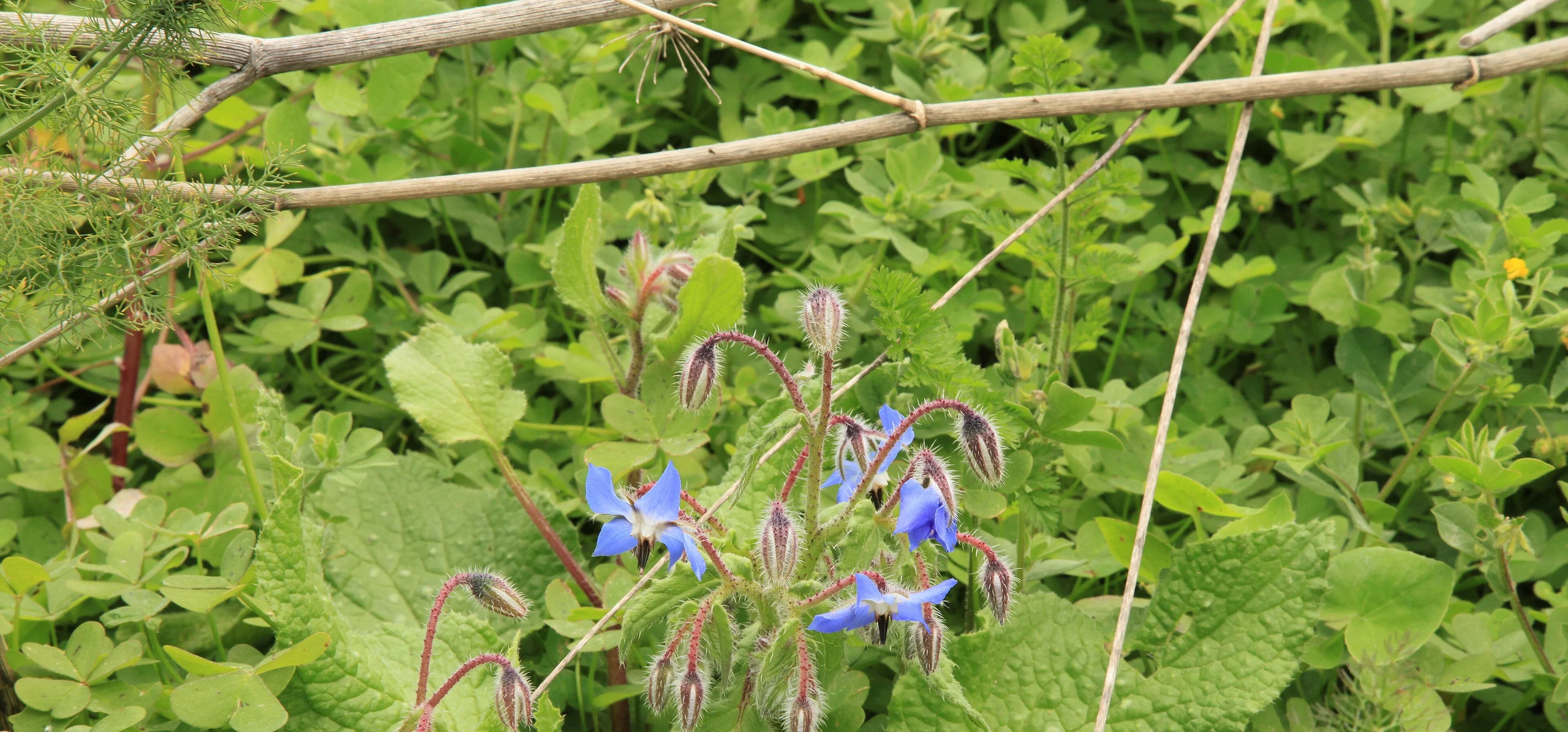
Borage (Borago officinalis) is a fast, hairy-leaved annual from the Mediterranean that most gardeners meet by seed packet rather than nursery pot, since its taproot resents transplanting and the plant is almost always sown straight into the bed. Within a few weeks of sowing it throws up rough, cucumber-scented leaves, then a loose spray of star-shaped flowers that open blue and often fade toward pink as they age, drawing bees from the moment the first bud cracks open. It is grown less for its own sake than for what it does around it: gardeners plant it near tomatoes and strawberries to keep pollinators working the bed, and the flowers and young leaves are edible in small amounts. That same plant carries pyrrolizidine alkaloids, which is why it belongs on the plate only sparingly.
Origin and Growth Habit
Borago officinalis is native to the western and central Mediterranean and has naturalized well beyond it, turning up as a garden escape across much of Europe and North America. NC State Extension classifies it as an annual with a medium growth rate, reaching roughly 50 to 95 cm tall and 30 to 40 cm across in a single season, on hollow, bristly stems that branch as they grow. The leaves get coarser and more heavily haired toward the base of the plant, stiff enough to notice when handling the older ones bare-handed, which is one reason most growers pick young, tender leaves rather than reaching low on the stem. Full sun produces the densest flowering, though NC State notes the plant also tolerates two to six hours of shade a day, which matters for a bed that only gets partial light.
Direct Sowing: Site, Soil and Timing
Borage is sown where it will grow rather than started indoors and moved, because the taproot is damaged easily and rarely recovers from transplant shock. Sow after the soil has warmed in spring, a few millimetres deep, and thin seedlings to give each plant its eventual 30 to 40 cm of spread; crowded plants stretch, flop over, and flower less. NC State Extension lists borage as tolerant of clay, loam and sandy soils and of a wide pH range from acid to alkaline, and it copes with poor soil as long as drainage is adequate; what it does not forgive is standing water at the root. A second sowing four to six weeks after the first extends the bloom window into fall, since a single planting tends to peak and then taper off once it sets the bulk of its seed.
A Companion for Tomatoes and Strawberries
Borage's reputation as a companion for tomatoes and strawberries rests on its pull on pollinators rather than on any repellent effect that has been rigorously measured: a border of borage in bloom stays busy with bees for weeks, and those same bees work the tomato and strawberry flowers nearby on the same pass. Some growers also treat it as a distraction planting, hoping it draws hornworms and other visiting insects away from the main crop, though that effect is closer to garden lore than a documented mechanism. What is easier to see in practice is timing: borage flowers early and keeps flowering, so it is already pulling bees into the bed before strawberries and tomatoes reach their own main bloom.


Plant it at the edge of the bed rather than between the rows. It self-seeds freely and would otherwise compete directly with the crop it is meant to support.
Watering and Feeding
Borage wants steady moisture while it establishes and builds leaf mass, then tolerates real dry spells once it is rooted in, a tolerance NC State Extension notes explicitly among its growing conditions. Water when the top few centimetres of soil have dried rather than on a fixed schedule, and ease off once flowering is underway, since a plant kept too wet grows leggy stems that lodge in wind or rain. It rarely needs feeding in reasonable garden soil; a light compost dressing at sowing is usually enough, and heavy nitrogen pushes soft leaf growth at the expense of flowers, the opposite of what most growers want from the plant.
Flowers: Harvest and Kitchen Use
Pick flowers in the morning once they have fully opened and turned a clean blue, snapping each one off just behind the base so the dark anther cone stays attached; they wilt within hours, so harvest close to when they will be used, frozen into ice cubes, or candied. The taste is a mild, cucumber-like coolness that fades fast, which is why borage flowers work best as a fresh garnish rather than a cooked ingredient. Young leaves can be used the same way, chopped fine to cut the texture of the hairs, but neither leaves nor flowers should be eaten in quantity or daily.
Self-Seeding: Living With a Volunteer
Left to finish its cycle, borage drops seed heavily once the flowers fade, and NC State Extension lists self-seeding as its main means of spreading through a garden. Volunteers appear the following spring, often earlier and thicker than a fresh sowing, and a bed that has hosted borage for even one season rarely needs replanting again. The tradeoff is control: seedlings turn up in paths and neighbouring beds, and a grower who wants borage confined to one spot should deadhead spent flower heads before they set seed, trading a shorter bloom period for fewer volunteers to weed out next year.
Pests, Mildew and Toxicity Caution
NC State Extension reports no major pest problems on borage, with powdery mildew as the one recurring issue in humid weather or when plants are crowded and airflow is poor; thinning stands and watering at the base rather than overhead keeps it in check. The more consistent caution concerns the plant's chemistry rather than its pests: borage contains pyrrolizidine alkaloids, compounds NC State Extension notes make it a low-severity poison, which is why the flowers and young leaves are used sparingly as a garnish rather than eaten as a green vegetable. The ASPCA lists borage as toxic to cats, dogs and horses, so a bed grown where pets graze on garden plants is worth fencing off or watching, and the same caution applies to children who might sample the striking blue flowers straight from the plant.
Test your plant knowledge
Tap a card to flip it and reveal the answer.
Borage is usually started indoors and transplanted into the garden. Tap to reveal ✕ False
Borage self-seeds readily, and volunteers often reappear the following spring. Tap to reveal ✓ True
The ASPCA lists borage as toxic to cats, dogs and horses. Tap to reveal ✓ True
Borage flowers and leaves can be eaten freely in large amounts with no caution. Tap to reveal ✕ False
Powdery mildew is the main disease problem borage runs into, especially in crowded, humid conditions. Tap to reveal ✓ True
Sources
References consulted for this guide
- GBIF: Borago officinalis L.gbif.org
- Plants of the World Online (Kew): Borago officinalis L.powo.science.kew.org
- ASPCA: Toxic and Non-Toxic Plants, Borageaspca.org
- NC State Extension: Borago officinalisplants.ces.ncsu.edu
- Reference entity : Wikipédiaen.wikipedia.org