Common Comfrey
Symphytum officinale
Family · Boraginaceae
Comfrey's taproot regrows from fragments left in the soil, so siting is permanent. Covers Bocking 14 versus seed-grown plants, tea ratio and mulching.
Symphytum officinale
Plant profile
- WateringModerateWater every 7 days
- Light exposurePartial sun
- Hardiness zoneUSDA 4–8
Growth
- Family
- Boraginaceae
- Life cycle
- Perennial
- Growth speed
- 8/10
- Mature size
- 30–91 cm
- Spread
- 23–76 cm
- Flowering
- Late spring to early summer (May-June)
- Propagation
- Seed
- Cutting
- Division
Soil & climate
- Soil pH
- pH 5.5–8.5
- Soil types
- clay, loam, rich in organic matter, well-drained
- Drought tolerance
- Yes
Light & Placement
- Origin
- Europe to western Siberia and northwestern Türkiye
- Where to place it
- vegetable garden edge
- orchard row
- dedicated fertiliser patch
- large container to restrain spread
Safety
- Toxicity
- HumansToxic
Invasive speciesNot on an invasive-species list reviewed here, but NC State Extension and the RHS both describe it as spreading readily from root fragments and self-sown seed, needing management in open ground.
Data fromGBIF: Symphytum officinale L.Plants of the World Online (Kew): SymphyNC State Extension: Symphytum officinaleRHS: Three Ways to Use Comfrey to Feed YMissouri Botanical Garden: Symphytum off
Where it grows
World distribution
Common Comfrey is native to 20 countries: Austria, Belarus, Belgium, Bulgaria, Croatia, Czechia, France, and Germany….GBIF records 445,894 documented identifications across 90 countries, with the largest concentrations in Netherlands, France, and United Kingdom.
- Austria
- Belarus
- Belgium
- Bulgaria
- Croatia
- Czechia
- France
- Germany
- Hungary
- Italy
- Kazakhstan
- Netherlands
Show 8 more countriesShow fewer countries
- Poland
- Romania
- Russia
- Spain
- Switzerland
- Türkiye
- Ukraine
- United Kingdom
Yellow to orange dots: concentration of documented identifications per country. Green countries: sourced native range. Source: GBIFNative range from POWO (Kew).
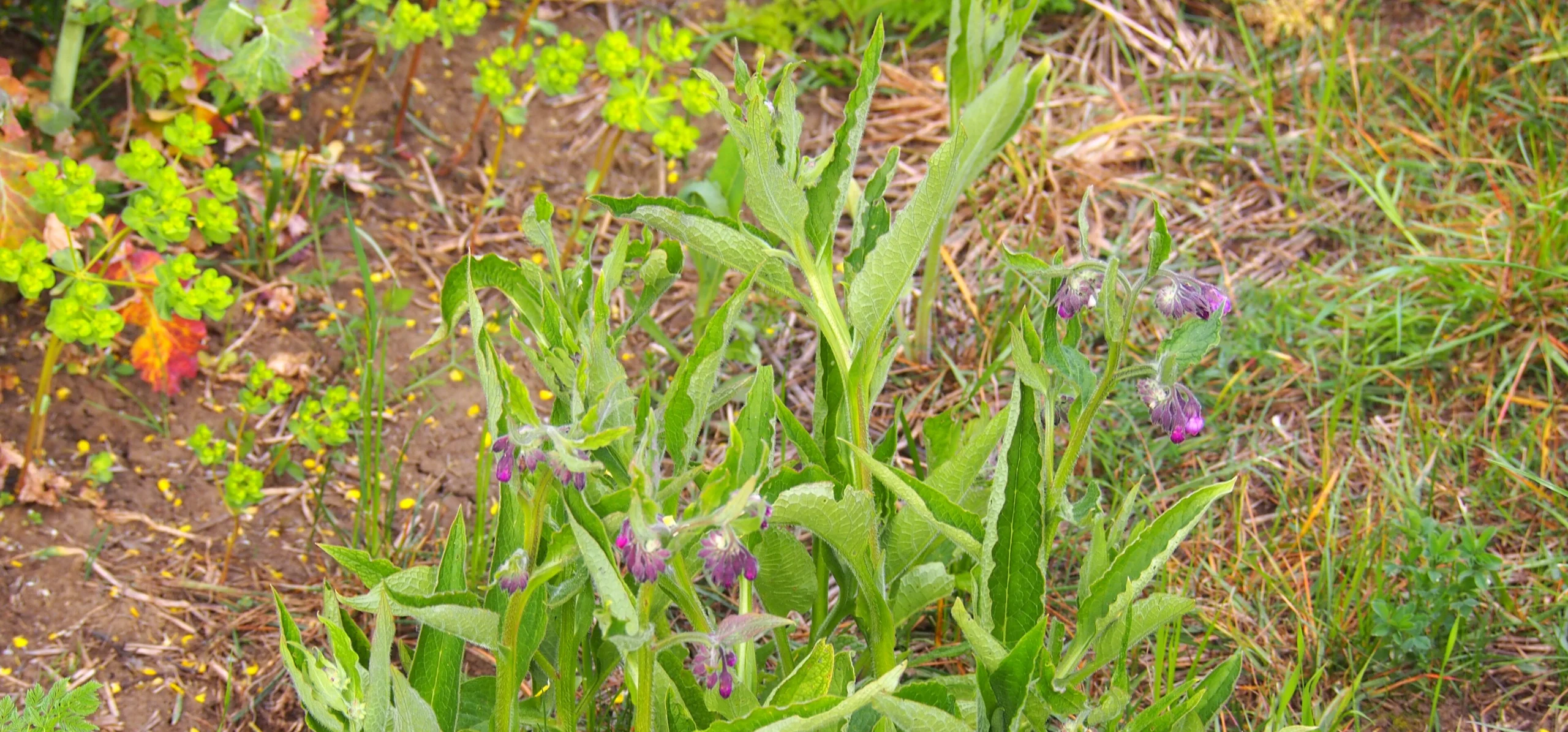
Common comfrey (Symphytum officinale) is a plant most gardeners get to know from the ground up: a deep taproot that will outlast whatever bed plan surrounds it. Above ground it forms a coarse clump of broad, hairy leaves reaching up to about 91 cm tall, topped from late spring into summer with curling sprays of nodding, tubular flowers that shade from mauve through pink to pale cream. It earns its place in a garden for what comes off the plant rather than for the flowers: cut leaves that rot down into a potassium-rich liquid feed, or go straight onto the bed as mulch. The one decision worth making before the first leaf unfurls is where it goes, because once comfrey is established, moving it means digging out a root system that regrows from whatever fragment you miss.
Origin and a Root You Cannot Fully Remove
Symphytum officinale is native from Europe east to western Siberia and northwestern Türkiye, according to Plants of the World Online, and has naturalized well beyond that range along damp meadows, ditches and riverbanks. It belongs to the borage family, Boraginaceae, alongside borage and forget-me-nots, and shares their bristly stems and coiled flower clusters. NC State Extension rates it a rapid-growing herbaceous perennial reaching roughly 30 to 91 cm tall and 23 to 76 cm wide, spreading from a thick taproot that, per Missouri Botanical Garden, sprouts a new plant from any piece of root left behind when you try to dig it out. That single trait, more than the flowers or the leaves, is what shapes every other decision about growing it.
Bocking 14 Versus the Wild, Seed-Grown Plant
Not every comfrey sold as a fertiliser plant is Symphytum officinale. The cultivar most recommended for tea and mulch, Bocking 14, is actually Symphytum x uplandicum, a sterile hybrid between common comfrey and the coarser Russian comfrey, bred in the 1950s at the Henry Doubleday Research Association in Bocking, England. Bocking 14 does not set viable seed, so a plant stays where it is put instead of drifting into the lawn or a neighbor's bed. True Symphytum officinale, the species this guide covers, reproduces by seed as well as by root, and NC State Extension notes it spreads easily enough to be considered weedy in open ground. If self-sowing is a concern where you garden, that difference is worth knowing before buying a plant labelled simply "comfrey."
Siting: Pick the Bed Once
Because the taproot resists removal and the species can self-sow, comfrey belongs in a spot you are prepared to commit to for years, not a border that gets redesigned every season. The RHS describes its growth as vigorous enough to become a nuisance once established, so the edge of a vegetable garden, an orchard row or a dedicated fertiliser patch works better than a mixed perennial bed where you will want to lift and divide neighboring plants later. A large container restrains the spread where space is tight, though the deep root still needs real depth to perform well as a cut-and-come-again leaf source. Full sun to partial shade and moderately fertile, moist soil suit it best, and NC State Extension lists it as tolerant of clay and loam across a wide pH range.


Comfrey Tea: The Ratio and the Smell
The RHS method is blunt and low-tech: cut the plant to the ground, pack the leaves into a bucket without fully crushing them, cover with water, and weigh them down with a brick so they stay submerged. Left for around three weeks, the liquid turns black and, by every account, genuinely foul, an ammonia-heavy smell that gardeners learn to brew somewhere away from the kitchen door. Dilute the finished liquid to roughly one part comfrey feed to ten parts water, aiming for a colour close to weak tea, and water it onto the soil at the base of plants rather than over the leaves. It does not keep well, so the RHS advises using it up soon after straining rather than storing a jar for later in the season.
Chop-and-Drop: Mulch Without the Bucket
A faster route to the same nutrients skips the bucket altogether. Cutting the plant back several times through the growing season and laying the wilted leaves directly on the soil surface as mulch lets them break down in place, feeding the bed underneath without the smell or the three-week wait. Comfrey's own preference for rich, moist soil means it usually regrows fast enough after cutting to be harvested this way three or four times a season, which is part of why growers plant it beside heavy feeders such as tomatoes, squash and fruit trees rather than tucking a single plant somewhere out of the way.
Flowers and Bees
The nodding, tubular flowers open through May and June and stay useful to pollinators for weeks, but not every bee that visits gets in the front way. Long-tongued bumblebees, such as the garden bumblebee, reach the nectar the way the flower is built for; shorter-tongued species instead bite a small hole at the base of the corolla and rob the nectar without ever touching the pollen, a workaround documented on this genus. The practical upshot for a gardener is that a stand of comfrey draws a steady mix of bumblebee species over a long bloom window, which is one more reason it turns up along the edges of vegetable plots rather than only in a fertiliser corner.
Pyrrolizidine Alkaloids: Grow It, Do Not Eat It
Every part of common comfrey, leaves, roots, stems and flowers, contains pyrrolizidine alkaloids, and NC State Extension rates the resulting toxicity as medium, with ingestion linked to liver damage, lung damage and, with sustained exposure, cancer risk. That rules out the herbal-tea and poultice uses the plant was historically known for under its old name, knitbone; the RHS is equally direct that it is harmful if eaten repeatedly. Topical use in small amounts is generally considered lower-risk, but internal use has no place in a home garden. Comfrey does not appear on the ASPCA's toxic or non-toxic plant lists, so there is no formal pet-safety verdict either way; treat it with the same caution you would give any plant carrying these alkaloids, and keep it out of reach of grazing animals and small children rather than assuming it is safe because no warning label exists.
Test your plant knowledge
Tap a card to flip it and reveal the answer.
Common comfrey's taproot can regrow into a new plant from a small fragment left in the soil. Tap to reveal ✓ True
Bocking 14, the cultivar most used for liquid feed, is Symphytum officinale and sets viable seed. Tap to reveal ✕ False
The RHS recommends diluting comfrey liquid feed to roughly one part comfrey liquid to ten parts water. Tap to reveal ✓ True
Comfrey leaves and roots are safe to eat regularly because they contain no pyrrolizidine alkaloids. Tap to reveal ✕ False
Every bee that visits comfrey's tubular flowers enters from the front and pollinates it in the process. Tap to reveal ✕ False
Sources
References consulted for this guide
- GBIF: Symphytum officinale L.gbif.org
- Plants of the World Online (Kew): Symphytum officinale L.powo.science.kew.org
- NC State Extension: Symphytum officinaleplants.ces.ncsu.edu
- RHS: Three Ways to Use Comfrey to Feed Your Plantsrhs.org.uk
- Missouri Botanical Garden: Symphytum officinalemissouribotanicalgarden.org
- Reference entity : Wikipédiaen.wikipedia.org