Hedge Bindweed
Calystegia sepium
Family · Convolvulaceae
Calystegia sepium climbs on brittle white rhizomes that snap into rooting fragments, so digging or rotavating a patch usually multiplies it, not clears it.
Calystegia sepium
Plant profile
- WateringLittleWater every 12 days
- Light exposurePartial sun
Growth
- Family
- Convolvulaceae
- Life cycle
- Perennial
- Growth speed
- 9/10
- Mature size
- 100–300 cm
- Flowering
- Large white funnel-shaped flowers about 5 cm across, roughly July to September
- Propagation
- Seed
- Division
Dormancytop growth is killed by the first hard frosts each autumn; the rhizome survives underground and pushes up new shoots the following spring
Time to maturityan established rhizome or a transplanted fragment can put out flowering stems the same season; a seedling usually needs a full season to build a rhizome system before flowering freely
Soil & climate
- Soil types
- clay, loamy, sandy
- Drought tolerance
- Yes
Light & Placement
- Where to place it
- hedgerows and fence lines
- riverbanks, ditches and damp fen edges
- waste ground and untended margins
OriginNative to Europe, Macaronesia and western Asia to Afghanistan, with separate native subspecies from Canada into the central and eastern United States; naturalized widely elsewhere
Safety
- Toxicity
- Not currently listed by the ASPCA for cats, dogs or horses
- Pet safe
- No
Invasive speciesregarded as a difficult, deep-spreading perennial weed in gardens and regulated as a noxious or quarantine weed in a number of US states and Canadian provinces; dispose of pulled rhizome material as waste rather than home compost, since fragments can reroot
Data fromGBIF: Calystegia sepium (L.) R.Br.Plants of the World Online (Kew): CalystRHS: Bindweed, Identification and ControNorth Carolina Extension Gardener Plant Penn State Extension: The Noxious, Persi
Where it grows
World distribution
Hedge Bindweed is native to 54 countries: Afghanistan, Albania, Algeria, Australia, Austria, Belarus, Belgium, and Bulgaria….GBIF records 684,716 documented identifications across 93 countries, with the largest concentrations in France, United Kingdom, and Netherlands.
- Afghanistan
- Albania
- Algeria
- Australia
- Austria
- Belarus
- Belgium
- Bulgaria
- Canada
- Chile
- China
- Croatia
Show 42 more countriesShow fewer countries
- Cyprus
- Czechia
- Denmark
- Estonia
- Finland
- France
- Georgia
- Germany
- Greece
- Hungary
- Iran
- Ireland
- Italy
- Japan
- Kazakhstan
- Kyrgyzstan
- Lebanon
- Mexico
- Morocco
- Netherlands
- New Zealand
- Norway
- Palestinian Territories
- Peru
- Poland
- Portugal
- Romania
- Russia
- South Africa
- South Korea
- Spain
- St. Helena
- Sweden
- Switzerland
- Tajikistan
- Tunisia
- Türkiye
- Turkmenistan
- Ukraine
- United Kingdom
- United States
- Uzbekistan
Yellow to orange dots: concentration of documented identifications per country. Green countries: sourced native range. Source: GBIFNative range from POWO (Kew).
A Fast-Climbing Perennial Built Around a Brittle White Rhizome
Calystegia sepium is the accepted name, per GBIF, for the vine most gardeners meet as hedge bindweed, or larger bindweed: a herbaceous perennial in the bindweed family (Convolvulaceae) that throws up new twining stems every spring and can bury a hedge, a shrub or an unattended fence in a single season. Its stems twine counterclockwise around anything they touch, climbing up to about 3 m, and its big pure-white trumpet flowers are hard to miss once they open. What is easy to miss, because it never shows above ground, is the reason this plant is so hard to be rid of: a spreading, brittle white rhizome that snaps rather than lifts, and regrows from almost every piece left behind.
Recognizing Hedge Bindweed
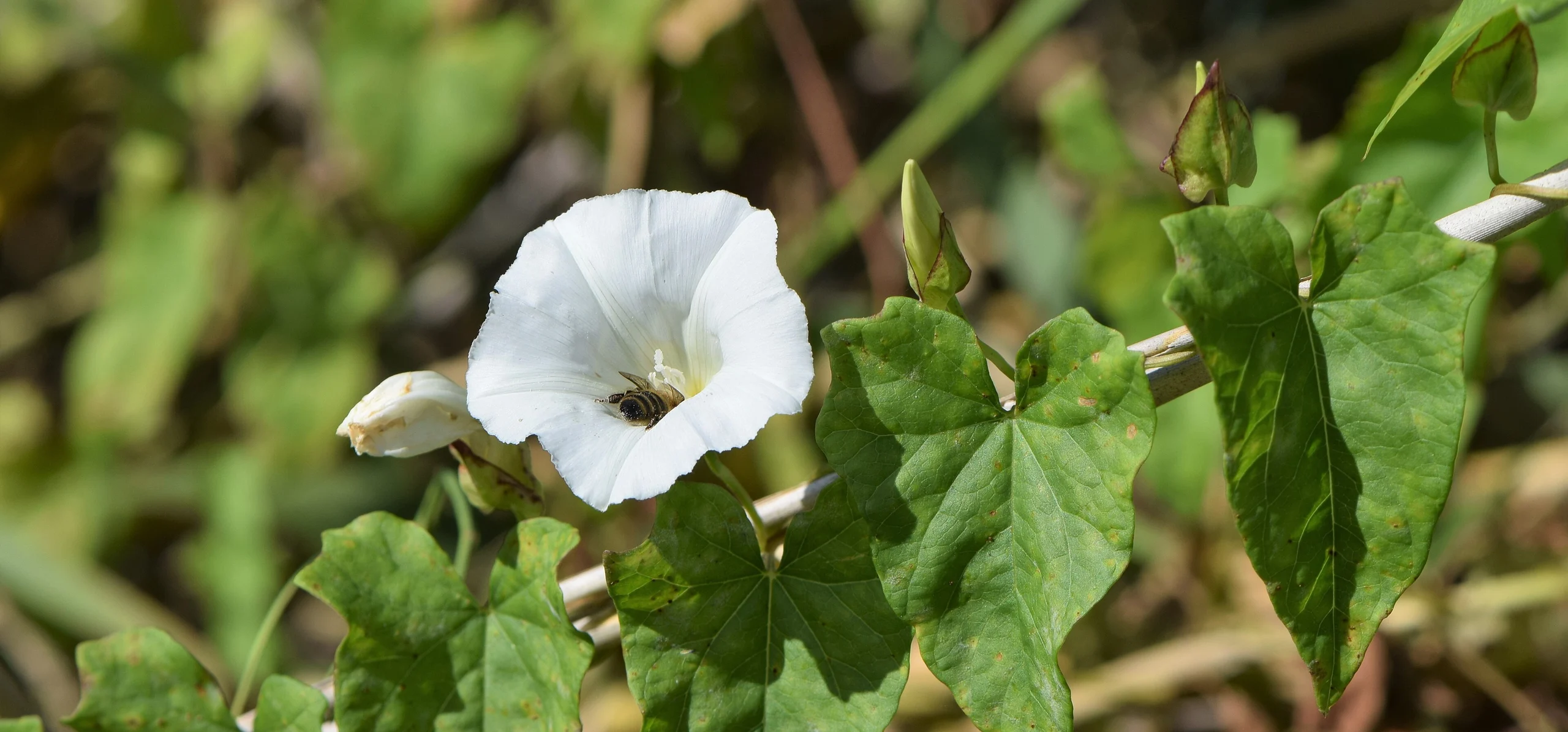
The flowers are funnel-shaped, pure white and roughly 5 cm across, according to the RHS, nearly twice the width of most similar bindweeds, and open from July into September. Each flower sits behind a pair of large, overlapping bracts that hide the true sepals entirely, a detail worth checking with a hand lens if you are unsure what you are looking at. The leaves are alternate and distinctly heart or arrow shaped (sagittate), pointed at the tip, and the stems twist counterclockwise as they climb, winding over hedge tops, wire fencing and the branches of shrubs that offer no resistance at all.
Hedge Bindweed or Field Bindweed, in One Line
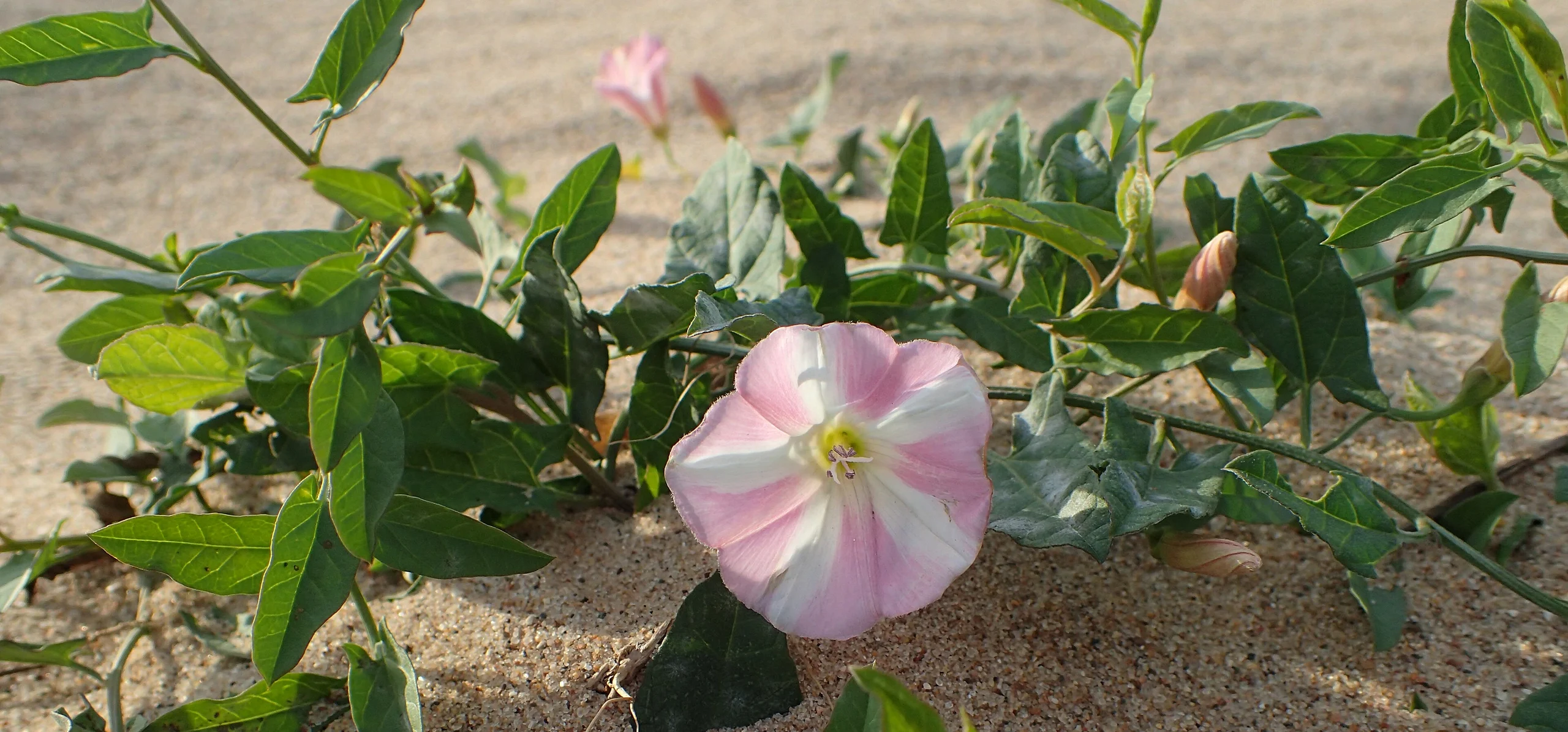
The plant most often confused with it is field bindweed, Convolvulus arvensis: its flowers are smaller, about 2 cm across and usually streaked pink and white rather than pure white, and it grows from a taproot that runs considerably deeper than hedge bindweed's shallow, wide-spreading rhizome network.


Why Digging and Rotavating Spread It Further
Most of the rhizome's active buds sit in the upper 30 to 35 cm of soil, though the network itself can run several metres sideways once established. Hand-digging out a section almost always snaps the rhizome somewhere below the point you can see, and every fragment left behind, even a piece a few centimetres long, is enough to push up a new shoot within weeks. Penn State Extension is blunt about tillage for exactly this reason: chopping the ground with a fork, hoe or rotavator does not destroy the rhizome, it cuts it into transportable pieces and drags them through the soil, turning one patch into several. Rotavating a bed with hedge bindweed in it is one of the most reliable ways to make an infestation worse rather than better.
Exhausting the Rhizome With Persistent Shoot Removal
Because the rhizome, not the visible stem, holds the plant's reserves, the realistic strategy is to force it to keep spending those reserves without ever letting a shoot reach full leaf. That means checking the patch every week or two through the growing season and cutting or pulling every new shoot the moment it appears, before it can photosynthesize enough to recharge the roots. Missed for a month, the plant recovers what it just lost and the season's work is undone; kept up without a real gap for a full growing season, and usually more than one, the rhizome's reserves genuinely decline.
A Light-Excluding Mulch, Left for a Season or Two
Ordinary bark mulch does nothing here: hedge bindweed's stored reserves easily push a shoot straight through a few inches of chippings. What works, per both RHS and Penn State Extension guidance, is a covering that blocks light completely, heavy-duty black plastic, a tarp or dense landscape fabric, pinned down over the whole patch with no gaps at the edges where a shoot can find its way out sideways. Because the rhizome carries enough stored energy to wait it out, the cover needs to stay in place for a full season and often a second one, not a few weeks, before the patch is reliably exhausted.
Unwinding It From Shrubs and Treating It on Canes
Where it is already twined through a hedge or a shrub worth keeping, pulling the stems out by force tends to snap the host plant's own growth along with the bindweed. Unwinding each stem by hand, following its counterclockwise turns back down to the ground, separates the two without that damage. Once free, wind the loosened growth around a bamboo cane pushed into the soil nearby: isolated on its own support, away from the hedge's foliage, it can be cut back repeatedly, or spot-treated, without touching the plant you are trying to protect.
A Wetland-Edge Native That Still Feeds Pollinators
Hedge bindweed is a genuine native, not an import gone wild. Plants of the World Online records it native to Europe, Macaronesia and western Asia as far as Afghanistan, with separate native subspecies established from Canada into the central and eastern United States, and it is naturalized well beyond both ranges today. In the wild it favors damp ground, riverbanks, ditches and fen edges as readily as ordinary hedge banks, which is part of why it tolerates almost any garden soil. Its flowers are visited by day-flying bees, and the RHS lists its foliage as a food plant for elephant hawkmoth and convolvulus hawkmoth caterpillars, so a patch left to grow in a truly wild corner is doing real ecological work, even if it has no place in a cultivated bed. Because the species is self-incompatible, an isolated patch descended from a single rootstock often sets little viable seed; rhizome fragments, not seedlings, are what actually spread it around a garden.
Hardiness and a Note on Toxicity
As a herbaceous perennial, hedge bindweed dies back to the rootstock with the first hard frosts and resprouts reliably each spring across the temperate range described above; it is not a plant anyone needs to protect from cold. The ASPCA's toxic and non-toxic plant lists do not currently include Calystegia sepium, so no claim about its safety to cats, dogs or horses can be made either way here, it is simply not listed. That gap is not a reason to plant it near animals or food crops on purpose: left alone, a single unnoticed patch can climb over and shade out a season's worth of neighboring plants well before anyone gets around to checking whether it is toxic.
Test your plant knowledge
Tap a card to flip it and reveal the answer.
Digging up hedge bindweed's rhizomes usually removes the plant for good. Tap to reveal ✕ False
Hedge bindweed's stems twine counterclockwise as they climb. Tap to reveal ✓ True
Field bindweed, Convolvulus arvensis, has larger flowers than hedge bindweed. Tap to reveal ✕ False
A single season under black plastic or a tarp is generally enough to exhaust an established patch's rhizome. Tap to reveal ✕ False
The ASPCA does not currently list hedge bindweed among plants with documented toxicity to cats, dogs or horses. Tap to reveal ✓ True
Sources
References consulted for this guide
- GBIF: Calystegia sepium (L.) R.Br.gbif.org
- Plants of the World Online (Kew): Calystegia sepium (L.) R.Br.powo.science.kew.org
- RHS: Bindweed, Identification and Controlrhs.org.uk
- North Carolina Extension Gardener Plant Toolbox: Calystegia sepiumplants.ces.ncsu.edu
- Penn State Extension: The Noxious, Persistent, Invasive, and Perennial Bindweedsextension.psu.edu
- Reference entity : Wikipédiaen.wikipedia.org