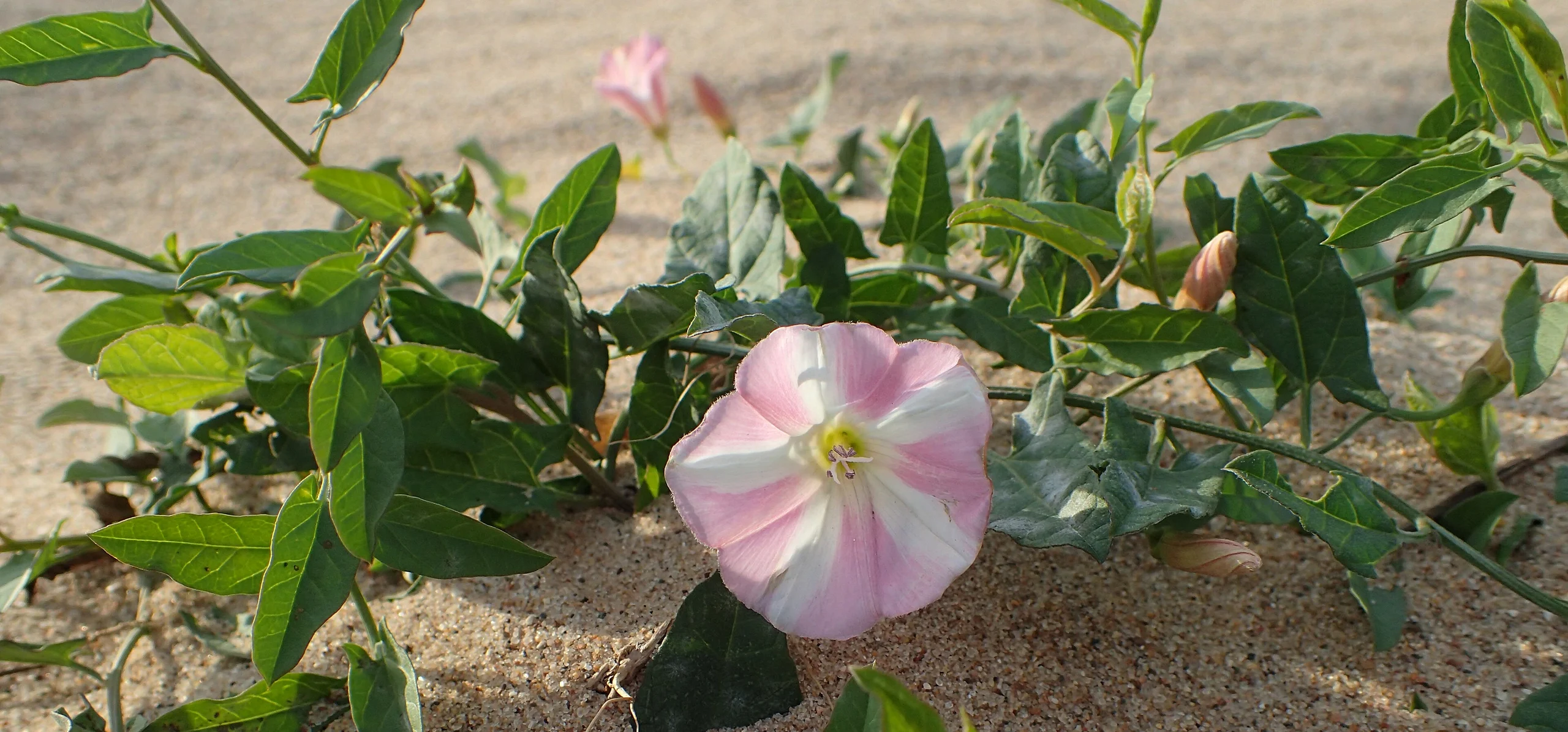
Field Bindweed
Convolvulus arvensis
Family · Convolvulaceae
Convolvulus arvensis roots can run six metres deep and its seed survives decades in soil, so pulling, digging and tilling all fail without a multi-season plan.
Convolvulus arvensis
Plant profile
- WateringLittleWater every 14 days
- Light exposureFull sun
Growth
- Family
- Convolvulaceae
- Life cycle
- Perennial
- Growth speed
- 9/10
- Propagation
- Seed
- Division
Mature sizeTrailing or twining stems, spreading into patches of unlimited size from a root system reported to run as deep as six metres
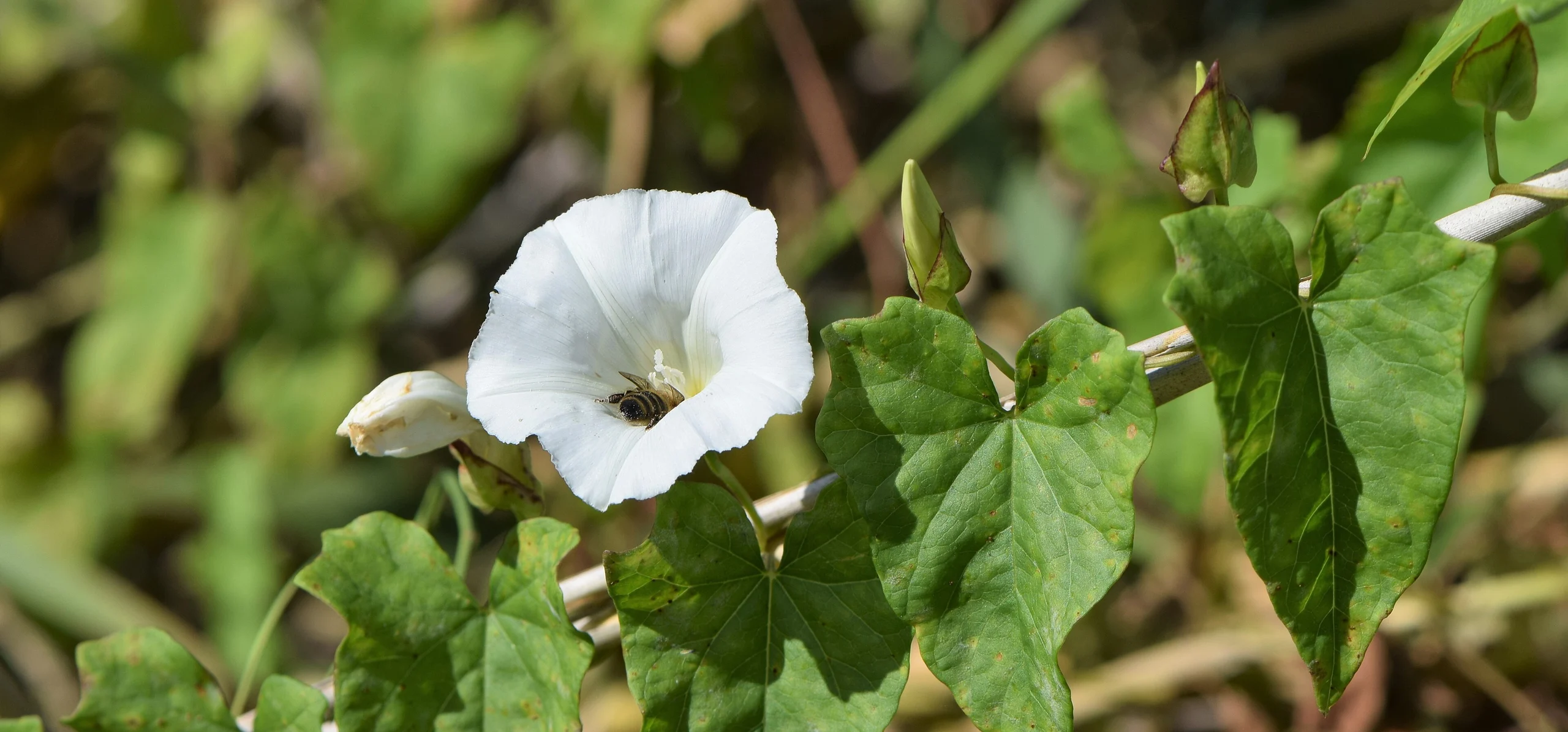
FloweringFunnel-shaped white flowers heavily striped pink, about 2 cm across, from roughly June to the first frost
Dormancytop growth dies back to the root system in cold winters and resprouts from buds along the roots each spring
Time to maturitya shoot from a root bud or a two-inch root fragment can reach flowering size within weeks; a seedling typically needs about a month to build the root reserves that make it hard to remove
Soil & climate
- Soil types
- clay, loamy, sandy
- Drought tolerance
- Yes
Light & Placement
- Where to place it
- disturbed ground and roadsides
- cultivated fields and gardens
- fence lines and other supports it can climb
OriginTemperate and subtropical Old World (Europe, Asia and North Africa); introduced and naturalized as a weed across North America and much of the temperate world
Safety
- Toxicity
- Not listed by the ASPCA for cats, dogs or horses
- Pet safe
- No
Invasive speciesListed as a noxious or restricted weed across most of the United States according to the USDA PLANTS database; dispose of pulled roots and runners as waste rather than in a home compost pile, since fragments can reroot
Data fromGBIF: Convolvulus arvensis L.Plants of the World Online (Kew): ConvolRHS: Bindweed, identification and controUC IPM (University of California AgriculUSDA PLANTS Database: Convolvulus arvens
Where it grows
World distribution
Field Bindweed is native to 57 countries: Afghanistan, Albania, Algeria, Austria, Belarus, Belgium, Bhutan, and Bulgaria….GBIF records 732,196 documented identifications across 123 countries, with the largest concentrations in France, United Kingdom, and Netherlands.
- Afghanistan
- Albania
- Algeria
- Austria
- Belarus
- Belgium
- Bhutan
- Bulgaria
- Chad
- China
- Croatia
- Cyprus
Show 45 more countriesShow fewer countries
- Czechia
- Denmark
- Egypt
- Estonia
- Finland
- France
- Georgia
- Germany
- Greece
- Hungary
- India
- Iran
- Iraq
- Ireland
- Italy
- Kazakhstan
- Kyrgyzstan
- Lebanon
- Libya
- Mauritania
- Mongolia
- Morocco
- Myanmar (Burma)
- Nepal
- Netherlands
- Norway
- Oman
- Pakistan
- Palestinian Territories
- Poland
- Portugal
- Romania
- Russia
- Saudi Arabia
- Spain
- Sudan
- Sweden
- Switzerland
- Tajikistan
- Tunisia
- Türkiye
- Turkmenistan
- Ukraine
- United Kingdom
- Uzbekistan
Yellow to orange dots: concentration of documented identifications per country. Green countries: sourced native range. Source: GBIFNative range from POWO (Kew).
Convolvulus arvensis, field bindweed, is rarely a plant anyone sets out to grow: it arrives on its own, threading through a border or a lawn edge, and by the time its pink-striped white trumpets open, the root system underneath it has usually already spread further than the visible vine suggests. The funnel-shaped flowers and arrow-shaped leaves are the easy part to recognise; the hard part is that pulling off the top growth, even repeatedly, rarely touches the actual plant, which lives well over a metre below the surface. Almost everything about controlling this species follows from that one fact.
Identifying Field Bindweed
The flowers are funnel-shaped, roughly 2 cm across, white with five broad pink stripes radiating out from the centre, and they open in full sun and close by evening or in overcast weather. Leaves are alternate and distinctly arrow-shaped (sagittate), with the two basal lobes pointing backward like a spade on a playing card, smaller and more angular than the heart-shaped leaves of a true morning glory. The stems are slender, twining and either trail along the ground or climb by wrapping counter-clockwise around anything upright, a fence wire, a perennial's stalk, another weed, which is how a single plant ends up woven through a whole bed rather than staying in one clump.
A Root System That Makes the Usual Rules Not Apply
According to UC IPM, field bindweed's vertical roots can grow 20 feet (about six metres) deep where soil conditions permit, and while roughly 70% of the total root mass stays in the top two feet, lateral roots regularly turn downward to form new vertical roots of their own, letting a single plant spread radially more than ten feet in one growing season. University of Nevada Reno Extension describes the same pattern independently, putting maximum root depth at 20 feet. This is not a taproot you can lever out with a fork on a Saturday afternoon; it is a branching underground network that a season's worth of visible vine barely hints at.
Why Pulling and Digging Don't Work
Hand-pulling snaps the stem away from the root at or just below the soil line almost every time, and the buds left on the remaining root push up a new shoot within days to weeks. UC IPM notes that a root fragment as small as two inches can regenerate into a full plant on its own, so any digging that breaks the network apart, rather than lifting it whole, multiplies the number of growing points instead of reducing them. A border fork inserted to its full depth, as RHS advises, can lift a meaningful amount of root close to the surface, but on an established patch it will never reach the deeper vertical roots doing most of the surviving.


Never Rotavate or Till a Patch
Rotavating looks like it should help, since it visibly shreds the plant, but both RHS and UC IPM single it out as one of the worst things to do to field bindweed: tillage chops the root and rhizome system into exactly the two-inch-and-under fragments that regrow most readily, then drags and scatters them across the tilled area. A single pass with a rotavator over one patch can leave a season's worth of new bindweed plants spread across the whole cultivated bed. If a section of ground has bindweed roots in it, treat digging tools with more caution there than almost anywhere else in the garden, not less.
What Actually Works: Persistent Removal and Light-Excluding Mulch
Because the root, not the seed, is the real target, control means forcing the plant to spend stored root reserves regrowing top growth over and over until those reserves run out. UC IPM recommends cutting or pulling new shoots every two to three weeks without fail through the growing season, which starves the root system faster than any single treatment. Light exclusion works on the same logic from a different angle: a heavy-duty tarp, black plastic, or RHS's suggestion of cardboard topped with about 20 cm of bark or wood-chip mulch, laid over the entire patch with no gaps at the edges, denies the plant the light it needs to rebuild reserves. Both sources are blunt about the timeline: UC IPM puts complete die-off under a light barrier at three to five years, and RHS advises leaving heavy mulch matting in place for a few years, not a few weeks.
Training It Up Canes for Spot Treatment
In a bed where bindweed is twining up through a valued perennial, an experienced gardener's trick is to give the emerging shoot a bare cane of its own to climb, a few centimetres from the host plant, and redirect the young growth onto it as soon as it appears. Once the runner is isolated on the cane rather than tangled through the perennial's stems, it can be cut cleanly at the base or treated on its own without any risk to the plant it was strangling. It does nothing to the root system by itself, so it has to be repeated every time a new shoot appears, but it turns an otherwise fiddly, damage-prone removal job into a quick, clean one, season after season.
Field Bindweed or Hedge Bindweed?
The lookalike most gardeners confuse this with is hedge bindweed, Calystegia sepium, whose flowers run roughly 5 cm across, more than double field bindweed's 2 cm blooms, and are usually pure white rather than pink-striped; its leaves are also larger and more sharply triangular. Both twine and both regrow from root fragments, but treating a hedge bindweed problem with field bindweed's timeline, or the reverse, mostly wastes a season, since the two have different root depths and growth habits despite the near-identical flower shape.
Seed Longevity, Legal Status and What Visits the Flowers
UC IPM puts seed viability in soil at up to 60 years, and University of Nevada Reno Extension separately reports seeds surviving dormant for over 50, which means a patch cleared of visible root can still resurface from seed set years before the current owner ever gardened there. Partly because of that persistence, the USDA PLANTS database lists field bindweed as a noxious or restricted weed across most of the United States, and pulled material should go out with the trash rather than into a home compost pile, since fragments and seed can both survive the process. The ASPCA does not include field bindweed on its toxic or non-toxic plant lists for cats, dogs or horses at all; it simply is not one of the species catalogued there. Its funnel flowers are, for what it is worth, genuinely visited by bees for nectar through a long summer bloom window, though that is a small consolation set against a root system built to outlast the person trying to remove it.
Test your plant knowledge
Tap a card to flip it and reveal the answer.
Field bindweed's roots have been recorded growing more than six metres (20 feet) deep where soil conditions allow it. Tap to reveal ✓ True
Tilling or rototilling an established patch is an effective way to destroy its root system. Tap to reveal ✕ False
A field bindweed seed can remain dormant and viable in the soil for more than fifty years. Tap to reveal ✓ True
Hedge bindweed (Calystegia sepium) has smaller flowers than field bindweed. Tap to reveal ✕ False
The ASPCA lists field bindweed as toxic to horses. Tap to reveal ✕ False
Sources
References consulted for this guide
- GBIF: Convolvulus arvensis L.gbif.org
- Plants of the World Online (Kew): Convolvulus arvensis L.powo.science.kew.org
- RHS: Bindweed, identification and controlrhs.org.uk
- UC IPM (University of California Agriculture and Natural Resources): Field Bindweedipm.ucanr.edu
- USDA PLANTS Database: Convolvulus arvensis (COAR4)plants.usda.gov
- Reference entity : Wikipédiaen.wikipedia.org