Creeping Thistle
Cirsium arvense
Family · Asteraceae
Cirsium arvense spreads by a rhizome-like root system that snaps rather than lifts, so pulling and rotavating both leave behind the fragments that regrow it.
Cirsium arvense
Plant profile
- WateringLittleWater every 10 days
- Light exposurePartial sun
Growth
- Family
- Asteraceae
- Life cycle
- Perennial
- Growth speed
- 9/10
- Mature size
- 30–150 cm
- Propagation
- Seed
- Division
FloweringSmall, pale pinkish-lilac flower heads about 2 cm across, clustered near the stem tips, roughly June to September
Dormancytop growth dies back to the root system each autumn and resprouts from buds along the roots in spring
Time to maturitya shoot from a root bud or fragment can flower the same season; a seedling usually needs about a year to build the root system required to flower
Soil & climate
- Soil types
- clay, loamy, sandy
- Drought tolerance
- Yes
Light & Placement
- Where to place it
- disturbed ground and roadsides
- pasture and cropland margins
- an unmown wildlife corner
OriginTemperate Eurasia and Northwest Africa; introduced and naturalized across North America and much of the temperate world
Safety
- Toxicity
- Not listed by the ASPCA for cats, dogs or horses
- Pet safe
- No
Invasive speciesone of five species regulated under the UK Weeds Act 1959 (an injurious weed an occupier can be ordered to control) and listed as a noxious weed by numerous US states, including Colorado, Minnesota and Washington; dispose of pulled roots as waste rather than in a home compost pile
Data fromGBIF: Cirsium arvense (L.) Scop.Plants of the World Online (Kew): CirsiuRHS: Creeping thistlePenn State Extension: Removing Canada ThColorado State University Extension: Can
Where it grows
World distribution
Creeping Thistle is native to 52 countries: Afghanistan, Albania, Algeria, Austria, Bangladesh, Belarus, Belgium, and Bhutan….GBIF records 1,645,160 documented identifications across 90 countries, with the largest concentrations in United Kingdom, France, and Netherlands.
- Afghanistan
- Albania
- Algeria
- Austria
- Bangladesh
- Belarus
- Belgium
- Bhutan
- Bulgaria
- China
- Croatia
- Cyprus
Show 40 more countriesShow fewer countries
- Czechia
- Denmark
- Egypt
- Estonia
- Faroe Islands
- Finland
- France
- Georgia
- Germany
- Greece
- Hungary
- India
- Iran
- Iraq
- Ireland
- Italy
- Japan
- Kazakhstan
- Kyrgyzstan
- Lebanon
- Mongolia
- Nepal
- Netherlands
- Norway
- Pakistan
- Palestinian Territories
- Poland
- Portugal
- Romania
- Russia
- South Korea
- Spain
- Sweden
- Switzerland
- Tajikistan
- Türkiye
- Turkmenistan
- Ukraine
- United Kingdom
- Uzbekistan
Yellow to orange dots: concentration of documented identifications per country. Green countries: sourced native range. Source: GBIFNative range from POWO (Kew).
A Perennial Built Entirely Around Its Roots
Cirsium arvense is a perennial in the daisy family (Asteraceae), accepted under that name by GBIF, and known almost everywhere as creeping thistle or, in North America, Canada thistle. The second name is a historical accident rather than a clue to its origin: Plants of the World Online places its native range in temperate Eurasia and Northwest Africa, and it simply arrived in Canada as a farmland weed before spreading south into the United States, where the name stuck. What makes it worth understanding before you touch it is entirely underground: a system of far-creeping, cord-like roots studded with dormant buds, which is why a plant that looks like a single rosette one week can be a metre-wide patch the next season, and why the usual weeding instincts, pull it or till it, tend to make the problem larger rather than smaller.
Identifying Creeping Thistle
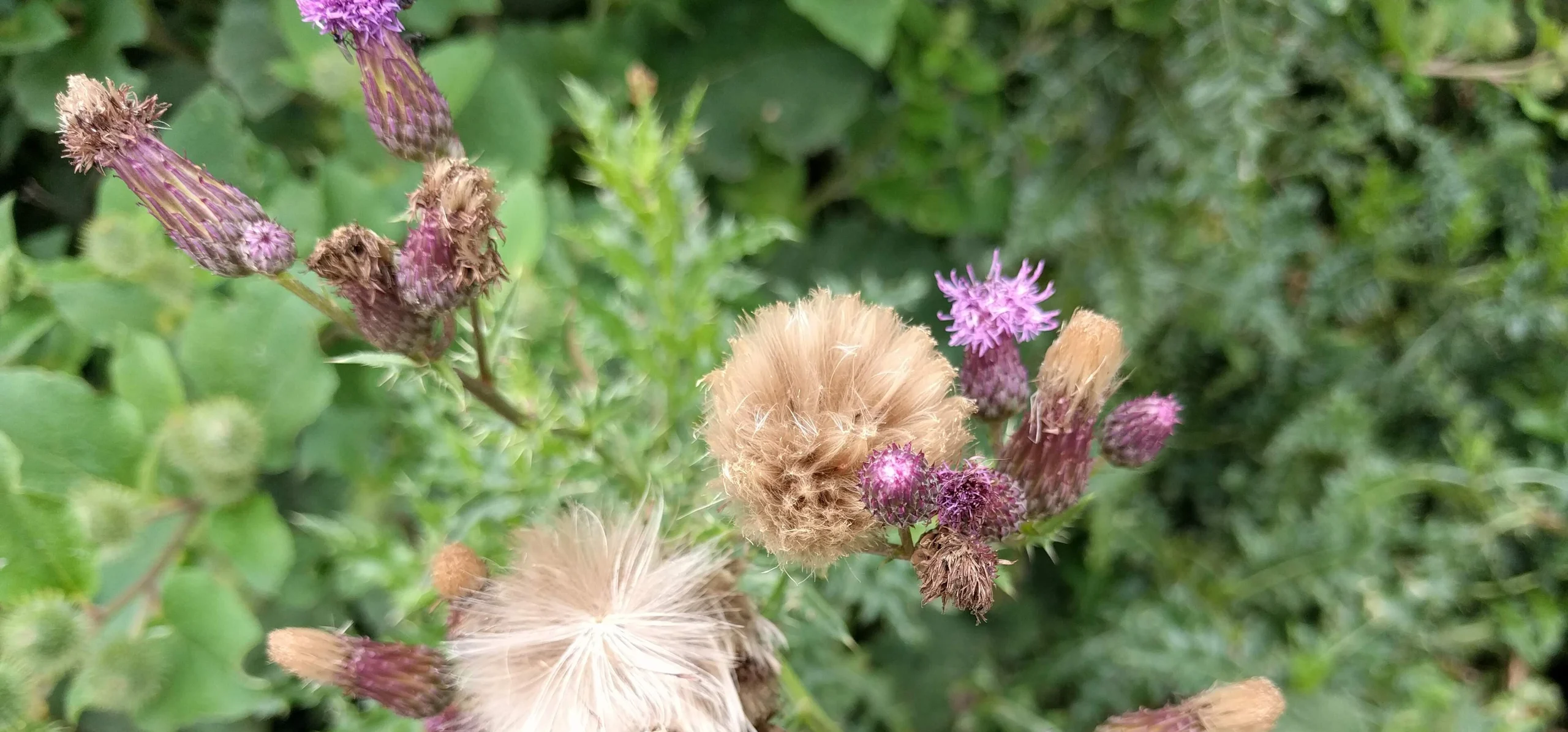
Stems are erect, ridged and, unlike most thistles, not edged with spiny wings; they carry alternate, lobed, spine-tipped leaves and stand anywhere from about 30 cm to 1.5 m depending on the site. From roughly June to September it produces small, pale pinkish-lilac flower heads, only about 2 cm across, clustered in loose groups near the stem tips rather than borne singly. Because whole patches grow from a shared root system, plants appear in distinct, roughly circular colonies rather than as scattered individuals, a growth habit Colorado State University Extension flags as one of the clearest field signs once you know to look for it.
Dioecious Clones: Why a Patch Can Fail to Set Any Seed
Creeping thistle is usually dioecious: an individual clone produces either pollen-bearing male flowers or seed-producing female flowers, never both. Because every shoot in a patch traces back to the same root system, an entire colony is typically a single sex, and a female patch growing in isolation, far from any male clone, can flower all summer while setting almost no viable seed at all. Where a male and a female clone do grow within insect-flying distance of each other, the female heads ripen into the familiar wind-carried, fluffy-tufted seed. This is also why treating an isolated, long-established patch as a seed threat is often less urgent than treating it as what it actually is, a slowly widening ring of shared roots.
Creeping Thistle or Spear Thistle?
The thistle most often confused with this one is spear thistle, Cirsium vulgare, and the two call for different expectations. Spear thistle is biennial, grows from a single taproot with no creeping rhizome, and bears larger flower heads, typically 3 to 5 cm, held singly on a stem that is conspicuously winged with spines running down its length. Creeping thistle's stem is unwinged, its flower heads are smaller and clustered, and, most importantly for control, pulling out a spear thistle's taproot genuinely removes the plant, while pulling a creeping thistle rarely does. Mistaking one for the other is the single most common reason a gardener expects a weed to be gone after one dig and finds it back within weeks.


Why Pulling and Rotavating Make It Spread Faster
Most of the root's active buds sit in the top 10 to 50 cm of soil, but the wider root network can run several metres sideways and multiple metres down in an established patch, according to Colorado State University Extension. Hand-pulling almost always snaps a root somewhere below the surface rather than lifting it whole, and the buds left behind simply push up new shoots within weeks. Tilling or rotavating is worse, not better: extension weed-science guidance is explicit that cultivation equipment cuts these roots into fragments and drags them across the ground, and because a fragment as small as an inch can sprout on its own, one pass of a rotavator can turn a single patch into dozens of new ones scattered over the tilled area.
Repeated Cutting and Mowing to Exhaust the Root
Because the root, not the seed, is the real adversary, the realistic approach is to keep cutting the top growth off so the plant is forced to spend stored root reserves regrowing it, over and over, until those reserves run down. Extension guidance points to the bud-to-early-flower stage in summer, when the root's energy reserves are at their lowest point in the season's cycle, as the most effective time to mow or cut, and stresses that this has to be repeated through the season and carried on for more than one year to have a real effect on an established patch. A single cut timed for looks, rather than repeated cuts timed to the plant's own cycle, mostly just delays flowering.
Mulching and Smothering a Patch
Ordinary organic mulch, bark or wood chips, does not control this weed on its own: its root reserves are large enough to push a shoot straight through a thick mulch layer, and the moisture the mulch conserves can even help it along. An opaque barrier that blocks light entirely, a heavy-duty tarp or a sheet of black plastic pinned down over the whole patch with no gaps, has a better chance, but perennial weeds with this much stored root energy need the covering left in place for several months to a full growing season rather than a few weeks, and any gap at the edge will be found and exploited. Smothering works best paired with mowing the surrounding area so the patch cannot simply send new growth around the barrier's border.
An Injurious Weed in the UK, a Noxious One Across the US
Creeping thistle is one of five species named under the UK's Weeds Act 1959, alongside spear thistle, curled dock, broad-leaved dock and ragwort; the law lets the authorities serve a notice on a landowner requiring action to stop the weed spreading, though in practice most gardens are never served one and are not expected to eradicate it entirely. In the United States it carries no single federal listing but is named as a noxious weed by numerous individual states, including Colorado, Minnesota and Washington, a patchwork of local restrictions that goes back further than most people expect: colonial-era Vermont had already legislated against it by 1795, not long after it arrived as a contaminant in imported grain seed.
A Genuine Nectar Plant for Pollinators
Regulated status and garden nuisance aside, creeping thistle is a real asset to bees, butterflies, moths and beetles, which visit its flower heads for nectar through a long summer bloom window. The RHS notes that it is worth tolerating in a less cultivated corner of a garden specifically for the wildlife it supports, reserving active control for the parts of a plot where it would otherwise compete with cultivated plants for light, moisture and space. Leaving one well-contained patch in a hedge base or rough margin, rather than clearing every trace of it, is often the more useful compromise than an all-or-nothing approach.
Common Mistakes That Bring It Right Back
- Pulling the visible rosette once and assuming the job is done, when the root almost always survives underground and simply resprouts.
- Rotavating or deep-tilling a patch to "clear" it, which cuts the roots into viable fragments and spreads the problem across the tilled area.
- Mowing once at whatever time is convenient rather than repeatedly through the bud stage, which slows flowering but does little to exhaust the root.
- Relying on organic mulch alone to smother it, when only a genuinely light-blocking barrier left in place for months has a realistic chance.
- Composting pulled roots instead of binning them as waste, which risks a live fragment rerooting in the heap.
Test your plant knowledge
Tap a card to flip it and reveal the answer.
Pulling a creeping thistle usually snaps its roots rather than removing them whole. Tap to reveal ✓ True
Tilling or rotavating a patch of creeping thistle is an effective way to destroy its root system. Tap to reveal ✕ False
A single isolated creeping thistle patch, made up of just one clone, will reliably set full seed on its own. Tap to reveal ✕ False
Its flower heads are noticeably smaller than those of the spear thistle, Cirsium vulgare. Tap to reveal ✓ True
In the United Kingdom, a landowner can be legally required to control creeping thistle on their land. Tap to reveal ✓ True
Sources
References consulted for this guide
- GBIF: Cirsium arvense (L.) Scop.gbif.org
- Plants of the World Online (Kew): Cirsium arvense (L.) Scop.powo.science.kew.org
- RHS: Creeping thistlerhs.org.uk
- Penn State Extension: Removing Canada Thistle from the Home Gardenextension.psu.edu
- Colorado State University Extension: Canada Thistleextension.colostate.edu
- Reference entity : Wikipédiaen.wikipedia.org