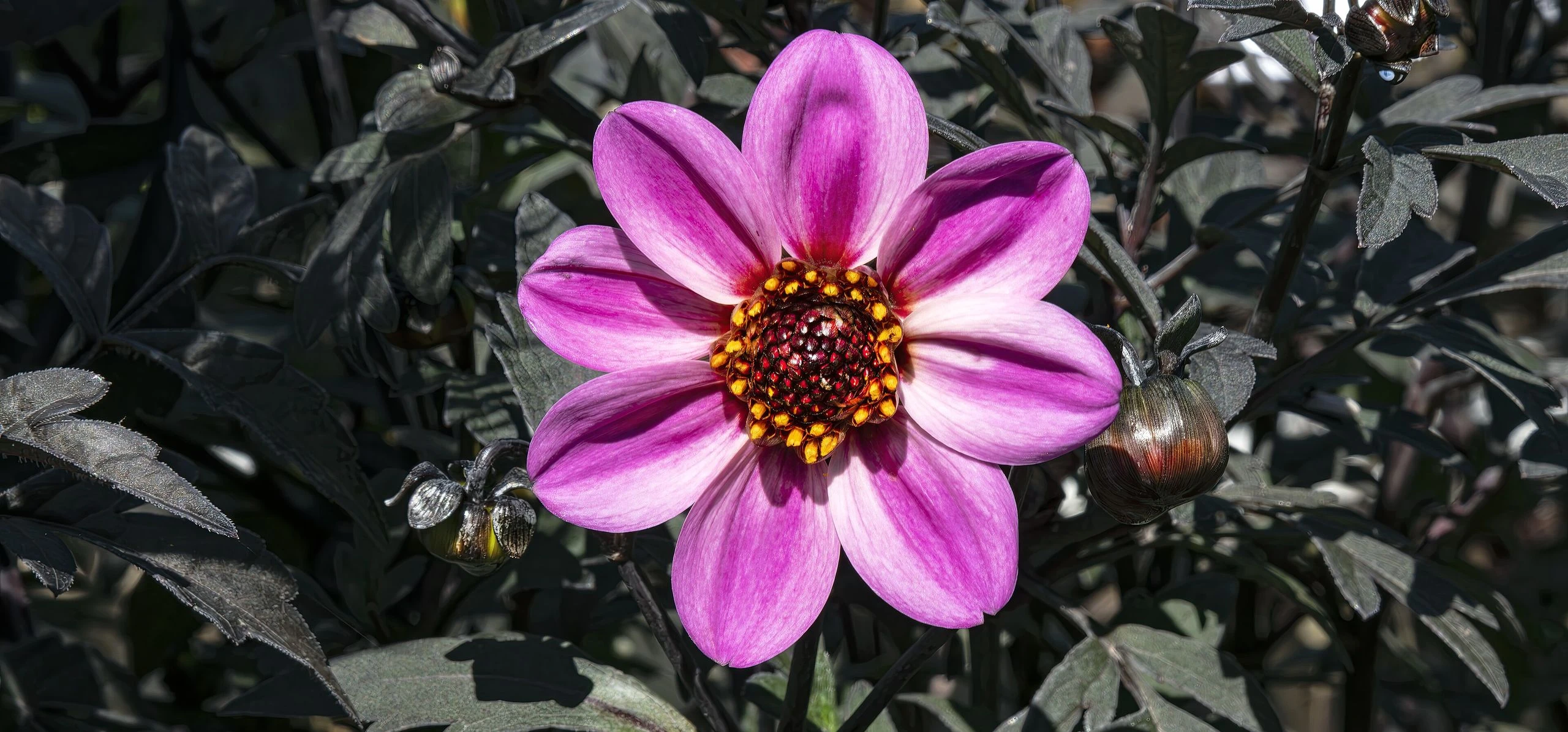
Garden Dahlia
Dahlia pinnata
Family · Asteraceae
Dahlia pinnata tubers need full sun, fertile soil and a frost-free start; here is how to plant, feed, stake and lift them for years of bloom.
Dahlia pinnata
Plant profile
- WateringHighWater every 4 days
- Light exposureFull sun
- Hardiness zoneUSDA 7–10
Growth
- Family
- Asteraceae
- Life cycle
- Perennial
- Growth speed
- 7/10
- Mature size
- 30–183 cm
- Spread
- 30–91 cm
- Flowering
- Early summer to first frost (NC State Extension)
- Propagation
- Division
- Cutting
- Seed
DormancyFoliage dies at first frost; tubers overwinter dormant, lifted and stored frost-free in cold climates (RHS)
Time to maturityBlooms from early summer, continuing to first frost (NC State Extension)
Soil & climate
- Soil pH
- pH 6.5–7
- Soil types
- Fertile, moist but well-drained soil, pH 6.5 to 7.0 (NC State Extension)
- Drought tolerance
- No
Light & Placement
- Origin
- Cultigen from Mexico (POWO)
- Where to place it
- Sunny border with at least 6 to 8 hours of direct sun daily (NC State Extension)
- Cutting garden bed sheltered from strong wind (RHS)
- Large container, 12 in (30 cm) or wider, for a full-sized tuber
- Smaller pots for dwarf bedding varieties
Safety
- Toxicity
- CatsToxic
- DogsToxic
- HorsesToxic
- HumansToxic
Data fromDahlia ×pinnata Cav., GBIF Backbone TaxoDahlia pinnata Cav., Plants of the WorldToxic and Non-toxic Plants: Dahlia, ASPCHow to grow dahlias, RHS Growing GuideDahlia, North Carolina Extension Gardene
Where it grows
World distribution
Garden Dahlia is native to a single country: Mexico.GBIF records 5,880 documented identifications across 97 countries, with the largest concentrations in France, Mexico, and Germany.
- Mexico
Yellow to orange dots: concentration of documented identifications per country. Green countries: sourced native range. Source: GBIFNative range from POWO (Kew).
A garden centre "dahlia" almost always carries a cultivar name rather than a species name, because the plants sold today descend from crosses bred from Dahlia pinnata and related Mexican species over more than a century. GBIF's accepted name for this line is Dahlia ×pinnata, the multiplication sign marking its hybrid origin, and pinnata still covers the classic single and semi-double garden dahlias with a central disc ringed by broad ray petals. Whatever the exact parentage on the label, the care is the same: a tuberous root that cannot survive freezing, planted fresh each spring and lifted again before winter in all but the mildest regions.
A Hybrid Species With Wild Mexican Roots
Plants of the World Online lists Dahlia pinnata as a cultigen native to Mexico, meaning it took its current form in cultivation there rather than growing wild exactly as sold today; the wild Dahlia species behind it, and the country's national flower, all trace back to the same region. That Mexican origin explains most of the plant's needs in a temperate garden: it grows fast and flowers hard through one warm season, then dies back completely at the first cold snap because its tuberous roots evolved for a climate that rarely freezes, not for a British or northern American winter.
Site, Sun and Soil
NC State Extension calls for full sun, at least six to eight hours of direct light a day; shade a dahlia and the result is tall, sparse stems chasing the light instead of a stocky plant covered in flowers. Soil should be fertile and well drained but not dry, with a pH of 6.5 to 7.0, since dahlias sulk in both waterlogged clay and a soil that bakes hard by midsummer. The RHS also recommends a spot sheltered from strong wind: the hollow, brittle stems that carry the heaviest blooms snap easily once gusts catch a plant that has grown tall and top-heavy.
Planting Tubers After the Last Frost
Dahlia tubers do not tolerate frost, so timing the planting matters more than almost anything else here. Wait until the soil has warmed and all danger of frost has passed before setting a tuber into the ground, laid on its side with the old stem base pointing upward, then cover it over. Resist the urge to water it in straight away; NC State Extension is explicit that excessive moisture rots the tuber before it has even sent up a shoot, so hold off until the first leaves break the surface. Gardeners in cooler regions can start tubers a few weeks early in pots indoors, then move the growing plants out once the frost risk has passed.
Watering and Feeding for Bigger Blooms
Once a dahlia is established and growing hard, the RHS calls it a thirsty plant: water deeply once or twice a week, more often in hot, dry spells, and aim the water at the base rather than over the foliage, which invites fungal disease. NC State Extension notes that dahlias can genuinely struggle in summer heat if they dry out, so a mulch that holds moisture through the hottest weeks is worth the effort even though the plant is not naturally drought tolerant.
How often to water your Garden Dahlia
Feeding follows the same logic as watering: little and often rather than one heavy dose. A balanced feed while the plant is bulking up gives way to a potassium-rich feed, the kind sold for tomatoes, once the first buds appear, since potassium drives flowers rather than the soft leafy growth that too much nitrogen produces.
Staking, Pinching and Deadheading
Put a stake in at planting time, before the tuber has sent out roots that a stake driven in later would damage, and loosely tie the main stem to it as the plant grows. The single most useful technique is pinching: once a young plant has three or four sets of leaves, snip out the growing tip just above a leaf pair. That one cut forces side shoots lower down the stem, turning one thin stalk into a bushy plant with several flowering stems instead of one. From there, deadheading keeps the display going: remove spent flowers by cutting back to the next leaf joint or side bud, since a dahlia left to set seed slows down and eventually stops producing new buds. Cutting flowers for the house has exactly the same effect, so the more you pick, the more the plant makes.
Pests, Diseases and Toxicity
NC State Extension lists aphids, leafhoppers and caterpillars as the main insect problems, alongside earwigs that chew ragged holes in petals overnight, most often on open, single-flowered forms where the disc florets sit exposed rather than packed under tight double petals. On the disease side, the same source names phytophthora blight and root rot, powdery mildew, crown gall and several viruses as recurring issues, most of which trace back to poor drainage or crowded, still air around the foliage. The ASPCA lists dahlia as toxic to cats, dogs and horses, with mild gastrointestinal upset and mild dermatitis as the typical signs, and NC State Extension separately notes that the foliage is toxic to humans if eaten in large amounts and that handling the tubers or brushing against the leaves in sunlight can irritate skin. None of this makes dahlias unusually dangerous in a garden, but it is worth keeping curious pets and children away from a bed in full bloom.
Lifting and Storing Tubers for Winter
NC State Extension places dahlias as hardy outdoors only in USDA zones 7 to 10, and even there a heavy mulch is the minimum protection; anywhere colder, the tubers need to come out of the ground. After the first frost blackens the foliage, cut the stems back to a stub, lift the tuber clump carefully with a fork rather than pulling by the stem, and let it dry for a few days before storing. Pack the dried tubers in barely damp compost, sand or vermiculite, somewhere cool, dark and reliably frost free, and check on them through winter for any that have gone soft or started to rot, removing those before they spread. In spring, the same clump can usually be divided into several new tubers, each with at least one eye near the old stem base, which is the easiest way to multiply a variety you already grow.


Test your plant knowledge
Tap a card to flip it and reveal the answer.
Pinching out the growing tip of a young dahlia encourages a bushier plant with more flowers. Tap to reveal ✓ True
Dahlias flower best in full shade. Tap to reveal ✕ False
Dahlia tubers should be watered heavily right after planting. Tap to reveal ✕ False
In USDA zones colder than about 7, dahlia tubers must be lifted and stored indoors to survive winter. Tap to reveal ✓ True
Dahlia foliage is toxic to cats, dogs and horses if eaten. Tap to reveal ✓ True
Sources
References consulted for this guide
- Dahlia ×pinnata Cav., GBIF Backbone Taxonomygbif.org
- Dahlia pinnata Cav., Plants of the World Online, Kew Sciencepowo.science.kew.org
- Toxic and Non-toxic Plants: Dahlia, ASPCAaspca.org
- How to grow dahlias, RHS Growing Guiderhs.org.uk
- Dahlia, North Carolina Extension Gardener Plant Toolbox, NC State Extensionplants.ces.ncsu.edu
- Reference entity : Wikipédiaen.wikipedia.org