Wood Avens
Geum urbanum
Family · Rosaceae
Wood avens is a shade-loving weed with hooked seeds and a clove-scented root: how to identify it, keep it out of borders, and where it is fine to leave it.
Geum urbanum
Plant profile
- WateringModerateWater every 10 days
- Light exposurePartial shade
Growth
- Family
- Rosaceae
- Life cycle
- Perennial
- Growth speed
- 6/10
- Mature size
- 50–100 cm
- Spread
- 10–50 cm
- Flowering
- Small five-petaled yellow flowers, roughly May to August
- Propagation
- Seed
- Division
Dormancyevergreen basal rosette persists through winter; only the flowering stems die back after seed is set
Time to maturityreaches flowering maturity in 2 to 5 years
Soil & climate
- Soil types
- chalk, clay, loam, sand
- Drought tolerance
- No
Light & Placement
- Origin
- Europe to Central Asia and Iran, and northwest Africa
- Where to place it
- shaded border
- hedge base
- woodland edge
- wild or wildlife corner
Safety
- Toxicity
- HumansSafe
Invasive speciesNot a regulated invasive; native across GB, Ireland and continental Europe, and spreads locally by self-seeding rather than by creeping roots
Data fromGBIF: Geum urbanum L.Plants of the World Online (Kew): Geum uRHS: Geum urbanum (wood avens, blessed hRHS Weeds: Herb Bennet
Where it grows
World distribution
Wood Avens is native to 41 countries: Albania, Algeria, Austria, Belarus, Belgium, Bulgaria, Croatia, and Czechia….GBIF records 1,053,546 documented identifications across 76 countries, with the largest concentrations in United Kingdom, France, and Sweden.
- Albania
- Algeria
- Austria
- Belarus
- Belgium
- Bulgaria
- Croatia
- Czechia
- Denmark
- Estonia
- Finland
- France
Show 29 more countriesShow fewer countries
- Georgia
- Germany
- Greece
- Hungary
- Iran
- Iraq
- Ireland
- Italy
- Kazakhstan
- Kyrgyzstan
- Lebanon
- Morocco
- Netherlands
- Norway
- Palestinian Territories
- Poland
- Portugal
- Romania
- Russia
- Spain
- Sweden
- Switzerland
- Tajikistan
- Tunisia
- Türkiye
- Turkmenistan
- Ukraine
- United Kingdom
- Uzbekistan
Yellow to orange dots: concentration of documented identifications per country. Green countries: sourced native range. Source: GBIFNative range from POWO (Kew).
A Rose-Family Weed That Thrives in Deep Shade
Geum urbanum, wood avens or herb bennet, is a low perennial in the rose family (Rosaceae) that seems to appear from nowhere at the base of a hedge, under a shrub or along a shady path edge. If you have just found a rosette of ragged, lobed leaves with a small yellow flower nodding above it, in a spot too dark for most border plants to bother with, this is very likely it. GBIF's accepted name is Geum urbanum L., and the species is native across Europe to Central Asia and Iran, and northwest Africa. It is not a plant anyone plants on purpose, but it is rarely a serious problem either: understanding its life cycle is most of what you need to keep it out of the beds you care about and leave it alone where it does no harm.
Identifying the Rosette, the Flower and the Bur
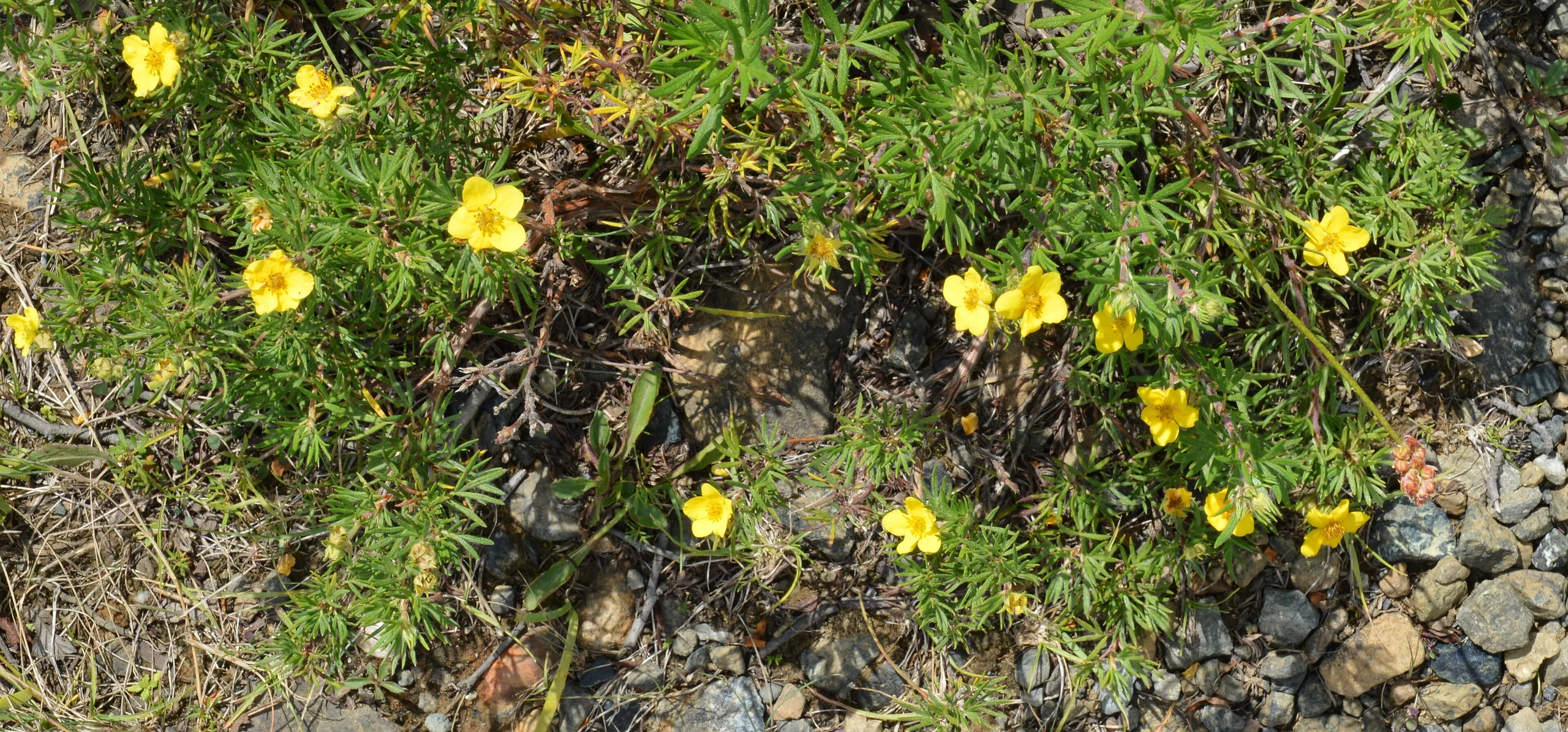
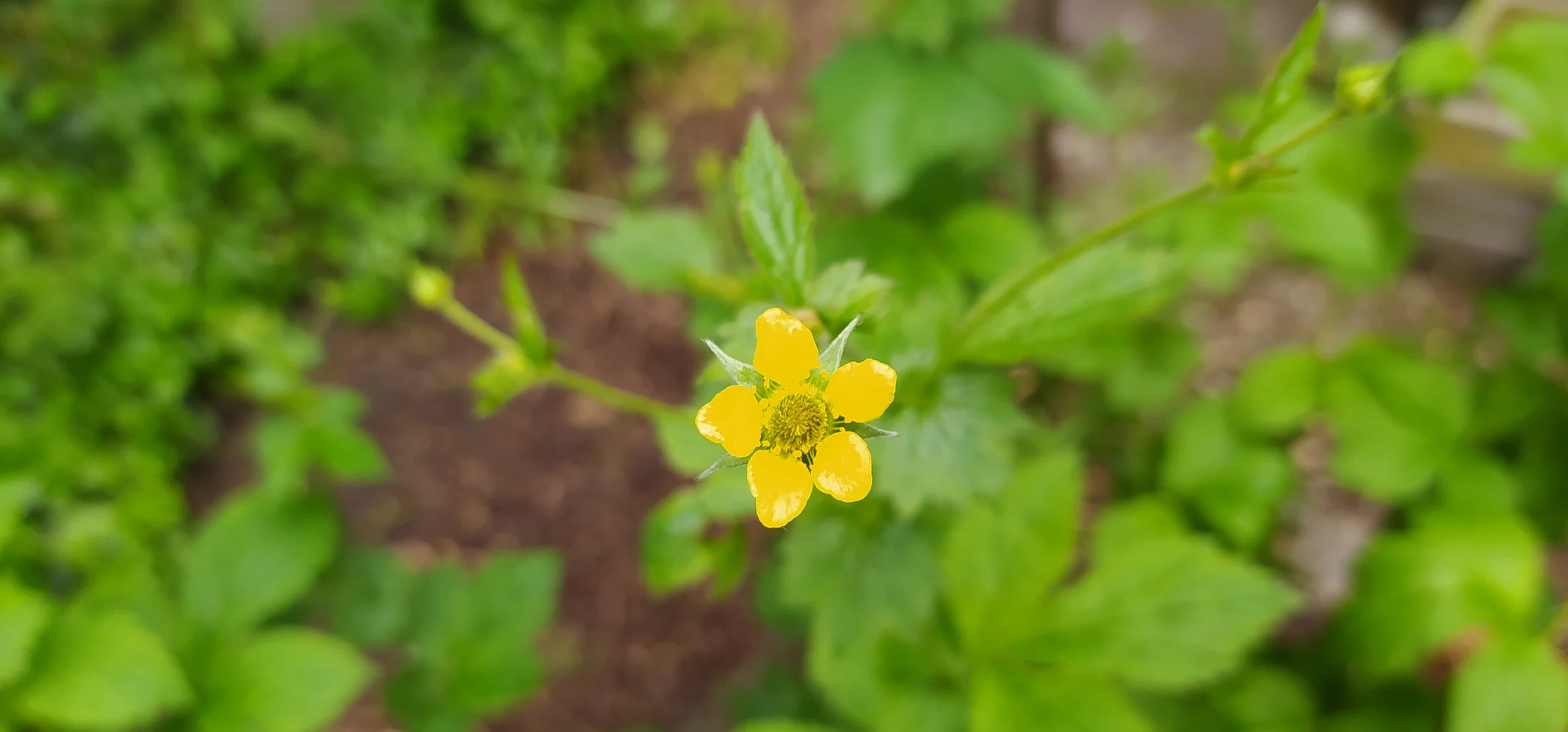
The basal leaves are pinnately lobed and hairy, with an oversized terminal lobe and smaller leaflets running down the stalk, and they form an evergreen rosette that stays green and low through winter while most neighboring foliage dies back. From late spring the plant sends up wiry, branching flowering stems, 50 to 100 cm tall on a mature clump, each carrying small five-petaled yellow flowers a centimeter or so across that nod slightly before opening. Flowering runs roughly from May to August. After petal fall, each flower turns into a tight round cluster of achenes, and every achene ends in a stiff, hooked bristle: this bur is the plant's entire dispersal strategy, catching on fur, wool sleeves and dog coats to hitch a ride away from the parent plant. It is easy to mistake the flower at a glance for creeping cinquefoil or creeping buttercup, both of which also throw yellow five-petaled flowers into shady lawns and borders, but neither produces a hooked seed head, and neither has wood avens' hairy, deeply divided rosette leaf.


The Clove-Scented Root Behind the Name Herb Bennet
Dig up a wood avens root on a dry day and snap it: the smell that comes off is unmistakably clove-like, the reason old herbals list the plant as a clove substitute for flavoring ale and stews. Herb bennet is itself a corruption of herba benedicta, blessed herb, a name that reflects how widely the root was once used, medicinally and in the kitchen, long before it was demoted to a border nuisance. The scent fades quickly once the root dries out, so it is really only obvious on freshly lifted material, which is one small consolation while weeding: a clove whiff off the trowel confirms exactly what was just pulled.
Where It Grows: Shade, Moisture and Ordinary Soil
Wood avens is unfussy about soil type, doing equally well in chalk, clay, loam or sand, across a range from acid to lime-rich, provided the ground holds some moisture. What it does care about is light: it is at its most vigorous in partial to full shade, under hedges, at the base of walls, along a north-facing border or beneath deciduous shrubs, and it visibly sulks in a hot, dry, sunny spot, producing fewer and smaller rosettes than the same plant would in a damp shady corner. That preference is exactly why it turns up in places gardeners struggle to plant anyway: the dry shade under a mature shrub, or the damp shade behind a shed, where more desirable groundcover has failed to establish.
How the Hooked Seeds Spread Through a Garden
A single flowering stem can carry a dozen or more seed heads, and because the bristles are stiff and genuinely hooked rather than just sticky, one pass through a border in seed brushes several onto trouser legs, dog fur or a sleeve, ready to drop wherever the next stop happens to be. This is why a wood avens problem often looks patchy and scattered rather than spreading outward from one obvious clump: new rosettes appear well away from the parent plant, wherever a hooked seed happened to be brushed off. The plant does not spread aggressively by rhizome, so a mature colony is really the sum of many individually seeded rosettes rather than one expanding mat, which matters for how it gets tackled.
Controlling It in a Border
Hand-pulling is the reliable method, and it works best after rain, when the short, wiry root tangle lifts cleanly with a hand fork rather than snapping off at the crown, which just resprouts. Deadheading flowering stems before the seed clusters ripen is the highest-value five minutes spent on this plant in a bed under active management, since it stops that season's crop of hooked seed before it is ever brushed onto a sleeve. Mulching bare ground after clearing a patch smothers the seedlings that keep germinating from seed already shed in previous years, and a dense, shade-tolerant groundcover planted into the gap denies new rosettes the open soil they need to establish. Hoeing is worth avoiding: it tends to sever the root at a point that resprouts rather than removing it, turning one plant into two.
Leaving It Alone in a Wild Corner
Where wood avens is not competing with something being grown on purpose, in a hedge base, a wild strip at the back of the garden or a shaded corner given over to native plants, there is a reasonable case for leaving it be. It is native across Europe and asks nothing of the soil, its small yellow flowers feed early-season pollinators through a long May-to-August season, and its evergreen winter rosette holds green ground cover in a season when little else in a shaded corner is doing so. The plants worth removing are the ones already flowering in a border meant to stay tidy; the plants tucked into a hedge bottom where nothing else wants to grow are doing useful, low-effort work.
Common Mistakes
The most frequent mistake is leaving a pulled flowering stem lying on the border rather than bagging or binning it: a stem with ripe or nearly ripe seed heads can still shed viable, hook-ready seed from the ground exactly as it would standing. The second is hoeing a patch instead of forking it out, which snaps roots at the crown and produces a flush of fresh regrowth rather than clearing anything. The third is assuming a sunny bed needs treating for it at all: wood avens rarely persists in a hot, dry, open position, so a colony that showed up in full sun usually thins itself out without intervention, and effort is better spent on the shaded, damp corners where it actually thrives.
Test your plant knowledge
Tap a card to flip it and reveal the answer.
The hooked seed clusters of wood avens catch on animal fur and clothing to spread. Tap to reveal ✓ True
Wood avens loses all its foliage and dies back completely over winter. Tap to reveal ✕ False
The freshly dug root of wood avens has a scent similar to cloves. Tap to reveal ✓ True
Wood avens grows best in a hot, dry, sunny border. Tap to reveal ✕ False
Deadheading wood avens before its seed clusters ripen reduces how much it self-seeds. Tap to reveal ✓ True
Sources
References consulted for this guide
- GBIF: Geum urbanum L.gbif.org
- Plants of the World Online (Kew): Geum urbanumpowo.science.kew.org
- RHS: Geum urbanum (wood avens, blessed herb)rhs.org.uk
- RHS Weeds: Herb Bennetrhs.org.uk
- Reference entity : Wikipédiaen.wikipedia.org