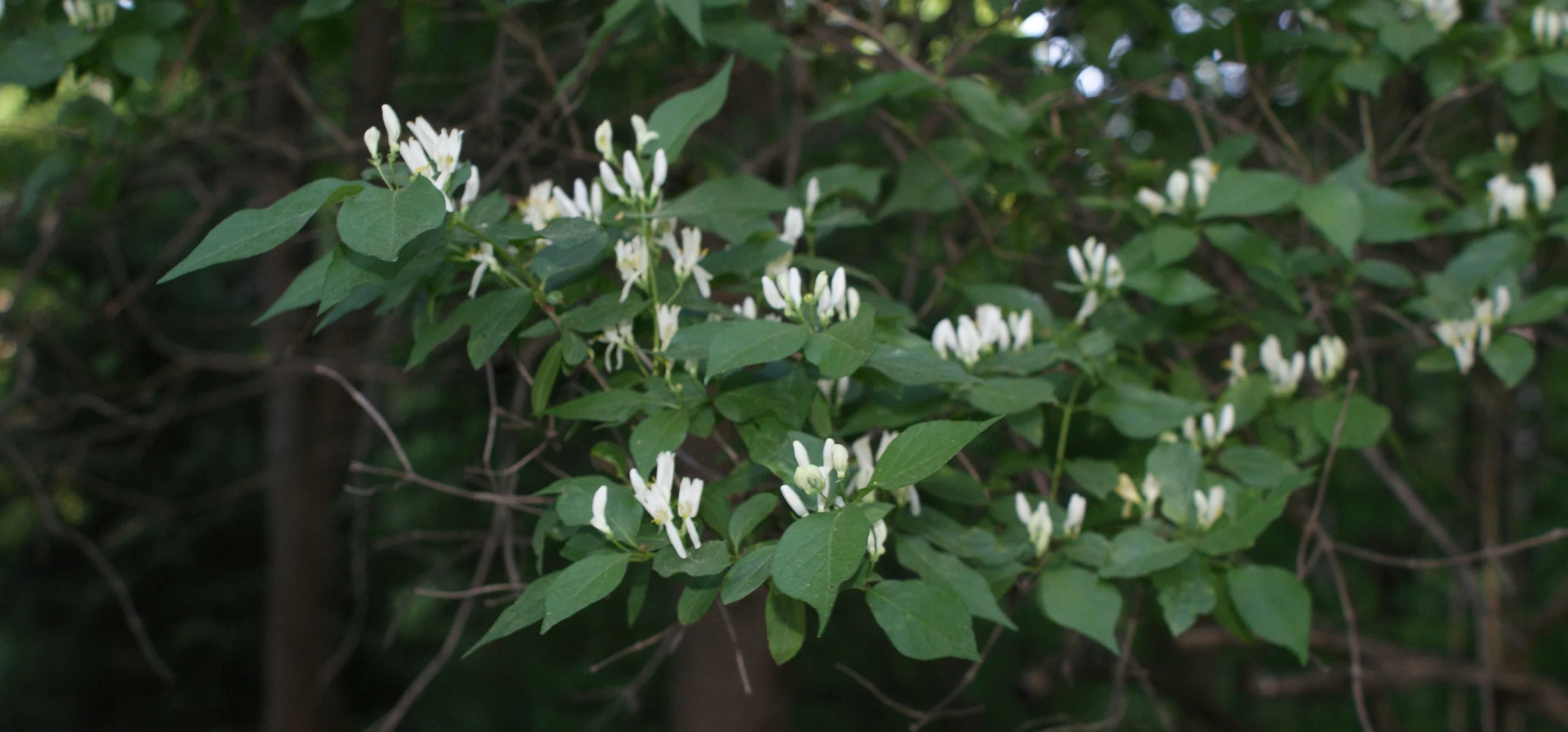
Amur Honeysuckle
Lonicera maackii
Family · Caprifoliaceae
Lonicera maackii leafs out weeks before native shrubs and has a hollow stem, unlike native honeysuckles. Banned in several states; here is how to remove it.
Lonicera maackii
Plant profile
- WateringModerateWater every 10 days
- Light exposurePartial sun
- Hardiness zoneUSDA 3–8
Growth
- Family
- Caprifoliaceae
- Life cycle
- Perennial
- Growth speed
- 9/10
- Mature size
- 300–460 cm
- Spread
- 300–460 cm
- Propagation
- Seed
FloweringFragrant, tubular white flowers aging to yellow, May to June, followed by clusters of dark red berries in fall
Dormancydeciduous; keeps its leaves later into fall than most native trees and shrubs and drops them last
Time to maturityseedlings typically exceed 3 feet within 3 years, and shrubs become reproductive once they pass roughly 8 feet
Soil & climate
- Soil types
- loamy
- Drought tolerance
- Yes
Light & Placement
- Origin
- Russian Far East to China and central Japan
Where to place itNowhere in North America. Where one already grows on your land, treat it as a removal project, not a landscape shrub
Safety
- Toxicity
- Not listed by the ASPCA for cats, dogs or horses; the berries are inedible to humans
- Pet safe
- No
Invasive speciesBanned in Connecticut, prohibited in Massachusetts and Maryland, regulated under the Illinois Exotic Weed Act, and listed as a noxious or restricted species in Vermont, Wisconsin, Minnesota and Kansas among others; forms dense stands that shade out native plants and lowers nesting success for robins and cardinals
Data fromGBIF: Lonicera maackii (Rupr.) Maxim.Plants of the World Online (Kew): LoniceMissouri Botanical Garden Plant Finder: University of Illinois Extension: InvasiUniversity of Maryland Extension: Non-na
Where it grows
World distribution
Amur Honeysuckle is native to 4 countries: China, Japan, Russia, and South Korea.GBIF records 61,206 documented identifications across 34 countries, with the largest concentrations in United States, China, and South Korea.
- China
- Japan
- Russia
- South Korea
Yellow to orange dots: concentration of documented identifications per country. Green countries: sourced native range. Source: GBIFNative range from POWO (Kew).
A Shrub You Identify in Order to Remove It
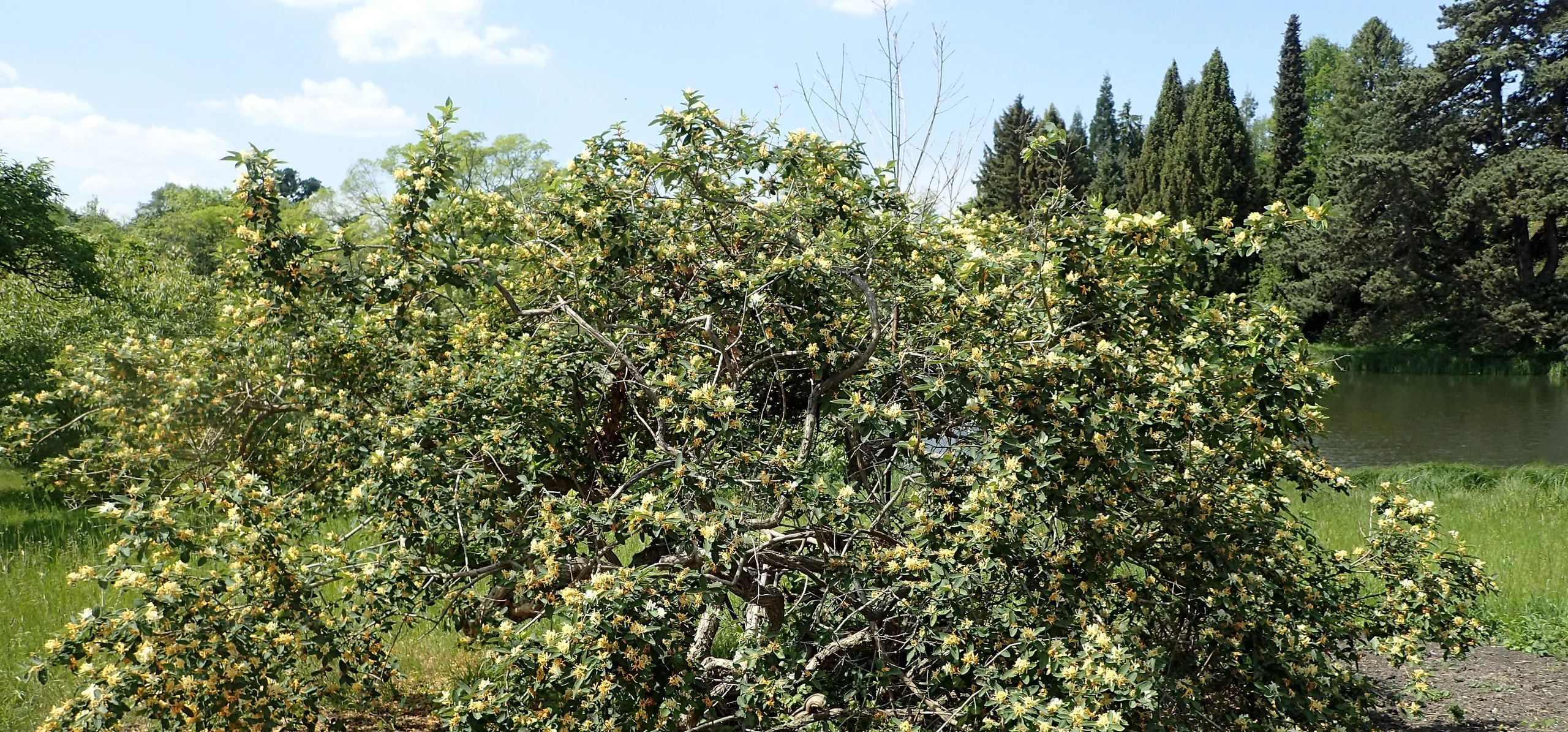
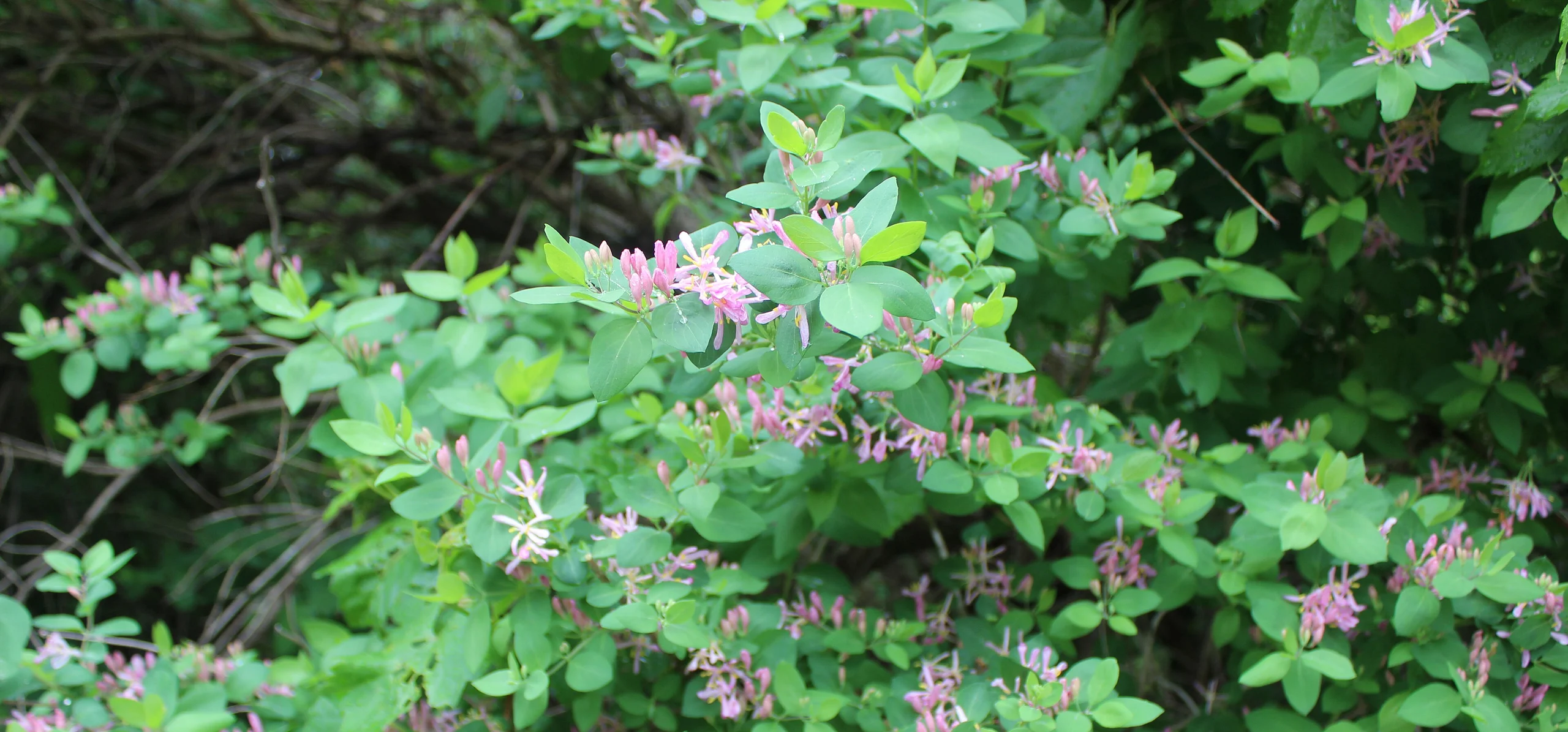
If you have found a densely branched, many-stemmed shrub that leafed out weeks before the trees around it, is now covered in fragrant, tubular white flowers fading to yellow, or by fall carries clusters of small dark red berries along bare stems, you are very likely looking at Lonicera maackii, Amur honeysuckle. This is one of the most damaging invasive shrubs in eastern North America, and the point of identifying it correctly is not to learn how to grow it well, it already does that on its own, but to confirm it before you cut it. One quick test settles most doubts on the spot: snap a pencil-thick stem in half and look at the center. A hollow pith rules out the native shrubs people most often confuse it with.
Reading the Plant: Leaves, Flowers and Berries
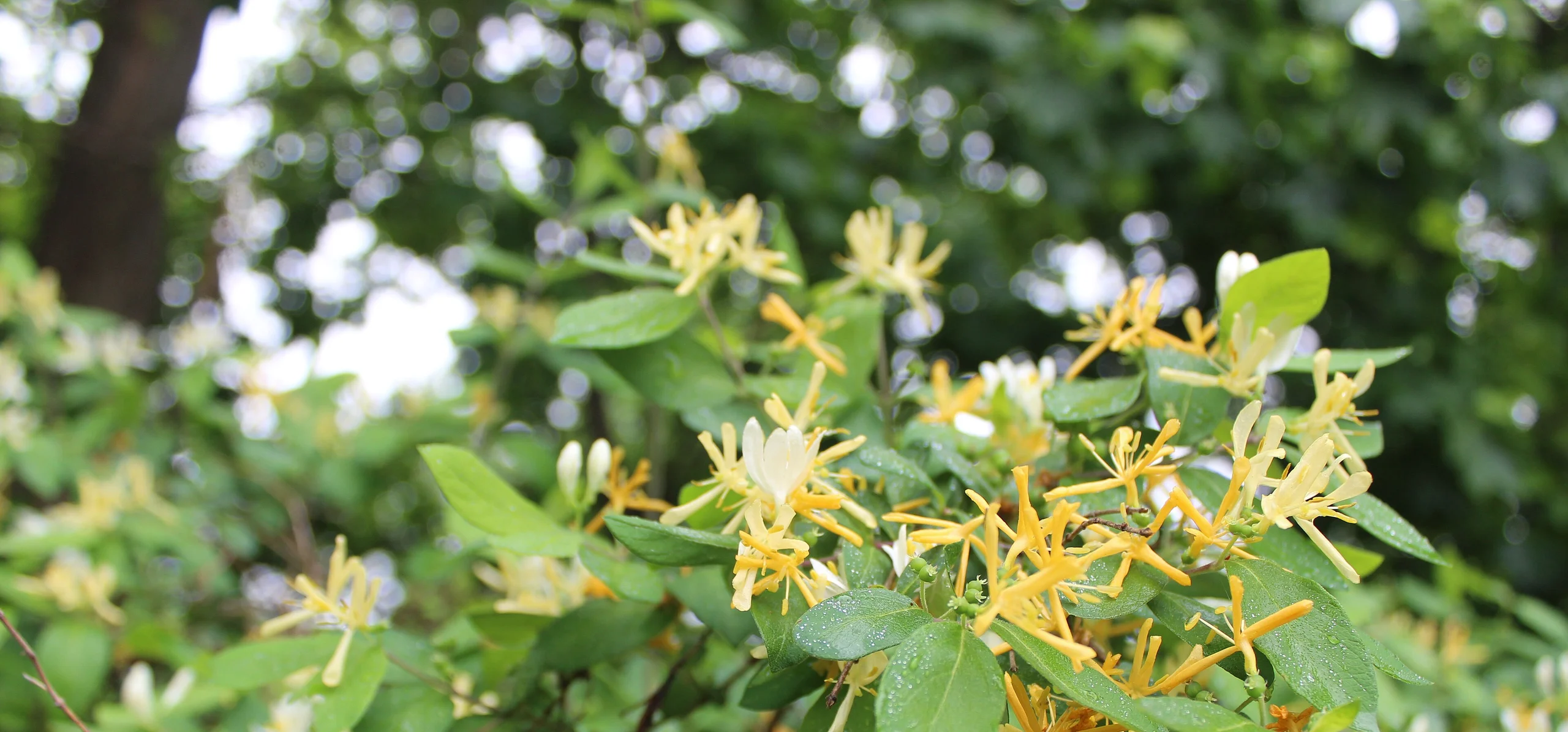
Leaves are opposite, ovate to lance-shaped with a tapered tip, up to about 3 inches long, dark green above and paler beneath, and they stay attached later into autumn than almost anything else in the understory. Flowers open in May and June in pairs at the leaf axils, white and two-lipped at first, aging to yellow so a single shrub in full bloom shows both colors together, a detail Missouri Botanical Garden records directly. Amur honeysuckle is also distinguished from other bush honeysuckles by its short pedicels, the flowers and the berries that follow sit almost directly against the stem rather than on an obvious stalk. By fall those flowers become juicy, dark red berries, showy, abundant, and eaten readily by birds, which is exactly how the species keeps spreading into new woodlots and fencerows.
Amur Honeysuckle Versus the Native Look-Alikes
The stem test is the fastest field mark: invasive bush honeysuckles like this one have hollow pith, while native bush honeysuckle (Diervilla lonicera) and native fly honeysuckle (Lonicera canadensis) have solid stems, according to University of Maryland Extension. The native shrubs also diverge in flower and fruit: Diervilla's flowers open yellow and age to orange-red, the reverse sequence of this species, and they ripen into dry seed capsules rather than fleshy berries. Timing helps too. Amur honeysuckle is often the first shrub in a woodland edge to show green leaves in late winter or early spring, well ahead of the native canopy and understory, and one of the last to lose them in fall, an extended leaf season that lets it photosynthesize while natives around it are still dormant.


Why It Is Worth Removing Rather Than Tolerating
A single shrub rarely stays a single shrub. Amur honeysuckle forms dense, shrubby colonies that shade out native wildflowers, tree seedlings and shrubs in the understory, and University of Maryland Extension notes it also competes with neighboring plants directly through allelopathic chemicals. Its berries look like a good deal for wildlife but are not: they are juicy and abundant, yet lower in the fat migratory songbirds need than the fruit of the native shrubs, such as viburnums and dogwoods, that it displaces. Field studies on nesting American robins and northern cardinals have found a further cost, birds nesting in this honeysuckle's low, thornless, easily climbed branches lost more chicks to predators than birds nesting in native viburnum or hawthorn nearby, in part because the nests sat several inches closer to the ground.
Where It Is Banned or Restricted
Because the ecological damage is well documented, several states no longer allow it to be sold. Missouri Botanical Garden records that it has been banned in Connecticut, prohibited in Massachusetts, and designated a Class B noxious weed in Vermont, while Maryland prohibits its sale under state law and Illinois regulates it under the state's Exotic Weed Act, which bars selling or distributing it. It also appears on noxious or restricted species lists in Wisconsin, Minnesota, Missouri and, as of 2026, Kansas. None of this makes an existing shrub illegal to remove, quite the opposite: check your own state's noxious weed list before buying any honeysuckle at a nursery, since common names overlap and a mislabeled shrub is how this species keeps arriving in new yards.
Cutting It Down for Good: Cut-Stump and Basal Bark
Pulling large shrubs rarely works; enough root stays behind to resprout. University of Illinois Extension describes the cut-stump method as the standard for established plants: cut the stem low, then apply a concentrated glyphosate solution, roughly 25 to 50 percent in water, or triclopyr, to the fresh-cut surface within about 10 minutes, before the plant seals the wound. For stems up to about 4 inches across you can skip cutting altogether and use a basal bark treatment, a triclopyr ester mixed 20 to 30 percent in oil painted around the lower trunk. Either way, check the site again in two to three weeks and again the following growing season; a shrub that looked dead in June sometimes throws new shoots from the root collar by August, and those need a repeat treatment before they flower and fruit.
Pulling Seedlings While They Are Still Small
Young plants are the easy case. While the root system is still shallow, usually within the first year or two, hand-pulling after rain, when the soil is soft, removes the whole plant including the root crown, and no herbicide is needed. Check the same ground again the following spring: a seed bank built up under an older shrub keeps producing new seedlings for several years after the parent plant is gone, and each missed seedling that reaches flowering size, generally within 3 to 5 years, restarts the whole cycle.
What to Plant Instead
If you want the shape, the fragrance or the berries an Amur honeysuckle offered, University of Maryland Extension points to native substitutes that give birds an actual fat-rich food source: spicebush (Lindera benzoin) for fragrant flowers and fall color on a woodland-edge site, arrowwood viburnum (Viburnum dentatum) for a similarly dense hedge-like shrub with real wildlife value, winterberry (Ilex verticillata) for showy fall and winter berries, and witch hazel for fragrant flowers at an unusual time of year. None of them will leaf out early enough to shade out your other plants, and none of them will turn up uninvited three properties away.
Test your plant knowledge
Tap a card to flip it and reveal the answer.
Amur honeysuckle stems are hollow in the center, while the native shrubs it is most often confused with have solid stems. Tap to reveal ✓ True
Its white flowers stay white all season and never change color. Tap to reveal ✕ False
Simply cutting an Amur honeysuckle stem to the ground is normally enough to stop it from growing back. Tap to reveal ✕ False
Its berries are a high-fat, high-quality food source that helps migratory birds fuel their fall flights. Tap to reveal ✕ False
Amur honeysuckle is banned or restricted for sale in some U.S. states, including Connecticut and Massachusetts. Tap to reveal ✓ True
Sources
References consulted for this guide
- GBIF: Lonicera maackii (Rupr.) Maxim.gbif.org
- Plants of the World Online (Kew): Lonicera maackiipowo.science.kew.org
- Missouri Botanical Garden Plant Finder: Lonicera maackiimissouribotanicalgarden.org
- University of Illinois Extension: Invasive Amur Bush Honeysuckleextension.illinois.edu
- University of Maryland Extension: Non-native Invasive Honeysucklesextension.umd.edu
- Reference entity : Wikipédiaen.wikipedia.org