Monstera Obliqua
Monstera obliqua
Family · Araceae
Monstera obliqua care: why almost every plant sold under this name is Monstera adansonii, the humidity a real one needs, and how it propagates from stolons.
Monstera obliqua
Plant profile
- WateringModerateWater every 6 days
- Light exposureIndirect light
- Ideal temperature20–28 °C
- Humidity80–95 %
Growth
- Family
- Araceae
- Life cycle
- Perennial
- Growth speed
- 2/10
- Mature size
- Very slow; thin climbing or trailing stems
- Flowering
- Rarely flowers in cultivation
- Propagation
- Cutting
Soil & climate
- Soil types
- bark, perlite and sphagnum aroid mix
- Drought tolerance
- No
Light & Placement
- Origin
- Costa Rica to South Tropical America and Trinidad
- Where to place it
- closed humid cabinet
- terrarium or greenhouse cabinet
- nursery pot with drainage inside a humid enclosure
Safety
- Toxicity
- Not ASPCA-listed; treat as toxic like related Monstera
- Pet safe
- No
Data fromGBIFPlants of the World Online (Kew)NC State Extension Gardener Plant ToolboASPCA
Where it grows
World distribution
Monstera Obliqua is native to 12 countries: Bolivia, Brazil, Colombia, Costa Rica, Ecuador, French Guiana, Guyana, and Panama….GBIF records 3,036 documented identifications across 22 countries, with the largest concentrations in Colombia, Brazil, and Peru.
- Bolivia
- Brazil
- Colombia
- Costa Rica
- Ecuador
- French Guiana
- Guyana
- Panama
- Peru
- Suriname
- Trinidad & Tobago
- Venezuela
Yellow to orange dots: concentration of documented identifications per country. Green countries: sourced native range. Source: GBIFNative range from POWO (Kew).
Whatever arrived labelled Monstera obliqua is, statistically, not Monstera obliqua. The true species is one of the rarest aroids in cultivation, with leaves so perforated and so thin that light passes straight through them, and it has almost nothing in common with the fast, cheap, heavily fenestrated vine sold under its name in every houseplant shop. Knowing which one you actually have changes everything about how to grow it, since the impostor is forgiving and the real thing is not.
The plant almost nobody actually owns
Monstera obliqua climbs the trunks of rainforest trees across Central and South America, from Costa Rica down through the Amazon basin to Trinidad, always in deep shade and constant humidity, its stems thin enough to wrap around a pencil. In the wild it barely photosynthesises through leaf tissue at all: on the most extreme Peruvian material, holes make up as much as 70 to 90 percent of the leaf surface, leaving a lattice held together by little more than the midrib and veins. Bolivian and Panamanian populations are somewhat less perforated and slightly sturdier, which is part of why growers argue over which locality they are looking at. Genuine plants are propagated slowly from stem cuttings and tissue culture, produced in small numbers, and priced accordingly: a single rooted node with one or two leaves regularly sells for several hundred euros or more.
Telling real obliqua from Monstera adansonii
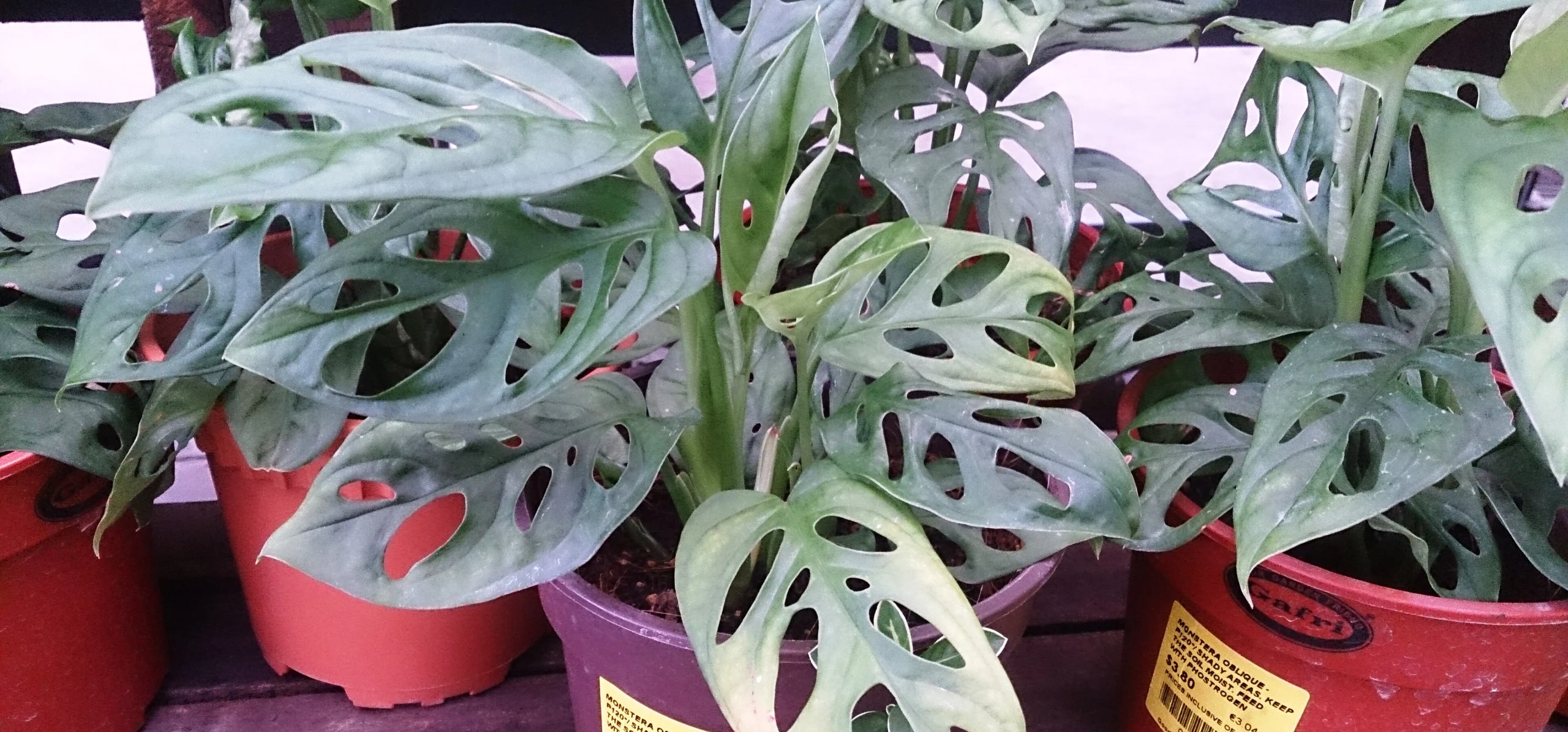
Almost everything sold cheaply as obliqua, including most plants labelled that way on marketplaces, is Monstera adansonii, a different and much more common species. Adansonii leaves are noticeably thicker and hold their shape when you lift one on a finger; obliqua leaves are close to translucent, thin enough to read text through, and tend to hang limp rather than stay rigid. Hole coverage is the second tell: adansonii, even on well-grown, heavily fenestrated specimens, rarely perforates past half the leaf, while true obliqua goes well beyond that. Growth rate settles the question over time, since adansonii is a fast vine that can add feet of growth a year, while obliqua is famously slow and can sit for months without pushing a new leaf. None of this is a flaw in adansonii, which NC State Extension notes is itself a fast-growing climber that tolerates ordinary indoor conditions far better than obliqua does; the problem is only paying obliqua prices for it.


Humidity, warmth and light it actually needs
This is the section that eliminates most attempts at growing it on an open shelf. Real obliqua wants humidity at 80 percent or higher, held there consistently rather than spiked with an occasional misting, which in practice means a closed cabinet, a terrarium, or a greenhouse rather than a normal living room. Warmth matters almost as much: keep it between roughly 20 and 28 degrees Celsius, and treat any cold draught, an opened window, an air conditioning vent, a chilly hallway, as a direct threat to the leaves. Light should be bright but indirect, filtered the way it would be under a rainforest canopy; direct sun scorches the thin leaf tissue almost immediately, while too little light slows an already slow plant to a standstill.
Potting mix and watering without rotting the roots
Use a chunky, fast-draining aroid mix built from bark, perlite, sphagnum moss and charcoal rather than anything resembling ordinary potting soil, so air reaches the fine roots between waterings. Keep that mix lightly and evenly moist, watering again once the top layer has just started to dry, and never let the pot sit in standing water. Soggy mix in high humidity is the single fastest way to lose the plant to root rot, since the same warm, wet conditions that keep the leaves happy are exactly what rot pathogens want at the roots.
Climbing a pole or running on stolons
Given something to climb, a moss pole or piece of cork bark kept damp, obliqua produces larger, more fenestrated leaves as it matures and the stem thickens against the support. Left without one, it does something few houseplants do: it sends out stolons, long leafless runners that search sideways or downward for the next surface to grip, only producing leaves once they find one. Both habits are normal for the species; letting a plant run on stolons for a while before training it onto a pole is a common way to multiply a single specimen into several growing points.
Propagating from stolon nodes and cuttings
New plants come from cutting a stolon or stem section that carries at least one node, then keeping that cutting in the same high humidity the parent needs to root and leaf out, whether it is laid on damp sphagnum in a closed box or set in water inside a cabinet. Rooting is slow and can take several weeks, and a cutting with no visible node will usually just sit without producing anything. Because material is scarce and slow to multiply, a single healthy stolon cutting is often the only realistic way collectors expand their own plants rather than buying more.
Buying it without getting scammed
Because the real plant is expensive and the fake is everywhere, the obliqua market is thick with mislabelled listings, some honest mistakes and some not. Buy from specialist aroid nurseries or established collectors who show the actual plant for sale, not a stock photo, and ask directly whether it has been verified against adansonii by leaf thickness and hole percentage rather than by the seller's own label. A price that looks low for the amount of foliage shown is the clearest warning sign there is.
Pests, root rot and toxicity
Spider mites and thrips are the pests to watch for, and both thrive precisely when humidity drops, so a dry spell is often the first sign of an infestation rather than the bugs themselves; check the undersides of leaves with a hand lens if growth stalls or fine stippling appears. Root rot from overwatering or stagnant mix is the more common killer of the two. Monstera obliqua itself is not individually listed by the ASPCA, but the ASPCA does list the related Monstera deliciosa as toxic to cats and dogs because of insoluble calcium oxalate crystals in its tissue, and every Monstera in cultivation should be treated with that same caution and kept away from pets that chew houseplants.
Test your plant knowledge
Tap a card to flip it and reveal the answer.
Most plants sold as Monstera obliqua are actually Monstera adansonii. Tap to reveal ✓ True
Real Monstera obliqua leaves are thicker than Monstera adansonii leaves. Tap to reveal ✕ False
Monstera obliqua needs sustained humidity of around 80 percent or higher. Tap to reveal ✓ True
Monstera obliqua grows leafless stolons that search for a surface to climb. Tap to reveal ✓ True
The ASPCA lists Monstera obliqua by name as toxic to cats and dogs. Tap to reveal ✕ False
Sources
References consulted for this guide
- GBIF - Monstera obliquagbif.org
- Plants of the World Online (Kew) - Monstera obliquapowo.science.kew.org
- NC State Extension Gardener Plant Toolbox - Monstera adansoniiplants.ces.ncsu.edu
- ASPCA - Toxic and Non-toxic Plants: Mexican Breadfruit (Monstera deliciosa)aspca.org
- Reference entity : Wikipédiaen.wikipedia.org