
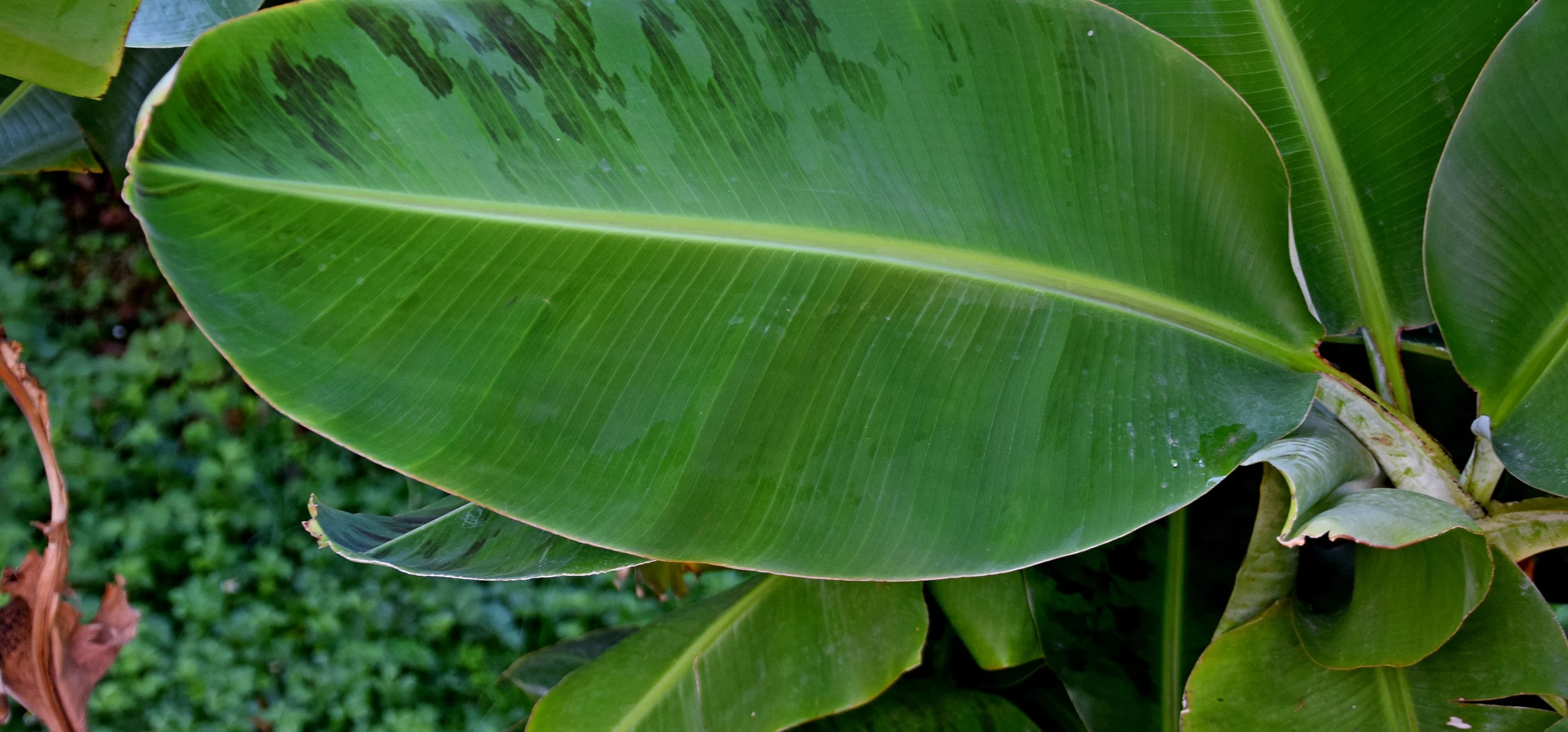
Banana Plant
Musa acuminata
Family · Musaceae
Water and feed a 'Dwarf Cavendish' banana heavily, expect wind-shredded leaves, propagate by separating pups, and bring it indoors before it nears 10 °C.
Musa acuminata
Plant profile
- WateringHighWater every 4 days
- Light exposurePartial sun
- Ideal temperature10–32 °C
- Humidity50–80 %
- Hardiness zoneUSDA 9–11
Growth
- Family
- Musaceae
- Life cycle
- Perennial
- Growth speed
- 7/10
- Mature size
- 150–250 cm
- Spread
- 150–250 cm
- Flowering
- Can flower in 2-3 years under strong warmth and light; each pseudostem flowers once
- Propagation
- Division
- Offsets
Dormancyno true dormancy; growth slows in cool weather or low winter light
Time to maturity2-3 years to first flowering under strong warmth and light
Soil & climate
- Soil pH
- pH 5.5–7
- Soil types
- loam
- Saline soil
- Partially tolerated
- Drought tolerance
- No
Light & Placement
- Origin
- Tropical and subtropical Asia
- Where to place it
- Brightest available window, south-facing if possible
- Away from cold drafts or single-pane glass in winter
- Full sun bed sheltered from strong wind
- Warm spot against a south-facing wall
- 10 to 15 gallon (about 40 to 60 L) container with drainage
Safety
- Toxicity
- CatsSafe
- DogsSafe
- HorsesSafe
Invasive speciesnot generally reported as invasive; spreads locally by pups rather than by seed
Data fromMusa acuminata Colla, GBIF Backbone TaxoMusa acuminata Colla, Plants of the WorlToxic and Non-toxic Plants: Edible BananMusa acuminata, Missouri Botanical GardeMusa acuminata, NC State Extension Garde
Where it grows
World distribution
Banana Plant is native to 11 countries: Bangladesh, China, India, Indonesia, Laos, Malaysia, Myanmar (Burma), and Philippines….GBIF records 6,620 documented identifications across 141 countries, with the largest concentrations in Australia, Malaysia, and Indonesia.
- Bangladesh
- China
- India
- Indonesia
- Laos
- Malaysia
- Myanmar (Burma)
- Philippines
- Sri Lanka
- Thailand
- Vietnam
Yellow to orange dots: concentration of documented identifications per country. Green countries: sourced native range. Source: GBIFNative range from POWO (Kew).
A 'Dwarf Cavendish' banana bought as a leafy potted plant will not fruit next summer, and outdoors it only survives where frost never reaches the ground; that single fact shapes every other decision below. Given full sun or the brightest window available, heavy and frequent watering through the growing season, and monthly feeding, this compact form of Musa acuminata reaches roughly 1.5 to 2.5 m (5 to 8 ft) and can flower in as little as two to three years under strong warmth and light. The trunk is not real wood but a tight column of rolled leaf sheaths, a pseudostem, which is why a hard freeze or one violent storm can take the whole top down in a single night. The rest of this guide covers keeping the leaves intact, feeding the plant enough to actually fruit, and getting a stalled indoor specimen through winter without losing it.
Choosing and Starting a 'Dwarf Cavendish'
'Dwarf Cavendish' is a cultivar of Musa acuminata, the wild banana native to tropical and subtropical Asia; nearly every seedless dessert banana sold today, this one included, descends from selections of this species and its relative Musa balbisiana. Nurseries sell it either as a small potted pseudostem with two or three leaves, or as a bare, trimmed rhizome piece; the potted version establishes faster and skips the weeks of watching a bare rhizome for the first shoot. Confirm the tag actually says 'Dwarf Cavendish' rather than just "banana plant," since some seed-grown ornamental Musa sold at big-box stores carry hard black seeds throughout the fruit and no edible pulp worth eating.
Light and Placement, Indoors and Out
Outdoors in a frost-free garden, full sun for most of the day builds the sturdiest pseudostem and the broadest leaves; part shade keeps the plant alive but slows growth and pushes fruiting further out of reach. Indoors, use the brightest spot in the house, ideally a south-facing window with several hours of direct sun, and expect noticeably slower, more upright growth than an outdoor plant gets; a banana kept in average room light survives for years without ever matching the nursery photo. Rotate a potted indoor plant a quarter turn every week or two, since the huge leaves lean hard toward the glass and the whole pseudostem will lean with them if left alone.


Watering and Feeding a Hungry Plant
A banana's root system is shallow and fibrous, and the huge leaf surface loses water fast, so soil that goes fully dry stalls growth and browns leaf edges within days; keep the top several centimeters of soil consistently moist through spring and summer, easing back only once growth slows in cool weather. This is one of the hungriest plants a home grower is likely to feed: a monthly balanced liquid feed high in nitrogen and potassium during active growth is closer to the minimum than a generous ceiling, and container plants in particular exhaust a potting mix's nutrients within a few weeks. A plant that produces small, pale, slow-to-unfurl new leaves despite regular watering is almost always underfed rather than under-watered.
Soil and Potting
Rich, well-drained soil with steady organic matter suits it best; heavy, waterlogged ground rots the rhizome just as fast as underfeeding stunts it, so raised beds or amended planting holes work better than dense clay straight from the ground. In containers, start a small pup in a pot only slightly larger than its rootball and size up as it grows, since a large volume of unrooted soil around a small plant tends to stay wet and sour; a mature 'Dwarf Cavendish' is comfortable in a 10 to 15 gallon (about 40 to 60 L) container. Refresh the top layer of potting mix yearly, since the plant is enough of a heavy feeder that spent soil limits growth well before the pot itself feels crowded.
Wind and Leaf Shredding
Those broad, unbroken leaves are more decorative than functional once wind is involved: the tissue tears along the parallel veins in a stiff breeze, and what looks like storm damage after a windy week is usually just normal wear that every banana leaf accumulates as it ages. A single leaf tearing into ribbons costs the plant little, since a new one is already forming in the center, but a site exposed to constant strong gusts keeps the whole canopy permanently tattered and slows growth by cutting the plant's working leaf area. Planting in the lee of a wall, fence, or taller shrubs, or simply accepting that outdoor leaves will look ragged by late summer even on a thriving plant, avoids treating a cosmetic issue as a health problem.
Pups and Division
A healthy 'Dwarf Cavendish' throws offsets, called pups, from the base of the rhizome once it is established, and these are the plant's normal means of propagation since commercial Cavendish bananas set no viable seed. Let a pup reach about 30 cm (1 ft) tall with its own leaves before separating it, then cut straight down between the pup and the parent rhizome with a clean, sharp spade or knife, keeping as much root as possible attached to the pup. A separated pup potted into fresh, moist mix and kept warm and shaded for its first week or two typically resumes visible growth within a month; pups left attached to a crowded clump instead compete with the parent for water and nutrients and slow the whole planting down.
Flowering and Fruiting, Realistically
Under good warmth, light, and feeding, 'Dwarf Cavendish' can flower within two to three years, sending up a heavy, drooping purple-red bud from the center of the pseudostem that opens in tiers to reveal rows of small female flowers, then male flowers further down the stalk. Indoors, or anywhere with a real winter, flowering is uncommon and fruiting rarer still, since the plant needs sustained warmth and strong light across many consecutive months with no real cold check; a plant grown mainly as houseplant foliage should be enjoyed as foliage, not expected to fruit on a windowsill. Where it does fruit outdoors, the pseudostem that flowered will not flower again: after harvest, cut it down at the base and let one strong pup take over as the new main stem, which is the normal life cycle rather than a failure.
Overwintering
Where winters stay above roughly 10 °C (50 °F), 'Dwarf Cavendish' can stay outdoors year-round with little more than reduced watering; anywhere colder, it needs to come inside, or be cut back hard and heavily mulched, before the first frost. A potted plant moved indoors for winter will drop some of its largest, most cold-marked leaves regardless of care, which is normal leaf turnover rather than dieback, as long as the pseudostem itself stays firm rather than turning soft or mushy at the base. Keep an overwintering plant in the brightest available light, water only enough to keep the roots from fully drying out, and stop feeding until new growth resumes visibly in spring; a mushy, foul-smelling pseudostem base at any point means the rhizome has rotted and that section will not recover.
Test your plant knowledge
Tap a card to flip it and reveal the answer.
A potted 'Dwarf Cavendish' grown as a houseplant will reliably flower and fruit within its first year. Tap to reveal ✕ False
Banana leaves tearing into ribbons in windy weather is normal wear, not necessarily a sign of a sick plant. Tap to reveal ✓ True
'Dwarf Cavendish' produces pups (offsets) at its base that can be separated to start new plants. Tap to reveal ✓ True
Once a pseudostem has flowered and fruited, it will flower and fruit again the following year. Tap to reveal ✕ False
The ASPCA lists Musa acuminata (Edible Banana) as toxic to cats, dogs and horses. Tap to reveal ✕ False
Sources
References consulted for this guide
- Musa acuminata Colla, GBIF Backbone Taxonomygbif.org
- Musa acuminata Colla, Plants of the World Online (Kew)powo.science.kew.org
- Toxic and Non-toxic Plants: Edible Banana, ASPCAaspca.org
- Musa acuminata, Missouri Botanical Garden Plant Findermissouribotanicalgarden.org
- Musa acuminata, NC State Extension Gardener Plant Toolboxplants.ces.ncsu.edu
- Reference entity : Wikipédiaen.wikipedia.org

