American Sycamore
Platanus occidentalis
Family · Platanaceae
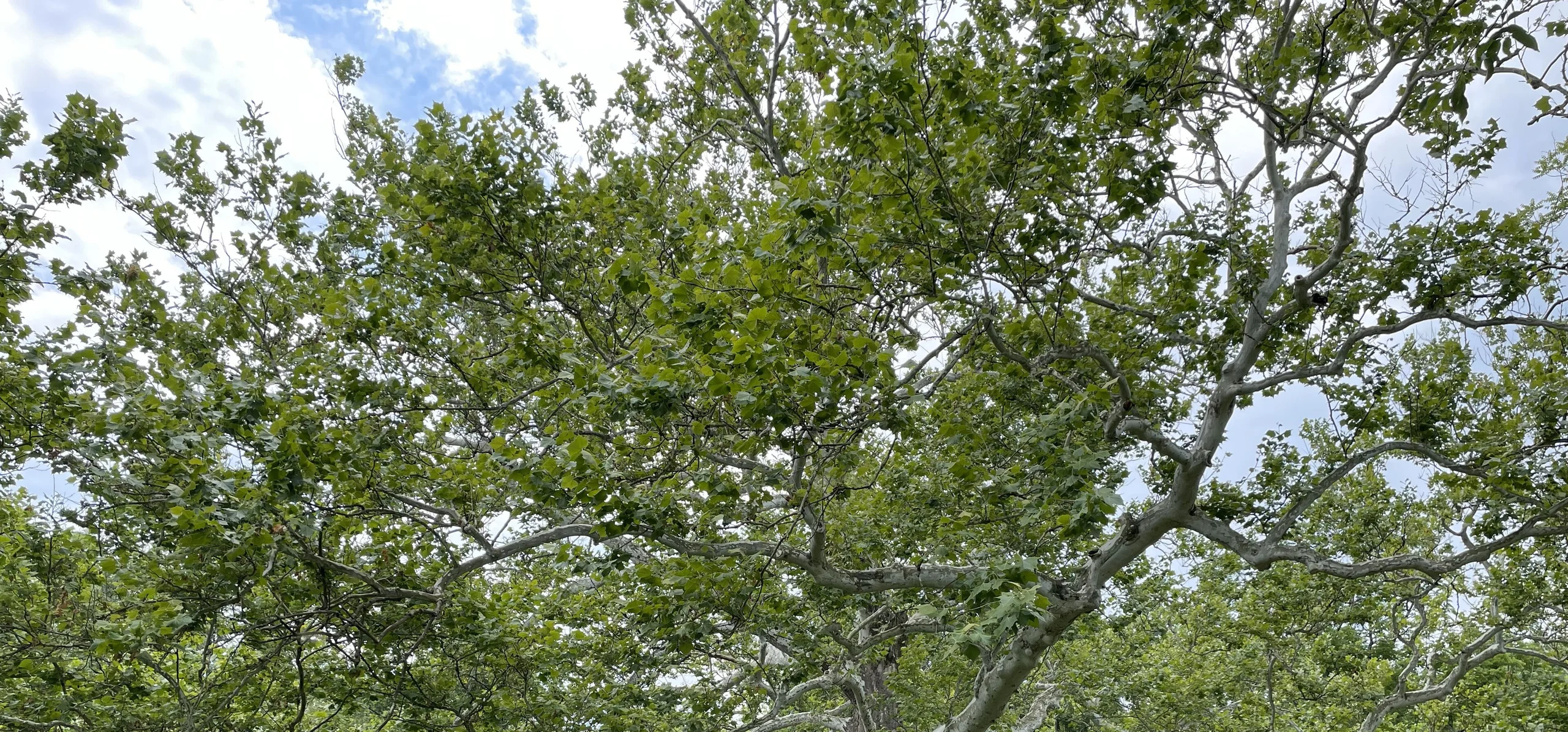
American sycamore grows 75 to 100 feet with exfoliating white bark, needs full sun, real space and moist soil, and sheds leaves to anthracnose in cool springs.
Platanus occidentalis
Plant profile
- WateringModerateWater every 7 days
- Light exposureFull sun
- Hardiness zoneUSDA 4–9
Growth
- Family
- Platanaceae
- Life cycle
- Perennial
- Growth speed
- 8/10
- Mature size
- 2286–3048 cm
- Spread
- 2286–3048 cm
- Flowering
- Inconspicuous spring flowers; buttonball fruit ripens in fall
- Propagation
- Seed
DormancyDeciduous, dormant in winter
Time to maturityFull size in 50-150 years
Soil & climate
- Soil types
- clay, loam, sand
- Drought tolerance
- Yes
Light & Placement
- Origin
- Southeastern Canada to central and eastern United States
- Where to place it
- Streamside or floodplain
- Large open lawn or park
- Riverbank stabilization planting
- Large nursery pot for young saplings only, not suited to long-term container culture
Safety
- Toxicity
- CatsSafe
- DogsSafe
- HorsesSafe
Data fromPlatanus occidentalis L., GBIF Backbone Platanus occidentalis L., Plants of the ASPCA: Toxic and Non-Toxic Plants, PlantNC State Extension Gardener Plant ToolboClemson HGIC: Sycamore
Where it grows
World distribution
American Sycamore is native to 2 countries: Canada and United States.GBIF records 55,874 documented identifications across 53 countries, with the largest concentrations in United States, Canada, and South Korea.
- Canada
- United States
Yellow to orange dots: concentration of documented identifications per country. Green countries: sourced native range. Source: GBIFNative range from POWO (Kew).
An American sycamore (Platanus occidentalis) announces itself before you ever learn its name: patchwork bark that flakes from reddish-brown to bright white high in the crown, and leaves the width of a dinner plate on a trunk that can eventually dwarf anything else on the property. It ranks among the largest native trees in eastern North America, capable of a canopy 75 to 100 feet across within a few decades, and it asks for exactly two things in return: real space, and a spring that is not repeatedly cold and wet while the new leaves unfurl. Get both right and the tree will likely outlive the person who planted it, sometimes by well over a century.
Identifying an American Sycamore
The leaves are large, three to five lobed, four to nine inches across, with coarsely toothed margins and a texture close to sandpaper on top. New growth in spring emerges pale and covered in a fine wool that rubs off within a couple of weeks, then hardens to a medium to dark green that holds until a plain yellow-brown drop in fall. The bark tells the story fastest: on the lower trunk it stays reddish-brown and scaly, but higher up it exfoliates in irregular plates to expose smooth, creamy white inner bark, a pattern unique enough among eastern trees that it is usually the first thing people notice. The solitary, long-stalked seed balls, an inch or so across, are another giveaway: the closely related London planetree, Platanus x hispanica, carries its balls in pairs, which is the quickest way to tell the two apart from a distance.
Site Selection: This Tree Needs Real Space
Plants of the World Online lists the native range as southeastern Canada south through the central and eastern United States, mostly along riverbanks, floodplains and bottomland where the soil stays consistently moist. In cultivation it wants the same: a spot with more than 60 feet of clearance in every direction, because a mature tree reaches 75 to 100 feet tall with an equal spread, and can exceed 150 feet under the best conditions. The roots are just as ambitious as the crown and will find and lift a sidewalk, driveway or foundation planted too close. Street tree plantings and small residential lots are usually the wrong fit; a large lawn, a park, or a spot near a stream or pond where the tree can also help stabilize the bank is the right one.
Light, Soil and Water
Give it full sun or, at most, light shade; six or more hours of direct light a day keeps growth dense rather than leggy. Soil texture barely matters, sycamore adapts to clay, loam or sand and to soils rich in organic matter, and it is not particular about pH, tolerating everything from acidic to alkaline above 8.0. The one soil trait it does care about is moisture: it grows fastest in deep, consistently moist ground and tolerates occasional flooding better than most shade trees, while established specimens also handle drought reasonably well once the root system is developed. Water a newly planted tree deeply once a week through its first two growing seasons, then let rainfall take over except in extended dry spells; growth runs two feet or more a year under decent conditions, among the fastest of any large native shade tree.


The Exfoliating Bark, Explained
New sycamore owners often worry that the peeling bark signals disease, but it is simply outpaced growth. The outer bark layer is rigid and cannot stretch, so as the trunk thickens it splits and sheds in flat plates rather than expanding smoothly the way a beech or maple's bark does. What is left behind, pale and almost bone-white in patches, is younger inner bark that has not yet weathered and darkened. The pattern is most dramatic on the upper trunk and large limbs, where growth is fastest and the bark is thinnest, and it becomes a defining feature of the tree's winter silhouette once the leaves are down.
Anthracnose and Other Problems
Sycamore anthracnose is the recurring headache with this species. University extension programs describe outbreaks as most severe when the average temperature stays below about 55 degrees Fahrenheit for the two weeks after leaf-out, conditions common in a cool, wet spring; the fungus kills young leaves as they emerge, browning and curling them along the main veins, and can defoliate a tree from the bottom up while leaving a rim of healthy foliage at the very top. A tree that looks half-dead in May from anthracnose almost always pushes a second flush of leaves by midsummer and survives the episode. Other issues worth watching for include canker, bacterial leaf scorch, powdery mildew and leaf spot, along with a roster of pests:
- Aphids and sycamore lace bugs
- Scale insects and borers
- Sycamore leaf beetle and Japanese beetle
- Spider mites in hot, dry weather
Deer generally leave it alone, which is not something you can say about most young shade trees.
Buttonballs: Fruit, Seed and Propagation
The common name buttonball comes from the fuzzy, spherical seed clusters that hang singly on long stalks, half an inch to an inch across, ripening from green to brown by autumn and persisting on the tree well into winter. Inside each ball are hundreds of tiny, hair-tufted achenes packed around a central core; as the ball weathers and breaks apart from late winter into early spring, the wind, and where a ball lands in water, the current, carries the seeds off to bare, moist ground, the same conditions the species needs to germinate. Propagation in cultivation is by seed, collected once the balls have dried and started to shatter; cuttings are not the practical route with this species the way they are with willows or poplars.
Wildlife Value and Safety Around Pets
The seed heads feed a range of songbirds through winter, including purple finches, juncos, American goldfinches and Carolina chickadees, and squirrels and other small mammals work through the fallen balls as well. The ASPCA lists Platanus occidentalis as non-toxic to cats, dogs and horses, so a curious pet chewing a fallen leaf or twig is not a poisoning concern, though the coarse leaf litter and abundant fruit drop are still worth raking up before they mat down a lawn. Historically the trunk's size made it useful too: early settlers and Indigenous communities within its native range hollowed sycamore logs for canoes, and the sap can be tapped in early spring much like a maple's, though it yields far less sugar.
Test your plant knowledge
Tap a card to flip it and reveal the answer.
American sycamore can grow well past 100 feet under good conditions. Tap to reveal ✓ True
Bark that peels away from the trunk means the tree is diseased. Tap to reveal ✕ False
This tree tolerates occasional flooding once it is established. Tap to reveal ✓ True
A cool, wet spring has little effect on a sycamore's new leaves. Tap to reveal ✕ False
American sycamore is toxic to dogs and cats. Tap to reveal ✕ False
Sources
References consulted for this guide
- Platanus occidentalis L., GBIF Backbone Taxonomygbif.org
- Platanus occidentalis L., Plants of the World Online (Kew)powo.science.kew.org
- ASPCA: Toxic and Non-Toxic Plants, Plantanus Occidentalisaspca.org
- NC State Extension Gardener Plant Toolbox: Platanus occidentalisplants.ces.ncsu.edu
- Clemson HGIC: Sycamorehgic.clemson.edu
- Reference entity : Wikipédiaen.wikipedia.org