Cape Leadwort
Plumbago auriculata
Family · Plumbaginaceae
Plumbago auriculata needs full sun and a hard late-winter cutback to keep blooming; covers 'Alba', overwintering frost-free and whitefly under glass.
Plumbago auriculata
Plant profile
- WateringLittleWater every 7 days
- Light exposureFull sun
- Ideal temperature1–38 °C
- Hardiness zoneUSDA 9–11
Growth
- Family
- Plumbaginaceae
- Life cycle
- Perennial
- Growth speed
- 7/10
- Mature size
- 250–400 cm
- Spread
- 100–150 cm
- Propagation
- Seed
- Cutting
FloweringSky-blue (white in 'Alba') flower clusters from spring through autumn, nearly year-round frost-free
Dormancysemi-dormant and kept near-dry when overwintered indoors; evergreen in frost-free climates
Time to maturityflowers in the first year; reaches ultimate size against a wall over roughly 5-10 years
Soil & climate
- Soil types
- sand, loam, chalk
- Drought tolerance
- Yes
Light & Placement
- Origin
- Native to Mozambique through South Africa
- Where to place it
- brightest available window
- conservatory or greenhouse border in full light
- south, west or east facing wall in full sun
- open sunny bed or trellis
- large pot with peat-free, loam-based compost and good drainage
Safety
- Toxicity
- Not evaluated by the ASPCA; toxicity undetermined
- Pet safe
- No
Data fromPlumbago auriculata Lam., GBIF Backbone Plants of the World Online (Kew): PlumbaRHS: Plumbago auriculata (Cape leadwort)RHS: Glasshouse whitefly, identificationUniversity of Florida IFAS Gardening Sol
Where it grows
World distribution
Cape Leadwort is native to 2 countries: Mozambique and South Africa.GBIF records 16,728 documented identifications across 155 countries, with the largest concentrations in South Africa, United States, and Italy.
- Mozambique
- South Africa
Yellow to orange dots: concentration of documented identifications per country. Green countries: sourced native range. Source: GBIFNative range from POWO (Kew).
Buy a Plumbago auriculata for a pot or a sunny wall and you are buying the sky-blue, phlox-like flower clusters that cover it from late spring into autumn, sometimes almost year-round where winters stay frost-free. It is not a climber in the true sense: left alone it scrambles and arches over long new stems in a season, leaning on whatever it grows against rather than twining or clinging by itself, which is why growers tie the stems to wire or trellis instead of expecting them to hold on. Give it full sun and a hard cutback each late winter and it repeats the display reliably for years; give it shade or constant summer pruning and it turns leafy with few flowers.
A Scrambling Shrub From Southern Africa
Plants of the World Online lists the native range of Plumbago auriculata as Mozambique to South Africa, where it grows as a sprawling shrub at forest margins and in subtropical scrub, using its long, arching stems to lean on neighbouring vegetation. GBIF's accepted classification places the species in Plumbaginaceae, the leadwort family, under the genus Plumbago; the older name Plumbago capensis, still printed on some plant tags, is a synonym for the same plant, not a different one. Tied to a wall, fence or pergola it behaves like a loose climber; left unsupported in a bed it forms a mounded, arching shrub roughly knee to waist height.
The Species and 'Alba'
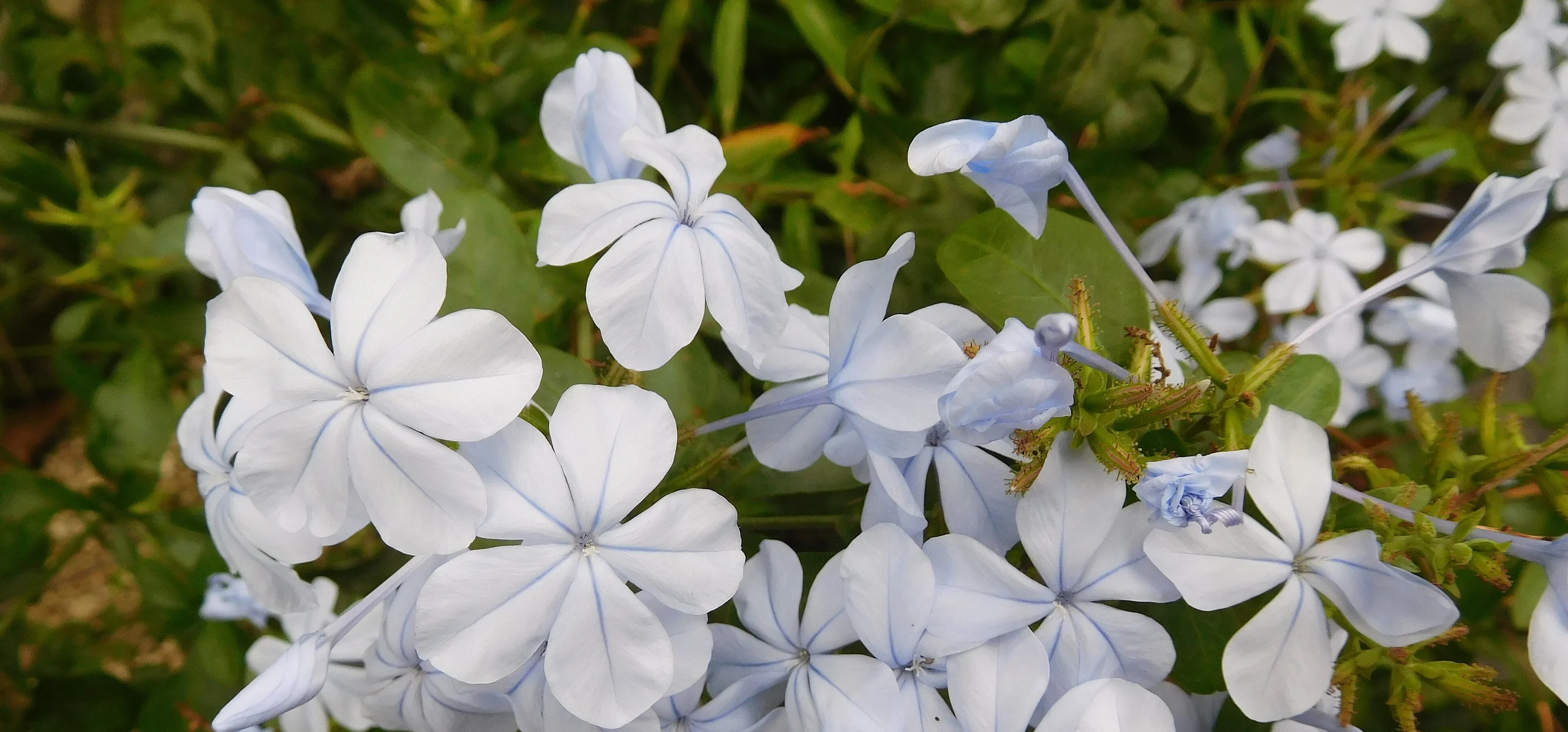
The straight species carries pale sky-blue flowers, five thin petals flaring from a slender tube, in dense rounded clusters at the stem tips. 'Alba' is the widely sold white-flowered form, otherwise identical in habit and care; nurseries also occasionally offer a deeper blue selection sold simply as an improved form. There is no real difference in hardiness or vigor between the colors, so the choice comes down to which shade suits the wall or pot it is going into.
Full Sun Is Non-Negotiable
Every reliable source on this plant agrees on one point: it needs direct sun for most of the day to flower well. The RHS lists full sun as its exposure requirement, and growers in warm climates report the same plant turning leafy and reluctant to bloom as soon as it sits in part shade for more than a few hours a day. A wall or fence facing south, west or east and catching sun for most of the day is the right outdoor spot; under glass or indoors, the brightest window or a conservatory border in full light is the minimum needed for any flowers at all.


Watering and Soil
Plumbago wants well-drained ground; sand, loam or even chalky soil all suit it according to the RHS, and it is not fussy about soil pH. Water a newly planted specimen regularly through its first season while roots establish, then ease off: an established plant tolerates real dry spells and flowers no worse for a light drought between waterings. Waterlogged roots, not underwatering, are the more common way to lose a plant, especially in a container without enough drainage.
Training and a Hard Cutback in Late Winter
Flowers form on new growth, so the RHS places plumbago in pruning group 12: cut back hard in late winter or very early spring, before the new season's growth begins, removing a third to half of the previous year's stems and shortening the rest to a framework of buds. This is also the time to tie in new growth against a wall or trellis, since the plant has no natural means of climbing on its own. A light trim after the first flush in early summer can tidy the shape and encourage a second round of bloom, but heavy pruning in autumn is worth avoiding: it forces soft new growth that has no time to harden before cold weather and only weakens the plant.
Overwintering Frost-Free
The RHS rates Plumbago auriculata H2, meaning it tolerates cool conditions but is damaged once temperatures drop close to freezing, and it needs to come under glass or indoors for winter anywhere outside the mildest, frost-free gardens. Where it is grown outdoors year-round, roughly USDA hardiness zones 9 to 11, a hard freeze cuts the top growth back to the ground but the roots usually survive and resprout in spring. For a potted plant brought inside, cut it back hard before the move, keep it in a bright, cool spot such as an unheated conservatory or sunroom, and water only enough to stop the compost from fully drying out; heavy watering during this near-dry, dormant period invites rot rather than growth. Resume normal watering and feeding once new shoots appear and the plant goes back outside after the last frost.
The Sticky Calyx That Hitchhikes
Each flower sits inside a ribbed, hairy calyx that turns sticky-glandular along its upper half once the bloom fades, and that stickiness is not incidental: it is how the seed capsule catches a ride on passing fur or clothing and disperses away from the parent plant. Anyone who has brushed past a spent plumbago in flower and found the papery brown calyces stuck to a sleeve or a sock has felt this mechanism firsthand; it brushes off easily, but it is worth knowing before working in good clothes near an untrimmed planting.
Pests: Whitefly Under Glass, Thrips Outdoors
Grown in a greenhouse or conservatory, plumbago can pick up glasshouse whitefly, which thrives in the same warm, still air the plant enjoys; the RHS recommends introducing the parasitic wasp Encarsia formosa or hanging yellow sticky traps before reaching for a broad insecticide. Outdoors the more common nuisances are chilli thrips, which curl and stunt new foliage, along with occasional cottony cushion scale or spider mites, none of which usually threaten an established plant's long-term health. The species has no major disease problems on record, and pest pressure generally eases once the plant is growing vigorously in full sun rather than struggling in shade or wet soil.
Toxicity and Pets
Plumbago auriculata does not appear on the ASPCA's toxic or non-toxic plant lists, so its safety for cats, dogs or horses is unevaluated rather than confirmed either way. Treat an unlisted plant with the same caution as a mildly suspect one: keep pets from chewing on it regularly, and check with a veterinarian if a pet eats a significant amount.
Test your plant knowledge
Tap a card to flip it and reveal the answer.
Plumbago auriculata is native to Mozambique and South Africa. Tap to reveal ✓ True
Plumbago auriculata flowers best in partial shade. Tap to reveal ✕ False
Because it blooms on new wood, plumbago is cut back hard in late winter or very early spring. Tap to reveal ✓ True
The sticky calyx left after flowering helps disperse the seed by clinging to fur or clothing. Tap to reveal ✓ True
The ASPCA lists Plumbago auriculata as toxic to cats and dogs. Tap to reveal ✕ False
Sources
References consulted for this guide
- Plumbago auriculata Lam., GBIF Backbone Taxonomygbif.org
- Plants of the World Online (Kew): Plumbago auriculata Lam.powo.science.kew.org
- RHS: Plumbago auriculata (Cape leadwort)rhs.org.uk
- RHS: Glasshouse whitefly, identification and controlrhs.org.uk
- University of Florida IFAS Gardening Solutions: Plumbagogardeningsolutions.ifas.ufl.edu
- Reference entity : Wikipédiaen.wikipedia.org