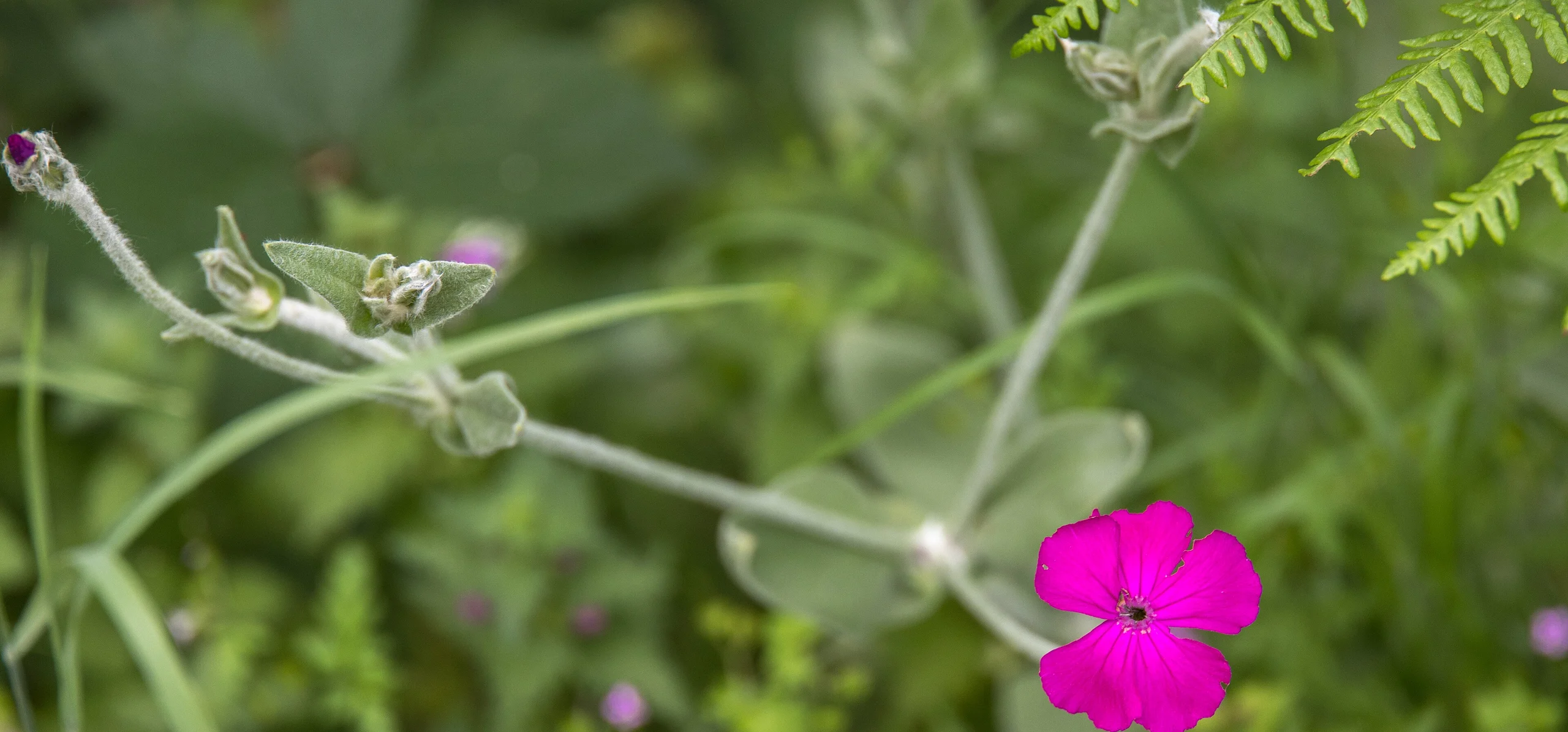
Rose Campion
Silene coronaria
Family · Caryophyllaceae
Silene coronaria, still sold as Lychnis coronaria, needs poor, fast-draining soil, dies back in rich wet ground, and self-seeds readily from magenta flowers.
Silene coronaria
Plant profile
- WateringLittleWater every 12 days
- Light exposurePartial sun
- Hardiness zoneUSDA 4–10
Growth
- Family
- Caryophyllaceae
- Life cycle
- Perennial
- Growth speed
- 6/10
- Mature size
- 50–100 cm
- Spread
- 10–50 cm
- Propagation
- Seed
- Cutting
FloweringRose-purple to magenta flowers from a branching stem, mainly summer, more of them if faded blooms are removed
Dormancycrowns can die out over a wet winter in slow-draining soil, but survive well below -20°C where drainage is good (RHS H7)
Time to maturityflowers from a silver basal rosette in its first or second year, then usually declines after two to three years
Soil & climate
- Soil types
- sandy, loamy, clay
- Drought tolerance
- Yes
Light & Placement
- Where to place it
- cottage garden
- coastal garden
- wildflower meadow
- flower border
OriginNative to east-central and southeastern Europe through northern Iran, Central Asia and the western Himalaya (POWO)
Safety
- Toxicity
- Not listed by the ASPCA for cats, dogs or horses
- Pet safe
- No
Invasive speciesself-seeds freely and NC State Extension notes it has the potential to become weedy in garden beds; not listed as invasive elsewhere in the sources checked
Data fromGBIF: Silene coronaria (L.) Clairv.Plants of the World Online (Kew): SileneRHS: Silene coronaria (rose campion)NC State Extension Gardener Plant ToolboUniversity of Arizona Cooperative Extens
Where it grows
World distribution
Rose Campion is native to 15 countries: Albania, Bulgaria, Croatia, Czechia, Georgia, Greece, Hungary, and India….GBIF records 51,009 documented identifications across 75 countries, with the largest concentrations in Belgium, United Kingdom, and Netherlands.
- Albania
- Bulgaria
- Croatia
- Czechia
- Georgia
- Greece
- Hungary
- India
- Iran
- Italy
- Kazakhstan
- Romania
- Tajikistan
- Türkiye
- Ukraine
Yellow to orange dots: concentration of documented identifications per country. Green countries: sourced native range. Source: GBIFNative range from POWO (Kew).
A Silver Rosette Built for Poor, Dry Ground
Silene coronaria, rose campion, announces itself twice: first as a low mound of felted, silvery-grey leaves that look almost like flannel, then a year or two later as a branching stem of magenta flowers held well above the foliage. If you bought a young plant or found one seeding into a gravel path, the two things worth knowing right away are that it is short-lived by design and that it fails faster in rich, damp soil than in poor, dry ground. The flower colour, the wool on the leaves, even its confused Latin name, all trace back to a plant built for thin mountain soils rather than a fed and watered flower bed.
Lychnis or Silene? The Name Depends on Where You Shop
GBIF's accepted name for this species is Silene coronaria (L.) Clairv., in the family Caryophyllaceae, order Caryophyllales. For most of the twentieth century it was classified as Lychnis coronaria (L.) Desr., and that older name is still the one printed on seed packets and used throughout the RHS plant database in the UK. Neither name is wrong in practice: taxonomists moved the species out of Lychnis after genetic work showed the boundary between Lychnis and Silene did not hold, and Lychnis coronaria now sits among its listed synonyms alongside older names such as Agrostemma coronaria. Expect to see both names side by side on labels for years yet.


Origin and Why Rich, Wet Soil Kills It
Plants of the World Online lists the native range as east-central and southeastern Europe through northern Iran and Central Asia to the western Himalaya, mountainous country with thin, free-draining, often gravelly soil and dry summers. That background explains the plant's one real vulnerability in gardens: crowns sitting in wet, rich, slow-draining soil over winter rot rather than resprout. The RHS rates it fully hardy (H7, tolerating well below -20°C) as long as drainage is good, so it is wet feet, not cold, that ends most plants early. Feeding it or planting it in a heavy, moisture-retentive bed does not make it grow bigger for long, it shortens its life. Ordinary, even poor, sandy or gravelly soil in full sun to light shade is what keeps a clump going for its full two-to-three-year span and lets it seed in behind itself.
Choosing a Variety: the Species, 'Alba' and 'Gardeners' World'
The wild-type species carries loose sprays of vivid rose-purple flowers around 3 cm across on stems 50 to 100 cm tall. 'Alba' is the same plant with white flowers instead, useful for breaking up a bed where the magenta of the species reads as too strong against neighbouring pinks. 'Gardeners' World' (sold as 'Blych') is a different proposition: its double, sterile magenta-red flowers, to about 4 cm across, never set seed, so a clump has to be kept going by basal cuttings rather than by the self-sown seedlings that renew the species and 'Alba' year after year. That trade-off, no seedlings but a longer, heavier bloom on each plant since none of its energy goes into seed, is the main reason to choose the named cultivar over the straight species.
Deadhead for More Flowers, or Leave the Seed
Rose campion answers to whichever you want more of. Removing spent flower spikes before the seed capsules ripen keeps a plant blooming later into the season and seems to help more crowns come back the following spring. Leaving the papery, peanut-sized seed capsules to ripen instead does the opposite for that plant but is how a self-seeding stand renews itself: rose campion sets seed in quantity, and a few pods left standing over a gravel path or bare bed are usually enough to keep a colony going indefinitely as older crowns die out. Most gardeners split the difference, letting an early flush set seed for next year's plants and deadheading the later flush purely to stretch the display.
Rabbits, Deer and the Few Pests That Bother It
The felted wool covering the leaves and stems is a genuine deterrent to browsing animals: the University of Arizona Cooperative Extension lists Lychnis coronaria among plants that deer and rabbits tend to leave alone in home gardens, and NC State Extension records the same reluctance in deer, attributing it to the woolly texture. That resistance does not extend to slugs, which will still shelter in a dense rosette and rasp at young leaves in wet spring weather; beyond that, both extensions describe the species as largely free of insect and disease problems.
Placing It: Light, Watering and Where It Earns Its Keep
Give rose campion full sun for the most compact growth and the whitest foliage, though it tolerates light shade. Water new plants while they establish, then largely leave them alone; established clumps handle dry spells well and rot faster than they wilt if watered on a fixed schedule regardless of rainfall. Gravel gardens, dry sunny borders, coastal beds and cottage-garden plantings are among the spots the RHS suggests for it, all places where drainage, not fertility, decides whether it lasts. In a mixed bed, plant it toward the front or middle where the silver foliage works as a foil for green-leaved neighbours before the magenta flowers take over in summer.
Toxicity: What the ASPCA Actually Says
Rose campion, under any of its names, does not appear on the ASPCA's toxic or non-toxic plant lists for cats, dogs or horses. That is not the same as a confirmed clean bill of health, it simply has not been evaluated and listed either way, so treat it with the same ordinary caution as any unlisted garden plant around pets that like to chew foliage.
Test your plant knowledge
Tap a card to flip it and reveal the answer.
Rose campion's felted, woolly leaves are one reason deer and rabbits tend to leave it alone. Tap to reveal ✓ True
Silene coronaria is the currently accepted scientific name, even though most nurseries and the RHS still label it Lychnis coronaria. Tap to reveal ✓ True
Rich, consistently moist soil is the safest way to keep a rose campion plant alive for many years. Tap to reveal ✕ False
The RHS cultivar 'Gardeners' World' produces double, sterile flowers and does not self-seed. Tap to reveal ✓ True
The ASPCA lists rose campion as toxic to cats and dogs. Tap to reveal ✕ False
Sources
References consulted for this guide
- GBIF: Silene coronaria (L.) Clairv.gbif.org
- Plants of the World Online (Kew): Silene coronariapowo.science.kew.org
- RHS: Silene coronaria (rose campion)rhs.org.uk
- NC State Extension Gardener Plant Toolbox: Silene coronariaplants.ces.ncsu.edu
- University of Arizona Cooperative Extension: Deer and Rabbit Resistant Plants (AZ1237)extension.arizona.edu
- Reference entity : Wikipédiaen.wikipedia.org