Horse Chestnut
Aesculus hippocastanum
Family · Sapindaceae
Horse chestnut needs room to reach 15 to 23 m: bare-root winter planting, why leaf miner browns leaves by August, bleeding canker, and toxic conkers.
Aesculus hippocastanum
Plant profile
- WateringModerateWater every 10 days
- Light exposurePartial sun
Growth
- Family
- Sapindaceae
- Life cycle
- Perennial
- Growth speed
- 5/10
- Mature size
- 1500–3000 cm
- Spread
- 800–2000 cm
- Propagation
- Seed
FloweringUpright white candle-like flower spikes in spring, followed by spiny fruit capsules each holding one or two conkers
Dormancydeciduous, bare in winter with large, sticky red-brown buds
Time to maturityreaches much of its ultimate size over 20 to 50 years (RHS)
Soil & climate
- Soil types
- chalk, clay, loam, sand
- Drought tolerance
- No
Light & Placement
- Origin
- Central Balkan Peninsula to Türkiye (POWO)
- Where to place it
- large park or avenue specimen
- big garden with room for full spread
- wildlife or amenity planting
Safety
- Toxicity
- CatsToxic
- DogsToxic
- HorsesToxic
- HumansToxic
Data fromGBIF Backbone Taxonomy: Aesculus hippocaRHS: Aesculus hippocastanum (horse chestRHS: Horse chestnut leaf-mining mothRHS: Horse chestnut bleeding cankerRHS: Horse chestnut leaf blotchUniversity of Illinois Extension: Common
Where it grows
World distribution
Horse Chestnut is native to 6 countries: Albania, Bulgaria, Croatia, Greece, Türkiye, and Turkmenistan.GBIF records 355,702 documented identifications across 73 countries, with the largest concentrations in United Kingdom, Germany, and France.
- Albania
- Bulgaria
- Croatia
- Greece
- Türkiye
- Turkmenistan
Yellow to orange dots: concentration of documented identifications per country. Green countries: sourced native range. Source: GBIFNative range from POWO (Kew).
Aesculus hippocastanum is the horse chestnut of European parks and avenues, the tree behind May's upright white candle flowers and the conkers that cover the ground every October. GBIF's Backbone Taxonomy accepts this name, and Kew's Plants of the World Online gives its native range as the central Balkan Peninsula to Turkiye, though centuries of planting have carried it into almost every temperate city street since. The one fact worth settling first: this is a big tree, commonly 15 to 23 m tall (50 to 75 feet) by Missouri Botanical Garden and University of Illinois Extension figures, with a crown the RHS rates wider than 8 m, so it belongs in a park, an avenue or a genuinely large garden, not a modest plot. Two problems have reshaped how arborists talk about the species over the last twenty years, a leaf-mining moth that browns the canopy every summer and a bacterial canker that can kill a tree outright, and neither changes what it actually needs: deep, moist soil, sun to light shade, and almost no pruning once established.
Size First: Not a Tree for a Small Garden
The RHS lists this species' ultimate height as higher than 12 m and its ultimate spread as wider than 8 m, the top brackets on its scale, while Missouri Botanical Garden and University of Illinois Extension both give a more concrete figure of 50 to 75 feet, roughly 15 to 23 m, for a mature specimen with an upright, oval-rounded crown. It reaches much of that size over 20 to 50 years, per the RHS, and is rated hardiness H7, hardy in the severest European continental winters below -20 degrees Celsius, so cold rarely limits where it can go. Space is the real constraint: a horse chestnut a few metres from a house or driveway will eventually shade it, lift paving with its roots and drop a heavy annual litter of leaves and spiny fruit cases, so plant with the full mature footprint in mind, not the size in the nursery pot.
Planting Bare-Root in Winter
Like most deciduous trees sold for parks and avenues, horse chestnut is commonly planted bare-root while dormant, and the RHS puts that window between November and March, provided the ground is neither waterlogged nor frozen. Soak the roots before planting, half an hour if they still look moist, up to two hours if they have dried out, then tease them out so they spread naturally into the hole rather than circling it. The RHS describes the preferred soil as deep, fertile and moist but well drained, tolerant of chalk, clay, loam or sand and of acid, alkaline or neutral pH, in full sun or partial shade. Afterward, a 5 to 8 cm mulch of organic matter over the root area holds moisture and suppresses weeds, but the RHS is specific that it should stop about 10 cm short of the trunk, since mulch packed against bark invites rot.
Watering and the Only Pruning It Needs


A newly planted tree needs regular watering through its first one or two seasons while roots reach into the surrounding soil, then far less once established, though University of Illinois Extension is blunt that this species struggles on dry sites and that leaf scorch, brown crisping along the leaf margins, becomes a serious problem in prolonged drought. Pruning sits in the RHS's group 1, meaning minimal work: remove only dead, damaged or diseased wood, ideally in dry weather, and disinfect tools between cuts. Keep cuts to that minimum for a second reason too, every pruning wound is a potential entry point for the bacterial canker covered further down, so formative shaping is not worth the risk here.
Growing a New Tree From a Conker
Raising a horse chestnut from a fallen conker is one of the easiest tree-growing projects there is, which is exactly why it has been a school and family activity for generations. A conker collected in autumn and pushed a few centimetres into moist soil outdoors, or kept in a bag of damp compost in a cold shed or fridge over winter, breaks dormancy with the cold and sends up a shoot the following spring with no special treatment. Growth is quick for the first few years, a single stem with the same broad palmate leaves as the parent in miniature, and the real decision is not how to grow it but where, since a conker planted on a whim in a border will, within a couple of decades, be the 15 to 23 m tree described above.
The Leaf Miner Moth Behind the Browned Canopy by August
Cameraria ohridella, the horse chestnut leaf-mining moth, arrived in Britain in 2002 and is now, per the RHS, widespread across England and spreading through Wales. Its caterpillars feed inside the leaf tissue from around June, leaving elongated blotches that start white and turn brown, and by August a heavily infested tree can look scorched from a distance well before autumn colour is due. The RHS is direct about what this means: the damage has almost no effect on a tree's growth rate or health, control is neither necessary nor practical, and horse chestnuts simply tolerate the moth, so felling a tree over leaf miner alone is not warranted. For an isolated garden tree where most fallen leaves can realistically be gathered, raking and burning them in autumn, or sealing them in bags until the following July, reduces overwintering pupae, though it will not clear the moth from the wider area.
Bleeding Canker and Guignardia Leaf Blotch
The more serious problem is bleeding canker, caused by the bacterium Pseudomonas syringae pv. aesculi, which produces dark or reddish-brown sticky fluid oozing from cracks in the bark, drying to a rusty crust in dry weather. Cutting away outer bark at an active site reveals discoloured inner tissue, and the RHS notes some infections stabilise with a sharply defined margin while others spread with a diffuse edge and can kill the tree outright; there is currently no chemical control, so management means monitoring, removing wood that keeps declining, burning rather than composting infected material, and disinfecting tools. Guignardia leaf blotch, now classified as Phyllosticta paviae, is a separate, much less serious fungal disease causing irregular brown blotches with yellow margins on summer foliage; the RHS calls it unsightly rather than damaging and recommends raking up and burning or composting fallen leaves in autumn, since the fungus overwinters there and releases spores the following spring.
Toxic Despite the Name: Conkers, Dogs, Horses and People
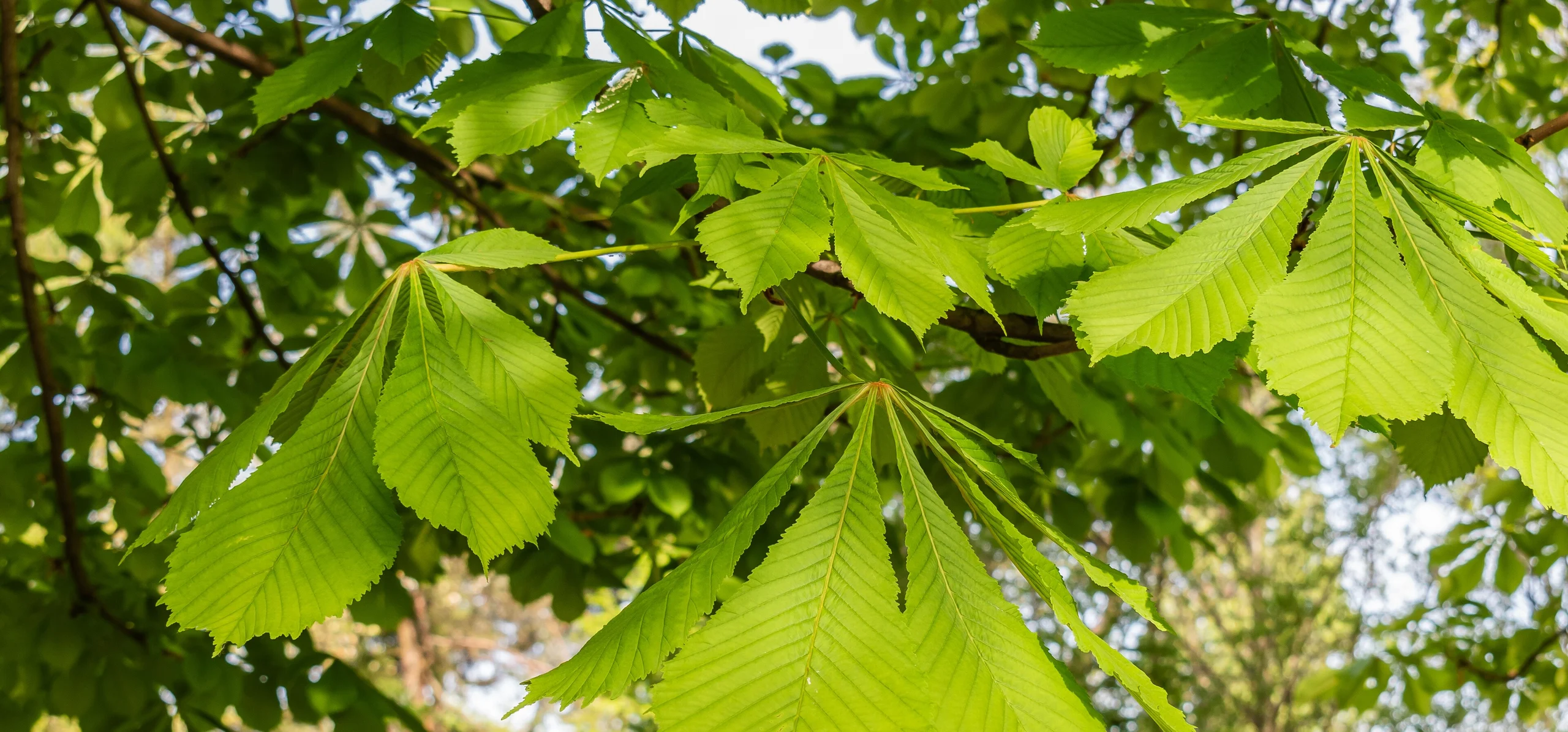
The ASPCA lists horse chestnut as toxic to dogs, cats and horses, with aesculin, a glycosidic saponin, and other saponins as the toxic principles, causing severe vomiting and diarrhoea, depression or excitement, dilated pupils, coma or convulsions after ingestion. The RHS separately notes the seeds and leaves are harmful if eaten by people too, so conkers are not a foraged snack whatever their resemblance to an edible nut. That resemblance is worth clearing up: true sweet chestnut, Castanea sativa, belongs to the beech family and holds edible nuts in a densely spiky bristling husk of two or three, while horse chestnut belongs to the soapberry family, per GBIF, and its glossy conkers sit one or two to a husk only lightly studded with soft spines. The leaves settle any doubt at a glance, palmate with five to seven leaflets on horse chestnut, simple, single and sharply toothed on sweet chestnut.
Red Horse Chestnut: A Smaller Alternative
Where the straight species is too large, Aesculus x carnea, the red horse chestnut, gives much of the same spring display in a more compact tree. It carries the same RHS H7 hardiness rating as its parent, but its flower spikes are pink rather than creamy white, and Missouri Botanical Garden lists its widely planted 'Briotii' form at 30 to 40 feet, roughly 9 to 12 m, well under the straight species' typical 50 to 75 feet. That still rules it out of a small plot, but it suits a large garden that could never carry a full-sized Aesculus hippocastanum, and it shares the same underlying susceptibility to bleeding canker and leaf miner, since both affect the genus rather than one species alone.
Test your plant knowledge
Tap a card to flip it and reveal the answer.
Horse chestnut leaf miner (Cameraria ohridella) can brown most of a tree's canopy by August, but the RHS says this pest alone has almost no effect on the tree's health. Tap to reveal ✓ True
The RHS recommends felling a horse chestnut whenever leaf miner damage appears. Tap to reveal ✕ False
There is currently no chemical control for horse chestnut bleeding canker (Pseudomonas syringae pv. aesculi). Tap to reveal ✓ True
Conkers are safe for dogs and horses to eat, despite the tree's name. Tap to reveal ✕ False
Horse chestnut needs regular formative pruning every year to grow into a healthy shape. Tap to reveal ✕ False
Sources
References consulted for this guide
- GBIF Backbone Taxonomy: Aesculus hippocastanum L.gbif.org
- RHS: Aesculus hippocastanum (horse chestnut)rhs.org.uk
- RHS: Horse chestnut leaf-mining mothrhs.org.uk
- RHS: Horse chestnut bleeding cankerrhs.org.uk
- RHS: Horse chestnut leaf blotchrhs.org.uk
- University of Illinois Extension: Common Horsechestnut (Aesculus hippocastanum)web.extension.illinois.edu
- ASPCA: Toxic and Non-Toxic Plants, Horse Chestnutaspca.org
- Missouri Botanical Garden Plant Finder: Aesculus x carnea 'Briotii'missouribotanicalgarden.org
- Reference entity : Wikipédiaen.wikipedia.org