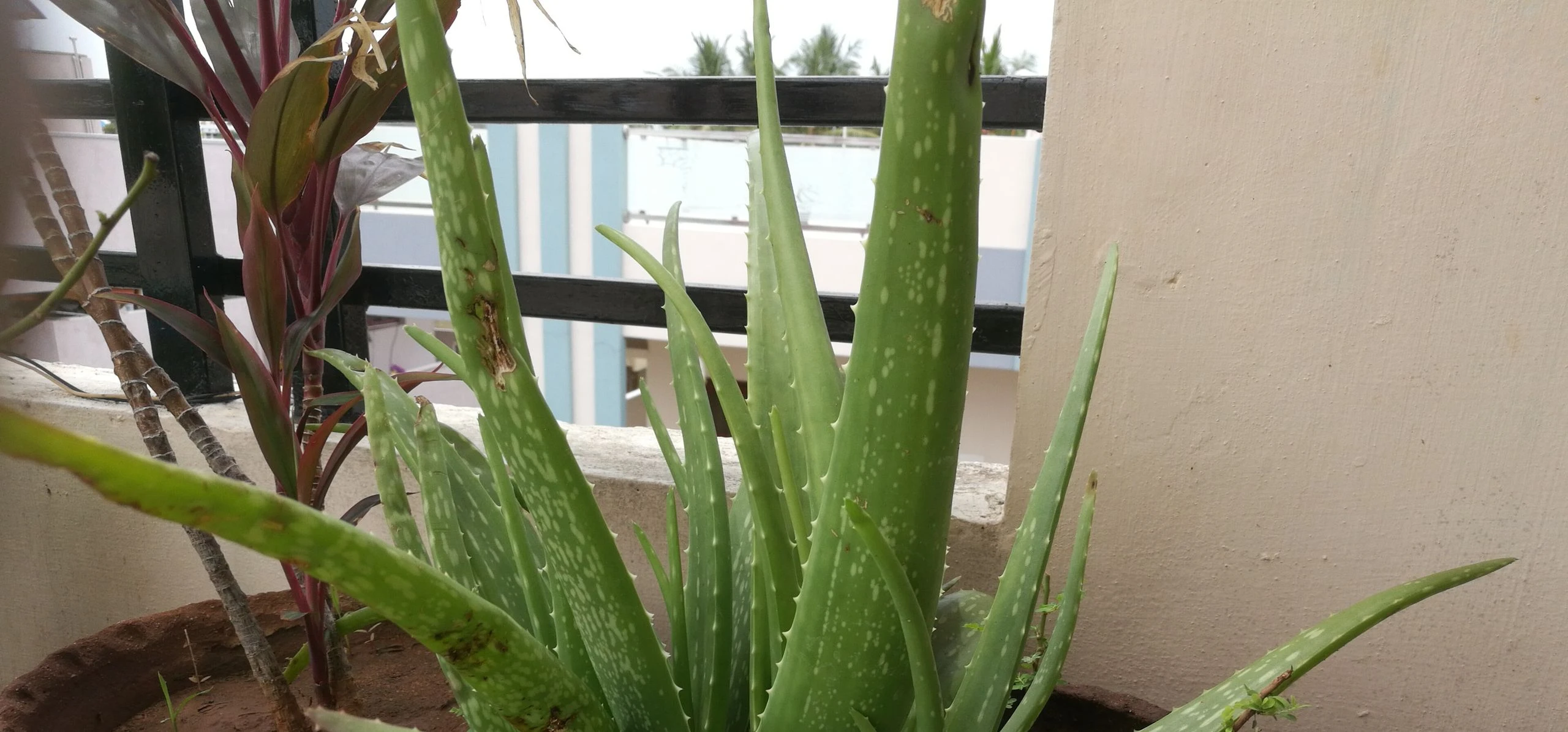
Aloe Vera
Aloe vera
Family · Asphodelaceae
RHS and Missouri Botanical Garden guidance on growing aloe vera: full sun, watering only when compost is dry, gritty soil, offsets and ASPCA toxicity status.
Aloe vera
Plant profile
- WateringVery littleWater every 16 days
- Light exposurePartial sun
- Hardiness zoneUSDA 10–12
Growth
- Family
- Asphodelaceae
- Life cycle
- Perennial
- Growth speed
- 3/10
- Mature size
- 30–100 cm
- Spread
- 50–100 cm
- Propagation
- Seed
- Offsets
FloweringOnly on mature, well-lit plants; yellow flowers on tall stalks (Missouri Botanical Garden)
DormancyGrowth slows in winter and watering drops to a minimum (RHS)
Time to maturityReaches full size in about 5 to 10 years (RHS)
Soil & climate
- Soil types
- loam, sand
- Drought tolerance
- Yes
Light & Placement
- Origin
- Northern Oman, Hajar Mountains (POWO)
- Where to place it
- Brightest available window, south- or west-facing
- Sheltered, full-sun patio in a Mediterranean-style planting (RHS)
- Peat-free cacti or loam-based compost with added grit (RHS)
Safety
- Toxicity
- CatsToxic
- DogsToxic
- HorsesToxic
Data fromAloe vera (L.) Burm.f., GBIF Backbone TaAloe vera (L.) Burm.f. | Plants of the WRHS: Aloe vera (Barbados aloe)ASPCA Toxic and Non-toxic Plants: AloeMissouri Botanical Garden Plant Finder:
Where it grows
World distribution
Aloe Vera is native to a single country: Oman.GBIF records 5,053 documented identifications across 125 countries, with the largest concentrations in Mexico, Spain, and United States.
- Oman
Yellow to orange dots: concentration of documented identifications per country. Green countries: sourced native range. Source: GBIFNative range from POWO (Kew).
Origin, Taxonomy and a Name Built on Confusion
A thick-leaved succulent forming a stemless rosette of grey-green, tooth-edged leaves is almost always Aloe vera, one of the most widely grown succulents in the world despite a native range far narrower than its reputation suggests. GBIF records the accepted name as Aloe vera (L.) Burm.f., in the family Asphodelaceae, and its long list of synonyms, including Aloe barbadensis Mill., Aloe chinensis and Aloe indica, reflects centuries of confused naming as the plant moved from region to region under cultivation. Plants of the World Online, from Kew, narrows the true native range to northern Oman, in the Hajar Mountains, a striking contrast with the Mediterranean and Caribbean associations the common names Barbados aloe and curacao aloe suggest. The Missouri Botanical Garden traces the common name to a folk medicine history reaching back into the pre-Christian era, long before the plant became a houseplant staple.
Light and Position
RHS growing notes for Aloe vera call for full sun on a south- or west-facing, sheltered spot, the same aspect it recommends for the container-grown houseplant form. Missouri Botanical Garden's culture notes agree the plant is best sited in full sun but add that it seems to adapt to some part shade, though it needs bright light to flower at all, and flowering on container plants only happens in the sunniest windows or outdoor spots. Indoors, that means the brightest window available; outdoors, RHS lists Aloe vera among plants suited to a sheltered, south- or west-facing patio in a Mediterranean-style planting.
Watering: Sparingly and Only When Dry
RHS instructions are blunt on this point: water sparingly, only once the compost feels dry, and hardly at all in winter. Missouri Botanical Garden's own culture notes echo the same rhythm, calling for watering very moderately through spring, summer and fall and reducing to the minimum once winter arrives. Both institutions list the plant as drought tolerant, which is why constantly damp compost is a far bigger risk to Aloe vera than an occasional missed watering, and why RHS warns that aloes will not grow well in continuously wet compost.


Soil and Potting
Missouri Botanical Garden recommends a sandy, well-drained commercial potting loam for container-grown plants, while RHS specifies loam with sharp sand or grit added for drainage, using a peat-free cacti or loam-based compost. RHS lists container and patio growing among its suggested planting locations for the species, which fits a plant whose native ground, per Kew's Plants of the World Online, is the rocky Hajar Mountains of northern Oman rather than damp lowland soil. A pot with the drainage this mix needs is not optional: compost that stays wet works against both institutions' watering advice above.
Feeding, Hardiness and Overwintering
RHS recommends a general liquid fertilizer applied monthly from May to August, with none needed the rest of the year, and rates Aloe vera H1c for hardiness, meaning it needs a minimum temperature of 5 to 10 degrees Celsius and can only go outside for the summer across most of the UK. Missouri Botanical Garden's figures for a container plant are more specific: nights of 50 to 60 degrees Fahrenheit in summer are tolerated, with a minimum of 40 degrees Fahrenheit in winter, and any plant taken outdoors for the summer should come back in before nights start dropping below 50 degrees Fahrenheit in early fall. Missouri Botanical Garden also lists the plant's own outdoor hardiness as USDA zones 10 to 12, which is why it is grown as a houseplant everywhere colder than that.
Propagation from Offsets
Both RHS and Missouri Botanical Garden describe the same easy route to new plants: Aloe vera produces offsets at the base of a mature rosette, and these can be separated and potted on their own once they are large enough to handle. RHS recommends rooting separated offsets in a cactus potting compost, ideally in spring or early summer, and also lists raising the species from seed sown as soon as it is ripe as a second option. Missouri Botanical Garden calls the offset method simply easy, matching the plant's reputation as one of the most forgiving succulents to multiply at home.
Pests and Problems
RHS lists Aloe vera as generally disease-free but notes it may be susceptible to scale insects and mealybugs, the same two pests flagged in Missouri Botanical Garden's own problems section for the species. Missouri Botanical Garden's single cultural warning is just as short: avoid overwatering, which lines up with both sources' watering advice and the plant's drought-tolerant rating. Because Aloe vera stores water in thick leaves, a soft, collapsing rosette is a far more common problem than a scorched or shrivelled one, and it almost always traces back to compost that never had the chance to dry out.
Toxicity and the Gel
The ASPCA lists Aloe vera as toxic to dogs, cats and horses, with saponins and anthraquinones as the toxic principles, and clinical signs of vomiting, lethargy and diarrhea, though vomiting itself is not listed for horses. The same ASPCA entry adds a specific exception: the gel is considered edible, which lines up with Missouri Botanical Garden's notes on the plant's use in skin care, where sap from a broken leaf is applied directly to burns and is widely added to commercial lotions and creams. Missouri Botanical Garden is more cautious about the whole leaf's sap being swallowed, noting it should not be eaten even though it has historically been used for peptic ulcers and has strong laxative properties. Kept out of reach of pets, with the outer leaf and its latex layer treated with more caution than the clear inner gel, Aloe vera remains one of the few succulents grown as much for its contents as for its rosette shape.
Test your plant knowledge
Tap a card to flip it and reveal the answer.
Aloe vera should be watered on a fixed weekly schedule, regardless of how dry the compost feels. Tap to reveal ✕ False
The RHS hardiness rating for Aloe vera means it can stay outdoors through a UK winter without protection. Tap to reveal ✕ False
The ASPCA lists Aloe vera as toxic to dogs, cats and horses. Tap to reveal ✓ True
New Aloe vera plants are usually grown from the offsets that form at the base of a mature rosette. Tap to reveal ✓ True
According to Kew's Plants of the World Online, Aloe vera is native to the rainforests of Central America. Tap to reveal ✕ False
Sources
References consulted for this guide
- Aloe vera (L.) Burm.f., GBIF Backbone Taxonomygbif.org
- Aloe vera (L.) Burm.f. | Plants of the World Online, Kew Sciencepowo.science.kew.org
- RHS: Aloe vera (Barbados aloe)rhs.org.uk
- ASPCA Toxic and Non-toxic Plants: Aloeaspca.org
- Missouri Botanical Garden Plant Finder: Aloe veramissouribotanicalgarden.org
- Reference entity : Wikipédiaen.wikipedia.org