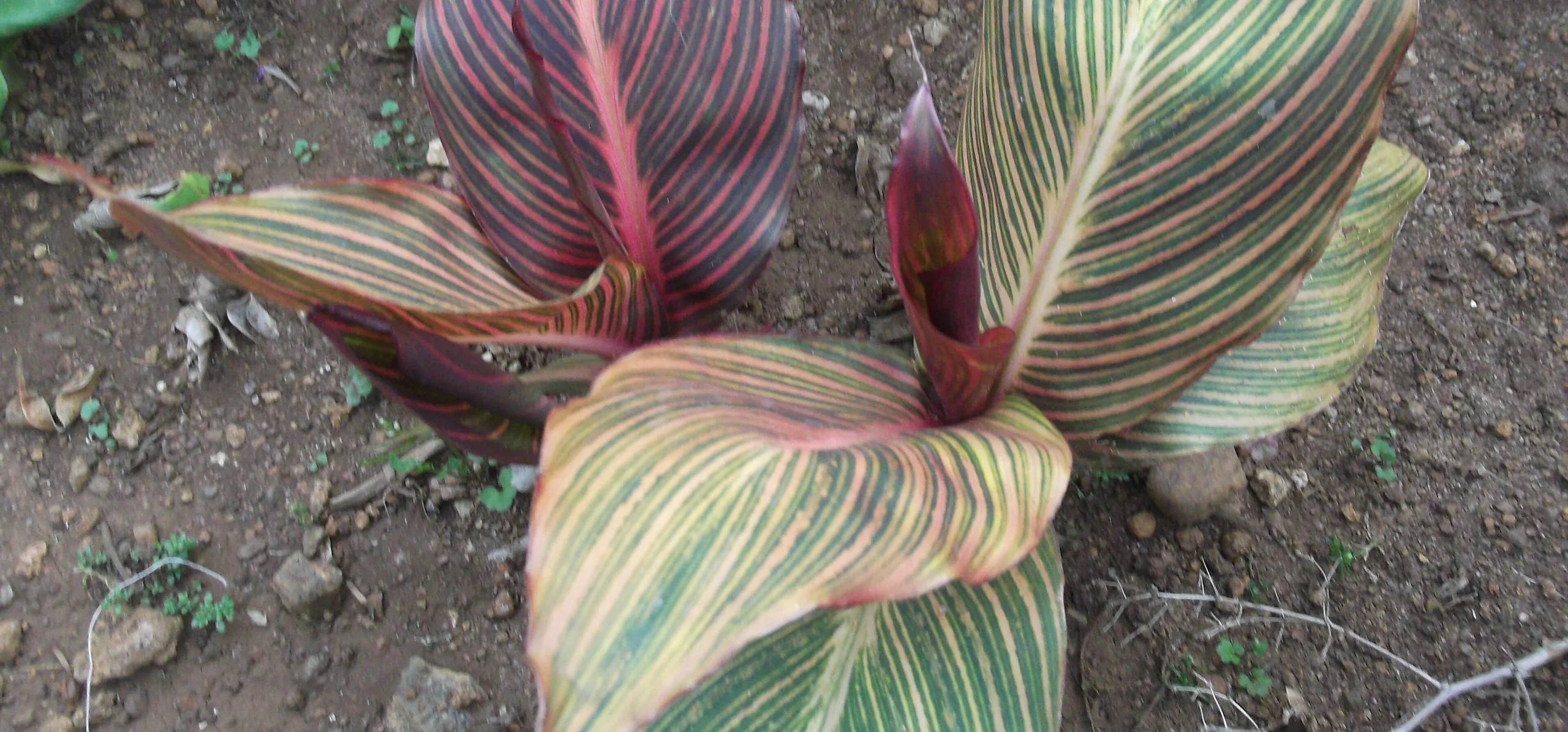
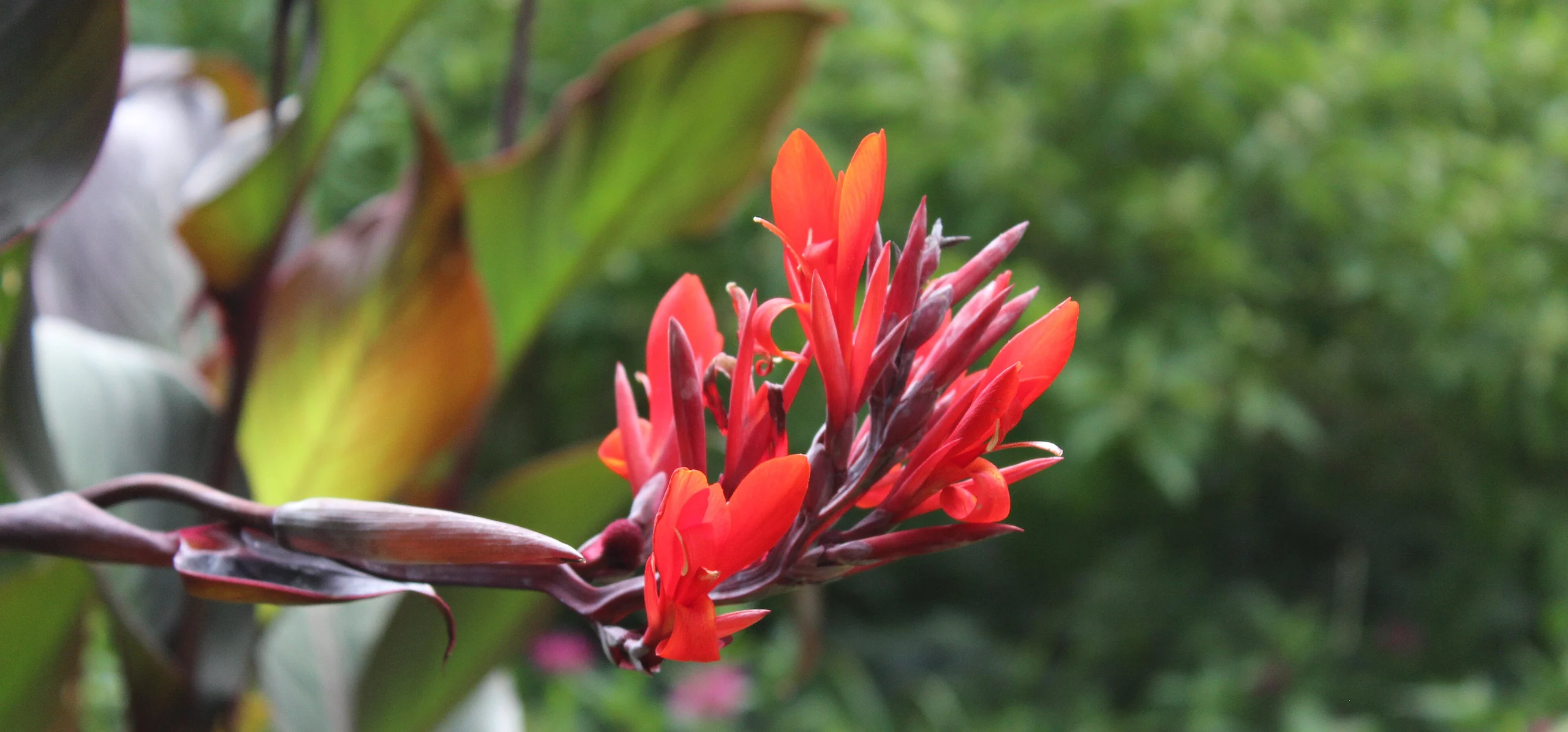
Canna Lily
Canna indica
Family · Cannaceae
Canna indica drinks and feeds heavily, needs its rhizome lifted before frost, and can catch canna virus or leaf roller caterpillars that shred new leaves.
Canna indica
Plant profile
- WateringHighWater every 4 days
- Light exposureFull sun
- Ideal temperature-5–35 °C
- Humidity40–80 %
- Hardiness zoneUSDA 7–10
Growth
- Family
- Cannaceae
- Life cycle
- Perennial
- Growth speed
- 8/10
- Mature size
- 150–250 cm
- Spread
- 10–50 cm
- Propagation
- Seed
- Division
FloweringRed, orange or yellow spikes from midsummer to early autumn, in its first growing season
Dormancyno true dormancy in the tropics; rhizomes are lifted and kept dry-dormant over winter where frost reaches the ground
Time to maturityflowers in its first growing season, from midsummer to early autumn
Soil & climate
- Soil types
- loam, sand
- Drought tolerance
- No
Light & Placement
- Origin
- Tropical and subtropical America
- Where to place it
- Full sun bed, south- or west-facing, sheltered from strong wind
- Pond or bog margin with up to 15 cm (6 in) of water over the roots
- Large container at least 30 cm (12 in) across with drainage, peat-free loam-based compost such as John Innes No. 3
Safety
- Toxicity
- CatsSafe
- DogsSafe
- HorsesSafe
Invasive speciesnot documented as invasive in cold-winter climates, but naturalized and locally invasive in parts of Australia, Pacific islands and East Africa, where it spreads into wetlands
Data fromCanna indica L., GBIF Backbone TaxonomyCanna indica L., Plants of the World OnlToxic and Non-toxic Plants: Canna Lily, Canna indica (Indian shot), RHSCannas Can Take the Heat!, Clemson Coope
Where it grows
World distribution
Canna Lily is native to 30 countries: Antigua & Barbuda, Argentina, Bahamas, Belize, Bolivia, Brazil, Colombia, and Costa Rica….GBIF records 20,454 documented identifications across 170 countries, with the largest concentrations in Brazil, Mexico, and Portugal.
- Antigua & Barbuda
- Argentina
- Bahamas
- Belize
- Bolivia
- Brazil
- Colombia
- Costa Rica
- Cuba
- Dominican Republic
- Ecuador
- El Salvador
Show 18 more countriesShow fewer countries
- French Guiana
- Guatemala
- Guyana
- Haiti
- Honduras
- Jamaica
- Mexico
- Nicaragua
- Panama
- Paraguay
- Peru
- Puerto Rico
- St. Lucia
- Suriname
- Trinidad & Tobago
- United States
- Uruguay
- Venezuela
Yellow to orange dots: concentration of documented identifications per country. Green countries: sourced native range. Source: GBIFNative range from POWO (Kew).
Canna indica, sold almost everywhere as Canna Lily or Indian Shot, is not a lily at all: it sits in the ginger order Zingiberales, closer kin to banana and ginger than to Lilium. It grows from a thick, branching rhizome that pushes up paddle-shaped leaves and spikes of red, orange or yellow flowers through summer into early autumn, reaching roughly 1.5 to 2.5 m (5 to 8 ft) in a single season. It is one of the hungriest, thirstiest plants in an ordinary border, and where winters bring hard frost the rhizome has to come out of the ground before that frost arrives or it rots or freezes in place. The rest of this guide covers keeping it fed and watered through summer, lifting and storing the rhizome over winter, and the two problems, a virus and a leaf-rolling caterpillar, that recur on this species specifically.
A Tropical American Rhizome Behind the "Indian Shot" Name
Canna indica is native to tropical and subtropical America, from Mexico and the Caribbean down through Central America into tropical South America, and has since been planted so widely across the tropics and subtropics that many gardeners assume it is native wherever they find it. The common name Indian Shot comes from the seeds, not the leaves: each hard, round, blackish seed is dense enough that it was once used as actual buckshot and is still strung into beads in parts of Latin America and Asia. The species is also called edible canna or achira, where the starchy rhizome is boiled or processed into a coarse starch, though ornamental cultivars are bred for flower color rather than eating quality. Botanically it sits in the family Cannaceae, order Zingiberales, the same order as banana (Musa) and ginger (Zingiber), which explains the broad, unribbed, faintly banana-like leaves.
Light and Site Selection
Full sun brings on the strongest flower spikes and the most compact growth; a south- or west-facing bed or border, sheltered from strong wind, is the standard recommendation. In partial shade the plant still grows, often taller and leggier as it stretches for light, but flowers later and more sparsely, and in deep shade it may not flower at all in a single season. Canna indica also tolerates the edge of a pond or a bog garden and can be grown as a marginal aquatic with up to about 15 cm (6 in) of water sitting over its roots, a trait most border perennials cannot match. Where summers are cool, a warm, reflected-heat spot against a south-facing wall makes up some of the difference and helps the plant reach flowering size before autumn.


Watering and Feeding a Hungry Rhizome
This is not a plant to treat like a drought-tolerant perennial: through the growing season the soil should stay consistently moist, and in a hot spell or a container it can need watering every day or two. Underwatering shows up fast as scorched, browning leaf edges and stalled new growth, while the plant's tolerance for boggy, waterlogged soil means overwatering is rarely the failure mode outdoors. Feeding matters just as much; a potassium-rich liquid fertilizer applied through midsummer keeps the flower spikes coming, and container-grown plants exhaust a pot of compost's nutrients within weeks and need feeding more often than a plant in open ground. A canna that produces small, pale leaves and few or no flower spikes despite regular watering is very often underfed rather than short of water.
Soil, Planting and Division
Canna indica grows in acid, neutral or alkaline soil as long as it is fertile and reliably moist; a loam or sandy loam enriched with well-rotted manure or garden compost at planting time suits it better than thin, fast-draining ground. Set rhizome pieces about 10 to 15 cm (4 to 6 in) deep once the soil has warmed in spring and all frost risk has passed, spacing clumps roughly 30 to 45 cm (12 to 18 in) apart to leave room for the colony to widen. In containers, a peat-free, loam-based compost such as John Innes No. 3, in a pot at least 30 cm (12 in) across with a controlled-release fertilizer mixed in, gives the root system enough volume for a full season of growth. An established clump is easiest to propagate by lifting the rhizome mass and dividing it into pieces that each carry at least one growing point, done in spring before replanting or right after lifting for winter storage.
Lifting and Storing Rhizomes for Winter
Canna indica is reliably hardy outdoors only where winters stay mild, roughly USDA zones 7 to 10; anywhere colder, the rhizome needs to be lifted and stored indoors rather than left in the ground. Wait until the first frost blackens the foliage, then cut the stems down to about 15 cm (6 in), lift the rhizome clump with a fork, and shake or rinse off the excess soil without breaking the fleshy roots more than necessary. Store the clumps in trays or crates of barely damp, peat-free compost, sand or vermiculite, in a frost-free space that stays cool and dark, checking occasionally through winter that the medium has not dried out or turned soggy enough to rot the rhizomes. Replant outdoors, or start into growth in pots indoors a few weeks early, once the danger of frost has passed the following spring.
Canna Virus: No Cure, Only Prevention
Several viruses circulate in canna collections, most often canna yellow mottle virus and bean yellow mosaic virus, and they show up as pale streaking or mottling between the leaf veins, stunted or distorted new growth, and pale streaks breaking up the normal flower color. Canna yellow mottle virus spreads mechanically, mainly on knives or shears used to divide infected rhizomes and then reused on healthy ones, while bean yellow mosaic virus is carried by aphids that pick it up feeding on an infected plant and inject it into the next one they visit. There is no chemical treatment or cure once a plant is infected: the only real management is buying rhizomes from a source that inspects for symptoms, disinfecting tools between plants when dividing, and digging out and discarding any clump that develops streaking or distortion. A virus-infected plant does not usually die outright, but it loses vigor and flower quality year after year, which is reason enough to remove it rather than propagate from it.
Canna Leaf Roller
The most common insect problem on this species is the canna leaf roller, the caterpillar of the Brazilian skipper butterfly, which hatches inside a new leaf while it is still tightly furled and pulls the edges together with silk into a tube as the leaf unrolls. Feeding inside that rolled tube, the caterpillar chews ragged holes and leaves rows of small dark droppings, and by the time the leaf fully unrolls the damage is already visible as torn, perforated foliage rather than fresh green growth. Opening the rolled sections by hand and removing the caterpillar inside controls light infestations without spraying anything; for heavier infestations, a Bacillus thuringiensis spray applied while leaves are still furled reaches the caterpillar before it seals itself inside and avoids harming bees. Cutting the whole planting back to the ground at the end of the season and clearing away the old foliage removes overwintering pupae and reduces how many caterpillars show up the following year.
Toxicity and Invasiveness in Warm Climates
The ASPCA lists Canna Lily, Canna indica, as non-toxic to cats, dogs and horses, which makes it one of the safer flowering border plants to grow around pets, unlike the true lilies (Lilium) that share part of its common name and are seriously toxic to cats. Its behavior in the landscape is a different question: outside of temperate gardens where frost keeps it in check, Canna indica has naturalized and become locally invasive in parts of Australia, several Pacific islands and parts of East Africa, spreading through wetlands and disturbed ground by both rhizome growth and its hard, long-lived seed. In cold-winter climates this spread risk is essentially moot, since the rhizome cannot survive an unprotected winter outdoors and any escape dies back with the first hard frost; the concern is specific to warm regions where it persists year-round. Gardeners in zone 7 and warmer, where the rhizome overwinters outdoors, are the ones who should deadhead spent flower spikes and avoid dumping rhizome-bearing garden waste near wetlands.
Test your plant knowledge
Tap a card to flip it and reveal the answer.
Canna indica rhizomes generally need to be lifted and stored indoors before winter in any climate colder than about USDA zone 7. Tap to reveal ✓ True
A canna plant infected with canna yellow mottle virus can be cured with a fungicide or antiviral spray. Tap to reveal ✕ False
The ASPCA lists Canna indica (Canna Lily) as toxic to cats, dogs and horses. Tap to reveal ✕ False
A canna leaf that emerges rolled into a tube and later shows ragged holes is usually the work of a leaf-rolling caterpillar, not a disease. Tap to reveal ✓ True
Canna indica is considered invasive mainly in cold, temperate climates, where its rhizome spreads uncontrolled through winter. Tap to reveal ✕ False
Sources
References consulted for this guide
- Canna indica L., GBIF Backbone Taxonomygbif.org
- Canna indica L., Plants of the World Online (Kew)powo.science.kew.org
- Toxic and Non-toxic Plants: Canna Lily, ASPCAaspca.org
- Canna indica (Indian shot), RHSrhs.org.uk
- Cannas Can Take the Heat!, Clemson Cooperative Extension HGIChgic.clemson.edu
- Reference entity : Wikipédiaen.wikipedia.org