Clivia
Clivia miniata
Family · Amaryllidaceae
Clivia miniata only flowers after a cool, dry winter rest near 10°C. How to trigger buds, why crowded roots help, and why the base rots if overwatered.
Clivia miniata
Plant profile
- WateringModerateWater every 14 days
- Light exposureIndirect light
- Humidity40–60 %
- Hardiness zoneUSDA 10–11
Growth
- Family
- Amaryllidaceae
- Life cycle
- Perennial
- Growth speed
- 2/10
- Mature size
- 10–50 cm
- Spread
- 10–50 cm
- Propagation
- Seed
- Offsets
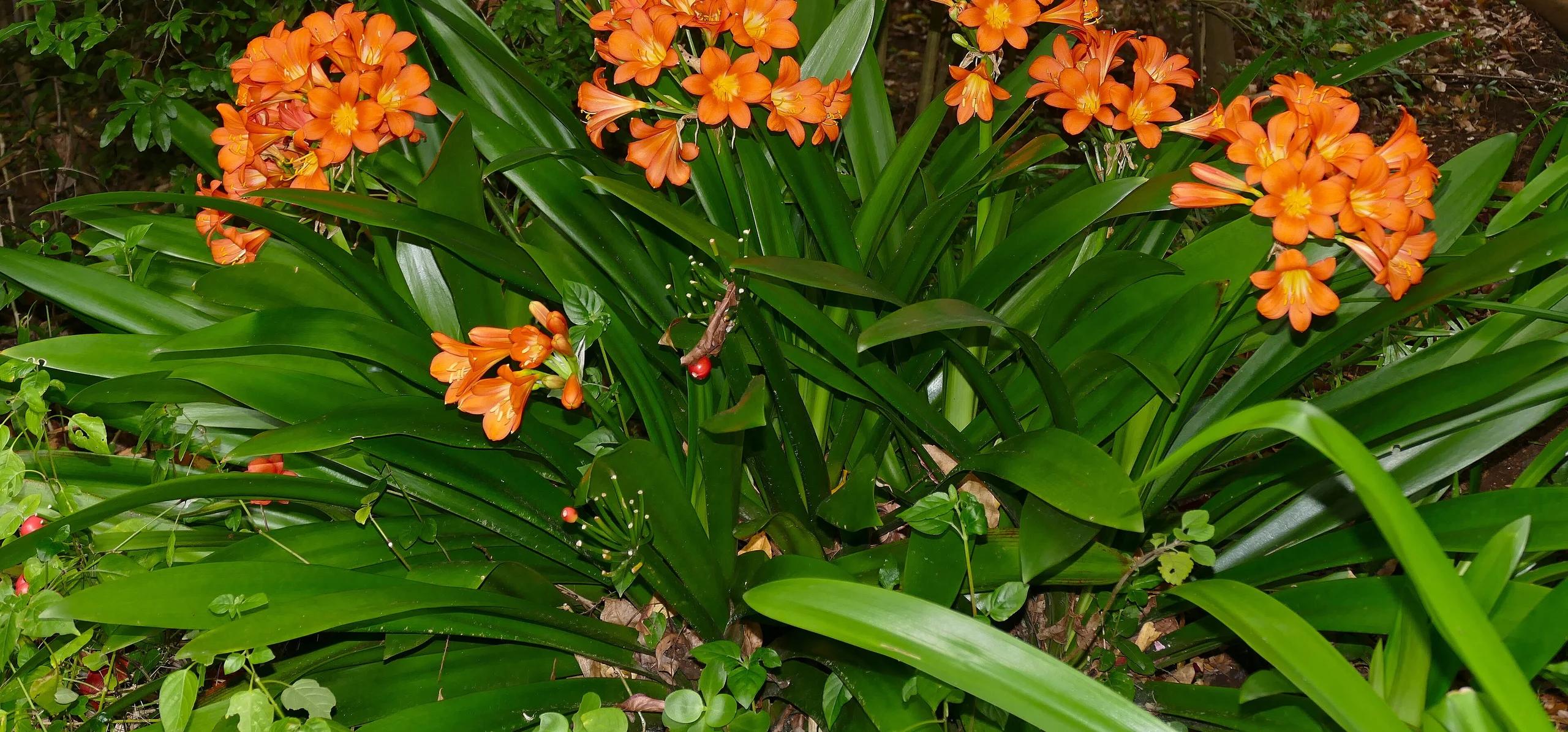
FloweringOrange (or yellow-form) trumpet clusters, typically December to April, after a cold dry rest
DormancyCool, dry rest for 6 to 8 weeks in winter, needed to trigger flowering
Time to maturity2 to 5 years to ultimate size (RHS); offsets flower sooner than seedlings
Soil & climate
- Soil types
- Loose, well-drained potting mix, Standard compost cut with perlite or coarse bark
- Drought tolerance
- Yes
Light & Placement
- Origin
- South Africa (Eastern Cape, Mpumalanga, KwaZulu-Natal) and Eswatini
- Where to place it
- Bright room a little back from an unshaded window
- North, east or west-facing window
- Sheltered, partial shade in frost-free climates
- Snug pot that keeps roots crowded; avoid sizing up often
Safety
- Toxicity
- CatsToxic
- DogsToxic
- HorsesToxic
Data fromClivia miniata (Lindl.) Verschaff., GBIFClivia miniata (Lindl.) Verschaff. | PlaClivia miniata | Natal lily, RHS PlantsHow to grow clivias, RHS Growing GuideClivia miniata, Plant Finder, Missouri BClivia Lily, Toxic and Non-Toxic Plants,
Where it grows
World distribution
Clivia is native to 2 countries: Eswatini and South Africa.GBIF records 601 documented identifications across 31 countries, with the largest concentrations in South Africa, Australia, and New Zealand.
- Eswatini
- South Africa
Yellow to orange dots: concentration of documented identifications per country. Green countries: sourced native range. Source: GBIFNative range from POWO (Kew).
A Clivia that only ever grows leaves and never flowers is not sick, it is simply warm and watered on a normal houseplant schedule year round. In the wild this forest-floor perennial from South Africa goes through a distinct cool, dry season that tells the plant it is time to build a flower stalk instead of another leaf. Skip that rest and you get a handsome, strappy-leaved plant that never blooms; give it six to eight weeks near 10°C with almost no water in autumn or early winter and an orange flower head pushes up a few weeks after you resume normal care. Everything else about growing Clivia is comparatively easy, which is why the flowering trigger trips up more owners than any pest or disease.
The cold, dry rest that triggers flowering
From around November to February, move the plant to the coolest room available, ideally close to 10°C (50°F), and cut watering back hard, essentially to nothing, for six to eight weeks. The RHS is specific that Clivia needs this cool spell to flower reliably and that keeping plants warm and well watered through winter is the single most common reason they stay leafy but bare. A porch, unheated spare room, or a cool windowsill away from radiators works; temperatures below about 5°C on the other hand damage the plant, so this is a cool rest, not a freeze. Once you can see the flower stalk emerging from the leaf fan, usually by late winter, move the pot back to warmth and start watering again.
Watering: normal in summer, almost none in the rest, careful at bud stage
Water freely through spring and summer while the plant is in active growth, letting the top of the compost dry between waterings. The tricky window is right after the cold rest ends: Missouri Botanical Garden notes that watering too early or too heavily once the flower stalk is forming can abort it before it reaches full height, so keep the compost just barely moist until the stalk is roughly 15cm (6 inches) tall, then resume watering normally. Water poured into the crown of leaves rather than the soil, or a pot left sitting in a saucer of water, shows up as yellow spotting on the leaves well before any root damage is visible.


Light: bright but never blasted with direct sun
Clivia grows naturally under the dappled canopy of coastal and inland forests, and it carries that preference indoors: bright, indirect light is ideal, with only a little early morning or late afternoon sun tolerated. The RHS lists it as suited to north, east or west-facing positions rather than a south-facing sill, and a leaf that splits or scorches along its length is the plant's way of saying it is getting too much direct sun. Too little light produces a looser, paler fan of leaves and fewer flower stalks over the years, so a bright spot a metre or two back from an unshaded window, rather than deep shade, is the target.
Soil, pots, and the case for leaving it alone
A loose, well-drained potting mix, a standard houseplant compost cut with extra perlite or coarse bark, suits Clivia's thick, fleshy roots, which rot quickly in soil that stays wet. What is unusual is how little the plant wants repotting: Clivia flowers better when its roots are crowded and restricted, and the RHS notes it actively resents root disturbance. Missouri Botanical Garden recommends repotting only every three to four years, and even then handling the root ball gently rather than shaking it out or dividing it hard, since torn roots are slow to recover and can knock a plant out of flowering for a season.
Fleshy roots and rot
The same fat, water-storing roots that let Clivia shrug off the dry winter rest are its biggest vulnerability the rest of the year. A pot without real drainage, compost that stays soggy, or a saucer that is never emptied will turn white, firm roots brown and mushy within weeks, and the first visible sign above soil is often a leaf base that pulls away soft and discoloured rather than crisp. There is no cure once a root has rotted through, only removing the damaged tissue with a clean blade, letting the remaining roots dry out, and repotting into fresh, gritty mix.
Propagation: offsets are faster than seed
A mature clump produces basal offsets, small plantlets attached at the base of the parent, that can be separated once they have their own roots and at least four or five leaves; these flower within a couple of years since they are already a reasonable size. Growing from seed is the slow route: pollinated flowers set large, berry-like fruits that ripen over close to a year, and a seedling raised from that seed typically takes three to four years to reach flowering size. Most named colour forms, including the yellow-flowered varieties, are propagated by offset division precisely because seed does not come true and takes so long.
Pests: mainly mealybugs
Mealybugs are the pest most likely to turn up on Clivia, tucked into the tight base where the leaves overlap and along the undersides near the midrib, where their white, cottony wax is easy to miss until a colony is established. They feed on sap and leave a sticky honeydew residue that can attract sooty mould on the leaves below. Wiping visible clusters off with a cotton swab dipped in rubbing alcohol, repeated every few days until none remain, controls a light infestation without resorting to a systemic spray on a plant that is often kept near living spaces.
Toxicity
The ASPCA lists Clivia as toxic to cats, dogs and horses, with the bulb and root tissue carrying the highest concentration of the toxic alkaloids, principally lycorine, that this plant shares with other Amaryllidaceae relatives like daffodils and amaryllis. Ingestion typically causes vomiting, drooling and diarrhoea, and the ASPCA notes that larger ingestions can bring on tremors, low blood pressure and cardiac arrhythmias, so a pot within reach of a chewing cat or dog is worth moving to a shelf or excluded room rather than risking it.
Yellow-flowered forms
Alongside the common orange-flowered species, several yellow forms exist, most traceable to Clivia miniata var. citrina and var. flava, and they are grown, priced and sold as distinct from the orange type despite sharing identical care needs. Yellow forms lack the orange and red carotenoid pigments of the species and are propagated almost exclusively by offset division to keep the colour true, which is part of why they command a premium price over ordinary orange seedlings.
Test your plant knowledge
Tap a card to flip it and reveal the answer.
Clivia needs a cool, dry rest of several weeks in winter to flower reliably. Tap to reveal ✓ True
This plant flowers best in a large pot with plenty of fresh, loose room for the roots. Tap to reveal ✕ False
Clivia tolerates full, direct sun all day on a south-facing windowsill. Tap to reveal ✕ False
The ASPCA lists Clivia as toxic to cats, dogs and horses. Tap to reveal ✓ True
Offsets from a mature clump flower faster than seedlings grown from seed. Tap to reveal ✓ True
Sources
References consulted for this guide
- Clivia miniata (Lindl.) Verschaff., GBIF Backbone Taxonomygbif.org
- Clivia miniata (Lindl.) Verschaff. | Plants of the World Online, Kew Sciencepowo.science.kew.org
- Clivia miniata | Natal lily, RHS Plantsrhs.org.uk
- How to grow clivias, RHS Growing Guiderhs.org.uk
- Clivia miniata, Plant Finder, Missouri Botanical Gardenmissouribotanicalgarden.org
- Clivia Lily, Toxic and Non-Toxic Plants, ASPCA Animal Poison Controlaspca.org
- Reference entity : Wikipédiaen.wikipedia.org