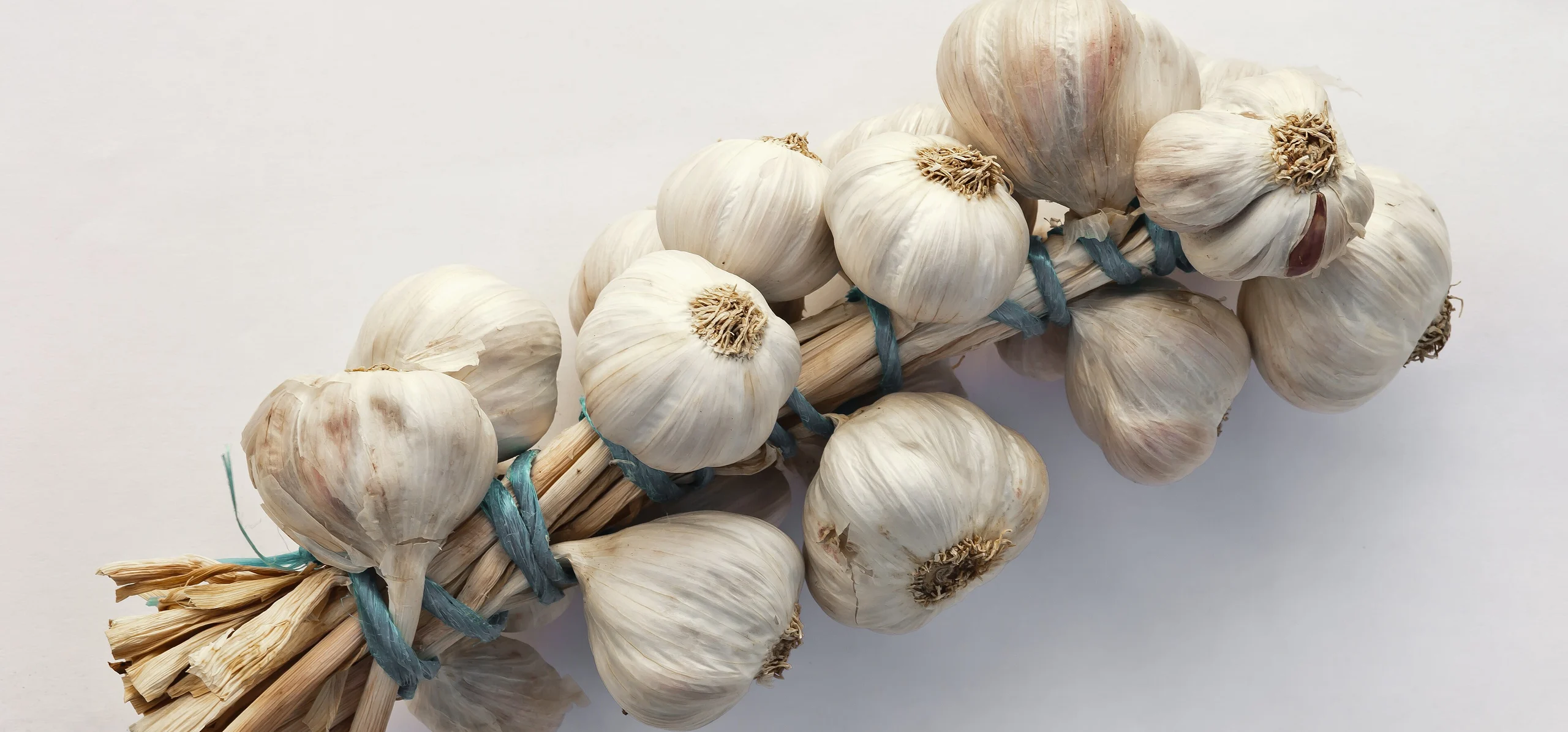
Garlic
Allium sativum
Family · Amaryllidaceae
Grow garlic from cloves: hardneck vs softneck, autumn planting for vernalisation, spacing, scapes, harvest timing, curing and long-term storage.
Allium sativum
Plant profile
- WateringModerateWater every 7 days
- Light exposureFull sun
- Ideal temperature-15–29 °C
- Humidity40–70 %
- Hardiness zoneUSDA 4–9
Growth
- Family
- Amaryllidaceae
- Life cycle
- Perennial
- Growth speed
- 3/10
- Mature size
- 30–60 cm
- Spread
- 10–15 cm
- Flowering
- Hardneck scapes curl in late spring
- Propagation
- Bulb
DormancyBulb dormant in winter cold, replanted as cloves
Time to maturity8-9 months from autumn planting to summer harvest
Soil & climate
- Soil pH
- pH 6–7
- Soil types
- loamy, well-drained, rich in organic matter
- Saline soil
- Not tolerated
- Drought tolerance
- No
Light & Placement
- Origin
- Central Asia to northeastern Iran
- Where to place it
- open vegetable bed
- raised bed
- deep container with drainage
Safety
- Toxicity
- CatsToxic
- DogsToxic
- HorsesToxic
Invasive speciesNot invasive; a cultivated crop that does not persist or spread outside beds.
Data fromGBIF: Allium sativum L.Plants of the World Online (Kew): AlliumASPCA: Toxic and Non-Toxic Plants, GarliUniversity of Minnesota Extension: Growi
Where it grows
World distribution
Garlic is native to 6 countries: Iran, Kazakhstan, Kyrgyzstan, Tajikistan, Turkmenistan, and Uzbekistan.GBIF records 12,828 documented identifications across 125 countries, with the largest concentrations in United States, Spain, and Germany.
- Iran
- Kazakhstan
- Kyrgyzstan
- Tajikistan
- Turkmenistan
- Uzbekistan
Yellow to orange dots: concentration of documented identifications per country. Green countries: sourced native range. Source: GBIFNative range from POWO (Kew).
Garlic (Allium sativum) arrives in the garden as a bulb of separate cloves, not as a seedling, and every clove you plant grows into one new bulb by the following summer. The bulb you buy is either a hardneck or a softneck type, and that single choice decides when you plant, how the plant behaves in the ground, and how long the harvested bulbs will keep. Garlic is planted in autumn in most climates rather than spring, because the cloves need weeks of cold soil to trigger the bulb to divide. Break the head into cloves only right before planting and leave the papery skin on each one intact, since a bruised or skinless clove rots before it roots.
Hardneck or Softneck: Choosing Your Type
Hardneck garlic sends up a rigid central stalk, the scape, that flowers before it curls. It carries fewer cloves per bulb, usually four to twelve arranged in a single ring, but each one is large and easy to peel. Hardneck types tolerate cold winters well and carry the sharper, more complex flavour prized by cooks, but the bulbs only store for four to six months before the cloves start to soften. Softneck garlic has no rigid stalk, which is why it can be braided, and it packs many more, smaller cloves in overlapping rings. It suits mild winters better than hard freezes and keeps for eight to twelve months in the right conditions, which is why softneck dominates supermarket shelves. Gardeners in a cold climate who want a long harvest window plant both: hardneck for flavour and the scapes, softneck for a bulb that lasts through winter.
Planting in Autumn for Vernalisation
Garlic needs a period of sustained cold, called vernalisation, to split each clove into a multi-clove bulb rather than growing into a single round like an onion. Without enough cold weeks, hardneck varieties in particular come up as a solid, undivided bulb with poor flavour. The University of Minnesota Extension recommends planting cloves one to two weeks after the first killing frost, late enough that the shoot does not push above the soil before winter, but early enough for roots to establish. In regions with mild or no winter frost, cloves can be pre-chilled in a refrigerator for six to eight weeks before planting to substitute for cold soil.
Spacing, Depth and Soil
Plant cloves pointed end up, root plate down, about 5 cm deep so the tip sits just under the soil surface. Space cloves 10 to 15 cm apart within the row and rows about 30 cm apart, giving each bulb room to swell without crowding its neighbours. Garlic wants a loose, well-drained soil rich in organic matter, with a pH between 6.0 and 7.0 according to University of Minnesota Extension; heavy clay that stays wet through winter is the single most common cause of rotted cloves before they ever sprout. Work compost into the bed before planting, then mulch with straw once the ground starts to freeze, which insulates the cloves and suppresses winter weeds without smothering the emerging shoots in spring.


Watering and Feeding Through the Season
Garlic wakes up in early spring and grows fastest through late spring as days lengthen, which is when it needs the most consistent moisture, roughly 2.5 cm of water a week from rain or irrigation. A side dressing of nitrogen in early spring, once new growth appears, pushes strong leaf development, and more leaves mean a bigger bulb later, since each leaf corresponds to one wrapper layer around the clove. Stop watering and feeding about three to four weeks before harvest, when the lower leaves begin to yellow. Wet soil at that stage encourages the wrapper skins to stain and split, which shortens how long the cured bulbs will store.
Scapes: The Hardneck Flower Stalk
In late spring, hardneck varieties send up a scape, a curling flower stalk topped with a cluster of bulbils. Left on the plant, the scape draws energy away from the bulb, so most growers cut it once it curls through one full loop, leaving the lower leaves untouched. Cutting scapes has been shown to increase bulb size, and the scapes themselves are a genuine harvest: mild, garlicky, and good chopped into stir-fries or blended into a pesto. Softneck garlic rarely produces a scape at all, which is one more reason it is easier to grow at scale.
Harvest and Curing
Harvest when the bottom third to half of the leaves have browned while the upper leaves are still green, generally early to mid summer depending on when the crop went in. Pulling too early gives small, thin-skinned bulbs that will not store; waiting until every leaf is dead lets the wrapper layers split and the cloves separate in the ground, exposing them to soil fungi. Lift bulbs gently with a fork rather than pulling by the stalk, and avoid bruising the skin. Curing is what turns a fresh-dug bulb into one that keeps: hang or lay the plants, roots and leaves still attached, in a shaded, airy spot out of direct sun for two to four weeks until the outer wrappers are dry and papery and the neck is fully closed.
Storing the Cured Bulbs
Once cured, trim roots close to the base and cut stems to about 2.5 cm, or leave softneck stems long for braiding. Store bulbs somewhere cool, dark and dry with good airflow, around 0 to 4 degrees Celsius for the longest storage or a cellar-like 10 to 15 degrees Celsius for everyday use; avoid the refrigerator's high humidity, which encourages sprouting and mould. Set aside the largest, healthiest bulbs as seed stock for autumn planting before eating into the pile, since replanting your own best cloves each year selects for bulbs suited to your soil and climate.
Rust, White Rot and Toxicity to Pets
Garlic rust shows as small orange-brown pustules on the leaves in cool, humid weather; it rarely kills the plant outright but weakens leaf area and reduces bulb size, so remove affected leaves and improve airflow between rows. Far more serious is white rot, caused by the soil-borne fungus Sclerotium cepivorum, which rots the roots and base plate and produces sclerotia that can survive in soil for well over a decade. There is no cure once white rot is in a bed; the only defence is buying clean seed garlic and never planting Allium species in infected ground again. Garlic is also a hazard indoors: the ASPCA lists it as toxic to cats, dogs and horses, since compounds in the Allium genus damage red blood cells and can cause vomiting, weakness and haemolytic anaemia if bulbs, leaves or cured cloves are eaten. Keep harvested garlic, and the growing bed itself, out of reach of curious pets.
Test your plant knowledge
Tap a card to flip it and reveal the answer.
Garlic is usually planted in autumn rather than spring. Tap to reveal ✓ True
Hardneck garlic typically stores longer than softneck garlic. Tap to reveal ✕ False
Leaving the flower scape on a hardneck plant increases bulb size. Tap to reveal ✕ False
Garlic bulbs should be dug up and eaten immediately, without curing. Tap to reveal ✕ False
Garlic is listed as toxic to dogs and cats by the ASPCA. Tap to reveal ✓ True
Sources
References consulted for this guide
- GBIF: Allium sativum L.gbif.org
- Plants of the World Online (Kew): Allium sativum L.powo.science.kew.org
- ASPCA: Toxic and Non-Toxic Plants, Garlicaspca.org
- University of Minnesota Extension: Growing Garlicextension.umn.edu
- Reference entity : Wikipédiaen.wikipedia.org