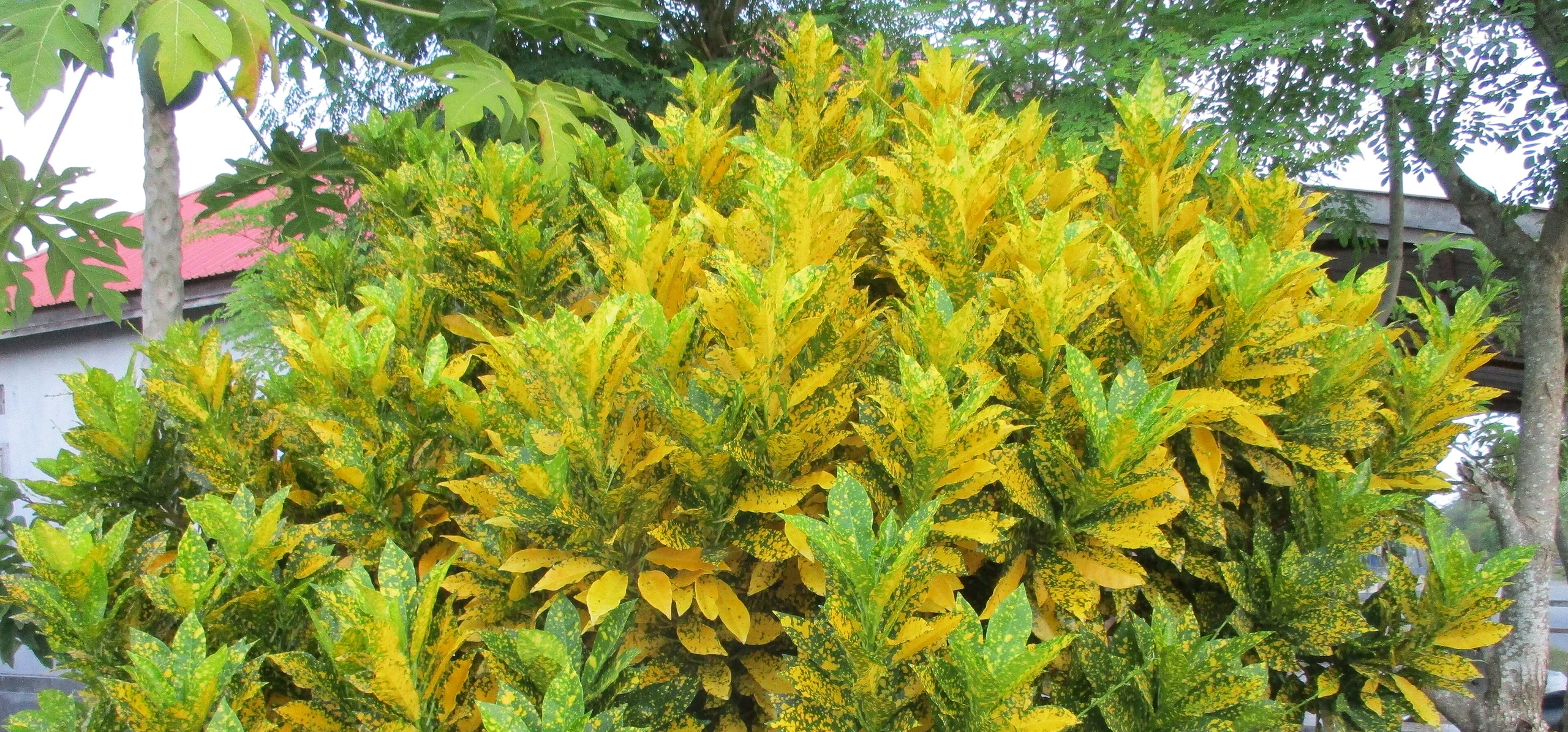
Croton
Codiaeum variegatum
Family · Euphorbiaceae
Croton (Codiaeum variegatum) care: why leaves drop after a move, bright light for colour, warmth above 15C with no draughts, humidity against spider mites.
Codiaeum variegatum
Plant profile
- WateringModerateWater every 7 days
- Light exposurePartial sun
- Ideal temperature15–29 °C
- Humidity50–70 %
- Hardiness zoneUSDA 11–12
Growth
- Family
- Euphorbiaceae
- Life cycle
- Perennial
- Growth speed
- 5/10
- Mature size
- 60–240 cm
- Spread
- 60–180 cm
- Flowering
- Small, inconspicuous, rare indoors
- Propagation
- Cutting
- Layering
DormancyNo true dormancy; rests with reduced watering in cool winter
Time to maturityReaches full size in 5 to 10 years
Soil & climate
- Soil types
- Rich, well-drained potting mix, Loam-based compost with perlite or bark
- Saline soil
- Not tolerated
- Drought tolerance
- No
Light & Placement
- Origin
- Malesia to the southwest Pacific
- Where to place it
- East or south-facing window
- A bright spot a step back from strong direct sun
- Full sun to partial shade in frost-free, tropical climates
- Terracotta or plastic pot with a drainage hole
Safety
- Toxicity
- CatsToxic
- DogsToxic
- HorsesToxic
Data fromCodiaeum variegatum (L.) Rumph. ex A.JusCroton, ASPCA Animal Poison ControlCodiaeum variegatum var. pictum 'Petra' Croton (Codiaeum variegatum), University
Where it grows
World distribution
Croton is native to 8 countries: Australia, Fiji, Indonesia, Malaysia, Papua New Guinea, Philippines, Solomon Islands, and Vanuatu.GBIF records 8,478 documented identifications across 141 countries, with the largest concentrations in Indonesia, Australia, and Brazil.
- Australia
- Fiji
- Indonesia
- Malaysia
- Papua New Guinea
- Philippines
- Solomon Islands
- Vanuatu
Yellow to orange dots: concentration of documented identifications per country. Green countries: sourced native range. Source: GBIFNative range from POWO (Kew).
A croton that arrives from a nursery or garden centre often panics within days: leaves yellow at the edges, curl and drop by the dozen, even though nothing about your care changed. That is acclimatisation shock, not neglect. The plant grew under a greenhouse's steady humidity and even light, and the trip home in a cold car boot or a dim hallway disrupts it more than the pot it will later spend years in. Give it several weeks in one stable spot before judging whether you have killed it; most crotons stop shedding on their own and rebuild a full crown of new leaves within two or three months.
Why the leaves drop after a move
The trigger is rarely one single thing. A drop in humidity, a few degrees of extra cold on the glass overnight, or simply less light than the greenhouse bench it came from is enough to make a croton shed its oldest leaves as a defence, redirecting resources to the leaves it keeps. This is different from ongoing decline: shock drop slows down after two to four weeks and is followed by new growth, while a plant that keeps losing leaves indefinitely, especially younger ones near the top, is telling you something is still wrong, usually a cold draught, a pot that never dries, or light that is too dim for the leaf it is trying to hold onto.
Bright light for the colour
Croton needs bright light, with a few hours of direct or filtered sun, to hold its yellow, orange and red pigment; new leaves that unfurl in a dim corner come in mostly green and stay that way. Outdoors in the tropics it takes full sun happily, but a plant that has spent months in a shop or a shaded room needs that sun introduced gradually over a week or two, since a sudden jump to unfiltered midday glass can dull and bleach the very colour you are trying to keep. An east-facing window, or a bright spot a step back from a south or west one, is the easiest compromise indoors.
Warmth above 15C and no draughts
Croton is comfortable between roughly 15 and 29C and starts to suffer below 10C, dropping leaves within days of a real cold snap. What catches people out more than the average room temperature is the draught: a spot between a front door and a hallway, on a windowsill behind a curtain drawn at night, or in the direct blast of an air conditioner puts the plant through repeated temperature swings that a thermostat set to a comfortable number does not show. Keep it away from single-glazed glass in winter and out of the line of any vent, and it will tolerate an ordinary heated home without complaint.


Humidity and spider mites
This is a plant from humid tropical understory and forest edge, and it does best with humidity well above what a centrally heated living room offers in winter. Stand the pot on a tray of wet pebbles, group it with other houseplants, or run a humidifier nearby rather than misting the leaves, which dries again within the hour and does little. The practical reason to bother: dry air is exactly what spider mites need, and they show up first as fine webbing in the leaf axils and a dull, finely stippled look on the upper leaf surface, with the mites themselves visible as moving specks on the underside if you check with a hand lens. Rinse the foliage under the tap or shower periodically and treat with insecticidal soap at the first webbing, since a heavy infestation on a croton is slow to reverse.
Watering evenly
Water when the top half-inch to inch of the mix has dried, generously enough that water runs from the drainage hole, then let it approach that same dryness again before the next round; cut back to noticeably less in winter when growth slows. The leaf drop that follows a watering mistake looks the same whether the mistake was too much or too little, which is why an erratic routine, long dry stretches followed by a heavy soak, does more damage than a schedule that is merely a little light or a little heavy but consistent. A pot with a drainage hole and a mix that does not stay soggy for days matters as much as the calendar.
Choosing a croton: Petra, Mammy and Gold Dust
Garden centres now stock dozens of croton cultivars bred mainly for leaf shape and pattern rather than flowers, since the flowers are small and easy to miss. 'Petra' is the one most people picture: broad, oval leaves with bold yellow, orange and red veining against dark green, and it is the parent look behind most of the others. 'Mammy' twists that idea sideways, with narrow leaves that curl and spiral along their length instead of lying flat, giving a plant the same rainbow colouring but a shaggier, more textured silhouette. 'Gold Dust' is the subtle option: slim green leaves flecked with small gold speckles rather than broad colour bands, closer to the wild species and easier to place next to plainer greenery. All three want the same light, warmth and humidity described above; the differences are entirely cosmetic.
Pruning a leggy plant and rooting tip cuttings
Left to its own devices, especially in light that is a little too low, a croton drops its lower leaves over a year or two and turns into a bare cane with a tuft of foliage on top. Cut it back hard, to within about 10cm of the base or wherever you want new growth to start, using a clean blade. The cut will bleed a milky sap; dust the wound with powdered charcoal to slow the bleeding and reduce the chance of rot setting in, then keep the plant on the dry side for a week while it seals over. Dormant buds below the cut break within a few weeks and rebuild a fuller shape. The tip you removed can usually be rooted: let the cut end stop bleeding and callus for an hour, then set it in warm, humid, free-draining cutting mix with gentle bottom heat, or root it in water and pot it once roots appear; either way it takes several weeks and rarely all at once.
Milky sap and toxicity to pets and people
Every cut leaf, stem or root weeps the same white latex, and it is not inert: the sap contains diterpene esters that irritate skin on contact, usually as redness or a mild sting that fades within minutes rather than a lasting burn, so wear gloves for any pruning or propagation session rather than working bare-handed. The ASPCA lists croton (Codiaeum variegatum) as toxic to cats, dogs and horses; a pet that chews a leaf typically drools, vomits or gets diarrhoea rather than facing anything life-threatening, but the discomfort is real and worth preventing by keeping the pot out of reach of a chewing puppy or a cat that likes to nibble foliage.
Test your plant knowledge
Tap a card to flip it and reveal the answer.
Croton often drops a number of leaves in the first few weeks after being moved to a new spot. Tap to reveal ✓ True
The yellow, orange and red colouring in croton leaves gets stronger in bright light and fades toward green in shade. Tap to reveal ✓ True
Croton is unbothered by cold draughts as long as the room's average temperature stays warm. Tap to reveal ✕ False
The milky sap released when a croton stem is cut is harmless and needs no precautions. Tap to reveal ✕ False
The ASPCA lists croton (Codiaeum variegatum) as toxic to cats, dogs and horses. Tap to reveal ✓ True
Sources
References consulted for this guide
- Codiaeum variegatum (L.) Rumph. ex A.Juss., GBIF Backbone Taxonomygbif.org
- Codiaeum variegatum (L.) Rumph. ex A.Juss., Plants of the World Online (Kew)powo.science.kew.org
- Croton, ASPCA Animal Poison Controlaspca.org
- Codiaeum variegatum var. pictum 'Petra' (v), RHSrhs.org.uk
- Croton (Codiaeum variegatum), University of Wisconsin-Madison Extensionhort.extension.wisc.edu
- Reference entity : Wikipédiaen.wikipedia.org