String of Pearls
Curio rowleyanus
Family · Asteraceae
Curio rowleyanus (String of Pearls) care: soak-and-dry watering by bead firmness, bright east or west light, and why overwatering, not drought, kills it.
Curio rowleyanus
Plant profile
- WateringLittleWater every 14 days
- Light exposurePartial sun
- Hardiness zoneUSDA 10–11
Growth
- Family
- Asteraceae
- Life cycle
- Perennial
- Growth speed
- 4/10
- Mature size
- 5–10 cm
- Spread
- 10–50 cm
- Flowering
- Small white, cinnamon-scented flowers in summer
- Propagation
- Cutting
- Layering
Dormancyslows in cool winter months
Time to maturity1 to 2 years
Soil & climate
- Soil types
- free-draining cactus/succulent mix, loam-based compost with added grit
- Drought tolerance
- Yes
Light & Placement
- Origin
- Cape Provinces, South Africa
- Where to place it
- east- or west-facing window
- sheltered, sun-facing patio (frost-free)
- terracotta pot with drainage holes
- hanging basket
Safety
- Toxicity
- HumansToxic
Data fromGBIFPlants of the World Online (Kew)RHSMissouri Botanical Garden
Where it grows
World distribution
String of Pearls is native to a single country: South Africa.GBIF records 74 documented identifications across 13 countries, with the largest concentrations in Brazil, United States, and South Africa.
- South Africa
Yellow to orange dots: concentration of documented identifications per country. Green countries: sourced native range. Source: GBIFNative range from POWO (Kew).
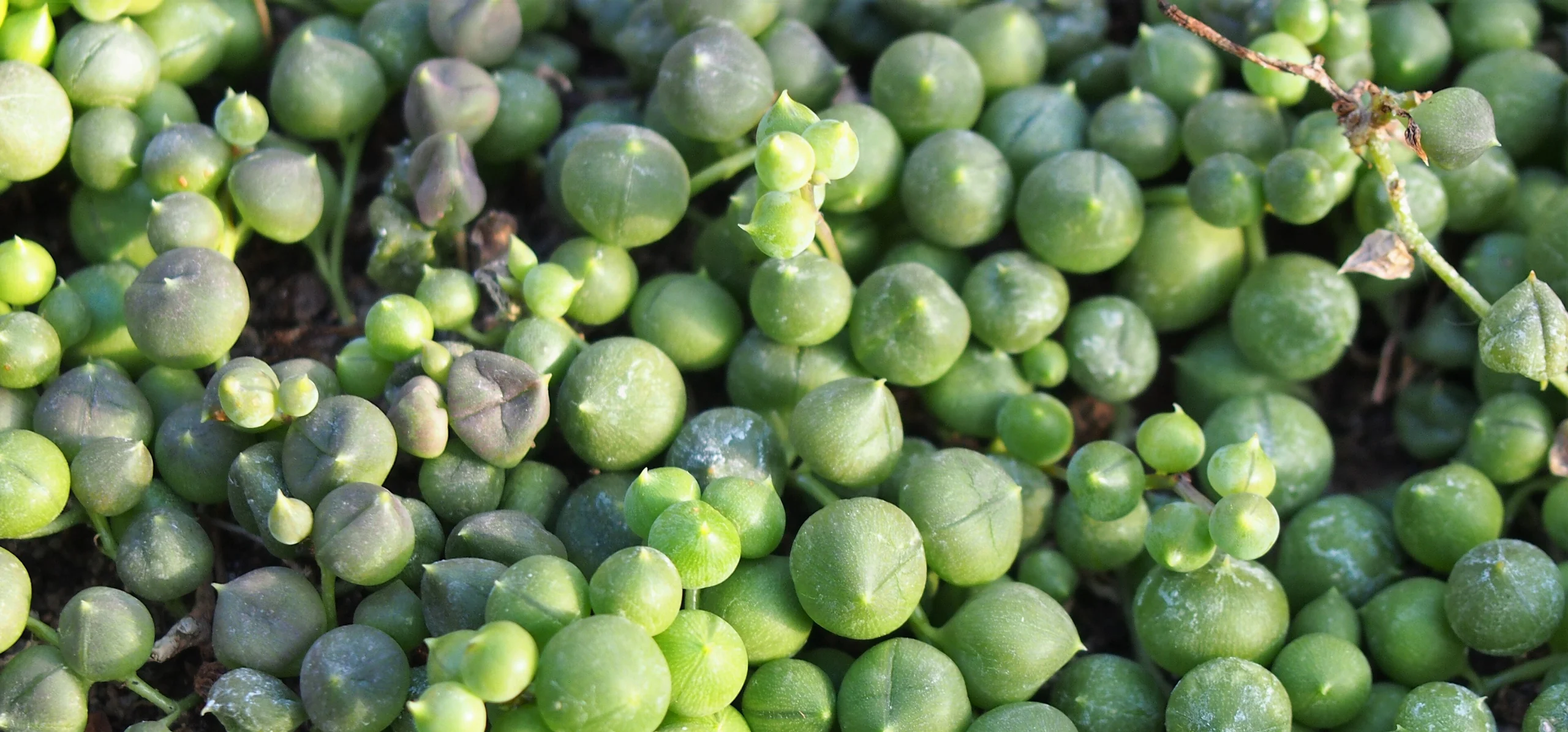
Curio rowleyanus is the trailing succulent sold almost everywhere as string of pearls: thread-thin stems strung with pea-sized, spherical leaves, each carrying a translucent window down one side that lets light reach the chlorophyll layer inside even when a bead faces away from the sun. It was grown and described for decades as Senecio rowleyanus before botanists moved most of that group into the genus Curio, so older books, plant tags and nursery labels still use the Senecio name interchangeably with the current one. A newly bought plant in a small nursery pot usually looks thin and sparse; strands thicken and multiply over its first year once it settles into brighter light and a watering rhythm it actually likes, which for this species means less water and more patience than most houseplants get.
Cape Province, not Namibia
Plants of the World Online lists the native range of Curio rowleyanus as Cape Prov., the Cape provinces of South Africa, where it grows as a groundcover on rocky slopes and cliff ledges. Plenty of houseplant guides repeat an older claim that it comes from Namibia or southwest Africa; that description traces back to Senecio-era references and to the plant's resemblance to other dry-country Curio species that do grow further north and west, but the accepted taxonomic source places it specifically in the Cape. In the wild the beads trail down rock faces and root wherever a stem touches soil, the same habit that lets a single hanging basket fill in so quickly once it is established.
Light: bright, not baking
The RHS rates it for full sun to partial shade outdoors, but its own growing guide is more specific for pots: an east- or west-facing window gives the beads enough light to stay plump and round without exposing them to the full force of midday summer sun, which scorches thin patches into the skin of each leaf within a day. A plant that has spent months in low light stretches, with wider gaps between beads so the strand looks sparse and cord-like rather than beaded; moved gradually into brighter light over a couple of weeks, new growth comes back dense while the older stretched section stays as it is. Full outdoor sun works only where the climate stays frost-free and the plant has been hardened off first.


Watering by the beads, not the calendar
Each bead is a water-storage leaf, so the plant tells you what it needs before the compost does: beads that go slightly soft and slack mean it is time to water, beads that shrivel and wrinkle mean it has gone too long dry, and beads that turn translucent, yellow or mushy mean the roots are sitting in water they cannot use. The RHS advises soaking the compost through in the growing season, letting it dry out completely between waterings, then cutting back to sparing waterings in winter, just enough to stop the beads shrivelling, since a resting plant in cool, dim conditions can rot from a single overwatering that would have been harmless in midsummer. Stem and root rot from a saturated pot, not underwatering, is what actually kills most string of pearls plants; a strand that has gone dry and crisp can often be saved by trimming to healthy growth and starting new cuttings, but a mushy, blackened base rarely recovers.
Soil, pots and repotting
Use a free-draining cactus or succulent mix, or build one from two parts loam-based, peat-free compost to one part horticultural grit, in a pot with a drainage hole; terracotta suits it better than glazed or plastic because the extra evaporation through the pot wall makes overwatering harder to do by accident. A hanging basket or shallow, wide pot works better than a tall one, since the roots stay shallow while the stems do the growing, trailing over the rim rather than down into the mix. Repot only when roots fill the pot or the compost has broken down, moving up one size at most and refreshing the mix rather than burying more stem, since buried beads sitting against wet compost are a common point where rot starts.
Feeding through the growing season
Feed once a month or less from April to September with a general-purpose liquid fertiliser at half strength, then stop completely once growth slows into autumn and winter; a plant fed on a fixed schedule through its resting months pushes soft, weak growth into conditions with too little light to support it. Because the beads themselves store the plant's water and energy reserves, string of pearls tolerates being under-fed far better than most houseplants do, so a missed month rarely shows, while a plant fed too generously in low light just grows leggy faster than the light can keep pace with.
Propagating new strands
The easiest method is stem cuttings: cut healthy lengths of about 10cm, let the cut ends dry for a day so they callus over, then lay them across the surface of moist cuttings compost rather than burying them upright, since new roots form along the underside of the stem wherever a bead touches soil. Roots typically appear within about a month at normal room temperature, faster in the height of the growing season than in a cool winter room. The same rooting habit makes layering just as easy: pin an intact stem still attached to the parent plant onto the soil surface of a second pot, and once it has rooted in on its own, sever the connection to the original plant.
Flowers, sap and handling
Established plants occasionally produce small white, paintbrush-shaped flowers with a faint cinnamon scent in summer, on short stalks above the beads; they are a minor feature compared with the foliage and not something to count on from a young or shaded plant. The RHS notes that the sap can irritate skin and that all parts may cause stomach upset if eaten, and recommends gloves when pruning or handling cuttings for that reason. The ASPCA's toxic and non-toxic plant database has no dedicated entry for this species, so its formal toxicity rating to cats, dogs or horses is not established, but treating it as you would any sap-bearing succulent, out of reach of pets that chew houseplants, is the sensible default.
Common mistakes and pests
The two mistakes that account for most dead string of pearls plants are watering on a fixed schedule instead of by the beads, and potting it in a mix that holds water around the roots; both end in the same soft, blackened stem base. Aphids and mealybugs occasionally settle into the tight growth near the crown or in the leaf axils of new shoots, visible as small clustered insects or the cottony residue mealybugs leave behind, and are cleared with a cotton swab dipped in isopropyl alcohol or an insecticidal soap before they spread further down the strand. Confusing it with Curio herreanus, the similar string of teardrops with elongated rather than round beads, is a common labelling mix-up at nurseries rather than a care issue, since both species want the same bright, sparingly watered conditions.
Test your plant knowledge
Tap a card to flip it and reveal the answer.
Curio rowleyanus is native to South Africa's Cape provinces, not Namibia as many houseplant guides claim. Tap to reveal ✓ True
String of pearls should be watered on a strict weekly schedule regardless of how the beads look. Tap to reveal ✕ False
This plant was formerly classified as a Senecio before being moved into the genus Curio. Tap to reveal ✓ True
The ASPCA lists Curio rowleyanus as toxic to cats, dogs and horses. Tap to reveal ✕ False
Stem cuttings should be buried upright in compost to root successfully. Tap to reveal ✕ False
Sources
References consulted for this guide
- GBIF - Curio rowleyanusgbif.org
- Plants of the World Online (Kew) - Curio rowleyanuspowo.science.kew.org
- RHS - Curio rowleyanusrhs.org.uk
- RHS - How to grow string of beadsrhs.org.uk
- Missouri Botanical Garden - Curio rowleyanus Plant Findermissouribotanicalgarden.org
- Reference entity : Wikipédiaen.wikipedia.org