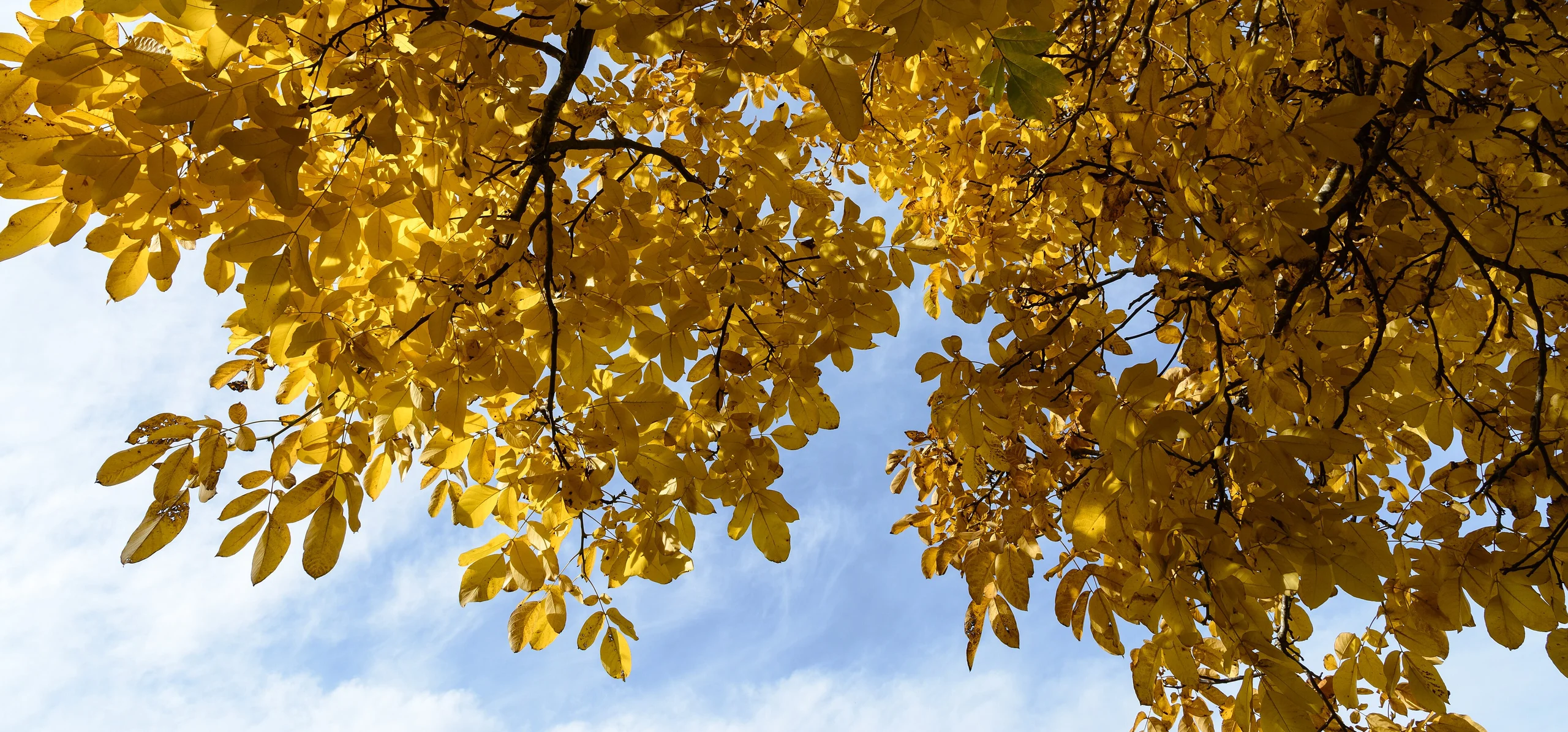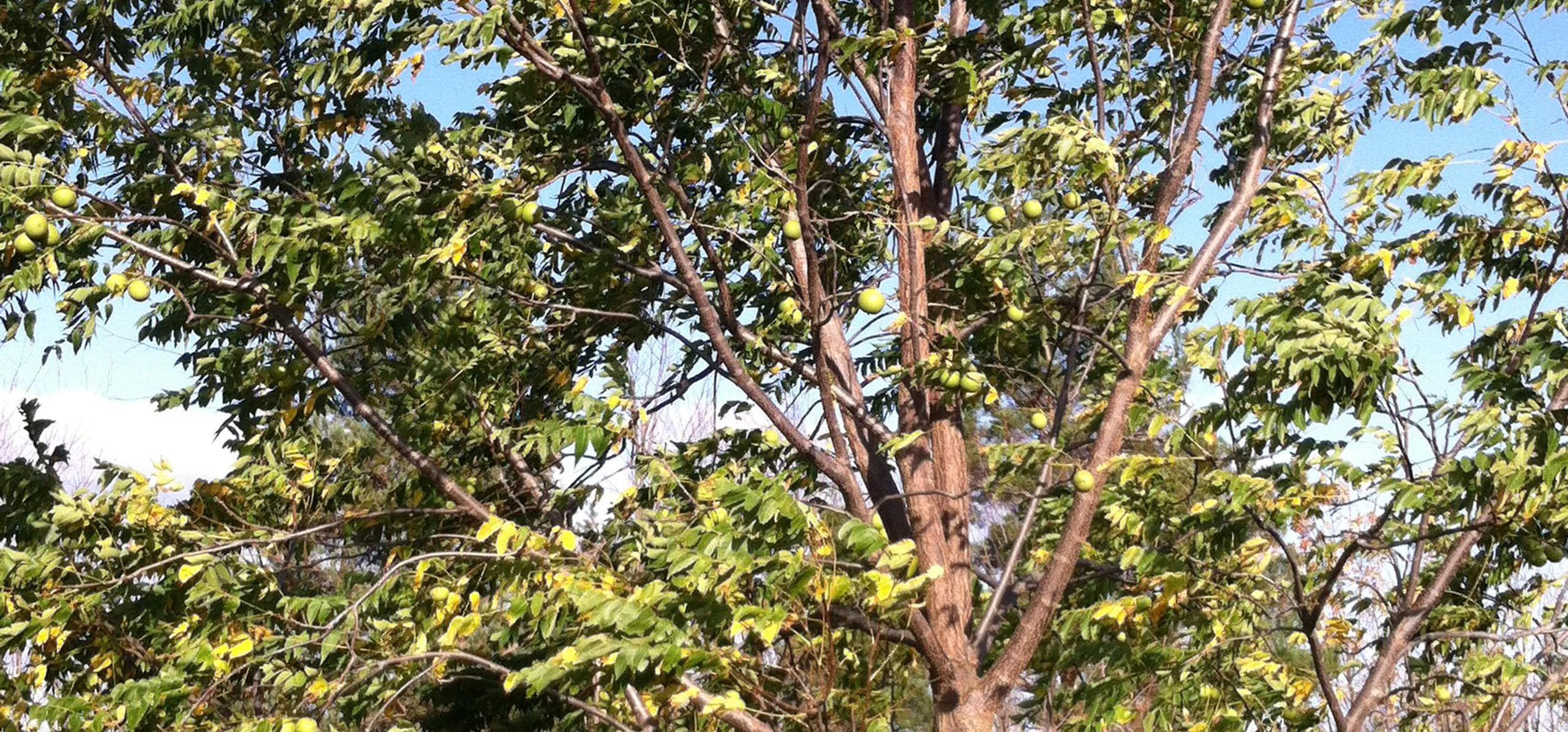
Black Walnut
Juglans nigra
Family · Juglandaceae
Black walnut's deep taproot resists transplanting, its juglone kills nearby tomatoes and azaleas, and its husks stain hands for days after the fall nut harvest.
Juglans nigra
Plant profile
- WateringModerateWater every 10 days
- Light exposureFull sun
- Hardiness zoneUSDA 4–9
Growth
- Family
- Juglandaceae
- Life cycle
- Perennial
- Growth speed
- 7/10
- Mature size
- 2286–3048 cm
- Spread
- 2286–3048 cm
- Flowering
- Small yellowish green catkins, May to June; nuts ripen in green husks by October
- Propagation
- Seed
Dormancydeciduous; bare in winter, leafs out late in spring
Time to maturityreaches much of its mature size over several decades; grows fastest while young on deep, fertile soil (NC State Extension)
Soil
- Soil types
- loam
Light & Placement
- Origin
- SE. Canada to Central and E. U.S.A. (POWO)
- Where to place it
- open lawn or field with room to mature
- naturalized woodland edge
- orchard or plantation grown for nuts or timber
Safety
- Toxicity
- CatsSafe
- DogsToxic
- HorsesToxic
Data fromGBIF Backbone Taxonomy: Juglans nigra L.Missouri Botanical Garden Plant Finder: ASPCA Toxic and Non-Toxic Plants: Black North Carolina State Extension Gardener Colorado State University Extension: Tho
Where it grows
World distribution
Black Walnut is native to 2 countries: Canada and United States.GBIF records 45,261 documented identifications across 60 countries, with the largest concentrations in United States, Canada, and France.
- Canada
- United States
Yellow to orange dots: concentration of documented identifications per country. Green countries: sourced native range. Source: GBIFNative range from POWO (Kew).
A black walnut growing on your property is usually a mixed blessing. It is the tree behind the tennis ball sized green husks that blacken the driveway every October and the reason a neighbor's tomatoes never thrive near the property line. Left to grow in the open it becomes a straight, high crowned tree 75 to 100 feet tall according to the Missouri Botanical Garden, prized for its timber and its intensely flavored nuts. Two things decide whether keeping or planting one works for your yard: how deep its taproot runs before you can move it, and how far its chemical defenses reach into the soil around it.
What You Are Growing: Black Walnut, Not English Walnut
GBIF's Backbone Taxonomy accepts Juglans nigra L. as the correct name, placing the species in the walnut family, Juglandaceae, within the order Fagales. Kew's Plants of the World Online gives its native range as SE. Canada to Central and E. U.S.A., a very different origin from Juglans regia, the English or Persian walnut sold in supermarkets, which comes from the Balkans through Central Asia and is usually grafted for orchard production. Black walnut's own nuts are edible and richly flavored, but the shell is thick, deeply corrugated and hard to crack, and the husk around it stains skin and clothing on contact, which is why homeowners either value the tree for its shade and timber or resent it for the mess each fall.
Site and Soil: Give It Room and Deep Ground
Plant black walnut in full sun, the only exposure the Missouri Botanical Garden lists for it, and in deep, moist, organically rich, well drained soil, the condition North Carolina State Extension gives as the tree's preference. It grows slowly and unevenly in shallow, compacted or poorly drained ground, since the taproot that anchors the tree needs real depth to develop. Give it space from the start: a mature specimen reaches 75 to 100 feet tall and nearly as wide, occasionally to 125 feet, with a trunk 3 to 6 feet across according to North Carolina State Extension, so a spot close to a house, driveway or patio will eventually feel crowded, quite apart from the juglone problem described below.
Planting: Why the Taproot Changes Everything


A black walnut seedling puts most of its early energy into a single deep taproot rather than top growth, and North Carolina State Extension notes this makes the species difficult to transplant once established. In practice, direct seeding a nut where you want the tree to grow, or planting a young bare root or containerized sapling in its first year or two, works far better than moving an older tree later. Squirrels do a lot of the planting themselves, burying nuts and forgetting a fraction of them, which is why walnut seedlings turn up unannounced at the base of fences and in flower beds. Pull them while they are still a single stem: a volunteer with a season or two of taproot growth behind it snaps back when you try to yank it and has to be dug out instead.
The Juglone Problem: What Not to Plant Nearby
Black walnut roots, husks, leaves and stems all contain juglone, a compound that suppresses the growth of sensitive plants nearby, and the Missouri Botanical Garden names azaleas, rhododendrons, blueberries, peonies and solanaceous crops such as tomatoes, peppers and potatoes among the plants it damages or kills. Most of the effect stays within the tree's drip line, but the Garden notes that the zone of toxicity widens as the tree matures and its root system spreads, so a bed that once sat safely outside the canopy can start failing years later with no obvious cause. The common mistake is blaming poor soil or disease when wilting, yellowing tomato plants near an established walnut are actually a juglone symptom. Moving the bed, or switching to juglone tolerant plants, solves it far faster than feeding or spraying ever will.
Flowering, Pollination and the Fall Nut Harvest
Black walnut is monoecious, carrying separate male and female flowers on the same tree, and blooms with small yellowish green flowers from May into June according to the Missouri Botanical Garden, wind pollinated rather than insect pollinated. The nuts develop inside a solid green husk about the size of a tennis ball and ripen by October, when they begin dropping, still husked, onto the ground below. Gather them promptly: squirrels compete hard for the crop, and a husk left too long on the ground blackens into a slippery, staining mess. Hulling is the unglamorous part of growing this tree; the husk clings tightly to the shell and stains skin and clothing on contact, so most growers work in old clothes and gloves, then spread the hulled nuts in a single layer somewhere dry and airy for several weeks before cracking, since a walnut dried too little molds in storage.
Pests and Diseases: Anthracnose and Thousand Cankers
Watch the leaves in wet spring weather for brown blotches and premature yellowing: that is usually walnut anthracnose, a fungal leaf disease that thrives in high humidity and can defoliate a tree early if damp conditions repeat for several years running, though a single bad season rarely threatens a mature tree's health. A far more serious threat is thousand cankers disease, caused by a fungus that the walnut twig beetle carries into the bark as it tunnels. Colorado State University Extension describes how the beetle's many small entry points create cankers that coalesce and girdle branches, and how black walnut, highly susceptible to the disease, can die within about three years of the first visible symptoms. The disease has spread out of its native range in the western United States into several eastern states, so a black walnut showing sudden branch dieback and a thinning crown is worth reporting to a local extension office rather than assuming ordinary drought stress.
Toxicity and the Practical Downsides
Black walnut is non-toxic to cats but toxic to dogs and horses according to the ASPCA: moldy hulls or nuts can cause tremors and seizures in dogs, while horses bedded on shavings containing even a modest proportion of black walnut wood can develop laminitis, a painful and potentially crippling hoof condition, from contact with the shavings rather than from eating them. If you keep horses, never accept walnut shavings for bedding, and rake up fallen husks and nuts before dogs get a chance to chew ones that have started to mold. None of this makes black walnut a tree to avoid entirely: it is a genuinely valuable native species for timber, wildlife and shade, but it asks for more planning around its placement than most trees in a nursery aisle, since gardening under it, moving it or keeping animals near it all run into the same two facts covered above, the depth of its taproot and the reach of its juglone.
Test your plant knowledge
Tap a card to flip it and reveal the answer.
A black walnut sapling can usually be transplanted safely after several years in the ground. Tap to reveal ✕ False
Tomatoes and peppers planted within a black walnut's root zone often wilt from juglone. Tap to reveal ✓ True
Black walnut husks wash off skin and clothing easily with soap and water. Tap to reveal ✕ False
Black walnut is toxic to cats but safe for dogs and horses. Tap to reveal ✕ False
Thousand cankers disease is spread by a beetle that carries a fungus into the tree's bark. Tap to reveal ✓ True
Sources
References consulted for this guide
- GBIF Backbone Taxonomy: Juglans nigra L.gbif.org
- Missouri Botanical Garden Plant Finder: Juglans nigramissouribotanicalgarden.org
- ASPCA Toxic and Non-Toxic Plants: Black Walnutaspca.org
- North Carolina State Extension Gardener Plant Toolbox: Juglans nigra (Black Walnut)plants.ces.ncsu.edu
- Colorado State University Extension: Thousand Cankers Disease of Walnutextension.colostate.edu
- Reference entity : Wikipédiaen.wikipedia.org