Nipplewort
Lapsana communis
Family · Asteraceae
Nipplewort has tiny yellow flowers that shut by afternoon, seeds with no parachute to carry them, and roots that pull out in one tug: how to spot and manage it.
Lapsana communis
Plant profile
- WateringLittleWater every 10 days
- Light exposurePartial shade
Growth
- Family
- Asteraceae
- Life cycle
- Annual
- Growth speed
- 7/10
- Mature size
- 30–100 cm
- Propagation
- Seed
FloweringSmall pale-yellow, dandelion-like flower heads in loose clusters from mid-summer to early autumn; each head shuts by mid-afternoon and stays closed on dull days
DormancyNone in a typical year; the plant completes its cycle and dies after seeding, though a sheltered individual can occasionally persist as a short-lived perennial
Time to maturityGerminates in spring and flowers the same year, typically from mid-summer to early autumn
Soil & climate
- Soil types
- sand, loam, clay
- Drought tolerance
- No
Light & Placement
- Where to place it
- shaded border
- hedge base
- woodland edge
- vegetable bed margin
- waste ground
OriginNative to Macaronesia and Europe east to Siberia and Iran, including the British Isles
Safety
- Toxicity
- Not listed by name in the ASPCA's toxic and non-toxic plant database
- Pet safe
- No
Invasive speciesNaturalized across most of Canada and dozens of US states after introduction from Europe; not listed as a noxious or regulated weed in either country despite being locally common
Data fromGBIF: Lapsana communis L.Plants of the World Online (Kew): LapsanRHS: Lapsana communis (nipplewort)USDA Plants Database: Lapsana communis LCABI Compendium: Lapsana communis (nippl
Where it grows
World distribution
Nipplewort is native to 40 countries: Albania, Algeria, Austria, Belarus, Belgium, Bulgaria, Croatia, and Czechia….GBIF records 806,700 documented identifications across 91 countries, with the largest concentrations in United Kingdom, France, and Germany.
- Albania
- Algeria
- Austria
- Belarus
- Belgium
- Bulgaria
- Croatia
- Czechia
- Denmark
- Estonia
- Finland
- France
Show 28 more countriesShow fewer countries
- Georgia
- Germany
- Greece
- Hungary
- India
- Iran
- Iraq
- Ireland
- Italy
- Kazakhstan
- Lebanon
- Morocco
- Netherlands
- Norway
- Pakistan
- Palestinian Territories
- Poland
- Portugal
- Romania
- Russia
- Spain
- Sweden
- Switzerland
- Tunisia
- Türkiye
- Ukraine
- United Kingdom
- Uzbekistan
Yellow to orange dots: concentration of documented identifications per country. Green countries: sourced native range. Source: GBIFNative range from POWO (Kew).
A modest, branching weed with wiry stems and small pale-yellow flowers that look like miniature dandelions scattered along the top of the plant rather than clustered at ground level: that combination turning up in a shaded border, a hedge bottom, or the untended edge of a vegetable bed is almost always Lapsana communis, commonly called nipplewort. GBIF's accepted classification places it in the family Asteraceae, genus Lapsana, and it is one of the least troublesome weeds a gardener will meet: shallow fibrous roots that lift out with one tug, seeds that barely travel, and a genuine tolerance for the shady corners where little else will grow. It rarely needs urgent action, but it is worth being able to name correctly and to tell apart from the more aggressive yellow composites it gets mistaken for.
Identifying Nipplewort: Small Yellow Flowers on Branched Stems
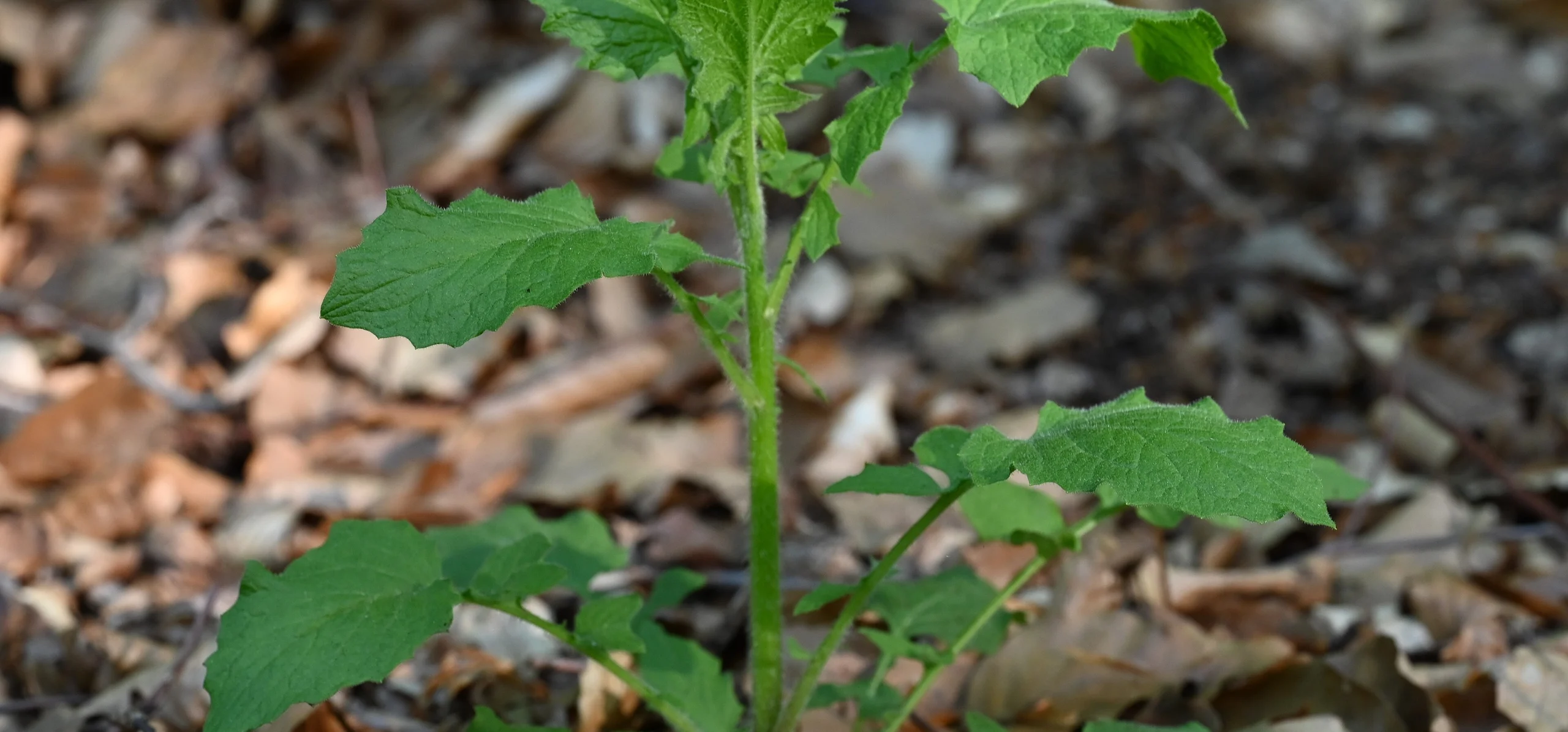
The leaves are alternate, up to about 15 cm long, and distinctly lyre-shaped: one large lobe at the tip with a pair of much smaller lobes lower down the leaf, on a slightly hairy stem that branches freely as the plant matures. Stems are hollow and reach roughly 30 to 100 cm depending on light and soil fertility, staying compact in a dry crevice and tall and leggy in rich, shaded ground. From mid-summer to early autumn, the plant carries loose, open clusters of small flower heads, each one only about a centimeter across and made up of 8 to 15 pale-yellow ray florets, with no central disc florets at all. A single plant can carry up to a dozen or more of these heads at once, opening in sequence rather than all together.
Flowers That Close by Mid-Afternoon
One of the most useful identification traits has nothing to do with shape or color: nipplewort's flower heads only open properly in bright light and shut again by mid-afternoon, staying closed altogether on a dull or rainy day. A patch that looks fully in bloom at ten in the morning can look almost flowerless by four in the afternoon, which trips up anyone trying to photograph or key it out later in the day. Other small yellow composites common in the same disturbed, shady ground, such as hawkweeds and hawksbits, tend to stay open much longer through the day, so checking the same clump at two different times is a quick way to rule nipplewort in or out.
Why It Barely Spreads: Seeds Without a Parachute
Most weedy Asteraceae, dandelion being the obvious example, ride the wind on a feathery pappus attached to each seed. Nipplewort has none. Its banana-shaped achenes, roughly 4.5 mm long and numbering several hundred per plant, sit inside a tubular involucre of bracts that never opens wide; it simply dries out, and the wind eventually shakes loose only a seed or two at a time from the cup-shaped base. Without a pappus to catch the air, those seeds fall close to the parent plant rather than drifting into the next bed or over the fence, which is the main reason a nipplewort problem tends to stay a small, local patch instead of turning into a garden-wide one.

Hand-Pulling: The Only Control You'll Need
The root system is shallow and fibrous rather than a taproot or a spreading rhizome, so grasping the plant firmly near its base and pulling usually brings the whole thing out cleanly, especially from moist soil after rain. There is no need to reach for a weedkiller for a plant this easy to remove by hand. The one habit worth keeping is pulling before the flower heads dry and release seed, since that stops the small, local reseeding cycle described above before it starts; a light hoe through seedlings on a dry day does the same job at an earlier stage.
A Weed That Actually Likes the Shade
Nipplewort is genuinely tolerant of the low light that stops many border plants and most other weeds from establishing: it favors partial shade and the dappled light of a woodland edge or hedge base, and only leans toward full sun in cool, consistently moist climates. It is not particular about soil texture either, turning up in sandy, loamy and clay ground alike, provided the site is reasonably fertile and not left bone dry for long stretches. That combination, shade tolerance plus soil indifference, is exactly why it colonizes the parts of a garden that get the least attention: under a hedge, along a shaded fence line, or in the gap behind a shed.
Where the Name Nipplewort Comes From
The English name is not a coincidence of sound. Herbalist John Parkinson translated it in 1640 from Papillaris, a name Prussian apothecaries had given the plant because its closed, unopened flower buds resemble a nipple, and, by the Doctrine of Signatures that guided a lot of pre-modern herbal practice, a plant part that looked like an ailment's location was assumed to treat it. On that basis the plant was historically applied to cracked or sore nipples in nursing mothers, an old use worth knowing as a piece of plant history rather than as a recommendation, since no modern clinical evidence supports it. The genus name Lapsana traces back further still, to a name Dioscorides used for a wild potherb.
Is Nipplewort Toxic to Pets or People?
A search of the ASPCA's toxic and non-toxic plant database turns up no dedicated entry for Lapsana communis or nipplewort by name, so the honest answer for pet owners is that its toxicity is simply unconfirmed there rather than proven safe. That is a different situation from a plant flagged toxic, but it still means keeping a curious dog or cat from eating a large amount of it and calling a vet if one does. For people, the young leaves have a long history as a foraged salad or cooked green in parts of Europe, but that is a foraging note, not a claim that every part of the plant is safe to eat without proper identification.
From European Hedgerow Weed to a Naturalized North American Plant
In its native range, Macaronesia and Europe east to Siberia and Iran, nipplewort is simply an unremarkable plant of hedgerows, woodland edges and disturbed ground, including throughout the British Isles. It was carried to North America, most likely as a contaminant in imported garden soil and seed, and the USDA Plants Database now documents it as an introduced, naturalized species across most of Canada and dozens of US states, concentrated in the northeast and Pacific northwest where it first took hold. Even so, neither country lists it as a noxious or regulated weed, and the lack of a wind-borne seed or a resprouting root system is exactly why: compared with a bindweed that regrows from any root fragment left in the ground or a dandelion that seeds a whole border in a single windy afternoon, nipplewort is a slow, local nuisance at worst, and in a shaded corner where nothing else will grow, it can be left alone without much consequence either way.
Test your plant knowledge
Tap a card to flip it and reveal the answer.
Nipplewort's flower heads open in sunshine and close again by mid-afternoon, or stay shut altogether on a dull day. Tap to reveal ✓ True
Nipplewort seeds carry a fluffy pappus, like dandelion seeds, that lets them drift long distances on the wind. Tap to reveal ✕ False
Nipplewort's fibrous roots mean the whole plant usually lifts out cleanly with one firm pull. Tap to reveal ✓ True
The ASPCA lists Lapsana communis by name as toxic to cats and dogs. Tap to reveal ✕ False
Nipplewort is native to Europe and has naturalized across most of Canada and many US states. Tap to reveal ✓ True
Sources
References consulted for this guide
- GBIF: Lapsana communis L.gbif.org
- Plants of the World Online (Kew): Lapsana communispowo.science.kew.org
- RHS: Lapsana communis (nipplewort)rhs.org.uk
- USDA Plants Database: Lapsana communis L.plants.usda.gov
- CABI Compendium: Lapsana communis (nipplewort)cabi.org
- Reference entity : Wikipédiaen.wikipedia.org