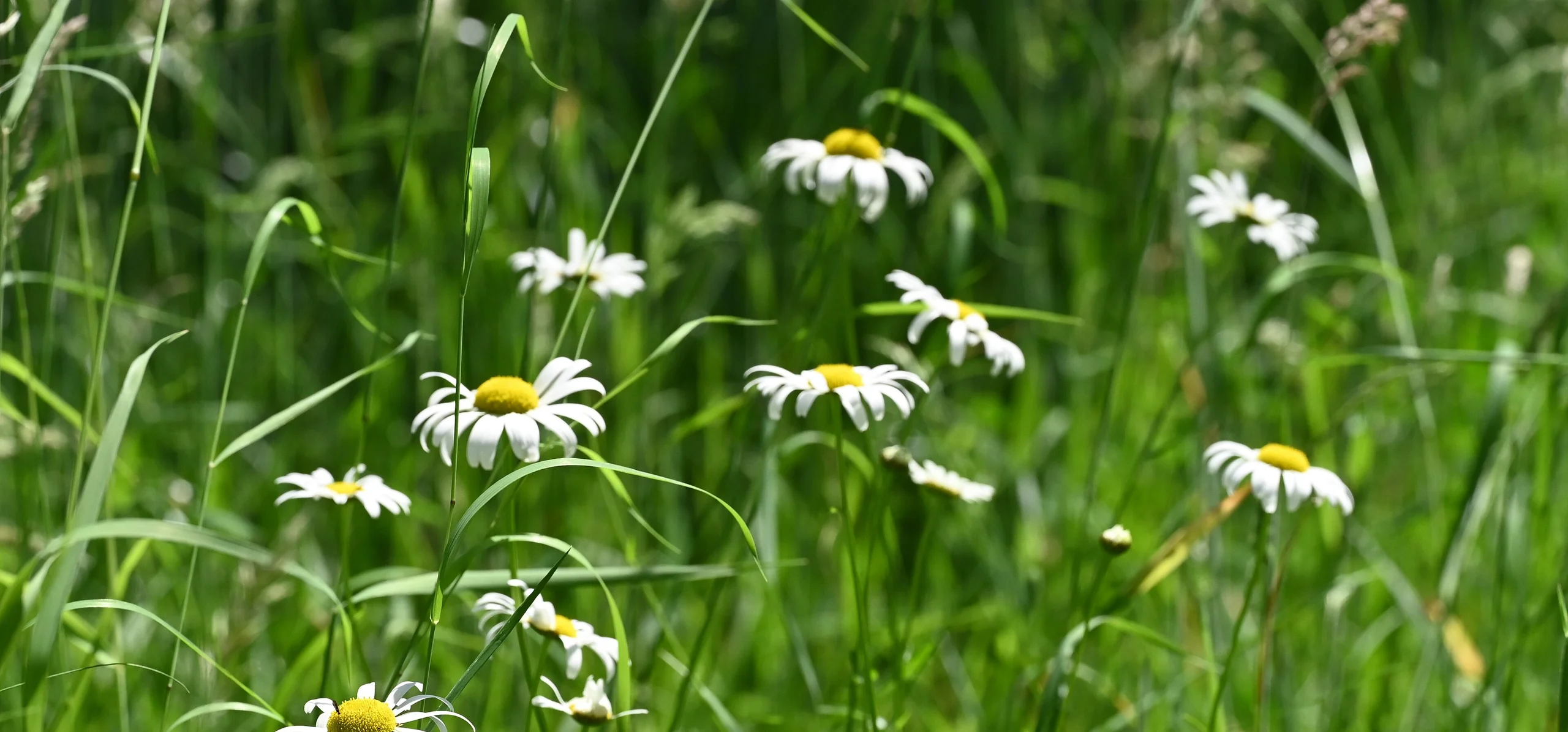
Oxeye Daisy
Leucanthemum vulgare
Family · Asteraceae
Oxeye daisy spreads by rhizome and thrives in thin, poor grass, but is a listed noxious weed across the US and in Tasmania and Victoria, Australia.
Leucanthemum vulgare
Plant profile
- WateringLittleWater every 10 days
- Light exposurePartial sun
- Hardiness zoneUSDA 3–8
Growth
- Family
- Asteraceae
- Life cycle
- Perennial
- Growth speed
- 6/10
- Mature size
- 30–100 cm
- Spread
- 10–60 cm
- Flowering
- Late spring through summer, again in early autumn if deadheaded
- Propagation
- Seed
- Division
Dormancydies back to a low basal rosette over winter, regrowing from the rootstock in spring
Time to maturitytypically flowers in its second year from seed, building a full clump over 2 to 5 years
Soil & climate
- Soil types
- chalk, clay, loam, sand
- Drought tolerance
- Yes
Light & Placement
- Where to place it
- unmown meadow
- wildflower border
- naturalised verge
- cutting garden
- large container with poor, well-drained compost to contain its spread
OriginEurope to Siberia and Iran (POWO), now naturalised across North America, Australia and beyond
Safety
- Pet safe
- No
ToxicityNo dedicated ASPCA listing; university extension sources note possible mild skin irritation and stomach upset if eaten
Invasive speciesregulated as a noxious or quarantined weed in several US states and declared a weed in Tasmania and Victoria, Australia
Data fromLeucanthemum vulgare Lam., GBIF BackbonePOWO: Leucanthemum vulgare Lam.RHS: Leucanthemum vulgare (ox-eye daisy)NC State Extension Gardener Plant ToolboMissouri Botanical Garden Plant Finder:
Where it grows
World distribution
Oxeye Daisy is native to 33 countries: Austria, Belarus, Belgium, Bulgaria, Croatia, Czechia, Denmark, and Estonia….GBIF records 891,023 documented identifications across 107 countries, with the largest concentrations in United Kingdom, France, and Sweden.
- Austria
- Belarus
- Belgium
- Bulgaria
- Croatia
- Czechia
- Denmark
- Estonia
- Finland
- France
- Georgia
- Germany
Show 21 more countriesShow fewer countries
- Greece
- Hungary
- Iran
- Ireland
- Italy
- Kazakhstan
- Kyrgyzstan
- Netherlands
- Norway
- Poland
- Portugal
- Romania
- Russia
- Spain
- Sweden
- Switzerland
- Tajikistan
- Türkiye
- Ukraine
- United Kingdom
- Uzbekistan
Yellow to orange dots: concentration of documented identifications per country. Green countries: sourced native range. Source: GBIFNative range from POWO (Kew).
A European Meadow Daisy Now Growing Almost Everywhere
Leucanthemum vulgare, the oxeye daisy, is the plain white-and-yellow daisy that fills unmown roadside verges and old hay meadows through early summer. It belongs to the daisy family, Asteraceae, native from Europe east to Siberia and Iran according to Plants of the World Online, and it has followed farming and settlement so thoroughly that it now grows wild across most of temperate North America, southern Australia and beyond. Each flowerhead is a single daisy face, white ray florets around a flat yellow disc, held on a wiry stem above a low rosette of toothed, spoon-shaped leaves. Gardeners meet it two ways: as a deliberate wildflower-mix component sown for a naturalistic meadow, or as an uninvited volunteer that arrived in a bag of wildflower seed or blew in from the verge next door.
Sowing Into Thin, Poor Grass
Direct-sown seed germinates readily in autumn, and autumn is the window that gives the best first-year stand: seed scattered onto raked, thin grass in September or October germinates before winter, overwinters as a small rosette, and flowers by its second summer. The trick is the seedbed, not the season. Oxeye daisy needs bare soil contact and low competition to get going, which is why it is raked into turf that has first been scalped hard or scarified, rather than sown into a full, thick sward. Sown too thickly or into lush grass, seedlings are shaded out within weeks; sown thinly into open, scruffy ground, they establish as a scatter of individual rosettes that fill in over one or two seasons.
Why It Struggles, and Disappears, on Rich Soil
The same trait that makes oxeye daisy easy to sow into poor ground makes it nearly impossible to keep in a well-fed border. On moderately fertile, nitrogen-rich soil, coarse grasses and vigorous perennials simply grow faster and taller, and the daisy's low rosette is shaded out within a couple of seasons. On thin, unimproved, often chalky or sandy ground, the reverse is true: little else grows fast enough to compete, and oxeye daisy dominates, sometimes forming near-solid sheets of white in June. This is the single most common reason a sown wildflower patch loses its daisies: topsoil that is too rich, or fertiliser applied out of habit, tips the balance back toward grass.


Rhizomes, Clumps and the Perennial Habit
Unlike an annual cornfield daisy, oxeye daisy is a true perennial that spreads by shallow, branching rhizomes as well as by seed, building outward into loose clumps rather than dying after one flowering season. A single sown rosette typically becomes a small colony within two to five years as its rhizomes push out new shoots at the margins. In a border, this means dividing clumps every two or three years to stop the centre going bare and woody, lifting and replanting the vigorous outer growth; in a meadow, it means an established patch keeps reappearing from the same rootstock even in a year when seed set was poor.
The Annual Hay Cut: Timing a Meadow for Daisies
Traditional hay meadows keep their oxeye daisy population through one deceptively simple rule: cut once, late, after flowering is over and seed has dropped, rather than mowing regularly through the growing season. A single hay cut in mid to late summer, once the daisy heads have browned and shed, lets that year's seed reach the ground and lets the rhizomes recharge before winter; hay taken any earlier removes the flowers before they set seed and, over a few years, thins the daisy out of the sward. Regular close mowing through spring and early summer has the same effect for the opposite reason: it stops flowering altogether and pushes the balance back toward grass, which is why an ordinary lawn never develops a daisy meadow on its own.
A Noxious Weed Outside Its Native Range
The habit that makes oxeye daisy a meadow favourite in its native Europe has made it a listed problem plant almost everywhere it was introduced. It arrived in North America in the 1800s, most likely in contaminated hay and pasture seed, and has since naturalised across the great majority of US states and Canadian provinces; several states, including Washington and Colorado, regulate it as a noxious weed with restrictions on sale or transport. In Australia it is a declared weed in Tasmania and Victoria, where it crowds out pasture grass on the same poor, grazed ground that suits it in Europe. The same shallow rhizome network and heavy seed production that let it fill an unmown verge let it outcompete forage in a paddock, which is the practical reason it is regulated rather than simply disliked.
Oxeye Daisy vs the Garden Shasta Daisy
The larger, showier daisy sold in nurseries as Shasta daisy, Leucanthemum x superbum, is a different plant bred from oxeye daisy and two other European Leucanthemum species in the early 1900s, and it swapped the wild parent's spreading rhizomes for a fibrous, clump-forming root system that stays where it is planted instead of colonising a meadow.
Pollinators and a Note on Toxicity
The flat, open flowerhead is an easy landing platform for a wide range of insects, and oxeye daisy draws bees, hoverflies, moths, butterflies and beetles through its long early-summer flowering window, making it one of the more reliably useful plants in an unmown patch even where it is not welcome in a border. The ASPCA does not carry a dedicated toxicity listing for this species under any of its common names; treat it with the same general caution as other Asteraceae, since university extension sources note that contact with the sap can cause mild skin irritation and that ingestion has been associated with hypersalivation and stomach upset in pets. No confirmed toxicity to horses or humans is documented by the sources checked here.
Test your plant knowledge
Tap a card to flip it and reveal the answer.
Oxeye daisy establishes best when sown into thin, poor grass rather than rich, fertile soil. Tap to reveal ✓ True
Oxeye daisy is a true perennial that spreads by rhizomes and returns from the same rootstock each year. Tap to reveal ✓ True
In several US states and in parts of Australia, oxeye daisy is officially listed as a noxious or quarantined weed. Tap to reveal ✓ True
The garden Shasta daisy (Leucanthemum x superbum) has the same spreading rhizomes as wild oxeye daisy. Tap to reveal ✕ False
The ASPCA lists Leucanthemum vulgare as confirmed non-toxic to cats and dogs. Tap to reveal ✕ False
Sources
References consulted for this guide
- Leucanthemum vulgare Lam., GBIF Backbone Taxonomygbif.org
- POWO: Leucanthemum vulgare Lam.powo.science.kew.org
- RHS: Leucanthemum vulgare (ox-eye daisy)rhs.org.uk
- NC State Extension Gardener Plant Toolbox: Leucanthemum vulgareplants.ces.ncsu.edu
- Missouri Botanical Garden Plant Finder: Leucanthemum x superbummissouribotanicalgarden.org
- Reference entity : Wikipédiaen.wikipedia.org